
Being 'green' in practice
BREEAM aims to promote buildings that are environmentally, socially, and economically sustainable, enhancing the well-being of the people who live and work in them while minimizing their environmental impact.
Recommended links:
What is BREEM and why is it important?
BREEAM Version 7 to focus on hotels and net zero carbon
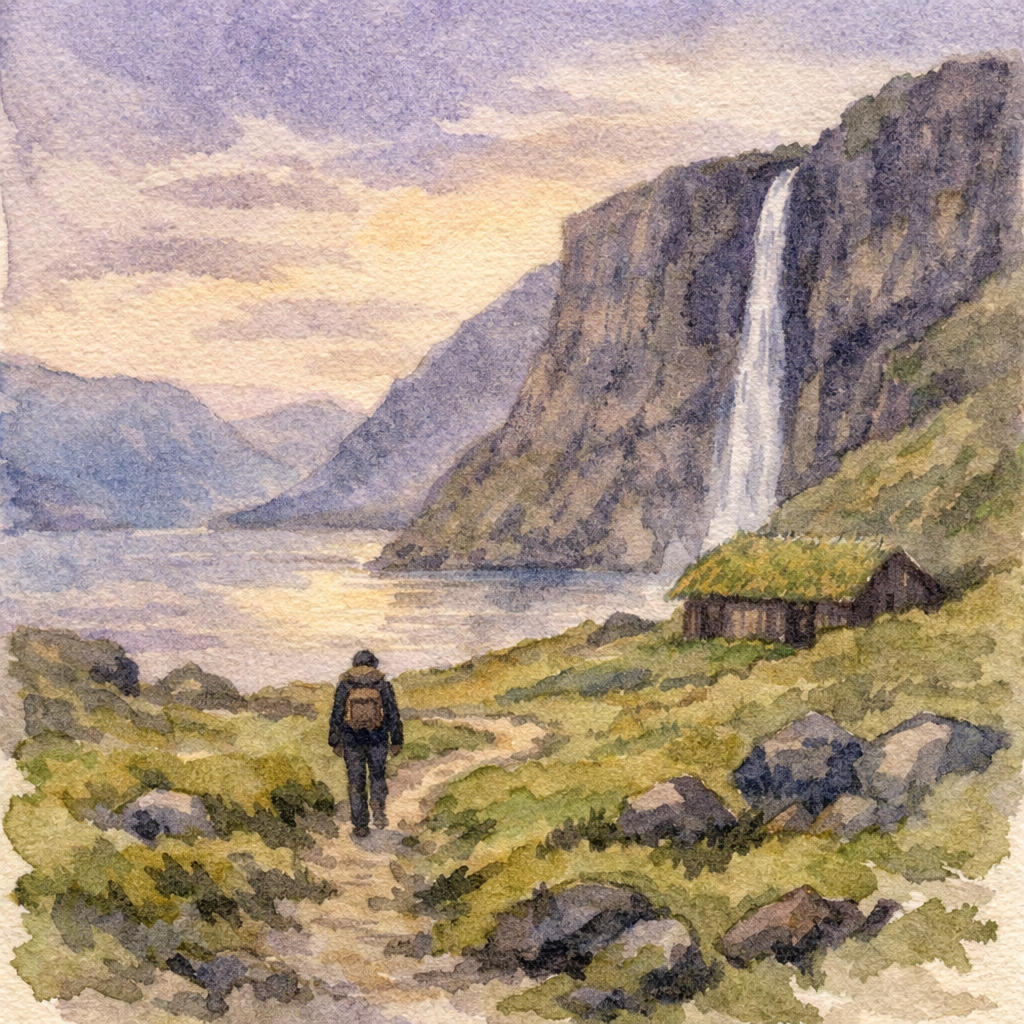
Where it started for us
In 2011, Icelandic geographer Gunnthóra Ólafsdóttir published a paper that would inspire the direction of our founder’s thinking. Her work — Practicing Nature-Based Tourism: Introduction, published in the academic journal Landabréfið — was not a market report or a business case. It was something more fundamental: a rigorous examination of why human beings feel compelled to seek out nature, and what actually happens to us when we do.
Her argument was simple but important. Nature-based tourism, she wrote, feeds “the perceived need to undertake an exodus from the everyday in order to be in nature” — a deeply rooted belief in the “therapeutic and regenerative agency of nature” for people whose lives have become tiring and stressful. Tourism, she argued, is not merely a product or a commercial transaction. At its best, it is “a creative, contextual, embodied practice” — one that creates a genuine sense of self, of place, and of connection.
That paper was the catalyst. It pointed our founder towards Iceland, and towards a question worth building a business around: what if we took this idea seriously?
More than a label
“Nature-based tourism” has become a catch-all — used to describe everything from five-star safari lodges to crowded waterfall selfie queues. The label alone means very little.
What we mean by it is closer to what Ólafsdóttir described: an experience that is embodied. One that engages all the senses. One where the most memorable moments are, as Icelandic architect and tour guide Hildigunnur Sverrisdóttir observed in her own research, “not tied to any pre-established must-sees or dos but to something completely random, simple and unforeseen.” The smell of moss after rain. The silence of a fjord at dusk. Standing at the base of a 198-metre waterfall and feeling very, very small.
That is what we are designing for.
The science behind the pull
The appeal of nature is not sentimental. It is physiological and psychological — and the evidence has been building for decades.
Research consistently demonstrates that contact with nature measurably reduces stress, anxiety, and depression. A landmark 2024 meta-analysis of 449 peer-reviewed studies, published in Nature Cities, quantified the mental health benefits of nature exposure across multiple outcome measures. Studies cited in the Environments special issue on nature-based tourism (Green, Croft & Wolf, 2019) confirm that tourism, planning, and psychological research “all find an important relationship between nature-based experiences and the physical and psychological well-being of participants.” Research from King’s College London has found that the risk of developing depression or anxiety is 71% lower among urban dwellers who live near green spaces — and that benefits extend to everyday, brief encounters with biodiverse nature. 1
The minimum threshold for detectable mental health benefit from nature exposure is approximately two hours per week. 5 This is not a luxury product. It is a response to a documented human need.
In an increasingly screen-saturated, urbanised world, that need is only growing. As Green, Croft and Wolf put it in their 2019 environmental impact study: “In a fractious world, where anxiety mounts as an irreversible tipping point to habitable climate change approaches, the calm of nature will be increasingly important.”
The market is responding
Traveller behaviour reflects this shift. The global nature-based tourism market was valued at approximately $600 billion in 2024 and is projected to reach $1.2 trillion by 2033, growing at a CAGR of 8.2%. 4 Of the 1.8 billion international tourist arrivals recorded in 2024, approximately 42% engaged in nature-related activities — wildlife tourism, ecotourism, and adventure travel. 2
Demand is particularly strong among younger travellers: 78% of millennials actively prefer destinations that feature natural landscapes, and 65% of global travellers now prioritise sustainable travel options when making decisions. 2
This is a structural shift, not a post-pandemic bounce. The direction of travel is clear.
An honest tension
We believe in being direct about what nature-based tourism can also get wrong.
Natural habitats are under pressure precisely because more people want to visit them. Research specifically examining Iceland’s vegetation — published in Environments (Runnström et al., 2019) — found that experimental trampling caused significant damage, particularly in highland areas and in moss and heath communities. The study recommends concentrating visitor trails in lowland grassland where resilience is higher. Iceland’s most popular sites already show the strain.
Traditional tourism on Iceland, as our own website acknowledges, “doesn’t have a very good track record when it comes to the environment.” Overcrowded trails, unmanaged visitor flows, and short-term commercial thinking are real problems — and they are precisely what distinguishes responsible operators from the rest.
The challenge, as Green, Croft and Wolf concluded in their research, is to “take visitors down the sustainable and gentle path of communing with nature and to leave the conquest of nature to an ignorant past.” We take that seriously.
Iceland: the right place
Few countries are better positioned for responsible nature-based tourism than Iceland. Tourism accounted for 8.8% of Iceland’s GDP in 2025, up from 8.2% the year before — one of the highest tourism-to-GDP ratios in the world. 3 Revenue from foreign tourists reached 621.4 billion ISK (approximately $4.9 billion USD) in 2024, up 9% year-on-year. 6 Just under 2.3 million international visitors arrived in 2025. 7
The country’s appeal is obvious: dramatic, unspoiled landscapes, geothermal energy, the Northern Lights, and a culture that has always lived in close relationship with the natural world. But what makes Iceland genuinely special for nature-based hospitality is scarcity. There is a finite amount of truly wild, accessible landscape — and that scarcity is an asset for operators who position themselves correctly.
Our first property, Hugarró Nature Retreat, sits at the gateway to Glymur — Iceland’s second-tallest waterfall, dropping 198 metres into Botnsá, the main river in Botnsdalur leading ot the Hvalfjörður fjord, just an hour from Reykjavík. Accessible only on foot, Glymur is one of Iceland’s most visited natural landmarks. The guests who make that hike are precisely the engaged, nature-motivated travellers our model is built for.
This is also, we should note, the country where Gunnthóra Ólafsdóttir’s academic conference on Practicing Nature-Based Tourism took place in 2011. Iceland has been a serious intellectual home for this conversation for a long time. We feel we belong in it.
How we do it differently
Following the nature-based tourism standards of Preferred by Nature, and inspired by the principles in Ólafsdóttir’s research, we have built our approach around a few commitments that inform every operational decision:
- Keep it small. A maximum of 32 rooms plus 31 intimate cabin, merged into the landscape. The environment is never overwhelmed, and the guest experience remains genuine.
- Protect the landscape. Fencing birch forest areas to allow natural regeneration; co-funding trail improvements near Glymur to manage visitor flow responsibly — applying the very recommendations made by Icelandic trampling research.
- Be honest about impact. Monitoring, measuring, and publishing our environmental footprint. Guests deserve to know, and so do investors.
- Invest in people. Affordable staff housing, real career development, and genuine integration with local communities — because, as Lucy Lippard argued at the 2011 Reykjavík conference, tourism that denigrates the communities it builds its attraction on is “simply wrong.”
- Design for depth, not throughput. Educating guests about Iceland’s ecology, geology, history, and culture. Leaving room for the unplanned moments that Sverrisdóttir identified as the most meaningful of all.
The financial case
Genuine nature-based hospitality is not a trade-off against financial performance. It is the basis for it.
Responsibly operated eco-lodges and nature retreats command 10–20% premium ADRs over conventional competitors, with some studies finding guests willing to pay up to 34% more for certified sustainable accommodation. Renewable energy and efficient design deliver 10–30% savings on operating costs compared to conventional builds. And ESG-aligned operators increasingly access capital on preferential terms — global ESG assets have surpassed $41 trillion, with institutional capital continuing to flow toward businesses with credible, measurable sustainability commitments.
More fundamentally: a location people genuinely want to visit, an experience that delivers what it promises, and an operation that takes its environmental responsibilities seriously — that combination produces loyal guests, strong reviews, high repeat intent, and a business worth investing in for the long term.
We believe the market is catching up to what the science has always known. Nature is good for people. And people who are good for nature build better businesses.
More than a certificate
Being green isn’t a box we tick. It’s not a plaque on the wall or a logo in the footer. For us, it’s a philosophy — a way of thinking about every decision we make, from how we design a building to how we source materials, employ staff, and engage guests.
Most sustainability conversations in hospitality start and end with reduce, reuse, recycle. We respect that, but we’re aiming higher. As an aspiring B-Corp, we’ve set ourselves a more ambitious standard: regenerative hospitality — not just doing less harm, but actively making things better.
What regenerative hospitality means
The difference between sustainable and regenerative is the difference between minimising damage and creating genuine value — for the land, the local community, and future generations.
At our first project, near Iceland’s Glymur waterfall, that means:
- Restoring native nature — planting trees and protecting the existing birch forest by fencing it off from roaming sheep that have long prevented its recovery.
- Improving public access — co-funding safer trails to the Glymur waterfall, one of Iceland’s most visited natural landmarks.
- Sharing knowledge — educating guests about the history, culture, and ecology of the area, turning a visit into a deeper connection.
- Investing in people — providing affordable, quality housing for staff, and creating real career development opportunities.
Our goal is simple: demonstrate that a responsible hospitality operation can have a negligible negative impact on its environment — and a meaningful positive one.
The Market Is Telling Us Something
This isn’t just an ethical stance. The numbers are clear.
Traveler attitudes have shifted dramatically. 84% of global travelers say sustainability is important when planning a trip, and 93% say they want to make more sustainable choices — and increasingly, they’re acting on it. 1 The share of travelers actively seeking sustainable accommodation has climbed from 62% in 2016 to around 81% today. 1
And this translates directly into revenue. Travelers are willing to pay 12–20% more for accommodations they trust to be environmentally responsible. 1 Eco-certified hotels report up to 28% higher booking rates compared to non-certified competitors. 1
Broad “green” marketing claims no longer cut it. Today’s guests are informed and discerning — they want to know specifically how their choice of accommodation makes a difference. That’s why we back every commitment with action, certification, and transparency.
The financial case for going green
The link between genuine sustainability and financial performance is well established. NYU Stern’s Center for Sustainable Business has found positive correlations between strong ESG performance and operational efficiencies, stock performance, and a lower cost of capital. 2 Global ESG assets surpassed $41 trillion in 2022 and are expected to exceed $50 trillion — a clear signal that institutional capital is moving toward businesses that take these commitments seriously. 3
For us, the logic is straightforward: a genuine sustainability commitment drives pricing power, higher occupancy, stronger guest loyalty, and preferential access to impact-aligned capital. It’s not a trade-off between doing good and performing well — it’s the same thing.
Our commitment
At Hugarró, sustainability is built into our model from the ground up — not retrofitted. Our properties are small by design (a maximum of 32 rooms and 31 intimate free-standing cabins, all merged into the natural landscape, built using biobased and recyclable materials, powered by renewable energy, and certified to internationally recognised standards including GreenKey, EarthCheck, BREEAM, and LEED Gold. We also aim for Global Ecosphere Retreat (GER) certification from The Long Run, which is among the most rigorous sustainability benchmarks in travel.
We’re not perfect — no operation is. But we believe that honest effort, measurable outcomes, and genuine transparency are what build lasting trust with guests, communities, and investors alike.
Being green isn’t our marketing strategy. It’s how we run the business.
Board questions
We planned for this from day one
Drilling for geothermal water in Iceland is well-founded — the geology around Hvalfjörður is exceptional and nearby wells prove the potential. But geothermal exploration always carries uncertainty. Fractures can be missed. A well can come up dry. Investors can lose patience.
We designed Hugarró so that this scenario, however unlikely (see this post), does not stop us.
Our answer is a purpose-built alternative heating system that delivers the same pools, the same warmth, the same experience — drawing heat not from the ground below, but from the river and the earth around us.
Why our heating needs are surprisingly modest
Most facilities of this kind would be in serious trouble without a geothermal source. Ours is not — because of how efficiently we use energy in the first place.
Our closed-loop pool system recirculates water rather than constantly replacing it, recovering 33% more heat than the traditional Icelandic approach. Our cascade design runs geothermal water through pools, then buildings, then roads — extracting every usable degree before returning it. Floating insulation covers eliminate heat loss overnight.
The result: our total heating demand — seven pools at 38°C, full hotel and cabin heating, road de-icing — requires the equivalent of just 1,185 kW of continuous thermal output. For a facility of this scale, that is a lean number. And it is exactly what our backup system is sized to deliver.
The alternative: CO₂ heat pumps
If no geothermal source is found, we install three Fenagy (or other reliable brand) H-600 CO₂ heat pump units, each delivering 600 kW of thermal output. Together they provide 1,800 kW of installed capacity — comfortably above our 1,185 kW peak demand, with full redundancy built in.
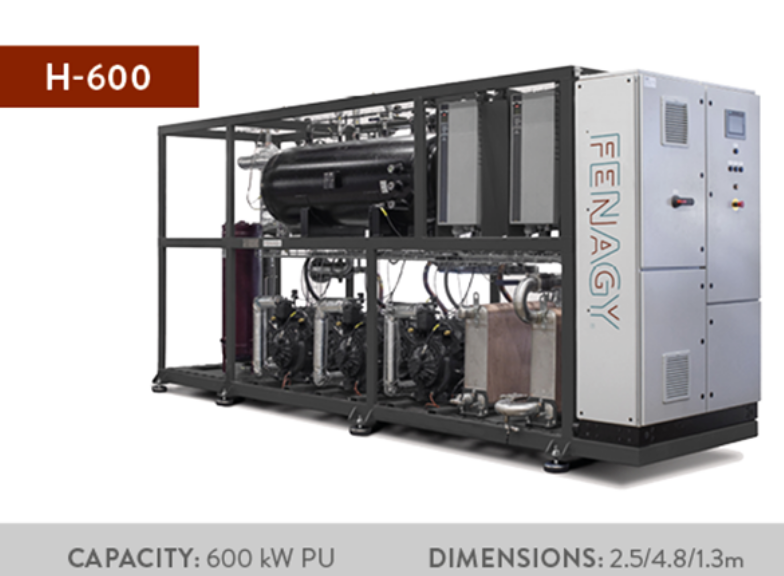
CO₂ (R744) is the ideal refrigerant for this application:
- GWP of 1 — the most climate-neutral refrigerant available
- No chemicals — fully aligned with Iceland’s environmental standards
- Highest efficiency in the 38–70°C output range — exactly our operating window
- Proven technology — widely used in Scandinavian district heating systems
The heat pumps run as water-to-water units, extracting heat from a local water source and delivering it at the temperatures our cascade system requires. The full cascade — pools, buildings, roads — operates identically to the geothermal design. From a guest perspective, nothing changes.
Where the heat comes from: a two-tier water source
Instead of one geothermal well, we use two complementary water sources that together provide year-round reliability.
Tier 1 — The Brunná river (primary, spring through autumn)
The Brunná flows just 200 metres from our plant room, crossing land whose owner has no objection to our intake (in fact, we are co-owner). A short insulated HDPE pipe draws water at ~6°C, passes it through a heat exchanger, and returns it a few degrees cooler. The river provides more than enough flow for our needs during the eight warmest months of the year.
Tier 2 — Two drilled groundwater wells (winter backup)
For the winter months, when surface water flow can drop and ice becomes a risk, we rely on two drilled wells at 80–150 metres depth. At that depth, groundwater in the Botnsdalur valley maintains a stable 4–6°C year-round — completely unaffected by surface weather, frost, or seasonal variation. No river. No tidal influence. No moving parts except a submersible pump in each well.
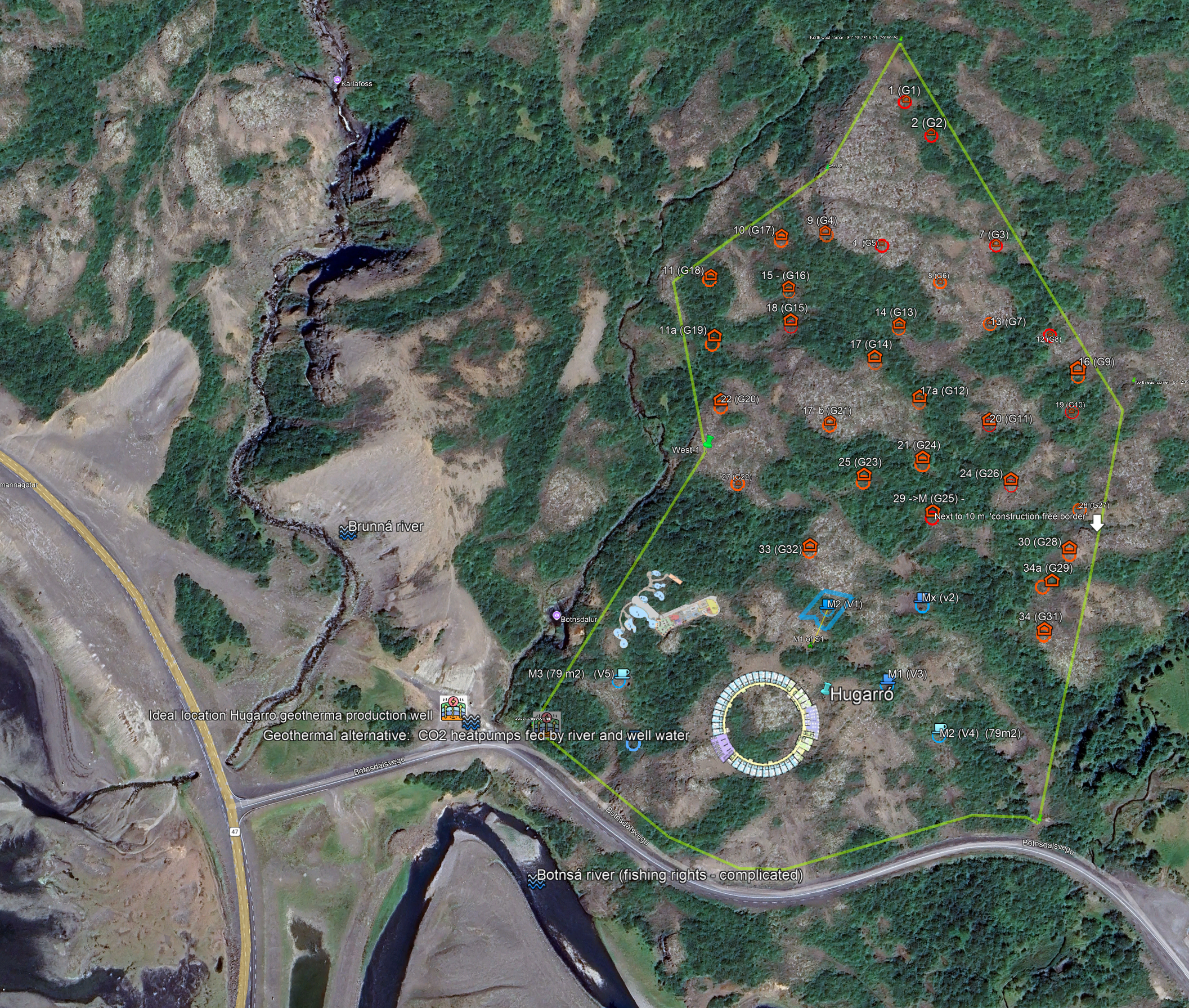
Crucially, these wells are drilled while the geothermal exploration rig is already on site — a modest incremental cost on an already-mobilised programme, and one that simultaneously provides valuable geological data to guide the deep geothermal drill.
The system switches automatically between sources based on flow sensors and temperature readings. No manual intervention required.
The buffer tank — smoothing out demand peaks
Between the heat pumps and the distribution system sits a 35 m3 insulated thermal buffer tank, maintained at 45–50°C. It acts as a reservoir of stored heat, absorbing demand peaks and allowing the heat pumps to run at steady, optimal load rather than cycling up and down.
The effect is meaningful: peak source water demand drops by around 20%, the heat pumps run more efficiently, and the system becomes more resilient to short interruptions in either water source. It is the thermal equivalent of a battery — simple, passive, and highly effective.
What it costs to run
Iceland’s electricity is among the cleanest and most affordable in Europe, generated almost entirely from hydro and geothermal sources. At current industrial tariffs:
| Scenario | Annual electricity | Annual cost |
|---|---|---|
| Winter conditions (COP 3.5) | Higher draw | — |
| Summer conditions (COP 5.0) | Lower draw | — |
| Annual average (COP ~3.8) | ~2,730 MWh | ~€240,000/year |
For every unit of electricity the heat pumps consume, they deliver 3.8 units of heat — the rest comes free from the river or the wells. Compared to direct electric heating, the CO₂ heat pump system saves approximately €750,000 per year in energy costs.
How the two systems compare
| Geothermal well | CO₂ heat pump backup | |
|---|---|---|
| Heat source | Earth (70–90°C) | River + groundwater wells |
| Electricity required | Minimal (pumps only) | ~312 kW continuous |
| Annual energy cost | Near zero | ~€240,000 |
| Guest experience | Identical | Identical |
| Environmental impact | Zero discharge | Zero discharge |
| Cascade compatibility | Full | Full |
| CO₂ emissions | Zero | Zero (Icelandic grid) |
The bottom line
Finding geothermal water is our ambition and our expectation. The geology strongly supports it. But if exploration falls short, Hugarró does not fall with it.
Our backup system — three CO₂ heat pumps, two groundwater wells, a river intake, and a thermal buffer — delivers the same warmth, the same pools, and the same guest experience at a known, manageable operating cost. It was engineered in parallel with the geothermal design, not as an afterthought.
We are not betting everything on a single drill result. That is how Hugarró was designed.
Hugarró: a facility powered by nature — with a plan B ready from day one
Hugarró will be a seven-pool geothermal wellness complex on the shores of Hvalfjörður, one of Iceland’s most striking fjords. From the water temperature in our pools to the warmth in our cabins and the heat under our roads in winter, every degree of energy in this facility comes from renewable natural sources.
We did not design this system around hope. We designed it around certainty — with a primary strategy backed by Iceland’s exceptional geology, and a fully engineered alternative ready to deploy if exploration falls short.
Either way, Hugarró will operate as planned!
The primary strategy — geothermal heat
Iceland sits on one of the most geothermally active zones on the planet. The geology around Hvalfjörður reflects this: temperature gradients of 120°C per 1,000 metres have been recorded nearby, and the Hvalur station a few kilometres away produces over 20 litres per second at 140°C. The natural resource is well-established.
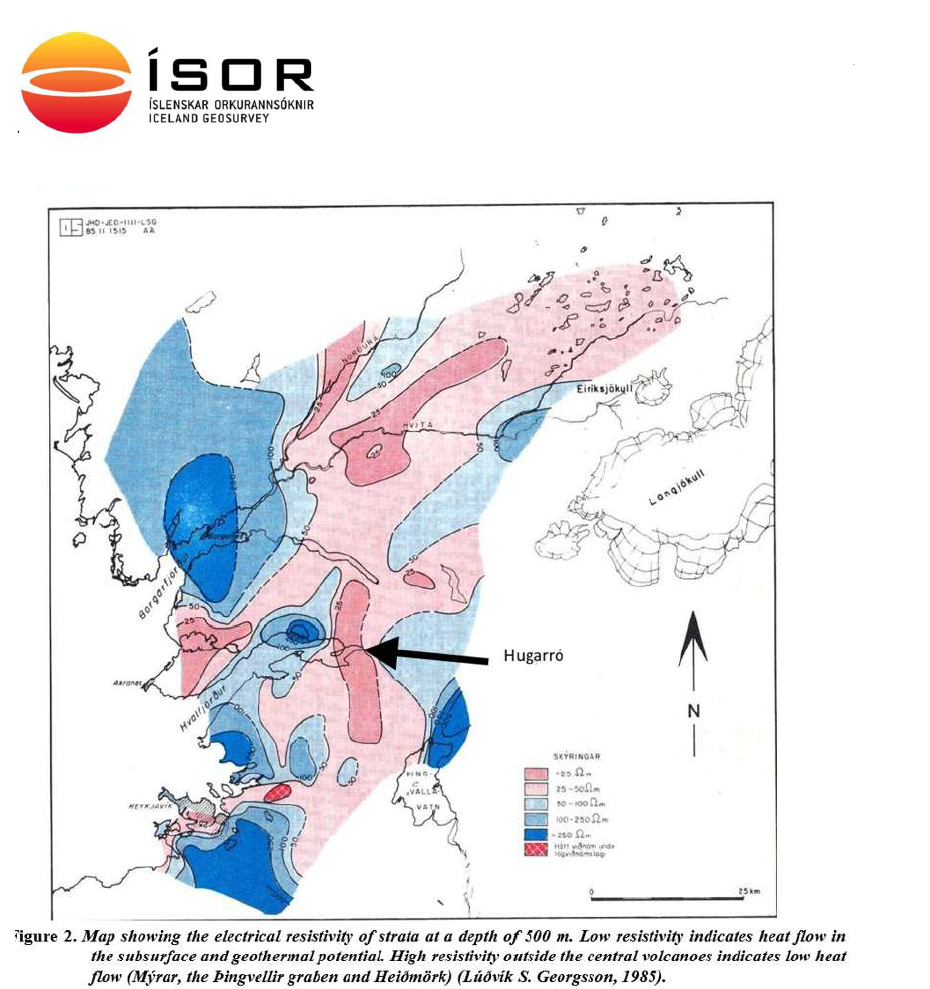
Our target is modest by Icelandic standards: a production well yielding 7–10 litres per second at 70–90°C. A typical productive Icelandic well delivers 15–50 litres per second. We are not asking for much.
Finding that water is the ambition. The three-phase exploration programme — shallow pre-drills, drone magnetic survey to map fracture zones, then a targeted production well at 900–1,500 metres — is designed to maximise the probability of a productive strike while managing exploration risk.
One source. Four uses. Nothing wasted
If geothermal water is found, it flows through a cascade that extracts every usable degree before returning the water underground:
- Pools — water enters at 70–90°C and heats all seven pools to a perfect 38°C
- Buildings — the same water, still warm, then heats the hotel and all cabins
- Hot water — covered in the same circuit, at no additional energy cost
- Roads — remaining warmth keeps paths and access roads clear in winter
The water returns underground at 30°C. Zero discharge. Zero waste.
This cascade design and our closed-loop pool heating recirculation system recovers 33% more thermal energy than the approach used by traditional Icelandic pools, which continuously replace pool water and discharge thousands of cubic metres of hot water to nature every year. We do not do that.
Pool water — clean without chemicals
Our pools recirculate water in a closed loop rather than replacing it. Water is kept clean through UV disinfection, ultrafiltration membranes and biologica filters — the same technology used in drinking water treatment — monitored continuously by real-time microbiological sensors across all seven pools.
No chemicals are used or permitted. The result: 91% less water consumed than a traditional Icelandic pool operation, and measurably cleaner water for guests.
Beyond the facility — a district heating opportunity
A geothermal well of this scale does more than serve Hugarró. Should the Botnsdalur valley develop into a wider community, the same well — with capacity to spare — could supply heat to an estimated 200–250 neighbouring vacation homes, each with a hot tub, through a district heating network.
At a metered tariff, this transforms a facility operating cost into a recurring revenue stream. A geothermal well becomes a utility asset.
If no geothermal water is found
Drilling always carries geological uncertainty. A well can miss a fracture. Pre-drills can show unfavourable results (see this related FAQ).
But we are planning for this before we break ground.
Our alternative is a purpose-built system of three Fenagy H-600 CO₂ heat pump units, each delivering 600 kW of thermal output. Together they provide 1,800 kW of installed capacity against a peak demand of 1,185 kW — full redundancy is built in. Two units alone cover peak load; the third is available for future expansion.
CO₂ (R744) is the most climate-neutral refrigerant available — a global warming potential of just 1, compared to 1,400+ for conventional refrigerants. It is also the most efficient refrigerant in the 38–70°C output range, which is exactly where we operate. For every unit of electricity these heat pumps consume, they deliver 3.8 units of heat — the rest comes free from the water sources below.
The cascade — pools, buildings, roads — operates identically to the geothermal design. From a guest perspective, absolutely nothing changes.
Where the heat comes from — two tiers, no single point of failure
The heat pumps draw their source heat from water. We use two complementary sources that together guarantee year-round reliability without dependence on rivers with fishing rights disputes, tidal complications, or expensive sea inlets.
Tier 1 — The Brunná river (spring through autumn)
The Brunná flows 200 metres from our plant room, crossing land whose owner raises no objection. A short insulated pipe draws river water at ~6°C, passes it through a heat exchanger, and returns it cooled by a few degrees. During the eight warmer months of the year, the Brunná provides everything we need.
Tier 2 — Two drilled groundwater wells (winter)
At 80–150 metres depth, groundwater in the Botnsdalur valley sits at a stable 4–6°C year-round — completely unaffected by surface frost, ice, or seasonal variation. Two drilled wells provide our winter heat source: reliable, permit-straightforward, and with no fishing rights complications.
Critically, these wells are drilled while the geothermal exploration rig is already on site — a modest incremental cost on an already-mobilised programme. The same activity that seeks geothermal water simultaneously secures our backup water source. The shallow geology data gathered also helps refine the deep drill target.
The system switches automatically between river and wells based on flow and temperature sensors. No manual intervention. No single point of failure.
The buffer tank
Between the heat pumps and the distribution system sits a 35,000-litre insulated thermal buffer tank at 45–50°C. It absorbs demand peaks, allows the heat pumps to run at steady optimal load, and reduces peak source water demand by around 20%. Think of it as a thermal battery — passive, simple, and highly effective.
The hydropower multiplier
The same river (Brunná) that provide our backup heat source offer a second opportunity: small-scale run-of-river hydropower.
A €300,000 investment in a small hydropower plant on the Brunná or Botnsá delivers:
- 150 kW for eight months of the year (spring through autumn)
- 50 kW through the four winter months
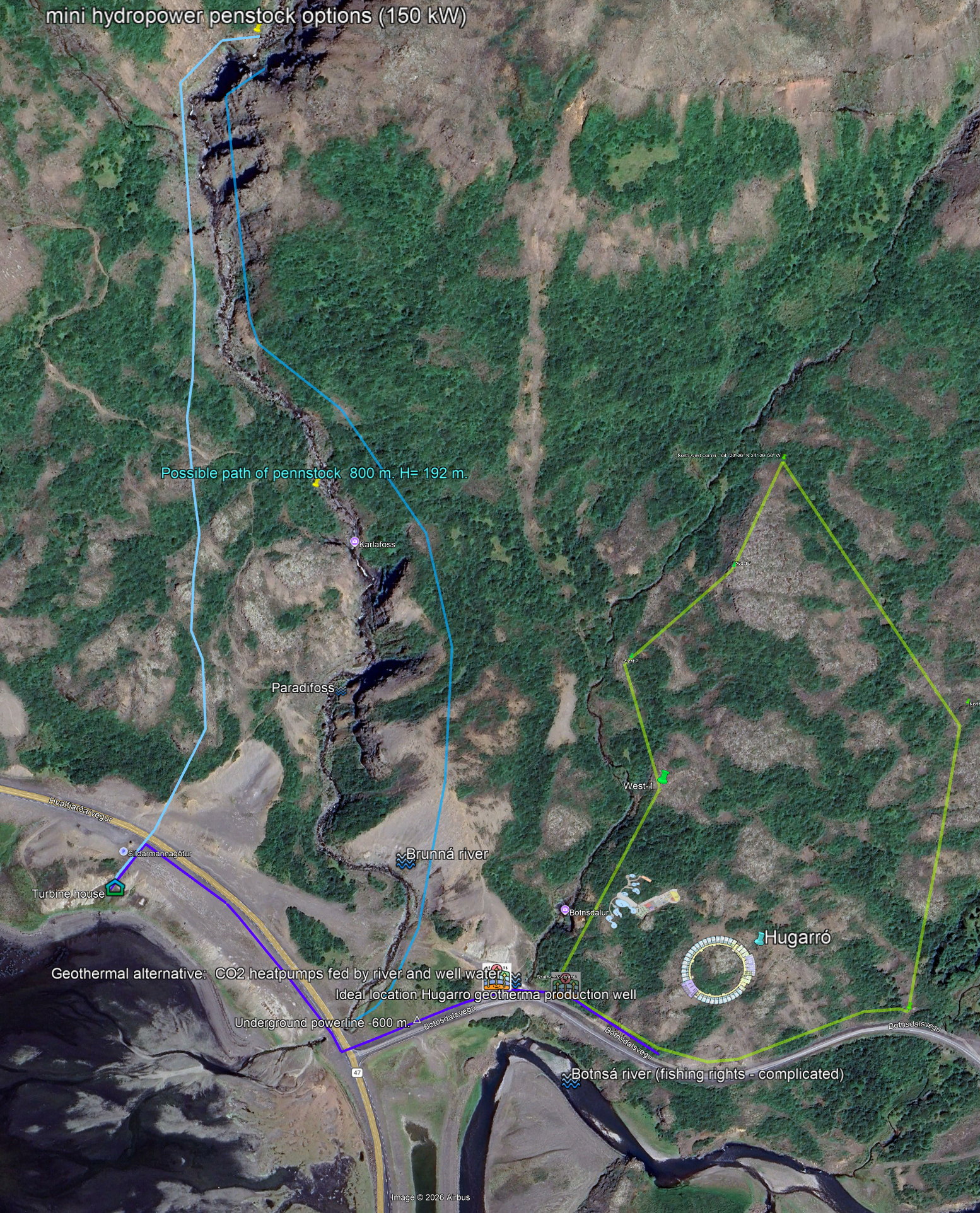
That is enough to offset 50% of the heat pump system’s annual electricity consumption — effectively halving the grid electricity bill.
When river flow is high and heat pump demand is low, surplus hydro power heats the buffer tank directly through resistance elements — free thermal energy that further reduces the load on the heat pumps.
| Metric | Value |
|---|---|
| Annual electricity saved | ~1,023 MWh |
| Annual cost saving | €97,200/year |
| Investment payback | 3.1 years |
| 20-year net present value | €1,114,000 |
A 3.1-year payback on renewable infrastructure is exceptional by any standard. After that, the plant runs free for its remaining 30–40 year lifespan.
The numbers — what each path costs
| Geothermal well | CO₂ heat pumps | CO₂ heat pumps + hydro | |
|---|---|---|---|
| Capital investment | ~€1,870,000 | ~€1,630,000 | ~€1,930,000 |
| Annual operating cost | ~€70,000 | ~€270,000 | ~€173,000 |
| 20-year total cost | ~€3,270,000 | ~€6,830,000 | ~€5,390,000 |
| Grid dependency | Minimal | High | Medium |
| CO₂ emissions | Zero | Zero | Zero |
| Guest experience | Identical | Identical | Identical |
| Technology risk | Exploration | Very low | Very low |
The geothermal well is the cheapest long-term solution by a wide margin — €3.5M cheaper than heat pumps alone over 20 years. But the heat pump system combined with hydropower is a fully viable, lower-risk alternative that closes that gap significantly.
The capital costs of all three paths are remarkably similar. What separates them is operating cost — and operating cost is where geothermal wins decisively. Every year of successful geothermal operation saves €200,000 in electricity that the heat pump alternative would otherwise purchase from the grid.
Resilience by design
Most geothermal wellness projects are built around a single assumption: that the well succeeds. Ours is not.
Our engineering team designed the geothermal cascade and the CO₂ heat pump alternative in parallel — same output temperatures, same cascade architecture, same pool experience, same environmental standards. Switching between the two strategies requires no redesign of the facility. The plant room, pipework, heat exchangers, and distribution circuits serve both.
The exploration programme is thorough and data-driven. We expect to find water. But if we do not, a fully costed, fully engineered alternative is ready — one that combines proven industrial heat pump technology with local renewable water and hydropower sources, and delivers the same Hugarró experience at a known, manageable operating cost.
That is not a fallback. It is a feature.
As part of our ongoing project development, we have been in contact with DMD Modular, a European modular construction specialist with direct experience delivering and installing projects in Iceland. We requested an indicative cost range for the construction of the cabin units to compare them with our own estimates based on feedback of Dutch builders.
Their initial indication is €2,300–2,500 per square metre, covering the full standard scope: factory-finished modules (including furnishings), transport from factory to site (including sea freight and in-country logistics), installation, and roof finishing. We are awaiting written confirmation that mobile crane costs on site are included within this scope, which we expect shortly.
Reassuringly, this range is very similar to what our own research showed us.
We want to be transparent: we do not yet have an independent, third-party validation of our construction cost assumptions, as technical drawings are not yet finalised. This is a deliberate consequence of project sequencing — drawings will be developed following zoning approval, which is the immediate next milestone. The current round is therefore pre-technical in nature, and part of its purpose is to unlock that next phase, including a formal cost review by an independent quantity surveyor.
In the meantime, the indicative pricing from DMD Modular aligns closely with our own projections and, in our view, provides a credible market reference. Their hands-on experience in Iceland — a market with well-understood logistical and climatic challenges — gives particular weight to their numbers. For additional context, per-room development costs published by HVS for comparable full-service hotel projects are consistent with the range we are working with.
We plan to stress-tested the financial model against a 10% increase in construction costs. We don’t expect this scenario to materially alter the project’s return profile or its overall viability. We are confident the current assumptions are grounded in market reality, and we will provide a formally validated cost plan as the project progresses through its next phase.
The foundation of everything
Hugarró runs on the heat of the earth. Our geothermal pools, building heating, hot water, and road de-icing all draw from a single underground source. Finding that source — and doing so reliably and cost-effectively — is one of the most important investments we make.
Click to enlarge Iceland’s geological advantage
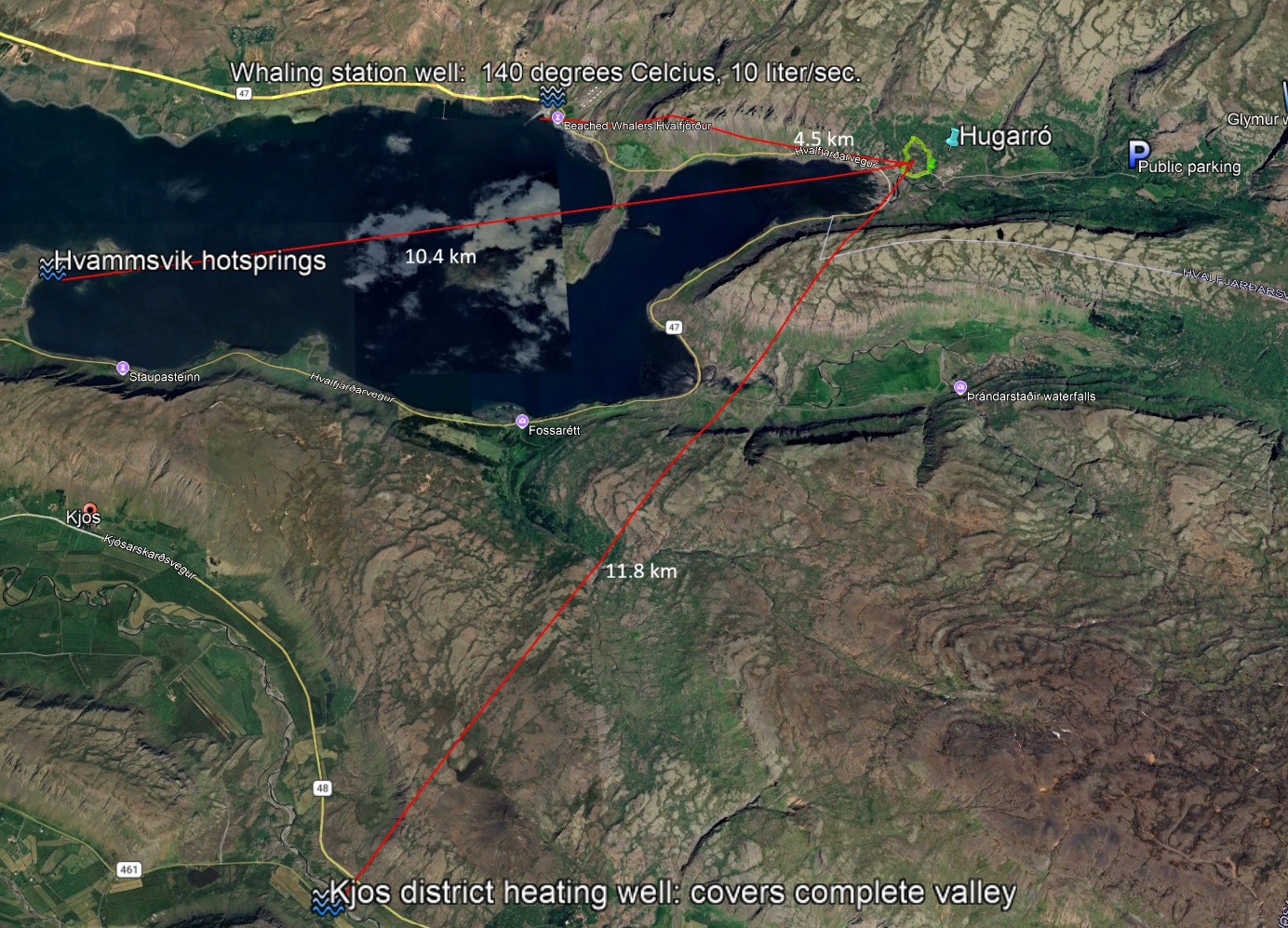
The area around Hvalfjörður sits on one of the most geothermally active zones on the planet. Exploratory data from previous drillings in the area shows a temperature gradient of 120°C per 1,000 metres — well above the global average. The nearby Hvalur station, just a few kilometres away, produces over 20 litres per second at 140°C. Nature has already proven the potential here.
How we find the water?
Geothermal water typically flows along fractures and fault lines in the rock. Hitting those fractures is the real challenge — which is why we do not simply drill and hope.
Our approach, developed with one of Iceland’s leading geothermal specialists, follows a structured three-phase methodology:
- Shallow exploratory drilling — 3 to 4 boreholes to 80 metres, mapping the subsurface geology
- Drone magnetic survey — a non-invasive aerial survey pinpointing fault lines and fracture zones below ground
- Production well — a single deep well of 900–1,500 metres, drilled with the best possible information, maximising the chance of a productive strike

On drilling method, we will choose between vertical, angled, or directional drilling based on what the survey data reveals. Directional drilling offers the greatest flexibility and the highest probability of intersecting a productive fracture — at a 40–60% premium over straight drilling. A worthwhile investment if the geology calls for it.
How much water do we actually need?
Surprisingly little, thanks to our closed-loop pool system. Our engineering calculations show that 7–10 litres per second at 70°C is sufficient to heat all seven pools to 38°C, supply all buildings and cabins with heat, and de-ice roads in winter — with capacity to spare.
Should the Botnsdalur valley ever develop into a wider community, that same well could realistically supply up to 50 holiday homes with heat at no additional extraction cost. If water temperature would be 90°C and the flow 12 litres per second , 250 modern, well-insulated homes could benefit. With their hot tubs of course: a must in Iceland!
Needless to say the additional potential revenue stream of this option is considerable which is why the design of our geothermal water distribution system will be designed for this opportunity.
What it costs
The table below shows our drilling budget, based on actual quotes from Icelandic contractors. Geothermal drilling in Iceland is one of the few things that costs significantly less here than in mainland Europe — geological conditions and a mature local industry make it so.
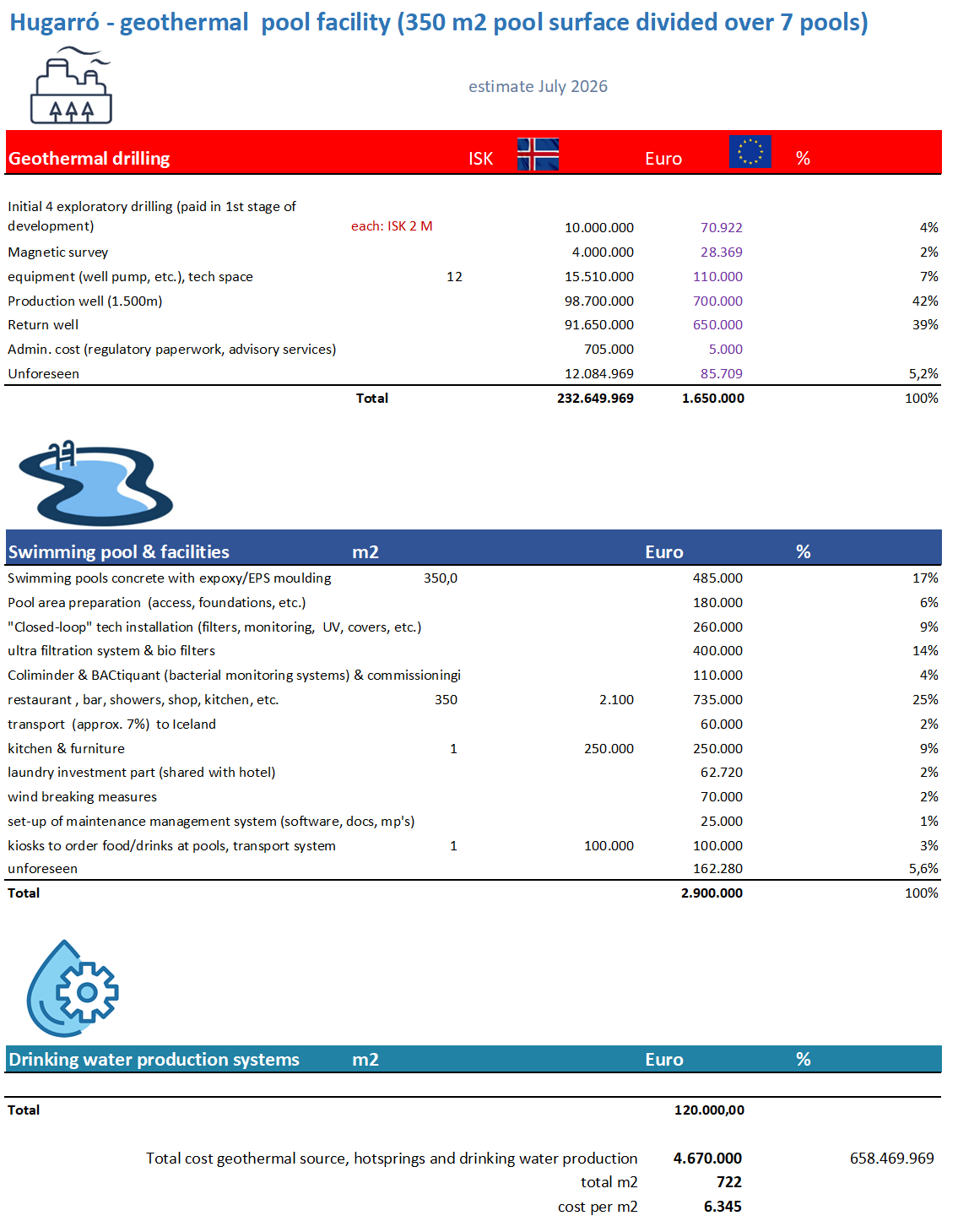 Click to enlarge
Our drinking water infrastructure — borehole, creek intake, filtration, UV disinfection, a 58 m³ storage tank and remote monitoring — is included in the budget above.

You may wonder why drilling a geothermal source in Iceland is considerably cheaper than in mainland Europe.
Icelandic groundwater is extremely hot (often 80°C to well over 150°C). The temperature gradient our our location suggests a temperature of 120 °C at 1.000 m. depth. So if we hit an aquafier at 800 m. with 90 °C water we’re avoid extra drilling cost. Moreover, the water there is often under natural pressure and rises on its own as an artesian spring, or with only a light pump. As a result, the costs for a heavy, expensive deep-well pump in the production well are often eliminated where a well depth of 2.500 m. is not uncommon.
The map below shows the distance to nearby wells.
The Hugarró development’s anchor are the geothermal pools. Needless to say we need hot water. We have already discussed the alternative if we don’t find (enough) geothermal water: C02 heat pumps.
But what are the actually chances of failure and which factors play a role? We dove deeper into this subject. Below the results of our research.
The most important distinction first
Almost every published statistic on geothermal well failure is based on power generation wells — where “success” means enough steam to drive a turbine, typically requiring 200°C+ at high flow rates. Our target is fundamentally different:
Our needs: 7–10 L/s at 70°C — a bar so low that many wells classified as “failures” in academic studies would comfortably pass for our purposes.
The IFC’s global study — the largest geothermal drilling database ever compiled — makes this explicit: “a dry well is a rarity — almost all wells flow to some extent” and “a well was only considered successful if the capacity was above a certain threshold.” 1 That threshold is set for power production — not for our modest direct-use application.
What the numbers actually say
Global baseline (IFC database)
| Stage | Success rate |
|---|---|
| Exploration wells | ~60% |
| Development wells | ~75% |
| Operational (established field) | ~80% |
| Overall global average | ~78% |
Iceland high-enthalpy – over 200 °C (213 wells studied)
| Wells drilled | Success rate |
|---|---|
| First well (no prior data) | 43% |
| After 5 wells | 60% |
| After 15 wells (plateau) | 74% |
Low-temperature Iceland — our actual peer group
Iceland has drilled approximately 900 low-temperature wells since 1928, successfully supplying ~90% of the country’s space heating. 4 The track record of the low-temperature programme is exceptional precisely because the bar is lower — 70°C water is found across a much wider geographical area and shallower depth range than the 200°C+ needed for power generation.
Real examples near analogous settings:
- Thelamörk, N-Iceland: productive fracture intersected at just 450m depth, yielding 17 L/s at 91°C — more than double our target, at less than half our planned depth 2
- Hjalteyri, Eyjafjörður: well HJ-19 to 1,450m following ground magnetic survey yielded 200 L/s at 90°C — the most productive low-temperature well in that region 3
What the magnetic survey does — and doesn’t — do
This is where honesty matters for investors:
| What the survey achieves | What it cannot guarantee |
|---|---|
| Maps subsurface fracture zones and fault lines | Exact fracture intersection at drill point |
| Identifies low-resistivity zones (geothermal fluid indicators) | Water temperature at depth |
| Eliminates obviously wrong locations | “Bad luck” — local absence of fractures at chosen point |
| Reduces “wrong area” risk dramatically | The final 10–15% site-specific uncertainty |
The research is direct on this: “pre-drill derisking techniques have not greatly mitigated the risk factors — there is a relatively small improvement in success rates between exploration and development wells.” 1 What surveys do is eliminate the worst outcomes — drilling in completely the wrong location. What they cannot do is guarantee fracture intersection at the exact drill point. That residual uncertainty is irreducible with current technology.
The IFC study describes this remaining risk as simply “bad luck — local absence of fractures, difficult to predict even with surveys.” 1
Our specific probability — After survey and pre-drills
Combining all factors — Iceland’s geological advantage, our low target, our pre-drill programme, the Hvalfjörður geological context, and proven nearby production at Hvalur:
| Risk factor | General statistics | Our adjusted probability | Why |
|---|---|---|---|
| True dry well (no water at all) | ~5% globally | <2% | Iceland’s volcanic geology always produces some water |
| Water found but below 70°C | ~4% (high-temp studies) | <3% | 70°C is easily achievable at 900–1,500m in Hvalfjörður |
| Water found, right temp, wrong flow (<7 L/s) | ~10–15% | ~8–12% | Our 7 L/s target is very modest; partially mitigated by directional drilling |
| Full success (≥7 L/s at ≥70°C) | 74–78% baseline | ~85–90% | Lower bar + better geology + survey + pre-drills |
The honest summary
| Question | Answer |
|---|---|
| Can the survey eliminate failure risk? | No — it reduces it, not eliminates it |
| What is the residual risk after full exploration programme? | ~10–15% of not meeting our specific target |
| What is the risk of finding absolutely nothing? | <2% in Iceland’s geology |
| Most likely failure mode | Missing the fracture zone at the drill point — “bad luck” |
| Does this justify the backup system? | Absolutely yes |
In plain terms: after a thorough magnetic survey, shallow pre-drills, and with the geological context of Hvalfjörður behind us, the probability of finding sufficient water for our modest needs is approximately 85–90%. The remaining 10–15% is not ignorance or poor planning — it is the irreducible geological uncertainty that every geothermal project carries, regardless of how much exploration is done first.
That is precisely why our CO₂ heat pump backup system exists, and why it was engineered in full detail rather than treated as a footnote.
and how Hugarró goes far beyond them
What makes geothermal pools in Iceland unique — and what does it take to keep them safe, sustainable, and natural at the same time?
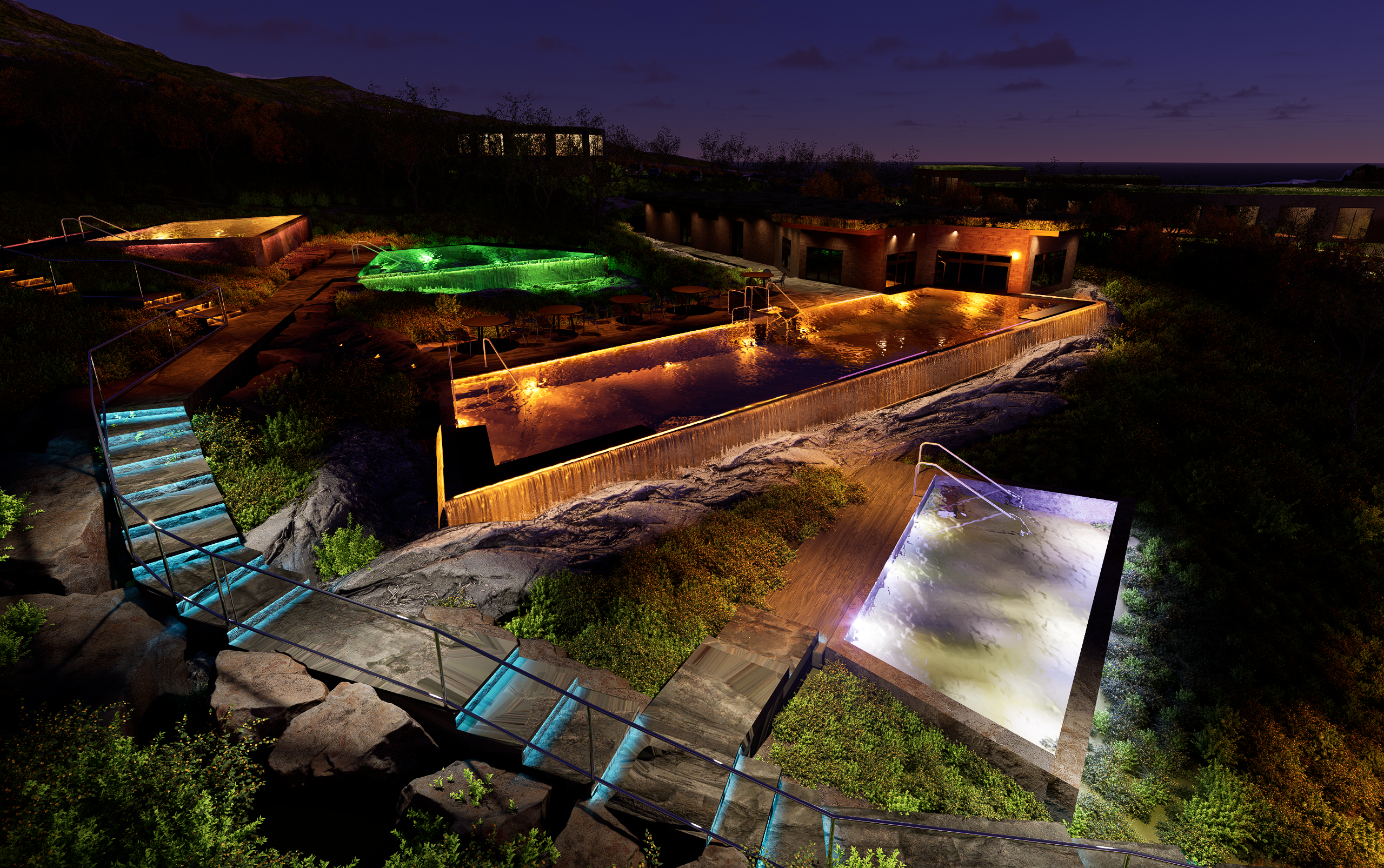
 translation below
What makes Icelandic geothermal pools so special?
Iceland’s geothermal pools are a product of the country’s unique geology. Water heated deep underground is mixed with cold water to set temperatures between 36–42°C — perfect for soaking, but also a warm, nutrient-rich environment in which bacteria can multiply quickly. Unlike outdoor seawater beaches or cold freshwater lakes, a warm pool with dozens of bathers needs active water quality management.
In most countries around the world, this is solved with chlorine and other chemical disinfectants. In Iceland, chemicals are explicitly prohibited in natural bathing facilities under Regulation No. 460/2015 (Reglugerð um baðstaði í náttúrunni). That is what makes Icelandic geothermal bathing culture genuinely different — and what makes the engineering challenge so interesting.
What does Icelandic law require instead?
The traditional solution used across Iceland is straightforward and effective, but also very resource-intensive: replace 30–40% of the pool’s total water volume every single day. Fresh cold water and geothermal hot water are continuously mixed in and the “old” water is flushed out — millions of litres of heated water discharged daily into drainage ditches.
The relevant law, Regulation No. 460/2015, classifies natural bathing facilities and sets bacterial count limits (e.g. E. coli < 500/100 ml; Enterococci < 200/100 ml for Class 1 facilities). The regulation requires:
- A minimum of 10 water samples per year for Class 1 facilities (like ours)
- An internal control system with risk assessments, incident logs, and staff training
- A documented emergency and contingency plan
- Strict bather number controls
- Mandatory signage, changing rooms, showers, and first aid on site
The regulation is outcome-based, not technology-prescriptive — meaning it sets the results you must achieve, not the method you must use. This is the regulatory opening that Hugarró’s engineering approach is built on.
What category does Hugarró fall under?
Hugarró is classified as a Recreation Pool (Afþreyingarlaug) — Class 1 — under Regulation 460/2015. This is the highest level of oversight, applying to facilities that operate regularly and year-round. It requires a full operating licence (starfsleyfi) from the local Health Committee, comprehensive internal controls, and continuous compliance with bacterial quality standards.
We welcome this level of scrutiny. Our systems are designed to far exceed Class 1 requirements, not merely meet them.
Why are chemicals not used — and why is that actually fine?
Chemicals such as chlorine kill bacteria effectively, but they have a serious downside: they react with organic matter introduced by bathers (sweat, skin cells, urine) to produce disinfection by-products (DBPs) — compounds that are themselves potentially harmful and are responsible for the characteristic “pool smell” most people associate with indoor public pools. In Iceland, the law simply prohibits them in natural bathing facilities.
The good news is that, as research has demonstrated, chemicals are not actually necessary if you control the source of contamination and treat the water effectively through physical methods.
What does the science say? The Keuten/Delft Study
Researcher M.C. Keuten at Delft University of Technology published a landmark study on bacterial pollution in swimming pools and how to reduce it — *Alternative Pool Water Treatment and the Influence of Swimmers on Water Quality*.
The study used a specially instrumented shower cabin to precisely measure the pollutants released by bathers before and during swimming. The key findings are striking:
| Source of bacterial/pollutant load | Share of total |
|---|---|
| Submerged sweating during swimming | ~40% |
| Not showering before entering the pool | ~30% |
| Not using the toilet before entering the pool | ~30% |
This means that up to 60% of the bacterial input into a pool is directly controllable through bather behaviour — before any filtration or treatment technology is even needed. This is something Icelanders know well, which is why the country has a very strict pre-bath showering culture.
Keuten also demonstrated that UV disinfection combined with ultrafiltration — with no chemicals — can achieve microbial water quality comparable to chlorinated pools. Biological filtration further improved the removal of dissolved substances such as urea, reducing the formation of unwanted by-products.
What does Hugarró do to reduce bacterial input at the source?
Based directly on Keuten’s research, Hugarró has designed a two-step pre-entry protocol backed by technology, not just signage:
- Mandatory pre-swim shower — Our facilities use sensor-based nudging technology that confirms a minimum 1.5 minutes of showering before entry is unlocked. This alone eliminates approximately 30% of the bacterial load that would otherwise enter the pool. A visible timer shows the bather how much time is left.
- Toilet-first culture — Clear prompts, facility design, and staff communication encourage guests to use the toilet before bathing — targeting the remaining 30% of avoidable bacterial input.
Across our 7 pools, strict bather number limits are enforced in real time, both to comply with the regulatory requirement for access control and to ensure that the filtration system is never overwhelmed.
How does Hugarró manage water quality without chemicals and without massive water waste?
Instead of continuously flushing out large volumes of water, Hugarró’s pools are equipped with continuous ultrafiltration — a physical membrane-based process that removes bacteria, particles, and micro-organisms from pool water in a closed loop. This is combined with continuous water quality monitoring using systems such as those developed by bNovate, which allows near-real-time measurement of bacterial counts.
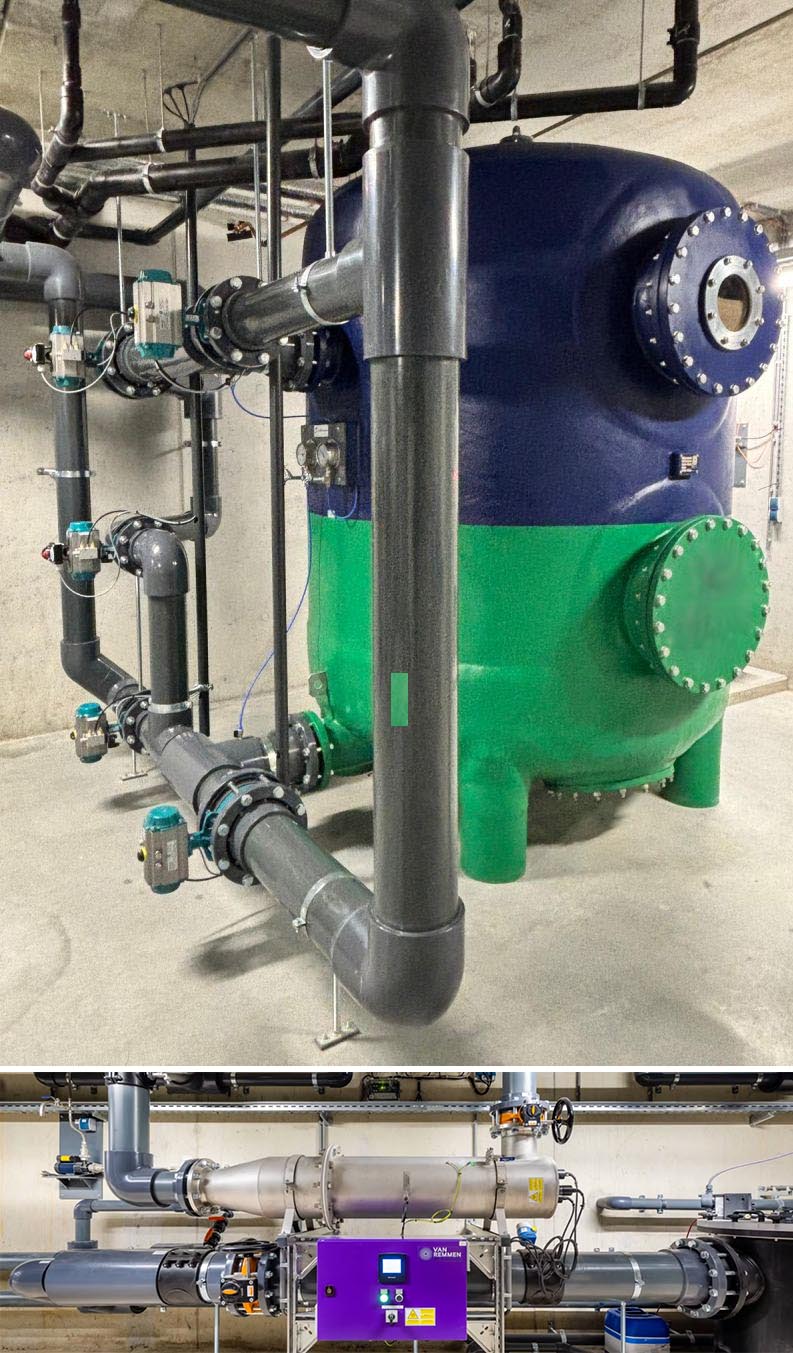 The result:
-
- Water savings of over 90% compared to the traditional daily-replacement model used elsewhere in Iceland
- Energy savings of over 30% in heating, as far less cold replacement water needs to be heated
- Pool water that can be cycled to within safe bacteriological limits within one hour if needed — compared to the days it would take under a simple dilution/replacement model
Why ultrafiltration alone is not enough — the role of the active carbon biofilter
Ultrafiltration is highly effective at removing bacteria, viruses, and suspended particles from pool water. However, it has one fundamental limitation: its membranes work by physical size exclusion, and the pores are far too large to capture dissolved molecules. Urea — the primary dissolved contaminant in sweat and urine — is a small molecule (~0.4 nm) that passes straight through a UF membrane unimpeded.
This matters particularly in a geothermal pool at 38°C. At that temperature, the water is warmer than the human body’s cooling threshold, meaning that bathers sweat continuously and passively, even while sitting still. Research has measured sweat secretion of over 500 ml per person per hour during passive immersion at this temperature. Urea accumulates in the water with every bather, every session, every day — and UF does nothing to stop it.
To address this, Hugarró’s filtration system includes a biological active carbon filter. Granular activated carbon (GAC) offers an extraordinarily large internal surface area — hundreds of square metres per gram — on which both physical adsorption and biological degradation take place simultaneously:
- Adsorption: urea and other dissolved organic compounds bind chemically to the carbon surface and are removed from the water
- Biodegradation: beneficial micro-organisms colonise the carbon medium and break down the adsorbed organic matter into harmless compounds
This dual mechanism makes active carbon significantly more effective than alternative biological media such as MBBR carriers (moving bed biofilm reactors), which rely on biological action alone and offer no adsorption capacity. In a chemical-free system with clean fill water, active carbon can dedicate its full adsorption capacity exclusively to the dissolved substances introduced by bathers — making it the ideal complement to ultrafiltration.
Together, UF and the active carbon biofilter cover what neither can achieve alone: UF handles pathogens and particles; the biofilter handles dissolved organics. The result is pool water that is clean in every meaningful sense of the word.
Does Hugarró have any water replacement at all?
Yes — a small amount. Natural evaporation from the pool surface means that water is slowly lost and must be topped up. This amounts to less than 10% of pool volume per day — a fraction of the 30–40% daily replacement that is standard practice at comparable Icelandic geothermal pools. This replacement water is part of the natural water cycle, not a deliberate “flush-and-refill” approach.and-refill” approach.
How does Hugarró monitor water quality — and how does this compare to the law?
The law requires a minimum of 10 water quality checks per year for Class 1 facilities — roughly once per month. At Hugarró, we check every pool every 2 hours, using continuous real-time monitoring technology. This means:
| Parameter | Legal minimum (Class 1) | Hugarró standard |
|---|---|---|
| Water quality sampling frequency | 10×/year (~monthly) | Every 2 hours |
| Response time to exceedance | Days (lab turnaround) | Within 1 hour (automated filtration response) |
| Bather number enforcement | Required, method unspecified | Real-time sensor-based control per pool |
Any exceedance of our internal quality thresholds triggers an automated filtration response. Our systems are designed to restore water to within safe parameters within one hour — even under peak load. In fact, the moment bacterial quality moves from the ‘green’ to the ‘yellow’ zone, we increase filtration on the pool in question to prevent it from ever reaching the ‘red’ zone.
Moreover, our system can be remotely monitored via online dashboards by the health authorities — providing real-time oversight rather than after-the-fact sampling during a site visit.
Other measures to assure water quality
An important part of our quality control system is pool design. By creating overflow around all pool edges, the formation of a bacterial biofilm on the water surface is minimised. Pool surfaces are smoother than standard concrete pool surfaces, which greatly reduces the build-up of deposits that are a breeding ground for bacterial growth, and allows easy cleaning.
Water flow through the pools — comprising evaporation replacement water as well as heated water inflow — is carefully engineered to avoid stagnant areas, which can lead to bacterial development. This is the principle behind the ‘islands’ in our pools: filtered water enters via the bottom of the pool and rises upward, flowing over the edges and carrying any contamination with it. This creates a continuously circulating cycle, carefully monitored by automation.
Are there any rules in Iceland that prohibit ultrafiltration?
No. Regulation 460/2015 contains no prohibition on ultrafiltration. The regulation is outcome-based — it sets bacterial limits and requires that a documented internal control system is in place. It does not prescribe which technology must be used to achieve those limits.
The regulation does describe the standard model for recreation pools as relying on “frequent water renewal and bather number control” — which is how the traditional approach is framed. However, since the law is outcome-focused, an alternative method that demonstrably achieves the same (or better) bacteriological outcomes is legally defensible.
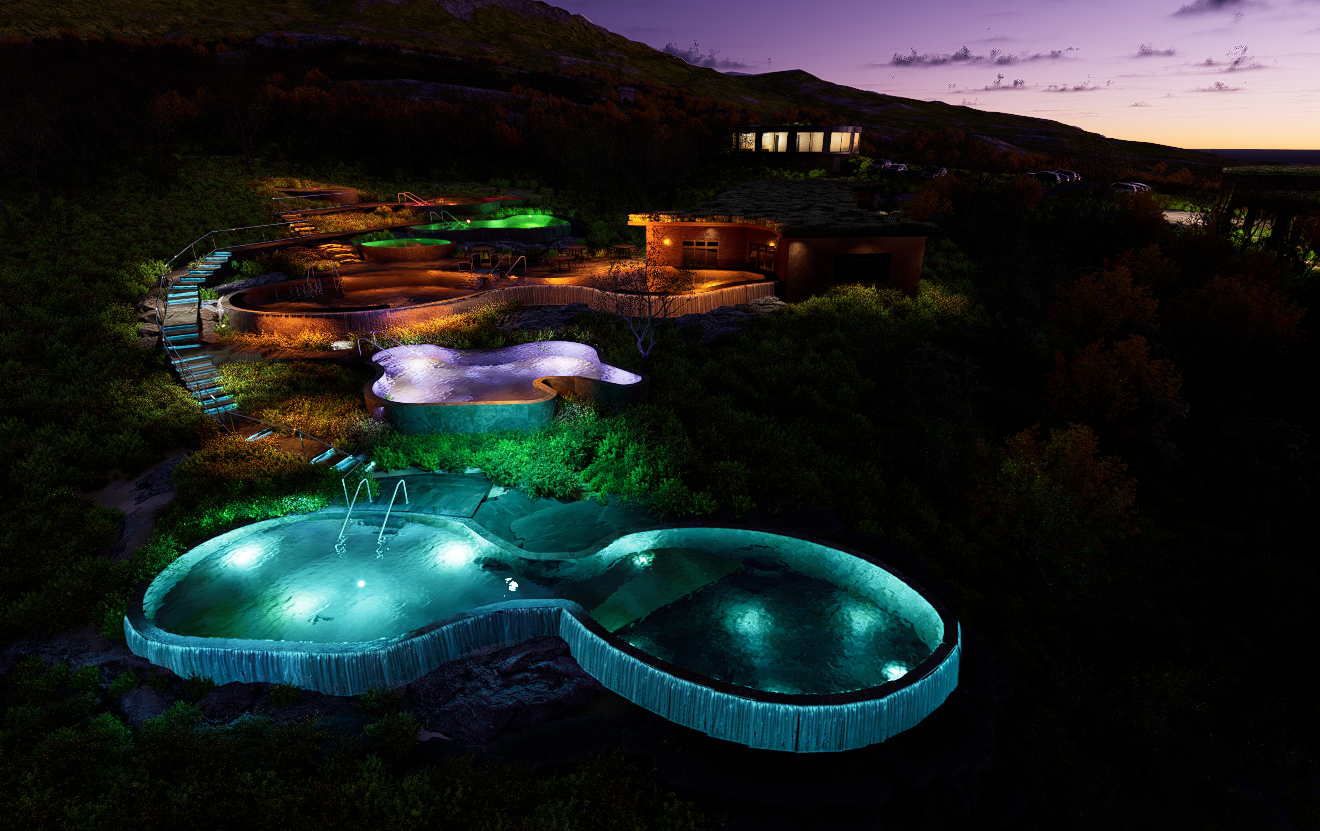
Hugarró engages proactively with the local Health Committee to ensure our approach is fully documented, understood, and approved as part of our operating licence conditions. This regulatory dialogue will be an ongoing part of our operations and we hope to set an example for bacterial water control in Iceland.
What does the local Health Committee inspect?
The local Health Committee (heilbrigðisnefnd) holds broad powers under Regulation 460/2015 and the underlying Public Health Act No. 7/1998:
- Unrestricted access for inspections and water sampling at any time
- Power to issue public warnings and erect warning signs if bacterial limits are repeatedly exceeded
- Power to cap the number of bathers in a recreation pool
- Power to order additional sampling beyond the minimum (at the operator’s cost)
- Power to authorise or order disinfection — only by radiation or other non-chemical means — if quality standards are repeatedly not met
All of Hugarró’s water quality results — as required — are forwarded to the Environment Agency of Iceland (Umhverfisstofnun), where they are published publicly. We are confident in our results and welcome public transparency.
The bottom line
Hugarró operates at the intersection of Icelandic bathing culture, environmental responsibility, and evidence-based water science. We comply fully with Regulation No. 460/2015 as a Class 1 Recreation Pool — and go significantly further in every measurable dimension of water safety, resource efficiency, and monitoring rigour.
Our approach is not a workaround. It is what responsible geothermal bathing looks like when engineering and science are applied seriously to an age-old challenge
Click to enlarge
Íslenskar reglugerðir um böðun í náttúrunni
Íslenskar reglugerðir um böðun í náttúrunni
og hvernig Hugarró fer langt fram úr þeim
Hvað gerir íslenskar jarðhitalaugar einstakar — og hvað þarf til að halda þeim öruggum, sjálfbærum og náttúrulegum á sama tíma?

Hvað gerir íslenskar jarðhitalaugar svona sérstakar?
Íslenskar jarðhitalaugar eru afurð einstakrar jarðfræði landsins. Vatni sem hitnar djúpt í jörðu er blandað við kalt vatn til að ná 36–42°C hita — fullkomið til að láta fara vel um sig, en jafnframt hlýtt og næringarríkt umhverfi þar sem bakteríur geta fjölgað sér hratt. Ólíkt sjávarströndum eða köldum ferskvatnsstöðum þarf hlý laug með tugum gesta virka stjórnun á vatnsgæðum.
Í flestum löndum heims er þetta leyst með klór og öðrum sótthreinsiefnum. Á Íslandi eru kemísk efni beinlínis bönnuð á náttúrulegum baðstöðum samkvæmt Reglugerð nr. 460/2015 (Reglugerð um baðstaði í náttúrunni). Það er það sem gerir íslenska baðmenningu sannarlega frábrugðna — og gerir verkfræðilegu áskorunina svo áhugaverða.
Hvað krefjast íslensk lög í staðinn?
Hefðbundna lausnin sem notuð er um allt Ísland er einföld og áhrifarík, en jafnframt mjög auðlindafrek: skipta út 30–40% af heildarvatnsmagni laugarinnar á hverjum einasta degi. Fersku köldu vatni og heitu jarðhitavatni er stöðugt blandað saman og „gamla“ vatninu skolað út — milljónir lítra af hituðu vatni renna daglega í frárennslisskurði.
Viðeigandi lög, Reglugerð nr. 460/2015, flokka náttúruleg baðsvæði og setja mörk fyrir gerlafjölda (t.d. E. coli < 500/100 ml; Enterokokkar < 200/100 ml fyrir flokk 1). Reglugerðin krefst:
- Að lágmarki 10 vatnssýni á ári fyrir mannvirki í flokki 1 (eins og okkar)
- Innra eftirlitskerfi með áhættumati, atvikaskráningu og þjálfun starfsfólks
- Skráð neyðar- og viðbragðsáætlun
- Strangt eftirlit með fjölda baðgesta
- Skyldubundnar merkingar, búningsklefar, sturtur og skyndihjálp á staðnum
Reglugerðin er árangursmiðuð, ekki tækniforskrift — sem þýðir að hún setur fram þá niðurstöðu sem þarf að ná, en ekki hvaða aðferð þarf að nota. Þetta er reglugerðaropnunin sem verkfræðileg nálgun Hugarró byggir á.
Undir hvaða flokk fellur Hugarró?
Hugarró er flokkað sem Afþreyingarlaug (Afþreyingarlaug) — Flokkur 1 — samkvæmt reglugerð 460/2015. Þetta er hæsta stig eftirlits og á við um mannvirki sem starfrækt eru reglulega og allt árið um kring. Það krefst fulls starfsleyfis frá heilbrigðisnefnd sveitarfélagsins, yfirgripsmikils innra eftirlits og stöðugrar fylgni við gæðastaðla fyrir gerla.starfsleyfistarfsleyfi
Við fögnum þessu eftirliti. Kerfin okkar eru hönnuð til að fara langt fram úr kröfur í flokki 1 ríflega, en ekki bara uppfylla þær.
Af hverju eru engin kemísk efni notuð — og af hverju er það í raun í lagi?
Efni eins og klór drepa bakteríur á áhrifaríkan hátt, en þeim fylgir alvarlegur galli: þau hvarfast við lífræn efni sem berast með sundgestum (svita, húðfrumum, þvagi) og mynda aukaafurðir sótthreinsunar (DBP) — efnasambönd sem geta sjálf verið skaðleg og bera ábyrgð á hinni dæmigerðu „sundlaugalykt“ sem flestir tengja við almenningslaugar innanhúss. Á Íslandi banna lög þessi efni einfaldlega í náttúrulegum baðstöðum.
Góðu fréttirnar eru þær að rannsóknir hafa sýnt að kemísk efni eru í raun óþörf ef stjórnað er upptökum mengunar og vatnið meðhöndlað á áhrifaríkan hátt með eðlisfræðilegum aðferðum.
Hvað segja vísindin? Keuten/Delft rannsóknin
Rannsakandinn M.C. Keuten við Tækniháskólann í Delft birti tímamótarannsókn á bakteríumengun í sundlaugum og hvernig megi draga úr henni — *Alternative Pool Water Treatment and the Influence of Swimmers on Water Quality*.
Í rannsókninni var notaður sérútbúinn sturtuklefi til að mæla nákvæmlega þau mengunarefni sem losna frá sundgestum fyrir og á meðan þeir synda. Helstu niðurstöður eru sláandi:
| Upptök bakteríu- og mengunarálags | Hlutfall af heild |
|---|---|
| Svitamyndun í kafi á meðan sundi | ~40% |
| Að fara ekki í sturtu áður en farið er í laugina | ~30% |
| Að nota ekki salernið áður en farið er í laugina | ~30% |
Þetta þýðir að hægt er að stjórna allt að 60% af bakteríumagni sem berst í laug beint með hegðun gesta — áður en nokkur síunar- eða hreinsitækni er yfirhöfuð nauðsynleg. Þetta er eitthvað sem Íslendingar þekkja vel, og þess vegna ríkir hér á landi mjög ströng menning varðandi sturtuferðir fyrir sund.
Keuten sýndi einnig fram á að UV-sótthreinsun ásamt ofursíun (ultrafiltration) — án nokkurra íðefna — getur náð fram örverufræðilegum vatnsgæðum sem eru sambærileg við klóraðar laugar. Líffræðileg síun bætti enn frekar fjarlægingu uppleystra efna eins og þvagefnis, sem dregur úr myndun óæskilegra aukaafurða.
Hvað gerir Hugarró til að draga úr bakteríumagni við upptökin?
Byggt beint á rannsóknum Keuten, hefur Hugarró hannað tveggja þrepa aðgangsferli sem studd er af tækni, ekki bara skiltum:
- Skyldubundin sturta fyrir sund — Aðstaða okkar notar skynjaratækni sem hvetur gesti og staðfestir að lágmarki 1,5 mínútna sturtuferð áður en opnað er fyrir aðgang. Þetta eitt og sér eyðir um það bil 30% af því bakteríumagni sem annars myndi berast í laugina. Sýnilegur tímamælir sýnir gestinum hversu mikill tími er eftir.
- Salernismenning í fyrirrúmi — Skýrar ábendingar, hönnun aðstöðunnar og samskipti starfsfólks hvetja gesti til að nota salernið fyrir sundferðina — sem beinist að þeim 30% af forðanlegu bakteríumagni sem eftir standa.
Í okkar 7 laugum, er ströngum takmörkunum á fjölda gesta fylgt eftir í rauntíma, bæði til að uppfylla reglugerðarkröfur um aðgangsstýringu og til að tryggja að síunarkerfið verði aldrei ofhlaðið.
Hvernig stýrir Hugarró vatnsgæðum án íðefna og án gífurlegrar vatnssóunar?
Í stað þess að skola stöðugt út miklu magni af vatni, eru laugar Hugarró búnar samfelldri ofursíun — eðlisfræðilegu ferli byggðu á himnum sem fjarlægir bakteríur, agnir og örverur úr laugavatninu í lokaðri hringrás. Þessu er fylgt eftir með stöðugri vöktun á vatnsgæðum með kerfum eins og þeim sem þróuð eru af bNovate, sem gerir kleift að mæla bakteríufjölda nánast í rauntíma.
 Niðurstaðan:
-
- Yfir 90% vatnssparnaður miðað við hefðbundna líkanið þar sem vatni er skipt út daglega eins og annars staðar á Íslandi
- Yfir 30% orkusparnaður í upphitun, þar sem hita þarf mun minna af köldu ferskvatni
- Laugavatn sem hægt er að hreinsa upp að öruggum gerlamörkum innan klukkustundar ef þörf krefur — samanborið við þá marga daga sem það tæki með einfaldri útskiptingu vatns
Af hverju ofursíun ein og sér dugar ekki — hlutverk lífvirkrar kolsíu
Ofursíun er mjög áhrifarík við að fjarlægja bakteríur, vírusa og svifagnir úr sundlaugarvatni. Hún hefur þó eina grundvallartakmörkun: himnurnar virka með eðlisfræðilegri stærðarsíun og svitaholurnar eru allt of stórar til að fanga uppleystar sameindir.Þvagefni — helsta uppleysta mengunarefnið í svita og þvagi — er lítil sameind (~0,4 nm) sem fer óhindrað beint í gegnum ofursíunarhimnu.
Þetta skiptir sérstaklega miklu máli í jarðhitalaug sem er 38°C heit. Við það hitastig er vatnið heitara en kæliþröskuldur mannslíkamans, sem þýðir að baðgestir svitna stöðugt og ómeðvitað, jafnvel þótt þeir sitji kyrrir. Rannsóknir hafa mælt svitamyndun yfir 500 ml á mann á klukkustund við óvirka dvöl í vatni við þetta hitastig. Þvagefni safnast upp í vatninu með hverjum gesti, hverri baðferð, á hverjum degi — og ofursíun gerir ekkert til að stöðva það.
Til að bregðast við þessu inniheldur síunarkerfi Hugarró lífvirka kolsíu. Virkt kornakol (GAC) býður upp á óvenju stórt innra yfirborð — mörg hundruð fermetra á hvert gramm — þar sem bæði eðlisfræðileg ásog og líffræðileg niðurbrot eiga sér stað samtímis:
- Ásog: þvagefni og önnur uppleyst lífræn efnasambönd bindast efnafræðilega við yfirborð kolsins og eru fjarlægð úr vatninu
- Líffræðilegt niðurbrot: gagnlegar örverur setjast að í kolefninu og brjóta niður ásoguð lífræn efni í skaðlaus efnasambönd
Þetta tvíþætta ferli gerir virkt kol mun skilvirkara en önnur líffræðileg síuefni eins og MBBR-berar (skolpsíur með hreyfanlegu undirlagi), sem treysta eingöngu á líffræðilega virkni og hafa enga ásogsgetu. Í efnalausu kerfi með hreinu fyllivatni getur virka kolið nýtt alla ásogsgetu sína eingöngu fyrir þau uppleystu efni sem berast með baðgestum — sem gerir það að fullkominni viðbót við ofursíun.
Saman ná UF og virka kolefnis-lífsían því sem hvorugt getur áorkað eitt og sér: UF sér um sýkla og agnir; lífsían sér um uppleyst lífræn efni. Niðurstaðan er sundlaugarvatn sem er hreint í fyllsta skilningi þess orðs.
Er einhver vatnsskipti yfirhöfuð hjá Hugarró?
Já — lítið magn. Náttúruleg uppgufun af yfirborði laugarinnar þýðir að vatn tapast hægt og rólega og þarf að fylla á hana. Þetta nemur minna en 10% af rúmmáli laugarinnar á dag — broti af þeim 30–40% daglegu vatnsskiptum sem eru venjubundin í sambærilegum íslenskum jarðhitalaugum. Þetta áfyllingarvatn er hluti af náttúrulegri hringrás vatnsins, ekki meðvituð „tæma-og-fylla“ nálgun.
Hvernig vaktar Hugarró vatnsgæði — og hvernig er það í samanburði við lög?
Lögin krefjast að lágmarki 10 mælingar á vatnsgæðum á ári fyrir flokk 1 — u.þ.b. einu sinni í mánuði. Hjá Hugarró athugum við hverja laug á 2 klukkustunda fresti, með því að nota tækni sem vaktar vatnið stöðugt í rauntíma. Þetta þýðir:
| Mælistærð | Lagalegt lágmark (Flokkur 1) | Hugarró staðall |
|---|---|---|
| Tíðni sýnatöku á vatnsgæðum | 10× á ári (~mánaðarlega) | Á 2 klukkustunda fresti |
| Viðbragðstími við frávikum | Dagar (bið eftir rannsóknarstofu) | Innan 1 klukkustundar (sjálfvirkt viðbragð síunarkerfis) |
| Eftirlit með fjölda gesta | Skylt, aðferð ekki tilgreind | Rauntíma eftirlit með skynjurum í hverri laug |
Öll frávik frá okkar innri gæðaviðmiðum ræsa sjálfvirkt viðbragð í síunarkerfinu. Kerfin okkar eru hönnuð til að koma vatninu aftur innan öruggra marka innan klukkustundar — jafnvel við hámarksálag. Í raun, um leið og bakteríugæði færast úr „græna“ svæðinu yfir í það „gula“, aukum við síun í viðkomandi laug til að koma í veg fyrir að hún nái nokkurn tímann í „rauða“ svæðið.
Auk þess geta heilbrigðisyfirvöld fylgst með kerfinu okkar í gegnum mælaborð á netinu — sem veitir rauntímaeftirlit í stað sýnatöku eftir á við vettvangsheimsókn.
Aðrar ráðstafanir til að tryggja vatnsgæði
Mikilvægur hluti af gæðaeftirlitskerfi okkar er hönnun lauganna. Með því að hafa yfirfall meðfram öllum laugarköntum er myndun örveruskánar á yfirborði vatnsins lágmörkuð. Yfirborð lauganna er sléttara en á hefðbundnum steyptum laugum, sem dregur verulega úr útfellingum sem eru gróðrarstía fyrir bakteríuvöxt og auðveldar þrif.
Vatnsrennsli í gegnum laugarnar — sem samanstendur af vatni til að mæta uppgufun ásamt innrennsli á heitu vatni — er vandlega hannað til að forðast kyrrstöðusvæði þar sem bakteríur geta þrifist. Þetta er meginreglan á bak við „eyjarnar“ í laugunum okkar: síað vatn kemur inn um botn laugarinnar og stígur upp, flæðir yfir kanta og ber með sér hvers kyns óhreinindi. Þetta skapar stöðuga hringrás sem er vandlega vöktuð með sjálfvirkni.
Eru einhverjar reglur á Íslandi sem banna ofursíun?
Nei. Reglugerð 460/2015 inniheldur ekkert bann við ofursíun. Reglugerðin er árangursmiðuð — hún setur mörk fyrir gerlafjölda og krefst þess að skjalfest innra eftirlitskerfi sé til staðar. Hún kveður ekki á um hvaða tækni skuli nota til að ná þeim mörkum.
Reglugerðin lýsir staðallíkani fyrir baðstaði sem byggir á „tíðri endurnýjun vatns og takmörkun á fjölda baðgesta“ — sem er hefðbundna nálgunin. Hins vegar, þar sem lögin einblína á niðurstöður, er önnur aðferð sem sýnanlega nær sömu (eða betri) niðurstöðum varðandi gerlafjölda lagalega verjanleg.

Hugarró á í virku samstarfi við Heilbrigðisnefnd til að tryggja að nálgun okkar sé fyllilega skjalfest, skilin og samþykkt sem hluti af starfsleyfisskilyrðum okkar. Þetta samtal við eftirlitsaðila verður áframhaldandi hluti af starfsemi okkar og við vonumst til að vera fyrirmynd í bakteríustjórnun vatns á Íslandi.
Hvað skoðar heilbrigðisnefndin?
Heilbrigðisnefnd (heilbrigðisnefnd) hefur víðtækar heimildir samkvæmt reglugerð nr. 460/2015 og undirliggjandi lögum um hollustuhætti og mengunarvarnir nr. 7/1998:
- Ótakmarkaður aðgangur vegna eftirlits og sýnatöku hvenær sem er
- Heimild til að gefa út opinberar viðvaranir og setja upp viðvörunarskilti ef gerlamörk eru ítrekað yfir mörkum
- Heimild til að takmarka fjölda baðgesta á baðstað
- Heimild til að fyrirskipa aukna sýnatöku umfram lágmark (á kostnað rekstraraðila)
- Heimild til að heimila eða fyrirskipa sótthreinsun — eingöngu með geislun eða öðrum aðferðum án íblöndunarefna — ef gæðakröfur eru ítrekað ekki uppfylltar
Öllum niðurstöðum úr mælingum á vatnsgæðum Hugarró er — eins og krafist er — miðlað til Umhverfisstofnun (Umhverfisstofnun), þar sem þær eru birtar opinberlega. Við treystum okkar niðurstöðum og fögnum gagnsæi gagnvart almenningi.
Kjarni málsins
Hugarró starfar á mótum íslenskrar baðmenningar, umhverfisábyrgðar og gagnreyndra vatnsvísinda. Við fylgjum reglugerð nr. 460/2015 að fullu sem flokkur 1 fyrir afþreyingarlaugar — og göngum mun lengra á öllum mælanlegum sviðum vatnsöryggis, auðlindanýtingar og eftirlits.
Nálgun okkar er ekki undanleið. Svona lítur ábyrg jarðhitabaðmenning út þegar verkfræði og vísindum er beitt af alvöru við forna áskorun
Vacation home district heating — Iceland
Prepared: September 2026 | Confidential — For Discussion Purposes
Executive Summary
Our geothermal project will generate significantly more thermal capacity than the primary development requires. We propose to monetise this surplus by supplying hot water to a neighbouring planned vacation home community of 50 homes across two clusters. The developer of that community has indicated willingness to co-invest in the distribution infrastructure, which materially de-risks the project and compresses the payback period to approximately 10–11 years on a shared CAPEX basis — well within the operational lifespan of the asset (30–40 years).
This is a low-marginal-cost, recurring revenue stream built on zero-cost fuel.
Project overview
| Parameter | Detail |
|---|---|
| Heat source | Geothermal (surplus capacity from primary project) |
| Customers — Phase 1 | 25 vacation homes, Cluster A |
| Customers — Phase 2 | 25 vacation homes, Cluster B |
| Distance to Cluster A | 800 m from source |
| Distance to Cluster B | 1,700 m from source |
| Billing model | Fixed annual subscription + flow capacity |
| Developer role | Co-investor in pipeline infrastructure (50% CAPEX) |
Capital expenditure
| Item | Total Cost | Developer (50%) | Our Share (50%) |
|---|---|---|---|
| Trunk line, Source → Cluster A (800 m) | €524,800 | €262,400 | €262,400 |
| Extension, Cluster A → Cluster B (900 m) | €590,400 | €295,200 | €295,200 |
| Internal distribution, Cluster A | €173,700 | €86,850 | €86,850 |
| Internal distribution, Cluster B | €173,700 | €86,850 | €86,850 |
| Pump station & substations | €65,000 | €32,500 | €32,500 |
| Metering cabinets (50 homes) | €75,000 | €37,500 | €37,500 |
| Total | €1,602,600 | €801,300 | €801,300 |
| Less: Connection fees collected (50 × €3,200) | –€160,000 | ||
| Net CAPEX outlay | €641,300 |
Build is phased: Phase 1 (Cluster A, ~€801k) triggers on Cluster A construction start; Phase 2 (Cluster B) triggers on Cluster B confirmation. No idle capital.
Revenue & Financial Projection
| Revenue Item | Annual |
|---|---|
| Subscriptions — 40 standard homes (×€1,450/yr) | €58,000 |
| Subscriptions — 10 hot tub homes (×€1,750/yr) | €17,500 |
| Gross Revenue | €75,500 |
| Operating costs (maintenance, pumping, admin) | –€15,000 |
| Net Annual Income | €60,500 |
| Financial Metric | Value |
|---|---|
| One-time connection fee income | €160,000 |
| Net annual income (steady state) | ~€60,500 |
| Net CAPEX after connection fees | €641,300 |
| Payback period | ~10.6 years |
| Revenue from year 11 onwards | Near-pure margin |
| Asset operational life | 30–40 years |
Why the developer co-invests
The developer’s motivation is straightforward. In Iceland, geothermal hot water access is a market baseline expectation — lots without it sell at a meaningful discount. Based on regional comparables, reliable hot water supply adds an estimated €15,000–€25,000 per lot in realised sale value. Across 50 lots, that represents a €750k–€1.25M uplift in gross development value — making a €800k infrastructure contribution not just reasonable, but commercially rational. We are effectively subsidising their product quality.
This alignment of interests is a structural strength of the deal.
Key strengths
- Zero fuel cost. The heat is a by-product of our existing geothermal investment. Marginal cost of production is effectively nil.
- Recurring, inflation-linked income. Subscription tariffs are typically indexed to energy price benchmarks. Utility revenues are sticky and predictable.
- Captive customer base. Once connected, switching costs are prohibitive. Customer churn is essentially zero.
- Developer co-investment halves our exposure and signals strong demand validation before a single pipe is laid.
- Phased build eliminates idle capital risk. Phase 2 is only committed when Cluster B development is confirmed.
- Enhances our own project’s social licence. Community benefit strengthens planning relationships and long-term operating position.
- Gateway asset. Once operational, additional projects in the area will find our infrastructure already in place, with extension economics improving per additional customer.
Risks & mitigants
| Risk | Likelihood | Mitigant |
|---|---|---|
| Developer delays Phase 2 or backs out | Medium | Phase-gate agreements; Phase 1 is independently viable |
| Connection take-up below 100% | Medium | Mandatory connection covenant in lot sale contracts |
| Hot water chemistry unsuitable for bathing | Low–Medium | Test borehole water pre-commitment; heat exchanger option |
| Regulatory licence requirement (Orkustofnun) | Low–Medium | Early engagement with regulator; licence process is established |
| Pipeline CAPEX overrun | Medium | Fixed-price contractor quotes locked before commitment; 10% contingency |
| Developer seeks equity/pricing control | Medium | Contribution structured as infrastructure grant, not equity; ownership stays with us |
| Phase 2 development delayed 3–5 years | Medium | Phase-gating means no stranded capital; Phase 1 payback unaffected |
Strategic upside (not in base case)
10 existing vacation homes in the wider area were judged too dispersed and few to connect at present. As our network grows and additional developments emerge, incremental connections become progressively cheaper per home.
- Future developments attracted by proven geothermal infrastructure can be connected on similar commercial terms — each new customer improves the network economics for all parties.
- Carbon credit potential. Displacing oil or electric boiler heating with geothermal may qualify under relevant Icelandic or European carbon mechanisms — upside not yet quantified.
Summary verdict
This is a long-duration, low-risk infrastructure asset generating clean recurring income from a zero-cost fuel source, with a co-investing partner whose financial interests are directly aligned with ours. The 10.6-year payback on net invested capital is conservative — and from year 11, the revenue stream runs largely unconstrained for a further 20–30 years.
The primary negotiation priority is the mandatory connection covenant in the developer’s lot sale contracts. That single clause converts a projected revenue stream into a contractual one — and that is the difference between a good investment and an excellent one.
This document is prepared for discussion purposes only and does not constitute a formal investment prospectus. All figures are estimates based on comparable Icelandic district heating projects and are subject to detailed engineering and commercial due diligence.
Prepared for investor reference · Based on formal appraisal dated 10 June 2026
The asset
Hugarró is a planned eco-luxury hospitality development on a 12.1-hectare site at Litli Botn, at the head of Hvalfjörður fjord — 55 kilometres northwest of Reykjavik and at the trailhead of Glymur, Iceland’s second-highest waterfall. The site benefits from master zoning approval (aðalskipulag) already in place, with detailed zoning (deiliskipulag) published for public consultation and final National Planning Agency approval expected imminently.
The approved development programme comprises:
- A 32-room hotel and 31 free-standing rotating cabins (up to 200-guest capacity)
- Seven geothermal pools and a 350m² wellness hub
- Five meeting facilities, staff housing, and a health-focused restaurant
- Total approved buildable area: 5,000m² of commercial hospitality space
The valuation
The formal appraisal was carried out by Croisette – Real Estate Partner, Iceland’s leading real estate advisory firm and the exclusive Nordic partner of Knight Frank — the world’s largest private property consultancy, active in over 60 countries. 1 The report was authored by Styrmir Bjartur Karlsson, Managing Director and licensed real estate broker, who heads Croisette’s Iceland operations. 5 The valuation is prepared on a Market Value basis — the standard used by banks and institutional investors — and is of a quality accepted for financing purposes.
The assessed values are:
| Planning Stage | Value (ISK) | Value (EUR approx.) |
|---|---|---|
| Master zoning in place (aðalskipulag) | 250–275 million | €1.8–2.0 million |
| Full detailed zoning + approved schematics | 500 million | ~€3.6 million |
The step-up from master to detailed zoning reflects standard Icelandic planning practice: as planning certainty increases, so does the land’s bankable value — a well-established principle in property markets worldwide.
Iceland tourism: A market in sustained demand
Iceland welcomed 2.3 million international visitors in 2025, with the United States, United Kingdom, and Germany as the three largest source markets. 6 Tourism’s gross value added grew 5.5% in 2025 year-on-year, and Keflavík Airport is expected to handle approximately nine million passengers in 2026. 4
Demand for nature-based, premium wellness experiences — the exact segment Hugarró targets — is the fastest-growing corner of that market. Iceland now counts eight major geothermal lagoon destinations, all of which operate at or near capacity during peak season. 2 The category has moved well beyond novelty; it is a structural pillar of Icelandic tourism.
Comparable projects
Two recently built geothermal wellness facilities provide useful context for assessing the Hugarró valuation:
Sky Lagoon (Reykjavik area): Phase 1 of this single-lagoon facility cost approximately ISK 4 billion (€24 million) to construct. 7 The fact that fully-zoned land rights for a more comprehensive mixed-use development are valued at 500 million ISK — roughly one-eighth of Sky Lagoon’s build cost alone — illustrates that the land valuation is measured and conservative relative to the asset class.
Laugarás Lagoon (Golden Circle, opened 2025): Construction of this 1,000m² geothermal lagoon on Iceland’s Golden Circle cost approximately ISK 2 billion (€13.7 million), with annual visitor projections of 150,000–250,000 guests. 3 Hugarró’s permitted development is significantly larger in scope, yet the land is valued at a fraction of Laugarás’s construction cost — again confirming the valuation sits comfortably within market norms.

In both cases, the underlying land value represents 10–15% of total anticipated project construction cost, which is exactly where one would expect it to sit for a planning-consented hospitality site in a premium natural setting.
Assessment
The appraised values are well-grounded. The per-m² rates applied by Croisette (ISK 50–55k at master zoning stage, rising to ISK 90–100k with full planning consent) are consistent with what comparable geothermal and hospitality assets have transacted at in Iceland. Hvalfjörður’s proximity to Reykjavik, its scenery, and its geothermal activity place it firmly in the upper tier of rural hospitality locations — a positioning that the approved 5,000m² programme fully supports.
Croisette’s standing as Knight Frank’s Icelandic representative, combined with Karlsson’s market knowledge and professional licensure, gives this valuation meaningful credibility. It is the type of report that lenders and institutional co-investors in Iceland expect and accept.
In short: the numbers are realistic, the methodology is sound, and the market context is supportive.
This summary is based on the formal land appraisal prepared by Croisette – Real Estate Partner (Knight Frank Iceland), dated 10 June 2026, supplemented by publicly available market data from the OECD, Statistics Iceland, and industry sources.
Q: You run a high-end hotel. Surely you will use proven HR frameworks from leading international chains?
Not exactly — and here’s why that matters.
When building our performance review, onboarding, and training systems, the obvious move is to look at what major hotel brands do and borrow their playbook. It’s tempting. But it’s also a classic mistake: confusing best practice with best fit.
Q: What’s the difference?
Strategic HRM literature distinguishes two fundamentally different approaches:
| Approach | Logic | Assumption |
|---|---|---|
| Best practice (universalist) | A fixed set of high-performance work practices — pay-for-performance, extensive training, employee voice — that reliably improve outcomes everywhere | One size fits all |
| Best fit (contingency) | HR effectiveness depends entirely on context: your strategy, culture, market conditions, and workforce | Fit your HR to your organisation |
The best-practice model is popular because it’s simple and sounds reassuring. The problem? What works at a 500-room airport hotel with high turnover and standardised service doesn’t automatically translate to a boutique four-star property built around personalised guest experiences.
Q: So what did you actually do differently?
We built our HR approach around what fits us, not what looks good in a conference presentation.
- Annual appraisals → out. We replaced them with short, regular feedback conversations between managers and staff — better suited to the rhythm of a hotel where every day is different.
- Individual performance targets → out. We tied incentives to team goals: guest satisfaction scores and sustainability metrics, values that reflect our actual culture.
- Rigid frameworks → out. We kept only the elements that genuinely work in our context.
Q: Why does this matter for guests?
Because engaged, empowered staff deliver better experiences — consistently. We’re confident this approach drives higher guest satisfaction, lower staff turnover, and — most importantly — a real sense of ownership among our team.
Q: Isn’t this just reinventing the wheel?
No. It’s grounded in solid academic research. A strong fit between HR practices and organisational context consistently outperforms the adoption of fashionable frameworks.
“There is no one best way to manage people.”
> — Boxall & Purcell, Strategy and Human Resource Management

References
- Boxall, P., & Purcell, J. (2016). Strategy and Human Resource Management. Palgrave Macmillan.
- Delery, J.E., & Doty, D.H. (1996). Modes of theorizing in strategic human resource management. Academy of Management Journal, 39(4), 802–835.
- Paauwe, J. (2009). HRM and Performance. Journal of Management Studies, 46(1), 129–142.
Finding and retaining good people is never easy — and doing so in a remote location makes it harder still. That is why we have committed meaningful investment to providing on-site staff accommodation at Hugarro.
This will be particularly valuable for non-Icelandic staff who have no existing housing in the area. Reykjavik is expensive, and a daily 55-minute commute is neither practical nor desirable. By housing the key people of our team on-site and running the facility at near-full occupancy, we can keep individual costs genuinely affordable.
For staff heading into Reykjavik on days off, we also plan to acquire a house or plot close to the city where employees can rent a room at a reasonable rate — a proper place to relax away from the work environment.
Why we’re doing this
Operational reliability. In Iceland’s remote highlands, severe weather can make travel dangerous or impossible at short notice. Having staff on-site keeps the operation running safely regardless of conditions.
A real recruitment advantage. Housing shortages are a known barrier for international and seasonal workers. Bundling accommodation with a role removes the single biggest obstacle many candidates face.
Team culture. Shared living, done well, builds a strong sense of community — something that matters when you’re working and living far from home.
Cost of living support. Nordic living costs are high. Employer-provided housing directly reduces the financial pressure on employees and eliminates daily transport costs for both parties.
Honest challenges to manage
Work-life separation. When home and workplace are the same location, the boundary between on- and off-duty time can blur. Without deliberate management, this becomes a driver of burnout.
Interpersonal dynamics. A multicultural team sharing confined living spaces requires clear expectations and good conflict-resolution processes. Issues in the accommodation can quickly affect performance on the floor.
Isolation. The on-site community can be close-knit, but it can also become insular. Geographic remoteness limits organic contact with the broader local community, which matters for long-term wellbeing.
Standards matter. Cramped or poorly maintained accommodation quickly erodes morale and, by extension, service quality. The investment in decent housing is an investment in operational continuity.
How we plan to implement this well
Private space is non-negotiable. Communal areas are fine, but every employee needs a genuinely private space to decompress. Hospitality is demanding work; people need a real off switch.
Clear boundaries for managers. Off-duty means off-duty. Management will respect that line.
Thorough onboarding. New staff will be prepared not just for their role, but for the realities of communal living in a remote environment.
Peer support. Returning staff will be paired with new joiners to help them settle in — practically and socially.

The units
To avoid eating into our 5,000 m² building allowance (cabin RevPAM runs approximately 10× higher than staff accommodation so the math is straightforward), we plan to use mobile/modular units rather than permanent structures. The advantages are meaningful: no foundations required, and the units can be relocated to other sites if needed. We may also configure one as a sales or café unit to support local marketing.
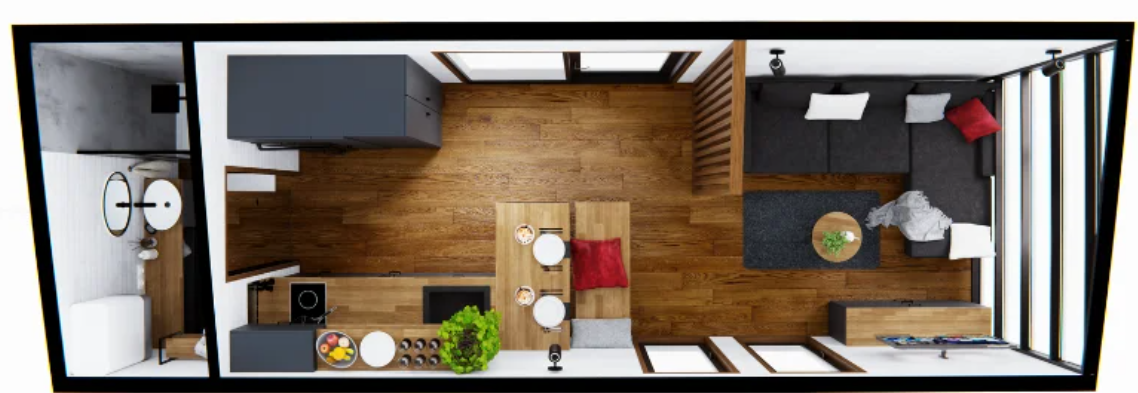
Our current plan is approximately 10 units, each suitable for one person or a couple, sourced directly from a manufacturer — likely in Eastern Europe — to keep costs down.
Ideally, we will acquire nearby land in future to expand staff housing capacity if required. We know the municipality looks favorable to this kind of arrangement.
(See the Iceland Property Register for land listings.)
Reykjavik off-site base
We have budgeted for the purchase of a building plot near Reykjavik — for example, in the Mosfellsbær area — with the intent to build a dedicated staff retreat. The concept: a purpose-built prefab house with approximately 10 small private rooms, shared bathrooms, and a well-equipped common area. Non-Icelandic employees would receive an allocation of roughly 8 days per month to use the facility on breaks.
At near-full utilisation, the property would comfortably pay for itself.
Our masterplan limits us to a maximum of 5,000 m² of built area — just 4% of the total site. Unroofed structures such as parking, roads, and pools are excluded from this calculation, which we consider a real advantage of Iceland’s planning regulations.
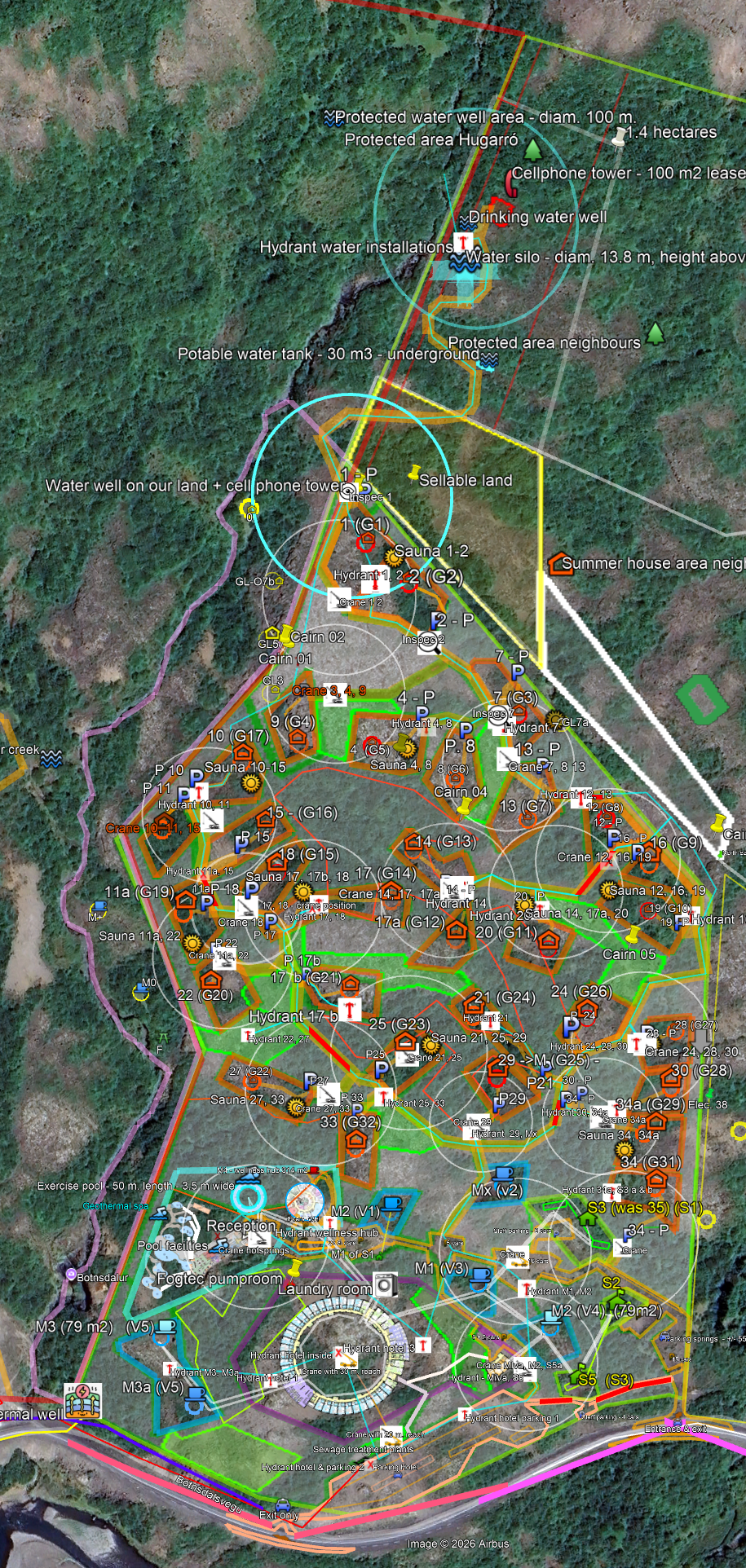
Mobile structures — including our planned staff housing on wheels, a containerized laundry, sewage treatment plant, watertanks, etc. — are not counted initially, but may be classified as permanent after two years, at which point we can relocate them. The ideal scenario: as demand for meetings and events grows, the spaces currently used for staff cabins become available for guest cabins, while staff accommodation moves to a nearby property within walking or cycling distance.
Why this voluntary limit?
Staying within 5,000 m² allows us to avoid the mandatory environmental impact assessment (EIA). We are confident we would pass such a study, but it could might add some extra time to the permit process and of course add additional consulting costs.
Our consultants at ELFA recommended we start within this 5,000 m² envelope. If, after a year or two of operation, we need more capacity, we will be well-placed to support the required EIA with a demonstrated track record of responsible, low-impact management.
Update August 28:
In consultation with the municipality and our EFLA consultants, we have decided to ask the Planning Ministry whether an EIA is required — proactively, rather than risk complaints that we stayed just under the threshold to avoid scrutiny. We are confident we will pass with flying colors, and full transparency now will also make it easier to add building capacity in the future.
A preliminary concept for discussion — financial modelling in progress
The concept
We are exploring a cabin leaseback structure as a complementary financing mechanism for the project. Under this model, individual investors purchase a cabin (the building), while we retain ownership of the land. Investors then lease the cabin back to our management company, which operates it commercially as part of the wider resort. Investors receive a revenue share; we retain full operational control.
This is not a new idea. It has been tried, tested and refined across Europe for over 70 years.
The Landal precedent
Landal GreenParcs — founded in the Netherlands in 1954 — is the clearest proof of concept. It pioneered precisely this model: private investors own individual holiday cabins; the park operator manages all bookings, pricing, maintenance and guest experience on their behalf. Today (following its 2024 merger with Roompot), Landal operates 260+ parks across 9 countries, with around 23,000 holiday accommodations and 6 million guests per year.
The model works because the operator controls everything that matters — design standards, pricing, brand, guest experience — while the investor holds a real, transferable asset with an income stream attached. Landal even added a dedicated real estate brokerage arm (Landal Makelaardij) to facilitate cabin resales within their parks, demonstrating how a healthy secondary market can be built around the concept.
Why Iceland — and why this project
A critical advantage here is that our cabins are situated on commercially licensed land in Hvalfjarðarsveit and may be rented out year-round, without restriction. This distinguishes our offering sharply from comparable vacation plots in Iceland — such as those sold near Hvammsvík in 2021, which are classified as frístundahúsalóðir (vacation home plots) and subject to Iceland’s homestay legislation, limiting short-term rental to 90 days per year. Year-round commercial operation means a materially larger income potential for investors — and a more resilient business model for the operator.
The legal framework
Icelandic property law is well-suited to this structure. Two mechanisms provide robust legal grounding:
1. Lóðarleigusamningur (Ground Lease)
Under Lög nr. 75/2008, investors hold a long-term lease over the cabin’s footprint. They can freely transfer or mortgage their lease rights and building without requiring the landowner’s consent. We retain the land — and with it, the zoning approval and planning permissions. No land subdivision is required.
2. Þinglýstar kvöðvar (Registered Covenants)
Rather than relying solely on contractual chain clauses, our obligations — brand standards, rental pool participation, access rights to shared facilities, maintenance charge obligations — are registered as real covenants at Þjóðskrá Íslands. These bind every future owner automatically. They run with the property, not just the original investor. This is the strongest possible form of operational control, embedded in property law rather than contract alone.
The net effect: investors get a clean, transferable asset with clear income rights; we retain full control over how the resort operates.
Ownership flexibility as a strategic tool
An important feature of the model is that our management company can buy cabins directly — either as an alternative to raising third-party investor capital, or by exercising a right of first refusal when early investors wish to exit. This creates meaningful strategic flexibility:
- Quick financing when needed: sell cabins to investors to raise capital for development phases.
- Consolidation when performance allows: buy cabins back over time as the business generates cash, shifting ownership back in-house.
- Investor confidence: a credible buyback mechanism makes the investment more liquid and lowers the perceived risk for initial investors — particularly important in what is still a niche secondary market.
This is a lever that traditional hotel development financing simply does not offer.
What comes next
This memo is deliberately high-level. For investors in the Hugarró project to consider this option in earnest, we need to complete a financial model that honestly compares:
- Projected investor returns (revenue share scenarios — base / expected / upside) under the leaseback model
- The cost of capital under this model vs. our current financing structure
- Sensitivity to occupancy rates, seasonal patterns, and operating costs
- The impact of ground rent (if any) and management fees on net investor yield
- Other external financing options in Iceland and elsewhere
The legal architecture is sound. The market precedent is strong. The next step is the numbers.
A strategic and philosophical essay on why less is, in every sense, more.
What Is a Landscape Hotel?
The term “landscape hotel” has been circulating in architectural and hospitality circles for over a decade, but it describes something timeless: a place where the building does not dominate the land — the land dominates the building.
A landscape hotel, as defined by the genre, is a type of accommodation designed to blend seamlessly into its surrounding environment, using sustainable materials and sensitive site planning to minimise ecological footprint. Unlike conventional hotels that alter or impose themselves upon a location, landscape hotels work with nature — preserving and amplifying the land’s natural character while enhancing the guest experience through immersion rather than distraction. 2
The genre arguably began in earnest with Juvet Landscape Hotel in Norway’s Valldal valley — famously used as the setting for the 2015 film Ex Machina — where glass-walled cabins are positioned in the forest to frame views of fjords and wilderness while maintaining minimal disturbance to the surroundings. 2
More recently, Piaule in New York’s Catskill Mountains brought the concept to North America: 24 prefabricated cabins on 50 wooded acres, each with floor-to-ceiling glass and almost nothing inside to compete with the view — and rates of $399 a night to match the philosophy. 5
The principles are consistent across the best examples:
| Principle | Application |
|---|---|
| Architectural integration | Design reflects natural topography; buildings blend rather than disrupt |
| Minimal environmental impact | Eco-friendly materials; structures elevated on piers to reduce ground disturbance |
| Sustainable energy | Passive heating/cooling, solar, geothermal, water-efficient fixtures |
| Immersive nature experiences | Floor-to-ceiling windows, outdoor decks, stargazing terraces |
| Small built footprint | Dispersed cabins across large sites preserve wilderness character |
Hugarró and Hvalfjörður: a perfect union of concept and place
Not every beautiful site is right for a landscape hotel. But Hugarró’s site at Litla-Botnsland in Hvalfjörður — Iceland’s dramatic Whale Fjord, roughly 55 minutes north of Reykjavik — is as well-suited to this concept as any location in Europe.
Hvalfjörður is 30 kilometres long, up to 5 kilometres wide and reaches 84 metres at its deepest. It is flanked by volcanic mountains, dense with seasonal greenery, and home to Glymur, Iceland’s second-highest waterfall. 7
It is, in the words of multiple travel writers, one of Iceland’s hidden gems — a word that matters enormously in today’s experience-driven travel economy. 9
Hugarró’s design philosophy is built directly around this landscape. Rather than imposing a resort on the land, the team has allowed the natural slope, existing tree cover, fjord views and site character to guide every design decision. Buildings are planned to be low-impact, carefully positioned and visually integrated into the hillside. Where possible, topography and vegetation will provide privacy, shelter and calm — without relying on heavy structures.
This approach is not merely aesthetic — it is ideological. Hugarró explicitly references the European Landscape Convention, which recognises landscape as more than scenery: it is part of local identity, ecological quality and human well-being. At Hugarró, the built environment is designed to remain secondary to the land itself.
The practical choices reinforce this:
- Only ~4% of the site will be built upon, leaving the vast majority of the land untouched and protected. 31 guest cabins will be spaced 25–80 metres apart, each privately sited within the landscape, with the ability to electrically rotate toward the guest’s preferred view.
- The hotel building itself consists of 48 prefabricated modules manufactured in Europe, drastically reducing on-site construction activity, noise, soil disturbance and traffic during the build phase.
- Outdoor lighting will follow strict dark-sky principles — shielded, downward-directed, warm-temperature fixtures — to preserve the night landscape for both guests and wildlife. A closed-loop geothermal system will power the seven hot spring pools, with 90%+ water reuse and heat recovery feeding building heating, hot water and road de-icing.
The ambition, stated plainly on the project’s own pages, is not simply to build a resort: “It is to create a first-class hospitality destination that protects and restores nature, contributes to the local economy and helps guests develop a deeper connection with Iceland’s extraordinary landscape.”
The market: why the world is ready for this
The timing for a project like Hugarró could not be more favourable. Several powerful market trends are converging precisely in the segment it targets.
1. Wellness Tourism Is Booming
The global wellness tourism market was valued at approximately $1.03 trillion in 2025 and is projected to reach $2.19 trillion by 2035, growing at a CAGR of roughly 7.8%. 10
This is no longer a niche. Wellness travel has expanded well beyond high-net-worth consumers and into aspirational middle-class travellers across multiple price points. 11
2. Eco-luxury is the direction of luxury travel
The global luxury hotel market was valued at $170.77 billion in 2025 and is forecast to grow to $416.5 billion by 2034. 12
</kcite> Within that market, 53% of guests now prefer eco-luxury hotels and 61% are influenced primarily by immersive, experiential stays. 13
</kcite> These are not marginal preferences — they are the defining characteristics of the dominant luxury traveller cohort.
3. Iceland draws high-value visitors in sustained numbers
Iceland welcomed 2.3 million international visitors in 2025, with foreign hotel overnight stays increasing 8.9% year-on-year. 6
</kcite> Average hotel occupancy across the country reached 67.2% for the year. 6
The top source markets — the USA (31.4%), the UK (12.3%) and Germany (8.4%) 6 — are precisely those countries with the highest concentration of eco-conscious, experience-seeking luxury travellers with both the means and the motivation to seek out a destination like Hugarró.
4. Proximity to Reykjavik without the Reykjavik crowd
Hvalfjörður sits less than an hour’s drive from the capital. This proximity unlocks a significant secondary market — high-value urban escapists seeking a genuine nature immersion without a long-haul flight or multi-day journey. This is increasingly how premium short-break travel works: guests fly into a capital, and detour for a night or two to something truly different. Hugarró is positioned perfectly for that pattern.
Community benefits: tourism that gives more than it takes
One of the most persistent criticisms of luxury resort development in sensitive natural areas is that it extracts value from a place while leaving the surrounding community largely unchanged — or worse, displaced. Landscape hotel design, done properly, inverts this dynamic.
Economic benefits
Rural tourism stimulates cooperation and partnership between local communities, improving employment opportunities, local income, entrepreneurial opportunity and local tax revenue. 4
Hugarró directly creates employment in accommodation, guiding, food production and a range of ancillary services.
Infrastructure investment
The project will improve local infrastructure beyond the hotel itself: guaranteed geothermal hot water access for the surrounding community and improved high-speed internet connectivity for local residents and businesses.
In a remote fjord community, these are genuinely meaningful contributions.
Safety and accessibility
With Glymur waterfall attracting increasing numbers of hikers to a remote and sometimes hazardous trail, the permanent staffing presence at Hugarró provides an additional layer of emergency response capacity that simply does not exist in the area today. 1
</kcite>
Cultural revitalisation
The opening of the Hvalfjörður Tunnel in 1998 effectively bypassed the fjord, causing a slow erosion of the small roadside communities that once served travellers making the longer coastal journey. Hugarró’s arrival at Litla-Botnsland will restore a genuine service hub to a location that historically anchored community life in the area — not as a nostalgic recreation, but as a modern, upgraded version of what once existed.
Conservation as community value
Beyond economics, rural tourism has been shown to generate environmental benefits: improved natural conservation, biodiversity protection, enhanced environmental awareness and infrastructure improvements that serve both residents and wildlife. 4
Hugarró’s commitment to restoring birch forest cover to 100% of its current extent — and the use of conservation funding generated by entrance fees, permits and concession arrangements — means the surrounding landscape will leave this project better than it found it. 3
The financial case: cost-benefit analysis
Cost advantages of the landscape hotel model
The landscape hotel model, particularly when combined with modular construction, carries structural cost advantages over conventional hotel development:
| Factor | Conventional Hotel | Landscape Hotel (Modular) |
|---|---|---|
| Per-key construction cost | High (complex structure, high material volume) | Lower — reduced footprint, fewer materials, efficient systems |
| Construction timeline | 18–36 months on-site | Compressed — off-site fabrication runs in parallel with site prep |
| Site disturbance | Significant | Minimal — shorter on-site window, fewer vehicle movements |
| Operational energy cost | Standard grid or conventional heating | Geothermal/renewable; 10–30% operational cost savings projected |
| Maintenance complexity | High — large, complex building systems | Lower — standardised modular systems, smaller spaces |
| Staffing model | Full-service, labour-intensive | Lean, efficient — lower housekeeping and maintenance overheads |
Modular construction also delivers predictable pricing and consistent quality control — critical advantages in Iceland’s environment, where on-site labour shortages and challenging weather conditions can cause severe cost overruns in traditional builds.
Revenue advantages
Landscape hotels occupy a premium pricing tier that conventional hotels in the same geography cannot access. The experiential rarity of the product — rotating cabins in an Icelandic fjord, geothermal pools fed by the earth itself, no light pollution, direct access to a waterfall hike — commands average daily rates (ADRs) that are structurally higher than comparably rated conventional product. This ADR premium, combined with the lean operating model, creates attractive unit economics.
Hugarró’s financial projections target 52% occupancy in Year 1, with individual cabins and hotel rooms sold to investors under a leaseback model generating estimated annual returns of 7–11%. 3
Sustainability as a commercial advantage
Sustainability certifications — BREEAM, Nordic Swan, GreenKey, EarthCheck — have moved from reputational bonuses to booking-decision factors. With 49% of luxury hotel guests now actively seeking eco-certified properties when booking, 8 these certifications are a direct driver of occupancy, not merely a marketing badge.
Furthermore, Hugarró’s geothermal energy system and ultra-efficient water filtration (90%+ water reuse, no chemical treatment) translate directly into lower operating costs — a competitive moat that conventional hotels simply cannot replicate without starting over from the ground up.
Conclusion: architecture in service of something larger
Landscape hotel design is not a trend. It is a correction — a return to the idea that great hospitality should enhance a place rather than consume it. The best landscape hotels feel inevitable: you cannot imagine the site without them, and yet you can barely see them when you arrive.
Hvalfjörður has waited quietly for the right project. A fjord of this beauty, this proximity to a major international hub, and this richness of natural and cultural heritage deserves something more thoughtful than a standard hotel block. Hugarró’s landscape-led design — with its dispersed cabins, rotating views, geothermal soul and commitment to restoring the land — is precisely the right answer to what this extraordinary place is asking for.
The market is ready. The site is ready. And the model works.
Hugarró Nature Retreat is in development at Litla-Botnsland, Hvalfjörður, Iceland. The project is designed by Studio SKA and targets opening in early 2028.
A property management system (PMS) is software that facilitates a hotel’s reservation management and administrative tasks. The most important functions include front-desk operations, reservations, channel management, housekeeping, rate and occupancy management, and payment processing.

To read more about the need for and advantages of a PMS, see this link.
 The best PMS systems are ranked on the very informative website of Hotel TechReport: check the list here.
We don’t use any of them 😊. Not because they are not good but most of them (for instance MEWS from the Netherlands) are not supported in Iceland. This seems to have to do with the fact that Iceland is member of the
European Free Trade Association (EFTA) but not of the EU and has its own currency.
Update December 2026:
We are currently leaning towards StayNTouch but our techstack will be determined in consultation with Provision-Partners, a company of which Daniel a consulting partner and European rep.
Luxury in Practice — The Details That Actually Make a Difference
We recently updated our Luxury page with a clearer explanation of what luxury means to us at Hugarró. The short version: it’s not about gold taps. It’s about a stay that is calm, effortless, and restorative.
But talk is easy. So let’s get specific.
Over years of travelling and staying in hotels — good ones, average ones, and a few that deserved better reviews than they got — a pattern emerges. The stays that linger in your memory aren’t defined by the grandeur of the lobby. They’re defined by a hundred small things that either worked or didn’t. Here’s our take on what “working” actually looks like.
🛏️ The bedroom — Where rest begins
When you get up in the middle of the night, you shouldn’t have to fumble for a light switch. A discreet red LED strip beneath the bed activates the moment your feet touch the floor — low light, the right colour temperature, just enough to find your way. The bathroom light follows the same logic: it comes on softly, not at full blast.
Sleep itself matters too. Beds should be genuinely comfortable — not just described that way. We offer a pillow menu and let guests indicate their mattress firmness preference at the time of booking. Not everyone sleeps the same way, and that’s fine.
Privacy goes without saying — or it should. Rooms are positioned and designed so that nobody outside can look in.
🚿 The bathroom — A room in its own right
The bathroom is soundproofed from the main room. If your travel companion keeps different hours, that’s their business.
Toilets have a bidet function. Once you’ve had one, going back feels like a step backwards.
Showers have somewhere to put your own things — your shampoo, your conditioner, whatever you’ve brought. A simple shelf. You’d think this was standard. It isn’t.
🧹 Cleanliness — The Baseline That Can’t Slip
The place is spotless. Full stop.
We’d also add: no strange smells in changing rooms or locker areas. Ever. That one’s non-negotiable and more commonly neglected than it should be.
⚠️ Safety — The airline mindset
Some geothermal destinations have pool pathways that are genuinely hazardous in winter — slippery surfaces, steep edges, poor lighting. That is not a design quirk; it’s a liability and, more importantly, a risk to people.
We take a simple principle from aviation: if you think safety costs money, wait until you price an accident. Every pathway, every pool edge, every walkway on the property is designed and maintained with this in mind.
Pathways are kept ice-free at all times. Roads with above-average inclines are cleared of snow and ice — always. Motion-activated lighting along all routes is effective but unobtrusive. You’re guided without being spotlit.
🥾 The outdoors — Ready when you are
“I’m thinking of going for a hike. Where should I go?”
Here’s a printed map with suggested routes. Scan this QR code and load them directly into your hiking app of choice. Want a packed lunch? Give us 20 minutes. Need a rain poncho just in case? We have a few — borrow one.
When you get back, there’s a drying room where your wet gear can dry properly overnight. Complimentary slippers are waiting.
🌊 The pools — All year round
Food and drink can be ordered at all the pools. You shouldn’t have to get out just because you’re thirsty.
In winter — which in Iceland means wind, snow, and occasionally full horizontal rain — glass barriers mean you can sit in a geothermal pool and enjoy the landscape without being battered by it. We keep complimentary beanies on hand, because your head isn’t in the water. And waterproof phone pouches too, because the views are worth photographing and we want you to share them.
Private pools can be arranged on request.
🚗 The Car
“My car is filthy.”
We have a cleaning station at the entrance to the car park. Prefer someone else handles it? We can arrange that too.
🪧 Getting around the property
Signage is discrete but effective. You won’t feel like you’re navigating a theme park, but you also won’t get lost.
👥 The people — staff and guests
Our staff smiles — genuinely, not as a performance requirement. More importantly, they have the authority to resolve issues on the spot. No “I’ll need to check with management.” They just fix it.
They also speak your language in a way you can actually understand. Clear communication is part of the service.
On the guest side: we don’t allow loud, disruptive children. We know this is a commercial decision as much as a design one, and we’re comfortable with it. Hugarró is a place for people who came to rest.
♿ Accessibility — No caveats
Accessibility at Hugarró is not a box-ticking exercise. Every inch of the property is designed with full ADA compliance in mind (including some pools), and our staff are trained — properly trained — on how to support guests with disabilities in a way that is helpful without being patronising.
This connects to something we believe firmly: our staff are our most important asset. Guests feel that, or they don’t. There’s no faking it.
What Would You Add?
This list came from real experience — hotels that got it right and ones that quietly got it wrong. We’re building Hugarró around the former, and we genuinely want to know: what’s missing from this list?
What’s the detail that made a stay memorable for you — or the small thing that quietly ruined it? Let us know in the comments below.
Where it started for us
In 2011, Icelandic geographer Gunnthóra Ólafsdóttir published a paper that would inspire the direction of our founder’s thinking. Her work — Practicing Nature-Based Tourism: Introduction, published in the academic journal Landabréfið — was not a market report or a business case. It was something more fundamental: a rigorous examination of why human beings feel compelled to seek out nature, and what actually happens to us when we do.
Her argument was simple but important. Nature-based tourism, she wrote, feeds “the perceived need to undertake an exodus from the everyday in order to be in nature” — a deeply rooted belief in the “therapeutic and regenerative agency of nature” for people whose lives have become tiring and stressful. Tourism, she argued, is not merely a product or a commercial transaction. At its best, it is “a creative, contextual, embodied practice” — one that creates a genuine sense of self, of place, and of connection.
That paper was the catalyst. It pointed our founder towards Iceland, and towards a question worth building a business around: what if we took this idea seriously?
More than a label
“Nature-based tourism” has become a catch-all — used to describe everything from five-star safari lodges to crowded waterfall selfie queues. The label alone means very little.
What we mean by it is closer to what Ólafsdóttir described: an experience that is embodied. One that engages all the senses. One where the most memorable moments are, as Icelandic architect and tour guide Hildigunnur Sverrisdóttir observed in her own research, “not tied to any pre-established must-sees or dos but to something completely random, simple and unforeseen.” The smell of moss after rain. The silence of a fjord at dusk. Standing at the base of a 198-metre waterfall and feeling very, very small.
That is what we are designing for.
The science behind the pull
The appeal of nature is not sentimental. It is physiological and psychological — and the evidence has been building for decades.
Research consistently demonstrates that contact with nature measurably reduces stress, anxiety, and depression. A landmark 2024 meta-analysis of 449 peer-reviewed studies, published in Nature Cities, quantified the mental health benefits of nature exposure across multiple outcome measures. Studies cited in the Environments special issue on nature-based tourism (Green, Croft & Wolf, 2019) confirm that tourism, planning, and psychological research “all find an important relationship between nature-based experiences and the physical and psychological well-being of participants.” Research from King’s College London has found that the risk of developing depression or anxiety is 71% lower among urban dwellers who live near green spaces — and that benefits extend to everyday, brief encounters with biodiverse nature. 1
The minimum threshold for detectable mental health benefit from nature exposure is approximately two hours per week. 5 This is not a luxury product. It is a response to a documented human need.
In an increasingly screen-saturated, urbanised world, that need is only growing. As Green, Croft and Wolf put it in their 2019 environmental impact study: “In a fractious world, where anxiety mounts as an irreversible tipping point to habitable climate change approaches, the calm of nature will be increasingly important.”
The market is responding
Traveller behaviour reflects this shift. The global nature-based tourism market was valued at approximately $600 billion in 2024 and is projected to reach $1.2 trillion by 2033, growing at a CAGR of 8.2%. 4 Of the 1.8 billion international tourist arrivals recorded in 2024, approximately 42% engaged in nature-related activities — wildlife tourism, ecotourism, and adventure travel. 2
Demand is particularly strong among younger travellers: 78% of millennials actively prefer destinations that feature natural landscapes, and 65% of global travellers now prioritise sustainable travel options when making decisions. 2
This is a structural shift, not a post-pandemic bounce. The direction of travel is clear.
An honest tension
We believe in being direct about what nature-based tourism can also get wrong.
Natural habitats are under pressure precisely because more people want to visit them. Research specifically examining Iceland’s vegetation — published in Environments (Runnström et al., 2019) — found that experimental trampling caused significant damage, particularly in highland areas and in moss and heath communities. The study recommends concentrating visitor trails in lowland grassland where resilience is higher. Iceland’s most popular sites already show the strain.
Traditional tourism on Iceland, as our own website acknowledges, “doesn’t have a very good track record when it comes to the environment.” Overcrowded trails, unmanaged visitor flows, and short-term commercial thinking are real problems — and they are precisely what distinguishes responsible operators from the rest.
The challenge, as Green, Croft and Wolf concluded in their research, is to “take visitors down the sustainable and gentle path of communing with nature and to leave the conquest of nature to an ignorant past.” We take that seriously.
Iceland: the right place
Few countries are better positioned for responsible nature-based tourism than Iceland. Tourism accounted for 8.8% of Iceland’s GDP in 2025, up from 8.2% the year before — one of the highest tourism-to-GDP ratios in the world. 3 Revenue from foreign tourists reached 621.4 billion ISK (approximately $4.9 billion USD) in 2024, up 9% year-on-year. 6 Just under 2.3 million international visitors arrived in 2025. 7
The country’s appeal is obvious: dramatic, unspoiled landscapes, geothermal energy, the Northern Lights, and a culture that has always lived in close relationship with the natural world. But what makes Iceland genuinely special for nature-based hospitality is scarcity. There is a finite amount of truly wild, accessible landscape — and that scarcity is an asset for operators who position themselves correctly.
Our first property, Hugarró Nature Retreat, sits at the gateway to Glymur — Iceland’s second-tallest waterfall, dropping 198 metres into Botnsá, the main river in Botnsdalur leading ot the Hvalfjörður fjord, just an hour from Reykjavík. Accessible only on foot, Glymur is one of Iceland’s most visited natural landmarks. The guests who make that hike are precisely the engaged, nature-motivated travellers our model is built for.
This is also, we should note, the country where Gunnthóra Ólafsdóttir’s academic conference on Practicing Nature-Based Tourism took place in 2011. Iceland has been a serious intellectual home for this conversation for a long time. We feel we belong in it.
How we do it differently
Following the nature-based tourism standards of Preferred by Nature, and inspired by the principles in Ólafsdóttir’s research, we have built our approach around a few commitments that inform every operational decision:
- Keep it small. A maximum of 32 rooms plus 31 intimate cabin, merged into the landscape. The environment is never overwhelmed, and the guest experience remains genuine.
- Protect the landscape. Fencing birch forest areas to allow natural regeneration; co-funding trail improvements near Glymur to manage visitor flow responsibly — applying the very recommendations made by Icelandic trampling research.
- Be honest about impact. Monitoring, measuring, and publishing our environmental footprint. Guests deserve to know, and so do investors.
- Invest in people. Affordable staff housing, real career development, and genuine integration with local communities — because, as Lucy Lippard argued at the 2011 Reykjavík conference, tourism that denigrates the communities it builds its attraction on is “simply wrong.”
- Design for depth, not throughput. Educating guests about Iceland’s ecology, geology, history, and culture. Leaving room for the unplanned moments that Sverrisdóttir identified as the most meaningful of all.
The financial case
Genuine nature-based hospitality is not a trade-off against financial performance. It is the basis for it.
Responsibly operated eco-lodges and nature retreats command 10–20% premium ADRs over conventional competitors, with some studies finding guests willing to pay up to 34% more for certified sustainable accommodation. Renewable energy and efficient design deliver 10–30% savings on operating costs compared to conventional builds. And ESG-aligned operators increasingly access capital on preferential terms — global ESG assets have surpassed $41 trillion, with institutional capital continuing to flow toward businesses with credible, measurable sustainability commitments.
More fundamentally: a location people genuinely want to visit, an experience that delivers what it promises, and an operation that takes its environmental responsibilities seriously — that combination produces loyal guests, strong reviews, high repeat intent, and a business worth investing in for the long term.
We believe the market is catching up to what the science has always known. Nature is good for people. And people who are good for nature build better businesses.
More than a certificate
Being green isn’t a box we tick. It’s not a plaque on the wall or a logo in the footer. For us, it’s a philosophy — a way of thinking about every decision we make, from how we design a building to how we source materials, employ staff, and engage guests.
Most sustainability conversations in hospitality start and end with reduce, reuse, recycle. We respect that, but we’re aiming higher. As an aspiring B-Corp, we’ve set ourselves a more ambitious standard: regenerative hospitality — not just doing less harm, but actively making things better.
What regenerative hospitality means
The difference between sustainable and regenerative is the difference between minimising damage and creating genuine value — for the land, the local community, and future generations.
At our first project, near Iceland’s Glymur waterfall, that means:
- Restoring native nature — planting trees and protecting the existing birch forest by fencing it off from roaming sheep that have long prevented its recovery.
- Improving public access — co-funding safer trails to the Glymur waterfall, one of Iceland’s most visited natural landmarks.
- Sharing knowledge — educating guests about the history, culture, and ecology of the area, turning a visit into a deeper connection.
- Investing in people — providing affordable, quality housing for staff, and creating real career development opportunities.
Our goal is simple: demonstrate that a responsible hospitality operation can have a negligible negative impact on its environment — and a meaningful positive one.
The Market Is Telling Us Something
This isn’t just an ethical stance. The numbers are clear.
Traveler attitudes have shifted dramatically. 84% of global travelers say sustainability is important when planning a trip, and 93% say they want to make more sustainable choices — and increasingly, they’re acting on it. 1 The share of travelers actively seeking sustainable accommodation has climbed from 62% in 2016 to around 81% today. 1
And this translates directly into revenue. Travelers are willing to pay 12–20% more for accommodations they trust to be environmentally responsible. 1 Eco-certified hotels report up to 28% higher booking rates compared to non-certified competitors. 1
Broad “green” marketing claims no longer cut it. Today’s guests are informed and discerning — they want to know specifically how their choice of accommodation makes a difference. That’s why we back every commitment with action, certification, and transparency.
The financial case for going green
The link between genuine sustainability and financial performance is well established. NYU Stern’s Center for Sustainable Business has found positive correlations between strong ESG performance and operational efficiencies, stock performance, and a lower cost of capital. 2 Global ESG assets surpassed $41 trillion in 2022 and are expected to exceed $50 trillion — a clear signal that institutional capital is moving toward businesses that take these commitments seriously. 3
For us, the logic is straightforward: a genuine sustainability commitment drives pricing power, higher occupancy, stronger guest loyalty, and preferential access to impact-aligned capital. It’s not a trade-off between doing good and performing well — it’s the same thing.
Our commitment
At Hugarró, sustainability is built into our model from the ground up — not retrofitted. Our properties are small by design (a maximum of 32 rooms and 31 intimate free-standing cabins, all merged into the natural landscape, built using biobased and recyclable materials, powered by renewable energy, and certified to internationally recognised standards including GreenKey, EarthCheck, BREEAM, and LEED Gold. We also aim for Global Ecosphere Retreat (GER) certification from The Long Run, which is among the most rigorous sustainability benchmarks in travel.
We’re not perfect — no operation is. But we believe that honest effort, measurable outcomes, and genuine transparency are what build lasting trust with guests, communities, and investors alike.
Being green isn’t our marketing strategy. It’s how we run the business.
Modular prefabricated construction is not simply a preference for Hugarró — it is the only construction approach that realistically reconciles the constraints we face: a chronic shortage of qualified local labour, volatile Icelandic weather, strict nature conservation rules that limit our on-site construction window, and the imperative to deliver a high-quality hospitality product on time and within budget. Every element of our build strategy has been designed around these realities.
The Icelandic imperative: why prefab is not optional
Building in a remote Icelandic location presents a set of compounding challenges that traditional in-situ construction simply cannot absorb:
- Labour scarcity and cost. Qualified construction tradespeople are in chronic short supply across Iceland. Where they exist, they are expensive and often not reliably available for remote sites. Foreign workers already account for roughly a quarter of Iceland’s entire workforce, reflecting how deep this structural gap runs.
- Weather exposure. Iceland’s wind, rain, frost, and rapidly shifting conditions make conventional on-site construction slow, unpredictable, and costly. Delays compound.
- Remote location. Mobilising and maintaining a large, multi-trade workforce on a remote site over many months is logistically complex and expensive.
Our strategy was therefore to out-design the dependency on local labour to an absolute minimum and to transfer as much of the construction process as possible to a controlled factory environment, where weather is irrelevant and quality is consistent.
There are no Icelandic companies that can deliver the combination of cost-effectiveness, precision, and relevant experience that we find in leading Central and Eastern European manufacturers. Most comparable projects currently operating in Iceland also use prefab units sourced from continental Europe — with varying degrees of success. We have been deliberate and thorough in our supplier selection.
The Birding Season: Our Construction Window Is Fixed
Iceland’s nature conservation legislation imposes strict seasonal access restrictions on ecologically sensitive sites — including the area around Hugarró. Nesting bird protection periods effectively close the site to significant construction activity from approximately May through August. This is a hard regulatory constraint, not a planning preference.
This means our window for on-site module placement activities runs roughly from September through April — Iceland’s most demanding months in terms of weather. The implications are significant:
- There is no flexibility to slide the programme into summer if something runs late
- A missed placement window means a minimum one-year delay to project opening
- Every unnecessary day of on-site activity is a day of unnecessary exposure to cost and risk
Modular prefab directly resolves this constraint. Module fabrication proceeds in the factory regardless of season, while site preparation and foundations are completed in Iceland in parallel. When the placement window opens, the modules are ready. The actual on-site placement operation is compressed into weeks, not months — well within the available window.
Factory & site: two workstreams running in parallel
One of the most powerful and often underappreciated advantages of modular construction is that factory fabrication and on-site civil works run simultaneously. While DMD Modular is manufacturing and fitting out the building modules in their Polish factory — including all interior fit-out, utilities installation, and quality testing — our team in Iceland is completing groundworks, foundations, and infrastructure. Neither stream waits for the other.
By the time the modules arrive on site, the ground is ready to receive them. This parallel working eliminates the sequential delays of traditional construction, where each phase must wait for the previous one to complete.
Our manufacturing partner: DMD Modular
Our modules are to be manufactured by DMD Modular, a leading Polish volumetric modular building company operating across Europe since 2016. Their portfolio includes hospitality, hotel, resort, residential, healthcare, and student accommodation projects in the UK, the Netherlands, Denmark, Belgium, Germany, and Iceland — making them one of the few manufacturers with direct Icelandic market experience and they came highly recommended by local hoteliers.
Relevant completed projects include a Hampton by Hilton (Bristol), a resort hotel extension (Belgium), Iceland’s Panorama Glass Lodge and multiple large-scale student accommodation schemes in Edinburgh and Copenhagen. DMD Modular operates under ISO-certified quality assurance processes and full compliance with European construction standards — including country-specific fire, acoustic, and structural requirements.
Factory-controlled production delivers measurably lower defect rates, superior thermal performance, and more predictable long-term operating costs compared to in-situ construction — all directly relevant to a 4-star nature retreat where post-opening remediation would be both costly and reputationally damaging.
Critically for our programme, DMD Modular will supply their own specialist installation crews to assist with on-site module placement. This eliminates our dependency on Iceland’s scarce and expensive local construction labour market for the most skilled and time-sensitive phase of the project.
The Logistics Chain
Our hotel consists of 48 modules in total. The cabin units are each made up of two halves. All modules will be transported by a specially chartered vessels sailing from a Polish seaport — a significantly more cost-effective and flexible option than standard ro-ro scheduled shipping services, and one that gives us full control over timing relative to our placement window.

Primary route — Port of Grundartangi:
The vessel docks at Grundartangi, approximately 30 minutes from site over ring-road quality infrastructure. Crucially, this stretch of the ring road is exceptionally quiet — carrying a maximum of approximately 30 vehicles per hour — meaning wide-load module convoys can move without traffic conflict, without night-time-only restrictions, and without the logistical complications that plague similar operations in more congested corridors through Reykjavik. Our team’s experience in maritime logistics is a further practical asset in coordinating this chain.

Alternative route — Nearby whaling station dock:
We are also considering to approach the owner of a whaling station with dock facilities located less than 10 minutes from the Hugarró site. If draft depth clearance is confirmed through a hydrographic survey, this option would reduce the road transport leg to a minimum and deliver meaningful additional cost and time savings. This remains an upside scenario under active development.
Crane strategy & module placement
The on-site placement of 48 modules has been planned around a tightly optimised mobile crane strategy designed to minimise crane repositioning — the single most expensive variable in the placement phase.
- Two crane positions cover the full placement of all 48 hotel modules.
- Each position allows the placement of an average of 2 cabins without repositioning
- Crane repositioning between the two positions is a single, planned move
This approach compresses what could otherwise be a lengthy, expensive, and ground-disturbing operation into a lean, efficient sequence — minimising both cost and the physical footprint of heavy machinery on ecologically sensitive terrain.
Time savings at a glance
The combined effect of parallel workstreams, factory fabrication, and optimised on-site placement is a dramatic compression of the overall project schedule compared to any traditional in-situ approach.
| Phase | Traditional In-Situ Construction | Hugarró Modular Approach |
|---|---|---|
| Module / building fabrication | On site, sequential, weather-dependent | In factory, parallel to civil works, weather-independent |
| On-site building programme | 18–24+ months continuous site activity | 3 weeks (cabin placement) + 2 week (hotel module placement) |
| Weather risk to programme | High — delays compound across full duration | Minimal — confined to short placement window only |
| Birding season compatibility | Extremely difficult — multi-year site presence conflicts | Fully compatible — placement within available window |
| Labour dependency | Large, multi-trade, local workforce required throughout | Small specialist crew (manufacturer-supplied) for placement only |
| Quality assurance | Variable — field conditions, multiple subcontractors | ISO-certified factory QA, tested before delivery |
The practical summary: what would require 18 months or more of continuous on-site activity under a traditional build is reduced to a focused four-week placement operation, supported by months of factory production running in parallel and entirely outside Iceland’s weather and conservation constraints.
A practical guide to a meaningful upgrade
Why are you adding junior suites at all?
The answer lies in where luxury travel is heading. Across the high-end hospitality segment, the expectation has shifted: guests are no longer simply looking for a beautiful room — they want a genuine sense of space, a place to properly settle in rather than perch on the edge of a bed, and the feeling that their accommodation was designed with them specifically in mind. Junior suites have become a baseline expectation at properties positioning themselves in the upper tier of the market.
We looked carefully at what comparable Icelandic luxury properties offer and at broader trends in boutique hotel design, and the conclusion was clear: building junior suites into Hugarro from day one — rather than retrofitting them later — is simply the smarter way to open. Comparable properties like Hotel Rangá charge around €989 per night for a junior suite in high season; Blue Lagoon’s Retreat sits between €1,636 and €2,489 depending on view and season. There is clear, proven demand at that price point — and Hugarro is positioned to offer something genuinely competitive.
Why four suites — is that not too many for a 32-room hotel?
It’s the right number, and we thought carefully about it. Four suites represent just over 12% of our total inventory — enough to be a meaningful premium tier, not so many that scarcity disappears.
We’re placing two suites at each of two separate locations within the property. This allows us to:
- Create two distinct suite pairings with slightly different character and view angles, giving returning guests a reason to experience the other
- Spread the footprint across the property, so suite guests aren’t concentrated in one area
- Build in redundancy — if one pair is fully booked, the other may still be available
How do you create 39 m² suites — what’s the trade-off?
It’s a deliberate and transparent decision. Every three standard modules of 26 m² are reconfigured into two junior suites of 39 m². The middle module is divided equally between the two flanking rooms, giving each suite an additional 13 m² — enough space for a proper sitting area, a larger bathroom arrangement, and genuine breathing room.
The honest trade-off: four junior suites replace six standard rooms, meaning the overall room count reduces from 32 to 28 (net: two standard rooms fewer, across two locations of conversion). We consider this the right exchange — fewer rooms, but a meaningfully better product mix, stronger average revenue per room, and a clearer tiered offering for guests.
A 39 m² suite is comfortably within international junior suite norms, and the additional space transforms the in-room experience without requiring a different building type.
What will the junior suites actually look like?
The design details will be revealed closer to opening, but the guiding principle is that every square metre should be purposeful. Expect:
- A clearly defined sitting area — not a corner with a single armchair, but a proper space to decompress
- Enhanced bathroom — more generous layout, upgraded finishes, longer soak time
- Premium bedding and in-room features consistent with the upgrade price
- The same iconic Hvalfjörður fjord views that make Hugarro what it is — because the luxury here has always been outside the window, not in the square footage
What the junior suites will not be: a connecting door between two standard rooms dressed up as something it isn’t. That approach is a shortcut we ruled out. Guests at this level are discerning — they research, they read reviews, and they know the difference. The suites are designed as suites from day one.
How quickly can the suites be added — is there major construction involved?
None whatsoever. This is one of Hugarro’s genuine structural advantages: the hotel is built in a fully prefabricated, modular system. The junior suite modules are simply designed and specified differently from the outset — or slotted into the build sequence as a distinct module type. There is no retrofitting, no disruption to existing structures, and no phased construction headache. It’s the same process as adding any other room, just with a different configuration. The modular approach makes this kind of product differentiation not just possible, but straightforward.
How are the junior suites different from the freestanding rotating cabins?
They serve a fundamentally different guest. The junior suites sit within the main building — you have full access to the restaurant, lounge, and shared facilities while enjoying meaningfully more space and a more generous in-room experience. They’re the natural next step for guests who want a more expansive stay within the hotel itself.
The freestanding rotating cabins are a category of their own. At 55 m² / 590 sq ft, they offer:
- Complete physical separation from the main building — your own retreat, not an upgrade within one
- The rotating feature: the cabin turns to follow the sun, the aurora, or simply whichever view calls to you — a genuinely rare architectural experience found almost nowhere else in the world
- Maximum privacy: no shared corridors, no neighbours on the other side of a wall
- More space — 55 m² versus 39 m² is a meaningful difference when you’re settling in for several nights
The cabin is not just a bigger suite. It is a different kind of stay entirely.
What does each room type cost?
| Room Type | Size | Low Season (Oct–Apr) | High Season (May–Sep) | Notes |
|---|---|---|---|---|
| Standard Room | 26 m² / 280 sq ft | €420–€520 | €620–€780 | Double room, extra bed option, fjord view |
| Junior Suite | 39 m² / 420 sq ft | €680–€820 | €950–€1,150 | Sitting area, premium bath, priority booking |
| Rotating Cabin | 55 m² / 590 sq ft | €1,100–€1,350 | €1,600–€1,900 | Freestanding, rotating, ultimate privacy |
A few notes on how we arrived at these figures:
- The junior suite sits at roughly 1.5x the standard room rate — in line with what comparable Icelandic properties charge (Hotel Rangá’s junior suites start at approximately €989 per night in high season)
- The rotating cabin is priced at approximately 2.5–3x the standard room. This is not simply about size — it reflects uniqueness, total privacy, and an architectural concept that has no direct comparator in Iceland. Blue Lagoon’s top suites exceed €2,400 per night; our cabin rate is competitive without being aggressive
- All rates are room-only. Breakfast packages are available separately, giving guests flexibility while helping the kitchen plan
- A minimum 2-night stay applies to both junior suites and rotating cabins — this reflects the kind of stay these rooms are designed for, and ensures guests have enough time to genuinely experience them
Will you always be able to book a junior suite?
No — and that’s intentional. With only four suites in the property, availability is limited, particularly across the summer months and aurora season. We wouild recommend our guests booking well in advance.
Business objectives
First of all, to make best use of the available land, topography and tree coverage, we decided to build our circle hotel on the indicated place. This location means minimum loss of trees and trees lost will be mostly under 50 cm. Since we are building in what is a ‘protected area’, we really want to commit to low-impact building practices.
This location is also close to where we plan to build our parking space the location of which was choosen based on similar considerations.
In cooperation with our architects we then came to 48 modular units of which 29 will be guest rooms (drawing below is not totally up to date).

The law requires to also have 3 wheelchair accessible rooms. We decided – in close consulting with Sjálfsbjörg, the National Confederation of Physically Disabled People in Iceland – to create 2 wheelchair accessible guestrooms (WAG) in the hotel and 3 separate WAGs with their own parking. Thanks to the products of the Norwegian company Bano, we can create a compliant WAG in the existing hotel modules.
With 5 WAG’s in total we showcase our commitment to travelers with a disability and plan to actively pursue their business. They comprise of just over 10% of the traveling public and few hotels in Iceland will meet our standards of accessibility.
Between these guestrooms and the hotel entrance will be a heated pathway (to keep it snow free) as required by law.
Recommended link:
Accessible tourism (by Icelandic Tourist board)
Q: You run a high-end hotel. Surely you will use proven HR frameworks from leading international chains?
Not exactly — and here’s why that matters.
When building our performance review, onboarding, and training systems, the obvious move is to look at what major hotel brands do and borrow their playbook. It’s tempting. But it’s also a classic mistake: confusing best practice with best fit.
Q: What’s the difference?
Strategic HRM literature distinguishes two fundamentally different approaches:
| Approach | Logic | Assumption |
|---|---|---|
| Best practice (universalist) | A fixed set of high-performance work practices — pay-for-performance, extensive training, employee voice — that reliably improve outcomes everywhere | One size fits all |
| Best fit (contingency) | HR effectiveness depends entirely on context: your strategy, culture, market conditions, and workforce | Fit your HR to your organisation |
The best-practice model is popular because it’s simple and sounds reassuring. The problem? What works at a 500-room airport hotel with high turnover and standardised service doesn’t automatically translate to a boutique four-star property built around personalised guest experiences.
Q: So what did you actually do differently?
We built our HR approach around what fits us, not what looks good in a conference presentation.
- Annual appraisals → out. We replaced them with short, regular feedback conversations between managers and staff — better suited to the rhythm of a hotel where every day is different.
- Individual performance targets → out. We tied incentives to team goals: guest satisfaction scores and sustainability metrics, values that reflect our actual culture.
- Rigid frameworks → out. We kept only the elements that genuinely work in our context.
Q: Why does this matter for guests?
Because engaged, empowered staff deliver better experiences — consistently. We’re confident this approach drives higher guest satisfaction, lower staff turnover, and — most importantly — a real sense of ownership among our team.
Q: Isn’t this just reinventing the wheel?
No. It’s grounded in solid academic research. A strong fit between HR practices and organisational context consistently outperforms the adoption of fashionable frameworks.
“There is no one best way to manage people.”
> — Boxall & Purcell, Strategy and Human Resource Management
References
- Boxall, P., & Purcell, J. (2016). Strategy and Human Resource Management. Palgrave Macmillan.
- Delery, J.E., & Doty, D.H. (1996). Modes of theorizing in strategic human resource management. Academy of Management Journal, 39(4), 802–835.
- Paauwe, J. (2009). HRM and Performance. Journal of Management Studies, 46(1), 129–142.
Consumption in the tourism industry works differently than consumption in many other sectors. People look for fresh experiences, spectacular places and the beauty of the local area, instead of material possessionsor services.
Likewise, as in the world of fashion or food, rends are always influencing the consumption choices in tourism. For example,choosing a destination based on the places that are currently in fashion, looking for the most Instagrammable corners or the places whose offer best suits our tastes and interests; which is indeed a decisive factor.
Here are some of the main trends that are busy shaping the tourism industry and the way people travel. As you will most likely agree, Iceland is perfectly positioned to tap into these trends.
MATCH with the destination
If you have a predilection for nature, you are more likely to travel to a wooded or rural area, rather than to big cities or urban areas. If you prefer to enjoy active sports, you will probably travel to places where you can practice your hobbies: coastal areas for water sports, ski resorts in winter… In this way, it is a question of orienting the tourist offer to the target group.
ECO mentality
Increasingly, travellers are taking into account factors such as travelling to nearby destinations to reduce their carbon footprint or opting for accommodation with sustainability certifications.
Millennial values
The younger generations, who are now making up the tourism target, have grown up in an educational culture with a strong environmental component and social struggle, giving importance to values that until now were not very present in the tourism industry, such as social integration and inclusion, the importance of the local, sustainability, among others.
Post-pandemic ecosystem
Covid-19 has left its mark on the tourism sector and is generating new trends, mostly related to alternatives to mass tourism, the discovery of new places with little influence from the tourism industry and respect for the destination’s environment, its identity and resources.
Public Concern for the Environment is Growing
Recent reports about climate change, together with the news about floods and fires, is raising social concern about this issue.
You yourself are probably already taking some measures to reduce your own
ecological footprint in your every-day life; recycling, driving an electric car or using cloth shopping bags are some of the most popular examples for people to express their environmental concerns.
However, are you keeping up with this responsible behaviour when on holiday?
Studies show that many people consider their holidays to be a time and place torelax and to forget about their environmental responsibilities, seeing them as time-consuming and a burden, assuming that companies should be the ones to ensure they are fulfilled instead.
This trend is shown by the results of the most recent surveys of booking portals, where most of the travellers prefer to choose “eco” options in order to feel fulfilled and happy in this respect, as long as these do not entail additional costs or responsibilities of any kind.
New generations are moving from “seeing” to “experiencing”
In modern-day tourism, a very visible trend is that the focus has shifted from “seeing” to “experiencing”. The main focus of tourism is not on physical high-lights, museums and monuments anymore, but on intangible elements such as culture, atmosphere and lifestyle.
One group playing a big role in this shift of trends is Generation Y (or Millennials) who are now between the ages of 25-35.
And we must be aware of their trends, as these are the present and future generations of the tourism sector and of society in general.
Do you know what their preferences are?
- Investing in experiences rather than material possessions.
- Investing in the present rather than saving for the future.
- Seeing travel as a priority and as a way of discovering the world and themselves.
- Young people give more importance than previous generations on environmental care, inclusiveness and social advocacy.
All in all important trends to consider as a hospitality provider.
BREEAM aims to promote buildings that are environmentally, socially, and economically sustainable, enhancing the well-being of the people who live and work in them while minimizing their environmental impact.
Recommended links:
What is BREEM and why is it important?
BREEAM Version 7 to focus on hotels and net zero carbon
Design
A strategic and philosophical essay on why less is, in every sense, more.
What Is a Landscape Hotel?
The term “landscape hotel” has been circulating in architectural and hospitality circles for over a decade, but it describes something timeless: a place where the building does not dominate the land — the land dominates the building.
A landscape hotel, as defined by the genre, is a type of accommodation designed to blend seamlessly into its surrounding environment, using sustainable materials and sensitive site planning to minimise ecological footprint. Unlike conventional hotels that alter or impose themselves upon a location, landscape hotels work with nature — preserving and amplifying the land’s natural character while enhancing the guest experience through immersion rather than distraction. 2
The genre arguably began in earnest with Juvet Landscape Hotel in Norway’s Valldal valley — famously used as the setting for the 2015 film Ex Machina — where glass-walled cabins are positioned in the forest to frame views of fjords and wilderness while maintaining minimal disturbance to the surroundings. 2
More recently, Piaule in New York’s Catskill Mountains brought the concept to North America: 24 prefabricated cabins on 50 wooded acres, each with floor-to-ceiling glass and almost nothing inside to compete with the view — and rates of $399 a night to match the philosophy. 5
The principles are consistent across the best examples:
| Principle | Application |
|---|---|
| Architectural integration | Design reflects natural topography; buildings blend rather than disrupt |
| Minimal environmental impact | Eco-friendly materials; structures elevated on piers to reduce ground disturbance |
| Sustainable energy | Passive heating/cooling, solar, geothermal, water-efficient fixtures |
| Immersive nature experiences | Floor-to-ceiling windows, outdoor decks, stargazing terraces |
| Small built footprint | Dispersed cabins across large sites preserve wilderness character |
Hugarró and Hvalfjörður: a perfect union of concept and place
Not every beautiful site is right for a landscape hotel. But Hugarró’s site at Litla-Botnsland in Hvalfjörður — Iceland’s dramatic Whale Fjord, roughly 55 minutes north of Reykjavik — is as well-suited to this concept as any location in Europe.
Hvalfjörður is 30 kilometres long, up to 5 kilometres wide and reaches 84 metres at its deepest. It is flanked by volcanic mountains, dense with seasonal greenery, and home to Glymur, Iceland’s second-highest waterfall. 7
It is, in the words of multiple travel writers, one of Iceland’s hidden gems — a word that matters enormously in today’s experience-driven travel economy. 9
Hugarró’s design philosophy is built directly around this landscape. Rather than imposing a resort on the land, the team has allowed the natural slope, existing tree cover, fjord views and site character to guide every design decision. Buildings are planned to be low-impact, carefully positioned and visually integrated into the hillside. Where possible, topography and vegetation will provide privacy, shelter and calm — without relying on heavy structures.
This approach is not merely aesthetic — it is ideological. Hugarró explicitly references the European Landscape Convention, which recognises landscape as more than scenery: it is part of local identity, ecological quality and human well-being. At Hugarró, the built environment is designed to remain secondary to the land itself.
The practical choices reinforce this:
- Only ~4% of the site will be built upon, leaving the vast majority of the land untouched and protected. 31 guest cabins will be spaced 25–80 metres apart, each privately sited within the landscape, with the ability to electrically rotate toward the guest’s preferred view.
- The hotel building itself consists of 48 prefabricated modules manufactured in Europe, drastically reducing on-site construction activity, noise, soil disturbance and traffic during the build phase.
- Outdoor lighting will follow strict dark-sky principles — shielded, downward-directed, warm-temperature fixtures — to preserve the night landscape for both guests and wildlife. A closed-loop geothermal system will power the seven hot spring pools, with 90%+ water reuse and heat recovery feeding building heating, hot water and road de-icing.
The ambition, stated plainly on the project’s own pages, is not simply to build a resort: “It is to create a first-class hospitality destination that protects and restores nature, contributes to the local economy and helps guests develop a deeper connection with Iceland’s extraordinary landscape.”
The market: why the world is ready for this
The timing for a project like Hugarró could not be more favourable. Several powerful market trends are converging precisely in the segment it targets.
1. Wellness Tourism Is Booming
The global wellness tourism market was valued at approximately $1.03 trillion in 2025 and is projected to reach $2.19 trillion by 2035, growing at a CAGR of roughly 7.8%. 10
This is no longer a niche. Wellness travel has expanded well beyond high-net-worth consumers and into aspirational middle-class travellers across multiple price points. 11
2. Eco-luxury is the direction of luxury travel
The global luxury hotel market was valued at $170.77 billion in 2025 and is forecast to grow to $416.5 billion by 2034. 12
</kcite> Within that market, 53% of guests now prefer eco-luxury hotels and 61% are influenced primarily by immersive, experiential stays. 13
</kcite> These are not marginal preferences — they are the defining characteristics of the dominant luxury traveller cohort.
3. Iceland draws high-value visitors in sustained numbers
Iceland welcomed 2.3 million international visitors in 2025, with foreign hotel overnight stays increasing 8.9% year-on-year. 6
</kcite> Average hotel occupancy across the country reached 67.2% for the year. 6
The top source markets — the USA (31.4%), the UK (12.3%) and Germany (8.4%) 6 — are precisely those countries with the highest concentration of eco-conscious, experience-seeking luxury travellers with both the means and the motivation to seek out a destination like Hugarró.
4. Proximity to Reykjavik without the Reykjavik crowd
Hvalfjörður sits less than an hour’s drive from the capital. This proximity unlocks a significant secondary market — high-value urban escapists seeking a genuine nature immersion without a long-haul flight or multi-day journey. This is increasingly how premium short-break travel works: guests fly into a capital, and detour for a night or two to something truly different. Hugarró is positioned perfectly for that pattern.
Community benefits: tourism that gives more than it takes
One of the most persistent criticisms of luxury resort development in sensitive natural areas is that it extracts value from a place while leaving the surrounding community largely unchanged — or worse, displaced. Landscape hotel design, done properly, inverts this dynamic.
Economic benefits
Rural tourism stimulates cooperation and partnership between local communities, improving employment opportunities, local income, entrepreneurial opportunity and local tax revenue. 4
Hugarró directly creates employment in accommodation, guiding, food production and a range of ancillary services.
Infrastructure investment
The project will improve local infrastructure beyond the hotel itself: guaranteed geothermal hot water access for the surrounding community and improved high-speed internet connectivity for local residents and businesses.
In a remote fjord community, these are genuinely meaningful contributions.
Safety and accessibility
With Glymur waterfall attracting increasing numbers of hikers to a remote and sometimes hazardous trail, the permanent staffing presence at Hugarró provides an additional layer of emergency response capacity that simply does not exist in the area today. 1
</kcite>
Cultural revitalisation
The opening of the Hvalfjörður Tunnel in 1998 effectively bypassed the fjord, causing a slow erosion of the small roadside communities that once served travellers making the longer coastal journey. Hugarró’s arrival at Litla-Botnsland will restore a genuine service hub to a location that historically anchored community life in the area — not as a nostalgic recreation, but as a modern, upgraded version of what once existed.
Conservation as community value
Beyond economics, rural tourism has been shown to generate environmental benefits: improved natural conservation, biodiversity protection, enhanced environmental awareness and infrastructure improvements that serve both residents and wildlife. 4
Hugarró’s commitment to restoring birch forest cover to 100% of its current extent — and the use of conservation funding generated by entrance fees, permits and concession arrangements — means the surrounding landscape will leave this project better than it found it. 3
The financial case: cost-benefit analysis
Cost advantages of the landscape hotel model
The landscape hotel model, particularly when combined with modular construction, carries structural cost advantages over conventional hotel development:
| Factor | Conventional Hotel | Landscape Hotel (Modular) |
|---|---|---|
| Per-key construction cost | High (complex structure, high material volume) | Lower — reduced footprint, fewer materials, efficient systems |
| Construction timeline | 18–36 months on-site | Compressed — off-site fabrication runs in parallel with site prep |
| Site disturbance | Significant | Minimal — shorter on-site window, fewer vehicle movements |
| Operational energy cost | Standard grid or conventional heating | Geothermal/renewable; 10–30% operational cost savings projected |
| Maintenance complexity | High — large, complex building systems | Lower — standardised modular systems, smaller spaces |
| Staffing model | Full-service, labour-intensive | Lean, efficient — lower housekeeping and maintenance overheads |
Modular construction also delivers predictable pricing and consistent quality control — critical advantages in Iceland’s environment, where on-site labour shortages and challenging weather conditions can cause severe cost overruns in traditional builds.
Revenue advantages
Landscape hotels occupy a premium pricing tier that conventional hotels in the same geography cannot access. The experiential rarity of the product — rotating cabins in an Icelandic fjord, geothermal pools fed by the earth itself, no light pollution, direct access to a waterfall hike — commands average daily rates (ADRs) that are structurally higher than comparably rated conventional product. This ADR premium, combined with the lean operating model, creates attractive unit economics.
Hugarró’s financial projections target 52% occupancy in Year 1, with individual cabins and hotel rooms sold to investors under a leaseback model generating estimated annual returns of 7–11%. 3
Sustainability as a commercial advantage
Sustainability certifications — BREEAM, Nordic Swan, GreenKey, EarthCheck — have moved from reputational bonuses to booking-decision factors. With 49% of luxury hotel guests now actively seeking eco-certified properties when booking, 8 these certifications are a direct driver of occupancy, not merely a marketing badge.
Furthermore, Hugarró’s geothermal energy system and ultra-efficient water filtration (90%+ water reuse, no chemical treatment) translate directly into lower operating costs — a competitive moat that conventional hotels simply cannot replicate without starting over from the ground up.
Conclusion: architecture in service of something larger
Landscape hotel design is not a trend. It is a correction — a return to the idea that great hospitality should enhance a place rather than consume it. The best landscape hotels feel inevitable: you cannot imagine the site without them, and yet you can barely see them when you arrive.
Hvalfjörður has waited quietly for the right project. A fjord of this beauty, this proximity to a major international hub, and this richness of natural and cultural heritage deserves something more thoughtful than a standard hotel block. Hugarró’s landscape-led design — with its dispersed cabins, rotating views, geothermal soul and commitment to restoring the land — is precisely the right answer to what this extraordinary place is asking for.
The market is ready. The site is ready. And the model works.
Hugarró Nature Retreat is in development at Litla-Botnsland, Hvalfjörður, Iceland. The project is designed by Studio SKA and targets opening in early 2028.
The more we explored the property, the more we realized how well its topography suits our project — more than we ever imagined. The cabins can be hidden from each other between the trees, allowing an unparalleled degree of privacy. The combination of topography and tree coverage was simply perfect for realising our vision.
Our guiding principle when choosing cabin sites was simple: you must be able to walk around naked without worrying about anyone walking by. We succeeded. And looking from cabin to cabin, the most you’ll see is its roof.
We’re happy to share a Google Earth KMZ file for a closer look. Just send us a mail.
This 3D viewer also gives a great sense of the topography.
And last but not least, have a look at this page to see pictures and videos of each carefully chosen cabin site.

Enjoy and get excited !
Modular prefabricated construction is not simply a preference for Hugarró — it is the only construction approach that realistically reconciles the constraints we face: a chronic shortage of qualified local labour, volatile Icelandic weather, strict nature conservation rules that limit our on-site construction window, and the imperative to deliver a high-quality hospitality product on time and within budget. Every element of our build strategy has been designed around these realities.
The Icelandic imperative: why prefab is not optional
Building in a remote Icelandic location presents a set of compounding challenges that traditional in-situ construction simply cannot absorb:
- Labour scarcity and cost. Qualified construction tradespeople are in chronic short supply across Iceland. Where they exist, they are expensive and often not reliably available for remote sites. Foreign workers already account for roughly a quarter of Iceland’s entire workforce, reflecting how deep this structural gap runs.
- Weather exposure. Iceland’s wind, rain, frost, and rapidly shifting conditions make conventional on-site construction slow, unpredictable, and costly. Delays compound.
- Remote location. Mobilising and maintaining a large, multi-trade workforce on a remote site over many months is logistically complex and expensive.
Our strategy was therefore to out-design the dependency on local labour to an absolute minimum and to transfer as much of the construction process as possible to a controlled factory environment, where weather is irrelevant and quality is consistent.
There are no Icelandic companies that can deliver the combination of cost-effectiveness, precision, and relevant experience that we find in leading Central and Eastern European manufacturers. Most comparable projects currently operating in Iceland also use prefab units sourced from continental Europe — with varying degrees of success. We have been deliberate and thorough in our supplier selection.
The Birding Season: Our Construction Window Is Fixed
Iceland’s nature conservation legislation imposes strict seasonal access restrictions on ecologically sensitive sites — including the area around Hugarró. Nesting bird protection periods effectively close the site to significant construction activity from approximately May through August. This is a hard regulatory constraint, not a planning preference.
This means our window for on-site module placement activities runs roughly from September through April — Iceland’s most demanding months in terms of weather. The implications are significant:
- There is no flexibility to slide the programme into summer if something runs late
- A missed placement window means a minimum one-year delay to project opening
- Every unnecessary day of on-site activity is a day of unnecessary exposure to cost and risk
Modular prefab directly resolves this constraint. Module fabrication proceeds in the factory regardless of season, while site preparation and foundations are completed in Iceland in parallel. When the placement window opens, the modules are ready. The actual on-site placement operation is compressed into weeks, not months — well within the available window.
Factory & site: two workstreams running in parallel
One of the most powerful and often underappreciated advantages of modular construction is that factory fabrication and on-site civil works run simultaneously. While DMD Modular is manufacturing and fitting out the building modules in their Polish factory — including all interior fit-out, utilities installation, and quality testing — our team in Iceland is completing groundworks, foundations, and infrastructure. Neither stream waits for the other.
By the time the modules arrive on site, the ground is ready to receive them. This parallel working eliminates the sequential delays of traditional construction, where each phase must wait for the previous one to complete.
Our manufacturing partner: DMD Modular
Our modules are to be manufactured by DMD Modular, a leading Polish volumetric modular building company operating across Europe since 2016. Their portfolio includes hospitality, hotel, resort, residential, healthcare, and student accommodation projects in the UK, the Netherlands, Denmark, Belgium, Germany, and Iceland — making them one of the few manufacturers with direct Icelandic market experience and they came highly recommended by local hoteliers.
Relevant completed projects include a Hampton by Hilton (Bristol), a resort hotel extension (Belgium), Iceland’s Panorama Glass Lodge and multiple large-scale student accommodation schemes in Edinburgh and Copenhagen. DMD Modular operates under ISO-certified quality assurance processes and full compliance with European construction standards — including country-specific fire, acoustic, and structural requirements.
Factory-controlled production delivers measurably lower defect rates, superior thermal performance, and more predictable long-term operating costs compared to in-situ construction — all directly relevant to a 4-star nature retreat where post-opening remediation would be both costly and reputationally damaging.
Critically for our programme, DMD Modular will supply their own specialist installation crews to assist with on-site module placement. This eliminates our dependency on Iceland’s scarce and expensive local construction labour market for the most skilled and time-sensitive phase of the project.
The Logistics Chain
Our hotel consists of 48 modules in total. The cabin units are each made up of two halves. All modules will be transported by a specially chartered vessels sailing from a Polish seaport — a significantly more cost-effective and flexible option than standard ro-ro scheduled shipping services, and one that gives us full control over timing relative to our placement window.
Primary route — Port of Grundartangi:
The vessel docks at Grundartangi, approximately 30 minutes from site over ring-road quality infrastructure. Crucially, this stretch of the ring road is exceptionally quiet — carrying a maximum of approximately 30 vehicles per hour — meaning wide-load module convoys can move without traffic conflict, without night-time-only restrictions, and without the logistical complications that plague similar operations in more congested corridors through Reykjavik. Our team’s experience in maritime logistics is a further practical asset in coordinating this chain.
Alternative route — Nearby whaling station dock:
We are also considering to approach the owner of a whaling station with dock facilities located less than 10 minutes from the Hugarró site. If draft depth clearance is confirmed through a hydrographic survey, this option would reduce the road transport leg to a minimum and deliver meaningful additional cost and time savings. This remains an upside scenario under active development.
Crane strategy & module placement
The on-site placement of 48 modules has been planned around a tightly optimised mobile crane strategy designed to minimise crane repositioning — the single most expensive variable in the placement phase.
- Two crane positions cover the full placement of all 48 hotel modules.
- Each position allows the placement of an average of 2 cabins without repositioning
- Crane repositioning between the two positions is a single, planned move
This approach compresses what could otherwise be a lengthy, expensive, and ground-disturbing operation into a lean, efficient sequence — minimising both cost and the physical footprint of heavy machinery on ecologically sensitive terrain.
Time savings at a glance
The combined effect of parallel workstreams, factory fabrication, and optimised on-site placement is a dramatic compression of the overall project schedule compared to any traditional in-situ approach.
| Phase | Traditional In-Situ Construction | Hugarró Modular Approach |
|---|---|---|
| Module / building fabrication | On site, sequential, weather-dependent | In factory, parallel to civil works, weather-independent |
| On-site building programme | 18–24+ months continuous site activity | 3 weeks (cabin placement) + 2 week (hotel module placement) |
| Weather risk to programme | High — delays compound across full duration | Minimal — confined to short placement window only |
| Birding season compatibility | Extremely difficult — multi-year site presence conflicts | Fully compatible — placement within available window |
| Labour dependency | Large, multi-trade, local workforce required throughout | Small specialist crew (manufacturer-supplied) for placement only |
| Quality assurance | Variable — field conditions, multiple subcontractors | ISO-certified factory QA, tested before delivery |
The practical summary: what would require 18 months or more of continuous on-site activity under a traditional build is reduced to a focused four-week placement operation, supported by months of factory production running in parallel and entirely outside Iceland’s weather and conservation constraints.
A practical guide to a meaningful upgrade
Why are you adding junior suites at all?
The answer lies in where luxury travel is heading. Across the high-end hospitality segment, the expectation has shifted: guests are no longer simply looking for a beautiful room — they want a genuine sense of space, a place to properly settle in rather than perch on the edge of a bed, and the feeling that their accommodation was designed with them specifically in mind. Junior suites have become a baseline expectation at properties positioning themselves in the upper tier of the market.
We looked carefully at what comparable Icelandic luxury properties offer and at broader trends in boutique hotel design, and the conclusion was clear: building junior suites into Hugarro from day one — rather than retrofitting them later — is simply the smarter way to open. Comparable properties like Hotel Rangá charge around €989 per night for a junior suite in high season; Blue Lagoon’s Retreat sits between €1,636 and €2,489 depending on view and season. There is clear, proven demand at that price point — and Hugarro is positioned to offer something genuinely competitive.
Why four suites — is that not too many for a 32-room hotel?
It’s the right number, and we thought carefully about it. Four suites represent just over 12% of our total inventory — enough to be a meaningful premium tier, not so many that scarcity disappears.
We’re placing two suites at each of two separate locations within the property. This allows us to:
- Create two distinct suite pairings with slightly different character and view angles, giving returning guests a reason to experience the other
- Spread the footprint across the property, so suite guests aren’t concentrated in one area
- Build in redundancy — if one pair is fully booked, the other may still be available
How do you create 39 m² suites — what’s the trade-off?
It’s a deliberate and transparent decision. Every three standard modules of 26 m² are reconfigured into two junior suites of 39 m². The middle module is divided equally between the two flanking rooms, giving each suite an additional 13 m² — enough space for a proper sitting area, a larger bathroom arrangement, and genuine breathing room.
The honest trade-off: four junior suites replace six standard rooms, meaning the overall room count reduces from 32 to 28 (net: two standard rooms fewer, across two locations of conversion). We consider this the right exchange — fewer rooms, but a meaningfully better product mix, stronger average revenue per room, and a clearer tiered offering for guests.
A 39 m² suite is comfortably within international junior suite norms, and the additional space transforms the in-room experience without requiring a different building type.
What will the junior suites actually look like?
The design details will be revealed closer to opening, but the guiding principle is that every square metre should be purposeful. Expect:
- A clearly defined sitting area — not a corner with a single armchair, but a proper space to decompress
- Enhanced bathroom — more generous layout, upgraded finishes, longer soak time
- Premium bedding and in-room features consistent with the upgrade price
- The same iconic Hvalfjörður fjord views that make Hugarro what it is — because the luxury here has always been outside the window, not in the square footage
What the junior suites will not be: a connecting door between two standard rooms dressed up as something it isn’t. That approach is a shortcut we ruled out. Guests at this level are discerning — they research, they read reviews, and they know the difference. The suites are designed as suites from day one.
How quickly can the suites be added — is there major construction involved?
None whatsoever. This is one of Hugarro’s genuine structural advantages: the hotel is built in a fully prefabricated, modular system. The junior suite modules are simply designed and specified differently from the outset — or slotted into the build sequence as a distinct module type. There is no retrofitting, no disruption to existing structures, and no phased construction headache. It’s the same process as adding any other room, just with a different configuration. The modular approach makes this kind of product differentiation not just possible, but straightforward.
How are the junior suites different from the freestanding rotating cabins?
They serve a fundamentally different guest. The junior suites sit within the main building — you have full access to the restaurant, lounge, and shared facilities while enjoying meaningfully more space and a more generous in-room experience. They’re the natural next step for guests who want a more expansive stay within the hotel itself.
The freestanding rotating cabins are a category of their own. At 55 m² / 590 sq ft, they offer:
- Complete physical separation from the main building — your own retreat, not an upgrade within one
- The rotating feature: the cabin turns to follow the sun, the aurora, or simply whichever view calls to you — a genuinely rare architectural experience found almost nowhere else in the world
- Maximum privacy: no shared corridors, no neighbours on the other side of a wall
- More space — 55 m² versus 39 m² is a meaningful difference when you’re settling in for several nights
The cabin is not just a bigger suite. It is a different kind of stay entirely.
What does each room type cost?
| Room Type | Size | Low Season (Oct–Apr) | High Season (May–Sep) | Notes |
|---|---|---|---|---|
| Standard Room | 26 m² / 280 sq ft | €420–€520 | €620–€780 | Double room, extra bed option, fjord view |
| Junior Suite | 39 m² / 420 sq ft | €680–€820 | €950–€1,150 | Sitting area, premium bath, priority booking |
| Rotating Cabin | 55 m² / 590 sq ft | €1,100–€1,350 | €1,600–€1,900 | Freestanding, rotating, ultimate privacy |
A few notes on how we arrived at these figures:
- The junior suite sits at roughly 1.5x the standard room rate — in line with what comparable Icelandic properties charge (Hotel Rangá’s junior suites start at approximately €989 per night in high season)
- The rotating cabin is priced at approximately 2.5–3x the standard room. This is not simply about size — it reflects uniqueness, total privacy, and an architectural concept that has no direct comparator in Iceland. Blue Lagoon’s top suites exceed €2,400 per night; our cabin rate is competitive without being aggressive
- All rates are room-only. Breakfast packages are available separately, giving guests flexibility while helping the kitchen plan
- A minimum 2-night stay applies to both junior suites and rotating cabins — this reflects the kind of stay these rooms are designed for, and ensures guests have enough time to genuinely experience them
Will you always be able to book a junior suite?
No — and that’s intentional. With only four suites in the property, availability is limited, particularly across the summer months and aurora season. We wouild recommend our guests booking well in advance.
Environment
and how Hugarró goes far beyond them
What makes geothermal pools in Iceland unique — and what does it take to keep them safe, sustainable, and natural at the same time?
translation below
What makes Icelandic geothermal pools so special?
Iceland’s geothermal pools are a product of the country’s unique geology. Water heated deep underground is mixed with cold water to set temperatures between 36–42°C — perfect for soaking, but also a warm, nutrient-rich environment in which bacteria can multiply quickly. Unlike outdoor seawater beaches or cold freshwater lakes, a warm pool with dozens of bathers needs active water quality management.
In most countries around the world, this is solved with chlorine and other chemical disinfectants. In Iceland, chemicals are explicitly prohibited in natural bathing facilities under Regulation No. 460/2015 (Reglugerð um baðstaði í náttúrunni). That is what makes Icelandic geothermal bathing culture genuinely different — and what makes the engineering challenge so interesting.
What does Icelandic law require instead?
The traditional solution used across Iceland is straightforward and effective, but also very resource-intensive: replace 30–40% of the pool’s total water volume every single day. Fresh cold water and geothermal hot water are continuously mixed in and the “old” water is flushed out — millions of litres of heated water discharged daily into drainage ditches.
The relevant law, Regulation No. 460/2015, classifies natural bathing facilities and sets bacterial count limits (e.g. E. coli < 500/100 ml; Enterococci < 200/100 ml for Class 1 facilities). The regulation requires:
- A minimum of 10 water samples per year for Class 1 facilities (like ours)
- An internal control system with risk assessments, incident logs, and staff training
- A documented emergency and contingency plan
- Strict bather number controls
- Mandatory signage, changing rooms, showers, and first aid on site
The regulation is outcome-based, not technology-prescriptive — meaning it sets the results you must achieve, not the method you must use. This is the regulatory opening that Hugarró’s engineering approach is built on.
What category does Hugarró fall under?
Hugarró is classified as a Recreation Pool (Afþreyingarlaug) — Class 1 — under Regulation 460/2015. This is the highest level of oversight, applying to facilities that operate regularly and year-round. It requires a full operating licence (starfsleyfi) from the local Health Committee, comprehensive internal controls, and continuous compliance with bacterial quality standards.
We welcome this level of scrutiny. Our systems are designed to far exceed Class 1 requirements, not merely meet them.
Why are chemicals not used — and why is that actually fine?
Chemicals such as chlorine kill bacteria effectively, but they have a serious downside: they react with organic matter introduced by bathers (sweat, skin cells, urine) to produce disinfection by-products (DBPs) — compounds that are themselves potentially harmful and are responsible for the characteristic “pool smell” most people associate with indoor public pools. In Iceland, the law simply prohibits them in natural bathing facilities.
The good news is that, as research has demonstrated, chemicals are not actually necessary if you control the source of contamination and treat the water effectively through physical methods.
What does the science say? The Keuten/Delft Study
Researcher M.C. Keuten at Delft University of Technology published a landmark study on bacterial pollution in swimming pools and how to reduce it — *Alternative Pool Water Treatment and the Influence of Swimmers on Water Quality*.
The study used a specially instrumented shower cabin to precisely measure the pollutants released by bathers before and during swimming. The key findings are striking:
| Source of bacterial/pollutant load | Share of total |
|---|---|
| Submerged sweating during swimming | ~40% |
| Not showering before entering the pool | ~30% |
| Not using the toilet before entering the pool | ~30% |
This means that up to 60% of the bacterial input into a pool is directly controllable through bather behaviour — before any filtration or treatment technology is even needed. This is something Icelanders know well, which is why the country has a very strict pre-bath showering culture.
Keuten also demonstrated that UV disinfection combined with ultrafiltration — with no chemicals — can achieve microbial water quality comparable to chlorinated pools. Biological filtration further improved the removal of dissolved substances such as urea, reducing the formation of unwanted by-products.
What does Hugarró do to reduce bacterial input at the source?
Based directly on Keuten’s research, Hugarró has designed a two-step pre-entry protocol backed by technology, not just signage:
- Mandatory pre-swim shower — Our facilities use sensor-based nudging technology that confirms a minimum 1.5 minutes of showering before entry is unlocked. This alone eliminates approximately 30% of the bacterial load that would otherwise enter the pool. A visible timer shows the bather how much time is left.
- Toilet-first culture — Clear prompts, facility design, and staff communication encourage guests to use the toilet before bathing — targeting the remaining 30% of avoidable bacterial input.
Across our 7 pools, strict bather number limits are enforced in real time, both to comply with the regulatory requirement for access control and to ensure that the filtration system is never overwhelmed.
How does Hugarró manage water quality without chemicals and without massive water waste?
Instead of continuously flushing out large volumes of water, Hugarró’s pools are equipped with continuous ultrafiltration — a physical membrane-based process that removes bacteria, particles, and micro-organisms from pool water in a closed loop. This is combined with continuous water quality monitoring using systems such as those developed by bNovate, which allows near-real-time measurement of bacterial counts.
The result:
-
- Water savings of over 90% compared to the traditional daily-replacement model used elsewhere in Iceland
- Energy savings of over 30% in heating, as far less cold replacement water needs to be heated
- Pool water that can be cycled to within safe bacteriological limits within one hour if needed — compared to the days it would take under a simple dilution/replacement model
Why ultrafiltration alone is not enough — the role of the active carbon biofilter
Ultrafiltration is highly effective at removing bacteria, viruses, and suspended particles from pool water. However, it has one fundamental limitation: its membranes work by physical size exclusion, and the pores are far too large to capture dissolved molecules. Urea — the primary dissolved contaminant in sweat and urine — is a small molecule (~0.4 nm) that passes straight through a UF membrane unimpeded.
This matters particularly in a geothermal pool at 38°C. At that temperature, the water is warmer than the human body’s cooling threshold, meaning that bathers sweat continuously and passively, even while sitting still. Research has measured sweat secretion of over 500 ml per person per hour during passive immersion at this temperature. Urea accumulates in the water with every bather, every session, every day — and UF does nothing to stop it.
To address this, Hugarró’s filtration system includes a biological active carbon filter. Granular activated carbon (GAC) offers an extraordinarily large internal surface area — hundreds of square metres per gram — on which both physical adsorption and biological degradation take place simultaneously:
- Adsorption: urea and other dissolved organic compounds bind chemically to the carbon surface and are removed from the water
- Biodegradation: beneficial micro-organisms colonise the carbon medium and break down the adsorbed organic matter into harmless compounds
This dual mechanism makes active carbon significantly more effective than alternative biological media such as MBBR carriers (moving bed biofilm reactors), which rely on biological action alone and offer no adsorption capacity. In a chemical-free system with clean fill water, active carbon can dedicate its full adsorption capacity exclusively to the dissolved substances introduced by bathers — making it the ideal complement to ultrafiltration.
Together, UF and the active carbon biofilter cover what neither can achieve alone: UF handles pathogens and particles; the biofilter handles dissolved organics. The result is pool water that is clean in every meaningful sense of the word.
Does Hugarró have any water replacement at all?
Yes — a small amount. Natural evaporation from the pool surface means that water is slowly lost and must be topped up. This amounts to less than 10% of pool volume per day — a fraction of the 30–40% daily replacement that is standard practice at comparable Icelandic geothermal pools. This replacement water is part of the natural water cycle, not a deliberate “flush-and-refill” approach.and-refill” approach.
How does Hugarró monitor water quality — and how does this compare to the law?
The law requires a minimum of 10 water quality checks per year for Class 1 facilities — roughly once per month. At Hugarró, we check every pool every 2 hours, using continuous real-time monitoring technology. This means:
| Parameter | Legal minimum (Class 1) | Hugarró standard |
|---|---|---|
| Water quality sampling frequency | 10×/year (~monthly) | Every 2 hours |
| Response time to exceedance | Days (lab turnaround) | Within 1 hour (automated filtration response) |
| Bather number enforcement | Required, method unspecified | Real-time sensor-based control per pool |
Any exceedance of our internal quality thresholds triggers an automated filtration response. Our systems are designed to restore water to within safe parameters within one hour — even under peak load. In fact, the moment bacterial quality moves from the ‘green’ to the ‘yellow’ zone, we increase filtration on the pool in question to prevent it from ever reaching the ‘red’ zone.
Moreover, our system can be remotely monitored via online dashboards by the health authorities — providing real-time oversight rather than after-the-fact sampling during a site visit.
Other measures to assure water quality
An important part of our quality control system is pool design. By creating overflow around all pool edges, the formation of a bacterial biofilm on the water surface is minimised. Pool surfaces are smoother than standard concrete pool surfaces, which greatly reduces the build-up of deposits that are a breeding ground for bacterial growth, and allows easy cleaning.
Water flow through the pools — comprising evaporation replacement water as well as heated water inflow — is carefully engineered to avoid stagnant areas, which can lead to bacterial development. This is the principle behind the ‘islands’ in our pools: filtered water enters via the bottom of the pool and rises upward, flowing over the edges and carrying any contamination with it. This creates a continuously circulating cycle, carefully monitored by automation.
Are there any rules in Iceland that prohibit ultrafiltration?
No. Regulation 460/2015 contains no prohibition on ultrafiltration. The regulation is outcome-based — it sets bacterial limits and requires that a documented internal control system is in place. It does not prescribe which technology must be used to achieve those limits.
The regulation does describe the standard model for recreation pools as relying on “frequent water renewal and bather number control” — which is how the traditional approach is framed. However, since the law is outcome-focused, an alternative method that demonstrably achieves the same (or better) bacteriological outcomes is legally defensible.
Hugarró engages proactively with the local Health Committee to ensure our approach is fully documented, understood, and approved as part of our operating licence conditions. This regulatory dialogue will be an ongoing part of our operations and we hope to set an example for bacterial water control in Iceland.
What does the local Health Committee inspect?
The local Health Committee (heilbrigðisnefnd) holds broad powers under Regulation 460/2015 and the underlying Public Health Act No. 7/1998:
- Unrestricted access for inspections and water sampling at any time
- Power to issue public warnings and erect warning signs if bacterial limits are repeatedly exceeded
- Power to cap the number of bathers in a recreation pool
- Power to order additional sampling beyond the minimum (at the operator’s cost)
- Power to authorise or order disinfection — only by radiation or other non-chemical means — if quality standards are repeatedly not met
All of Hugarró’s water quality results — as required — are forwarded to the Environment Agency of Iceland (Umhverfisstofnun), where they are published publicly. We are confident in our results and welcome public transparency.
The bottom line
Hugarró operates at the intersection of Icelandic bathing culture, environmental responsibility, and evidence-based water science. We comply fully with Regulation No. 460/2015 as a Class 1 Recreation Pool — and go significantly further in every measurable dimension of water safety, resource efficiency, and monitoring rigour.
Our approach is not a workaround. It is what responsible geothermal bathing looks like when engineering and science are applied seriously to an age-old challenge
Click to enlarge
Íslenskar reglugerðir um böðun í náttúrunni
Íslenskar reglugerðir um böðun í náttúrunni
og hvernig Hugarró fer langt fram úr þeim
Hvað gerir íslenskar jarðhitalaugar einstakar — og hvað þarf til að halda þeim öruggum, sjálfbærum og náttúrulegum á sama tíma?
Hvað gerir íslenskar jarðhitalaugar svona sérstakar?
Íslenskar jarðhitalaugar eru afurð einstakrar jarðfræði landsins. Vatni sem hitnar djúpt í jörðu er blandað við kalt vatn til að ná 36–42°C hita — fullkomið til að láta fara vel um sig, en jafnframt hlýtt og næringarríkt umhverfi þar sem bakteríur geta fjölgað sér hratt. Ólíkt sjávarströndum eða köldum ferskvatnsstöðum þarf hlý laug með tugum gesta virka stjórnun á vatnsgæðum.
Í flestum löndum heims er þetta leyst með klór og öðrum sótthreinsiefnum. Á Íslandi eru kemísk efni beinlínis bönnuð á náttúrulegum baðstöðum samkvæmt Reglugerð nr. 460/2015 (Reglugerð um baðstaði í náttúrunni). Það er það sem gerir íslenska baðmenningu sannarlega frábrugðna — og gerir verkfræðilegu áskorunina svo áhugaverða.
Hvað krefjast íslensk lög í staðinn?
Hefðbundna lausnin sem notuð er um allt Ísland er einföld og áhrifarík, en jafnframt mjög auðlindafrek: skipta út 30–40% af heildarvatnsmagni laugarinnar á hverjum einasta degi. Fersku köldu vatni og heitu jarðhitavatni er stöðugt blandað saman og „gamla“ vatninu skolað út — milljónir lítra af hituðu vatni renna daglega í frárennslisskurði.
Viðeigandi lög, Reglugerð nr. 460/2015, flokka náttúruleg baðsvæði og setja mörk fyrir gerlafjölda (t.d. E. coli < 500/100 ml; Enterokokkar < 200/100 ml fyrir flokk 1). Reglugerðin krefst:
- Að lágmarki 10 vatnssýni á ári fyrir mannvirki í flokki 1 (eins og okkar)
- Innra eftirlitskerfi með áhættumati, atvikaskráningu og þjálfun starfsfólks
- Skráð neyðar- og viðbragðsáætlun
- Strangt eftirlit með fjölda baðgesta
- Skyldubundnar merkingar, búningsklefar, sturtur og skyndihjálp á staðnum
Reglugerðin er árangursmiðuð, ekki tækniforskrift — sem þýðir að hún setur fram þá niðurstöðu sem þarf að ná, en ekki hvaða aðferð þarf að nota. Þetta er reglugerðaropnunin sem verkfræðileg nálgun Hugarró byggir á.
Undir hvaða flokk fellur Hugarró?
Hugarró er flokkað sem Afþreyingarlaug (Afþreyingarlaug) — Flokkur 1 — samkvæmt reglugerð 460/2015. Þetta er hæsta stig eftirlits og á við um mannvirki sem starfrækt eru reglulega og allt árið um kring. Það krefst fulls starfsleyfis frá heilbrigðisnefnd sveitarfélagsins, yfirgripsmikils innra eftirlits og stöðugrar fylgni við gæðastaðla fyrir gerla.starfsleyfistarfsleyfi
Við fögnum þessu eftirliti. Kerfin okkar eru hönnuð til að fara langt fram úr kröfur í flokki 1 ríflega, en ekki bara uppfylla þær.
Af hverju eru engin kemísk efni notuð — og af hverju er það í raun í lagi?
Efni eins og klór drepa bakteríur á áhrifaríkan hátt, en þeim fylgir alvarlegur galli: þau hvarfast við lífræn efni sem berast með sundgestum (svita, húðfrumum, þvagi) og mynda aukaafurðir sótthreinsunar (DBP) — efnasambönd sem geta sjálf verið skaðleg og bera ábyrgð á hinni dæmigerðu „sundlaugalykt“ sem flestir tengja við almenningslaugar innanhúss. Á Íslandi banna lög þessi efni einfaldlega í náttúrulegum baðstöðum.
Góðu fréttirnar eru þær að rannsóknir hafa sýnt að kemísk efni eru í raun óþörf ef stjórnað er upptökum mengunar og vatnið meðhöndlað á áhrifaríkan hátt með eðlisfræðilegum aðferðum.
Hvað segja vísindin? Keuten/Delft rannsóknin
Rannsakandinn M.C. Keuten við Tækniháskólann í Delft birti tímamótarannsókn á bakteríumengun í sundlaugum og hvernig megi draga úr henni — *Alternative Pool Water Treatment and the Influence of Swimmers on Water Quality*.
Í rannsókninni var notaður sérútbúinn sturtuklefi til að mæla nákvæmlega þau mengunarefni sem losna frá sundgestum fyrir og á meðan þeir synda. Helstu niðurstöður eru sláandi:
| Upptök bakteríu- og mengunarálags | Hlutfall af heild |
|---|---|
| Svitamyndun í kafi á meðan sundi | ~40% |
| Að fara ekki í sturtu áður en farið er í laugina | ~30% |
| Að nota ekki salernið áður en farið er í laugina | ~30% |
Þetta þýðir að hægt er að stjórna allt að 60% af bakteríumagni sem berst í laug beint með hegðun gesta — áður en nokkur síunar- eða hreinsitækni er yfirhöfuð nauðsynleg. Þetta er eitthvað sem Íslendingar þekkja vel, og þess vegna ríkir hér á landi mjög ströng menning varðandi sturtuferðir fyrir sund.
Keuten sýndi einnig fram á að UV-sótthreinsun ásamt ofursíun (ultrafiltration) — án nokkurra íðefna — getur náð fram örverufræðilegum vatnsgæðum sem eru sambærileg við klóraðar laugar. Líffræðileg síun bætti enn frekar fjarlægingu uppleystra efna eins og þvagefnis, sem dregur úr myndun óæskilegra aukaafurða.
Hvað gerir Hugarró til að draga úr bakteríumagni við upptökin?
Byggt beint á rannsóknum Keuten, hefur Hugarró hannað tveggja þrepa aðgangsferli sem studd er af tækni, ekki bara skiltum:
- Skyldubundin sturta fyrir sund — Aðstaða okkar notar skynjaratækni sem hvetur gesti og staðfestir að lágmarki 1,5 mínútna sturtuferð áður en opnað er fyrir aðgang. Þetta eitt og sér eyðir um það bil 30% af því bakteríumagni sem annars myndi berast í laugina. Sýnilegur tímamælir sýnir gestinum hversu mikill tími er eftir.
- Salernismenning í fyrirrúmi — Skýrar ábendingar, hönnun aðstöðunnar og samskipti starfsfólks hvetja gesti til að nota salernið fyrir sundferðina — sem beinist að þeim 30% af forðanlegu bakteríumagni sem eftir standa.
Í okkar 7 laugum, er ströngum takmörkunum á fjölda gesta fylgt eftir í rauntíma, bæði til að uppfylla reglugerðarkröfur um aðgangsstýringu og til að tryggja að síunarkerfið verði aldrei ofhlaðið.
Hvernig stýrir Hugarró vatnsgæðum án íðefna og án gífurlegrar vatnssóunar?
Í stað þess að skola stöðugt út miklu magni af vatni, eru laugar Hugarró búnar samfelldri ofursíun — eðlisfræðilegu ferli byggðu á himnum sem fjarlægir bakteríur, agnir og örverur úr laugavatninu í lokaðri hringrás. Þessu er fylgt eftir með stöðugri vöktun á vatnsgæðum með kerfum eins og þeim sem þróuð eru af bNovate, sem gerir kleift að mæla bakteríufjölda nánast í rauntíma.
Niðurstaðan:
-
- Yfir 90% vatnssparnaður miðað við hefðbundna líkanið þar sem vatni er skipt út daglega eins og annars staðar á Íslandi
- Yfir 30% orkusparnaður í upphitun, þar sem hita þarf mun minna af köldu ferskvatni
- Laugavatn sem hægt er að hreinsa upp að öruggum gerlamörkum innan klukkustundar ef þörf krefur — samanborið við þá marga daga sem það tæki með einfaldri útskiptingu vatns
Af hverju ofursíun ein og sér dugar ekki — hlutverk lífvirkrar kolsíu
Ofursíun er mjög áhrifarík við að fjarlægja bakteríur, vírusa og svifagnir úr sundlaugarvatni. Hún hefur þó eina grundvallartakmörkun: himnurnar virka með eðlisfræðilegri stærðarsíun og svitaholurnar eru allt of stórar til að fanga uppleystar sameindir.Þvagefni — helsta uppleysta mengunarefnið í svita og þvagi — er lítil sameind (~0,4 nm) sem fer óhindrað beint í gegnum ofursíunarhimnu.
Þetta skiptir sérstaklega miklu máli í jarðhitalaug sem er 38°C heit. Við það hitastig er vatnið heitara en kæliþröskuldur mannslíkamans, sem þýðir að baðgestir svitna stöðugt og ómeðvitað, jafnvel þótt þeir sitji kyrrir. Rannsóknir hafa mælt svitamyndun yfir 500 ml á mann á klukkustund við óvirka dvöl í vatni við þetta hitastig. Þvagefni safnast upp í vatninu með hverjum gesti, hverri baðferð, á hverjum degi — og ofursíun gerir ekkert til að stöðva það.
Til að bregðast við þessu inniheldur síunarkerfi Hugarró lífvirka kolsíu. Virkt kornakol (GAC) býður upp á óvenju stórt innra yfirborð — mörg hundruð fermetra á hvert gramm — þar sem bæði eðlisfræðileg ásog og líffræðileg niðurbrot eiga sér stað samtímis:
- Ásog: þvagefni og önnur uppleyst lífræn efnasambönd bindast efnafræðilega við yfirborð kolsins og eru fjarlægð úr vatninu
- Líffræðilegt niðurbrot: gagnlegar örverur setjast að í kolefninu og brjóta niður ásoguð lífræn efni í skaðlaus efnasambönd
Þetta tvíþætta ferli gerir virkt kol mun skilvirkara en önnur líffræðileg síuefni eins og MBBR-berar (skolpsíur með hreyfanlegu undirlagi), sem treysta eingöngu á líffræðilega virkni og hafa enga ásogsgetu. Í efnalausu kerfi með hreinu fyllivatni getur virka kolið nýtt alla ásogsgetu sína eingöngu fyrir þau uppleystu efni sem berast með baðgestum — sem gerir það að fullkominni viðbót við ofursíun.
Saman ná UF og virka kolefnis-lífsían því sem hvorugt getur áorkað eitt og sér: UF sér um sýkla og agnir; lífsían sér um uppleyst lífræn efni. Niðurstaðan er sundlaugarvatn sem er hreint í fyllsta skilningi þess orðs.
Er einhver vatnsskipti yfirhöfuð hjá Hugarró?
Já — lítið magn. Náttúruleg uppgufun af yfirborði laugarinnar þýðir að vatn tapast hægt og rólega og þarf að fylla á hana. Þetta nemur minna en 10% af rúmmáli laugarinnar á dag — broti af þeim 30–40% daglegu vatnsskiptum sem eru venjubundin í sambærilegum íslenskum jarðhitalaugum. Þetta áfyllingarvatn er hluti af náttúrulegri hringrás vatnsins, ekki meðvituð „tæma-og-fylla“ nálgun.
Hvernig vaktar Hugarró vatnsgæði — og hvernig er það í samanburði við lög?
Lögin krefjast að lágmarki 10 mælingar á vatnsgæðum á ári fyrir flokk 1 — u.þ.b. einu sinni í mánuði. Hjá Hugarró athugum við hverja laug á 2 klukkustunda fresti, með því að nota tækni sem vaktar vatnið stöðugt í rauntíma. Þetta þýðir:
| Mælistærð | Lagalegt lágmark (Flokkur 1) | Hugarró staðall |
|---|---|---|
| Tíðni sýnatöku á vatnsgæðum | 10× á ári (~mánaðarlega) | Á 2 klukkustunda fresti |
| Viðbragðstími við frávikum | Dagar (bið eftir rannsóknarstofu) | Innan 1 klukkustundar (sjálfvirkt viðbragð síunarkerfis) |
| Eftirlit með fjölda gesta | Skylt, aðferð ekki tilgreind | Rauntíma eftirlit með skynjurum í hverri laug |
Öll frávik frá okkar innri gæðaviðmiðum ræsa sjálfvirkt viðbragð í síunarkerfinu. Kerfin okkar eru hönnuð til að koma vatninu aftur innan öruggra marka innan klukkustundar — jafnvel við hámarksálag. Í raun, um leið og bakteríugæði færast úr „græna“ svæðinu yfir í það „gula“, aukum við síun í viðkomandi laug til að koma í veg fyrir að hún nái nokkurn tímann í „rauða“ svæðið.
Auk þess geta heilbrigðisyfirvöld fylgst með kerfinu okkar í gegnum mælaborð á netinu — sem veitir rauntímaeftirlit í stað sýnatöku eftir á við vettvangsheimsókn.
Aðrar ráðstafanir til að tryggja vatnsgæði
Mikilvægur hluti af gæðaeftirlitskerfi okkar er hönnun lauganna. Með því að hafa yfirfall meðfram öllum laugarköntum er myndun örveruskánar á yfirborði vatnsins lágmörkuð. Yfirborð lauganna er sléttara en á hefðbundnum steyptum laugum, sem dregur verulega úr útfellingum sem eru gróðrarstía fyrir bakteríuvöxt og auðveldar þrif.
Vatnsrennsli í gegnum laugarnar — sem samanstendur af vatni til að mæta uppgufun ásamt innrennsli á heitu vatni — er vandlega hannað til að forðast kyrrstöðusvæði þar sem bakteríur geta þrifist. Þetta er meginreglan á bak við „eyjarnar“ í laugunum okkar: síað vatn kemur inn um botn laugarinnar og stígur upp, flæðir yfir kanta og ber með sér hvers kyns óhreinindi. Þetta skapar stöðuga hringrás sem er vandlega vöktuð með sjálfvirkni.
Eru einhverjar reglur á Íslandi sem banna ofursíun?
Nei. Reglugerð 460/2015 inniheldur ekkert bann við ofursíun. Reglugerðin er árangursmiðuð — hún setur mörk fyrir gerlafjölda og krefst þess að skjalfest innra eftirlitskerfi sé til staðar. Hún kveður ekki á um hvaða tækni skuli nota til að ná þeim mörkum.
Reglugerðin lýsir staðallíkani fyrir baðstaði sem byggir á „tíðri endurnýjun vatns og takmörkun á fjölda baðgesta“ — sem er hefðbundna nálgunin. Hins vegar, þar sem lögin einblína á niðurstöður, er önnur aðferð sem sýnanlega nær sömu (eða betri) niðurstöðum varðandi gerlafjölda lagalega verjanleg.
Hugarró á í virku samstarfi við Heilbrigðisnefnd til að tryggja að nálgun okkar sé fyllilega skjalfest, skilin og samþykkt sem hluti af starfsleyfisskilyrðum okkar. Þetta samtal við eftirlitsaðila verður áframhaldandi hluti af starfsemi okkar og við vonumst til að vera fyrirmynd í bakteríustjórnun vatns á Íslandi.
Hvað skoðar heilbrigðisnefndin?
Heilbrigðisnefnd (heilbrigðisnefnd) hefur víðtækar heimildir samkvæmt reglugerð nr. 460/2015 og undirliggjandi lögum um hollustuhætti og mengunarvarnir nr. 7/1998:
- Ótakmarkaður aðgangur vegna eftirlits og sýnatöku hvenær sem er
- Heimild til að gefa út opinberar viðvaranir og setja upp viðvörunarskilti ef gerlamörk eru ítrekað yfir mörkum
- Heimild til að takmarka fjölda baðgesta á baðstað
- Heimild til að fyrirskipa aukna sýnatöku umfram lágmark (á kostnað rekstraraðila)
- Heimild til að heimila eða fyrirskipa sótthreinsun — eingöngu með geislun eða öðrum aðferðum án íblöndunarefna — ef gæðakröfur eru ítrekað ekki uppfylltar
Öllum niðurstöðum úr mælingum á vatnsgæðum Hugarró er — eins og krafist er — miðlað til Umhverfisstofnun (Umhverfisstofnun), þar sem þær eru birtar opinberlega. Við treystum okkar niðurstöðum og fögnum gagnsæi gagnvart almenningi.
Kjarni málsins
Hugarró starfar á mótum íslenskrar baðmenningar, umhverfisábyrgðar og gagnreyndra vatnsvísinda. Við fylgjum reglugerð nr. 460/2015 að fullu sem flokkur 1 fyrir afþreyingarlaugar — og göngum mun lengra á öllum mælanlegum sviðum vatnsöryggis, auðlindanýtingar og eftirlits.
Nálgun okkar er ekki undanleið. Svona lítur ábyrg jarðhitabaðmenning út þegar verkfræði og vísindum er beitt af alvöru við forna áskorun
How Hugarro cabins handle wastewater the Icelandic way
At Hugarro, every detail of our cabin design is guided by three principles: respect for the landscape, reliability in all conditions, and simplicity of installation, operation and maintenance. Our approach to wastewater treatment is no exception — and it gives rise to one of our most quietly ingenious features: a small, fully functional utility structure that disappears almost entirely into the Icelandic hillside.
Why we separate black water and grey water
Not all wastewater is equal. In conventional systems, toilet waste and sink/shower water are combined and sent to a single treatment unit. We deliberately keep them separate — and for good reason.
Black water — from toilets only — is biologically concentrated but hydraulically modest. It contains the pathogens and nitrogen compounds that require robust biological treatment.
Grey water — from sinks, showers, and baths — accounts for 65–75% of total wastewater volume from a cabin, but carries a far lower biological load. It is primarily soap, body oils, food residue, and warm water.
Mixing the two forces a single system to handle both the peak hydraulic loads of bathing and the biological complexity of toilet waste simultaneously — a compromise in both directions. Separating them allows each system to be optimised for its actual task:
| Black water | Grey water | |
|---|---|---|
| Source | Toilets only | Sinks, showers, baths |
| Volume | Low (~50 L/person/day) | High (~100 L/person/day) |
| Biological load | High | Low–moderate |
| Treatment required | Full biological treatment | Filtration + passive biotreatment |
| Our system | Biorock BEASY-2000 | Biolan + surge buffer |
The practical result: ouir biological reactor will never be overwhelmed by peak shower or bath flows, operates well within its rated capacity at all times, and requires far less frequent maintenance than a combined system would. The grey water system, in turn, handles a cleaner, more predictable load and performs accordingly.
Black water treatment — The Biorock BEASY-2000
We treat black water (toilet waste) using the Biorock BEASY-2000, a compact, all-in-one biological treatment unit certified to the European standard EN 12566-3+A2. It was chosen after careful evaluation of available technologies, and for good reason:
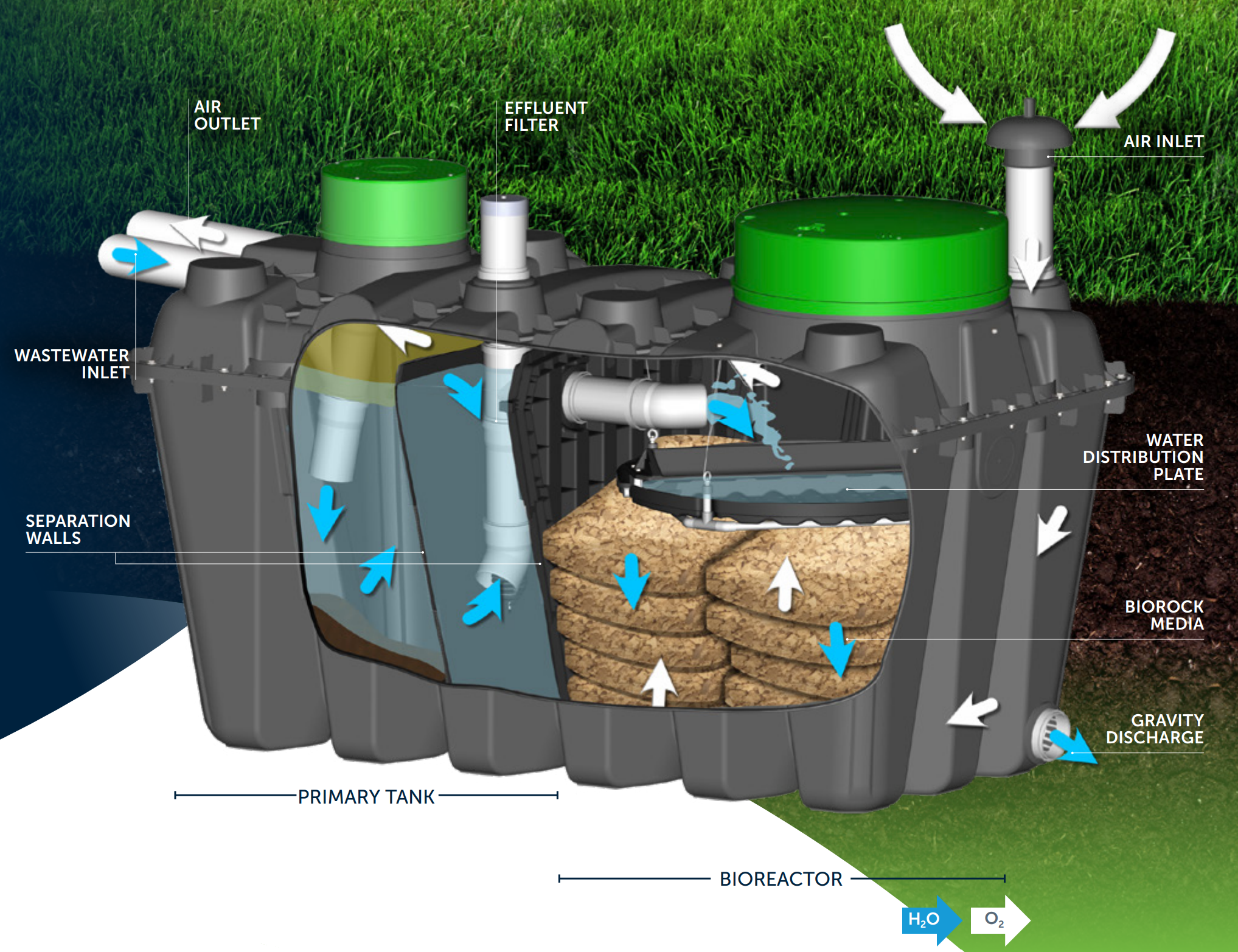
Click to enlarge
No electricity, no moving parts. The BEASY-2000 operates entirely on passive aeration — wastewater flows through a mineral biofilm media bed where naturally occurring bacteria break down pollutants. There is nothing to break down, no pump to fail, no alarm to go off in the middle of the night.
Minimal maintenance. The system requires only an annual visual inspection and a desludging of the primary tank every three to five years under our low-occupancy cabin loading. No specialist equipment is needed — a licensed tanker visit every few years is all it takes.
Built for low and intermittent loads. Because we treat grey water separately, only toilet waste enters the BEASY-2000. This significantly reduces the biological load on the system — effectively placing it well within its rated capacity at all times. At this load level, the internal biofilm media may never need replacement over the lifetime of the installation.
Compact and self-contained. At just 225 × 121 × 121 cm, the entire two-stage system — primary settling tank and bioreactor — is housed in a single moulded unit. One tank, one connection, one annual check.
European certified. Discharge quality meets or exceeds the EN 12566-3+A2 standard, with BOD removal exceeding 94% and COD removal exceeding 85% in certified testing. This is a system with a documented, verified performance record across thousands of installations in Europe, including Scandinavia.
Grey water treatment — Biolan filter with surge buffer
Grey water from sinks, showers, and baths is treated by a dedicated passive filter system: the Biolan Greywater Filter, a compact Finland-land made unit designed specifically for cabin and holiday home use in cold climates. Like the BEASY-2000, it requires no electricity and has no moving parts.
Water trickles downward through successive layers of peat, mineral fibre, and activated carbon, which together remove suspended solids, organic compounds, phosphorus, and odours before the treated water reaches a soakaway or drainage field. The filter media requires replacement every few years — a straightforward task taking less than an hour.
Managing peak flows — The surge buffer tank
The Biolan filter is optimised for steady, low flow rates — ideal for showers and basin use. A bathtub, however, can release 150 litres in under five minutes: a peak flow rate some 40 times higher than the filter can accept. Sending a bathtub drain directly to the Biolan would bypass treatment entirely and risk overloading the filter media.
Our solution is simple and entirely passive: a 200-litre surge buffer tank mounted on a rack above the Biolan inside the utility shed. All grey water — from kitchen sink, shower, basin, and bath — enters the surge tank first. A small-bore outlet at the base of the tank allows water to trickle down into the Biolan at a controlled, gentle rate regardless of how fast it arrived. No sensors, no valves, no electronics — just gravity doing its job.
Kitchen sink water carries fats, oils, and greases (FOG) from cooking and dishwashing. FOG is the primary cause of premature clogging in passive grey water filters. A simple passive grease trap — a small baffled chamber where warm water slows, FOG floats to the surface, and is retained — is installed immediately after the kitchen sink drain and before the surge tank. It requires cleaning every three to six months: a quick scoop-and-dispose task during routine cabin checks.
Shower and basin water bypasses the grease trap (it carries soap but negligible FOG) and flows directly into the surge tank. This separation of kitchen and bathing water streams keeps the grease trap small and the Biolan filter performing at its best.
Winter operation
Grey water arriving from a heated cabin is warm by nature — shower water at 35°C, dishwashing water at 40°C — and warms the Biolan filter media continuously during occupancy. The utility shed enclosure, already heated passively by the BEASY-2000’s thermostat heater, maintains a stable internal temperature well above freezing throughout winter. No supplemental heating is needed for the grey water system.
In the rare event of Biolan maintenance or media replacement, grey water can be temporarily rerouted to the BEASY-2000 via a simple manual valve — a contingency built into the pipework from the start. The BEASY handles the short-term combined load with ease.
The structure — A partial dig that makes sense and looks great
Rather than burying the tanks fully underground — expensive and challenging in Iceland’s rocky volcanic substrate at several cabin locations — we partially sink a purpose-built utility enclosure into the ground, typically one metre below grade. This approach is deliberate and smart on multiple levels:
Excavation cost is kept to a minimum. Full burial of tanks in Icelandic lava rock can cost several times the price of the equipment itself. Our partial-dig approach requires a modest, manageable excavation — reducing groundwork costs significantly while achieving the same thermal and structural benefits.
The ground does the heavy lifting thermally. At one metre depth, the surrounding earth and rock maintain a stable temperature year-round — buffering the system against Iceland’s winter extremes. The three buried or bermed walls of the enclosure are insulated with moisture-resistant XPS foam board, ensuring that the internal environment stays comfortably above the minimum operating temperature even in the coldest months.
A small 200W thermostatically controlled heater — no larger than an aquarium heater — is placed in the BEASY-2000 primary tank as a backup for the coldest periods. It consumes less energy annually than a single light bulb left on for a week, and ensures the bacterial treatment community remains active and effective regardless of external conditions.
Pipe runs between the cabin and the enclosure are kept short and insulated, eliminating any risk of freezing in the connection lines.
The architecture — An Icelandic turf structure
The enclosure itself is built in the tradition of Iceland’s historic torfbær — the turf outbuildings that have sheltered tools, food stores, and animals in this landscape for over a thousand years. A simple timber-framed structure with a 30-degree pitched roof, it presents only a weathered wooden gable and a low door to the outside world. Everything else disappears under living turf.
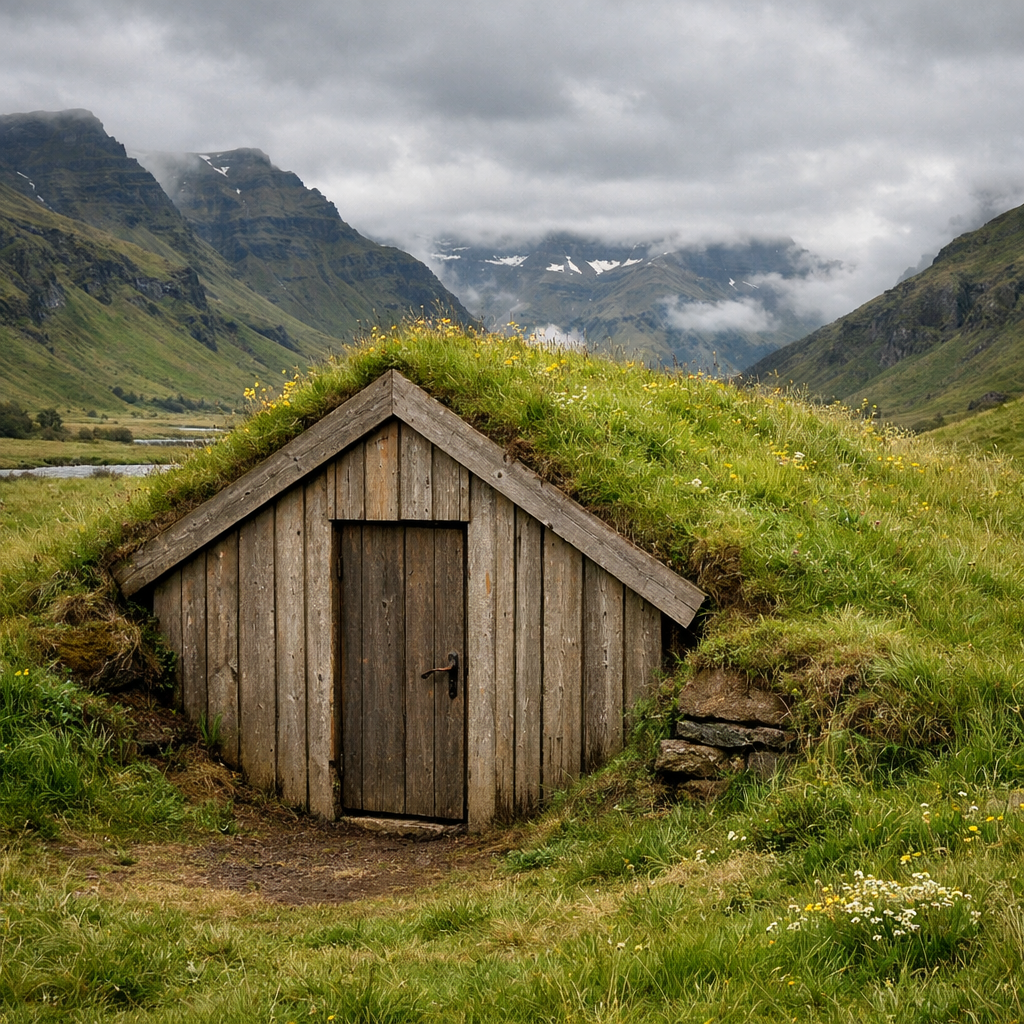
Click to enlarge
The roof follows traditional construction: a structural timber deck, a modern EPDM rubber waterproofing membrane in place of the original birch bark, a drainage layer, and two layers of Icelandic turf slab — the lower layer grass-side down, the upper grass-side up — just as it has always been done. Within a single growing season, the roof is indistinguishable from the surrounding meadow.
Three sides of the structure are bermed with the excavated material and seeded with local grasses. The fourth side — the entrance face — can be oriented toward the cabin for convenient access, or away from the main view to preserve sightlines.
The result is a structure that is essentially invisible in the landscape — a small green rise in the ground, entirely at home in Iceland’s valleys and hillsides.
More than a utility box — A true services hub
The enclosure is dimensioned generously enough — approximately 250 × 320 cm internally — to serve as a complete services hub for each cabin cluster. Inside, every system is accessible from a single point:
| Service | Notes |
|---|---|
| Biorock BEASY-2000 | Black water biological treatment — primary tank + bioreactor in one unit |
| Biolan grey water filter | Passive filter for sink, shower, and bath water |
| 200L surge buffer tank | Mounted on rack above Biolan — absorbs peak bath flows passively |
| Kitchen sink grease trap | Protects filter media from fats, oils, and grease |
| Potable water meter & shutoff | Accessible without entering the cabin |
| Heating circuit distribution & heat exchanger | Hot water from a central source distributed to cabins from this point |
| Electrical connection point & main breaker | Per-cabin metering and isolation in one accessible location |
| Storage | Chemicals, maintenance tools, spare parts — on a simple shelf above the tanks |
This means that every utility serving the cabin can be accessed, inspected, isolated, and serviced from a single point, without entering the cabin or disturbing guests. For a hospitality operation, this is a significant operational advantage — maintenance can be performed discreetly, quickly, and at any time.
The cabin underfloor installation for the cabin turning system will have a separate access point, also avoiding the need for cabin entry during routine checks.
In summary
Our wastewater and utility approach at Hugarro combines European-certified biological treatment technology with centuries-old Icelandic building tradition. Black water and grey water are treated separately — each by a system sized and optimised for its specific task — and both housed within a single compact enclosure that is virtually invisible in the landscape.
The result is a system that is invisible to guests, kind to the environment, robust in all seasons, and straightforward to maintain — a small buried structure that quietly does everything, and shows almost nothing.
All Hugarró sewage systems meet or exceed applicable Icelandic and European standards (ÍST EN 12566 / EN 16941-2).
Hotel & geothermal pool facilities
Our hotel and pool complex is served by a compact, containerised biological treatment plant — fully out of sight and designed for the higher load of a commercial accommodation facility.
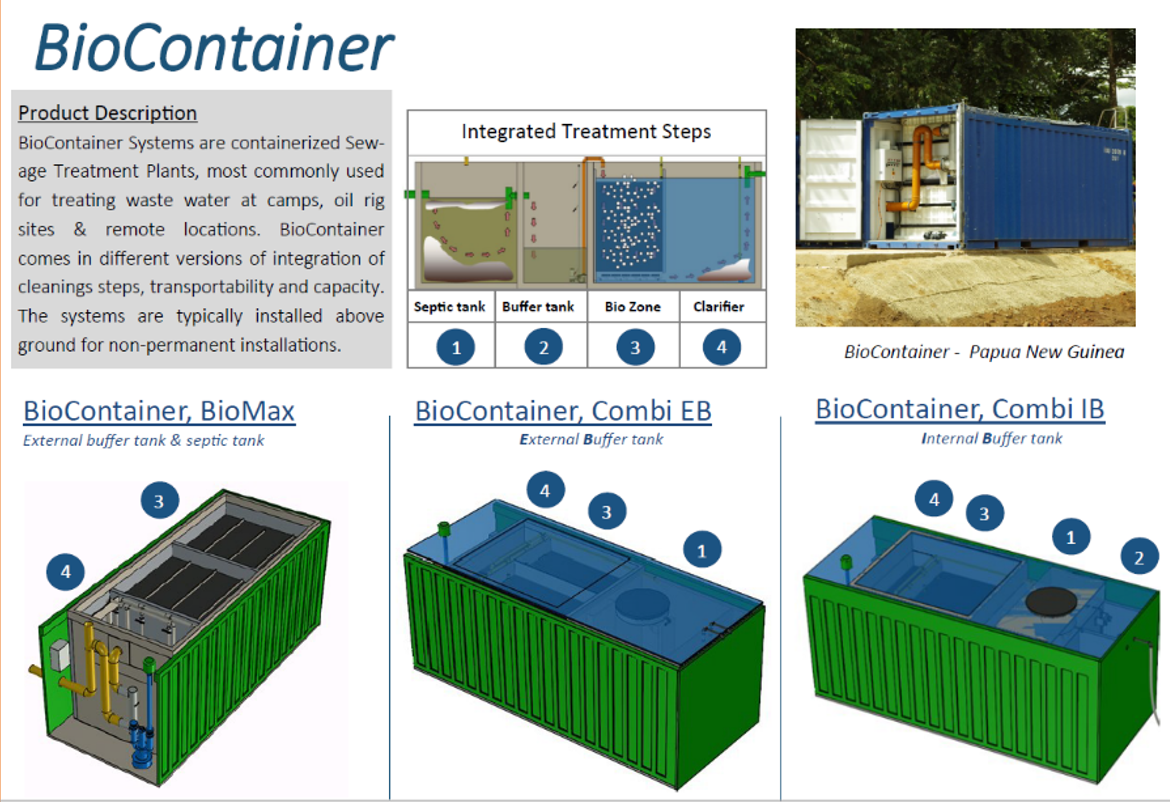
Free-standing cabins
Each cabin uses a certified two-stage septic system. We separate grey water (showers, kitchen sinks — typically up to 70% of total wastewater volume) from black water (toilets), feeding only the smaller black water stream into the septic tank. This significantly reduces tank size and the footprint of the required soakaway field — a real advantage on a site where we want to keep the land as undisturbed as possible.
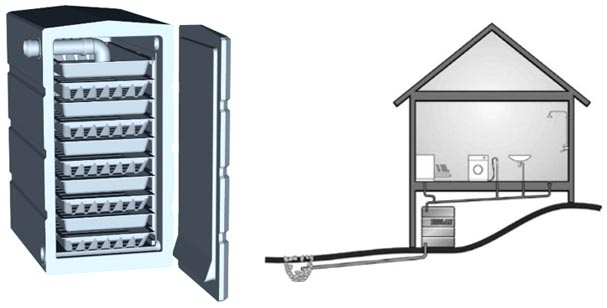
Monitoring & maintenance
All systems are remotely monitored — tank levels and temperatures are tracked continuously so that any issue can be caught and resolved before it becomes a problem. Routine maintenance needs are minimal by design.
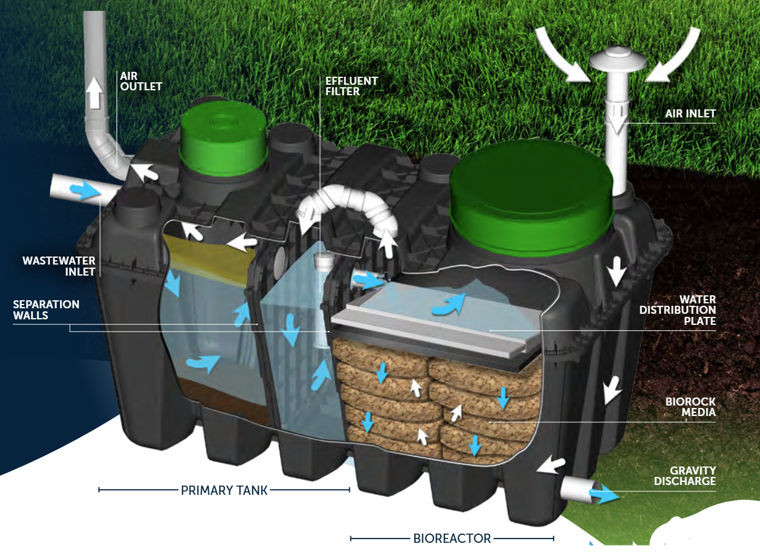
Year-round reliability — Thanks to geothermal
Iceland’s winters can challenge conventional septic systems. Because Hugarró has its own geothermal source, every cabin can be connected to gentle tank heating, ensuring reliable, trouble-free operation throughout the year — at no additional energy cost.
Water reuse
Treated effluent from the grey water systems can be used for on-site irrigation where appropriate, and otherwise infiltrates naturally back into the ground. A clean cycle, fitting for a site where clean water is both abundant and worth protecting.
Financials
As part of our ongoing project development, we have been in contact with DMD Modular, a European modular construction specialist with direct experience delivering and installing projects in Iceland. We requested an indicative cost range for the construction of the cabin units to compare them with our own estimates based on feedback of Dutch builders.
Their initial indication is €2,300–2,500 per square metre, covering the full standard scope: factory-finished modules (including furnishings), transport from factory to site (including sea freight and in-country logistics), installation, and roof finishing. We are awaiting written confirmation that mobile crane costs on site are included within this scope, which we expect shortly.
Reassuringly, this range is very similar to what our own research showed us.
We want to be transparent: we do not yet have an independent, third-party validation of our construction cost assumptions, as technical drawings are not yet finalised. This is a deliberate consequence of project sequencing — drawings will be developed following zoning approval, which is the immediate next milestone. The current round is therefore pre-technical in nature, and part of its purpose is to unlock that next phase, including a formal cost review by an independent quantity surveyor.
In the meantime, the indicative pricing from DMD Modular aligns closely with our own projections and, in our view, provides a credible market reference. Their hands-on experience in Iceland — a market with well-understood logistical and climatic challenges — gives particular weight to their numbers. For additional context, per-room development costs published by HVS for comparable full-service hotel projects are consistent with the range we are working with.
We plan to stress-tested the financial model against a 10% increase in construction costs. We don’t expect this scenario to materially alter the project’s return profile or its overall viability. We are confident the current assumptions are grounded in market reality, and we will provide a formally validated cost plan as the project progresses through its next phase.
Prepared for investor reference · Based on formal appraisal dated 10 June 2026
The asset
Hugarró is a planned eco-luxury hospitality development on a 12.1-hectare site at Litli Botn, at the head of Hvalfjörður fjord — 55 kilometres northwest of Reykjavik and at the trailhead of Glymur, Iceland’s second-highest waterfall. The site benefits from master zoning approval (aðalskipulag) already in place, with detailed zoning (deiliskipulag) published for public consultation and final National Planning Agency approval expected imminently.
The approved development programme comprises:
- A 32-room hotel and 31 free-standing rotating cabins (up to 200-guest capacity)
- Seven geothermal pools and a 350m² wellness hub
- Five meeting facilities, staff housing, and a health-focused restaurant
- Total approved buildable area: 5,000m² of commercial hospitality space
The valuation
The formal appraisal was carried out by Croisette – Real Estate Partner, Iceland’s leading real estate advisory firm and the exclusive Nordic partner of Knight Frank — the world’s largest private property consultancy, active in over 60 countries. 1 The report was authored by Styrmir Bjartur Karlsson, Managing Director and licensed real estate broker, who heads Croisette’s Iceland operations. 5 The valuation is prepared on a Market Value basis — the standard used by banks and institutional investors — and is of a quality accepted for financing purposes.
The assessed values are:
| Planning Stage | Value (ISK) | Value (EUR approx.) |
|---|---|---|
| Master zoning in place (aðalskipulag) | 250–275 million | €1.8–2.0 million |
| Full detailed zoning + approved schematics | 500 million | ~€3.6 million |
The step-up from master to detailed zoning reflects standard Icelandic planning practice: as planning certainty increases, so does the land’s bankable value — a well-established principle in property markets worldwide.
Iceland tourism: A market in sustained demand
Iceland welcomed 2.3 million international visitors in 2025, with the United States, United Kingdom, and Germany as the three largest source markets. 6 Tourism’s gross value added grew 5.5% in 2025 year-on-year, and Keflavík Airport is expected to handle approximately nine million passengers in 2026. 4
Demand for nature-based, premium wellness experiences — the exact segment Hugarró targets — is the fastest-growing corner of that market. Iceland now counts eight major geothermal lagoon destinations, all of which operate at or near capacity during peak season. 2 The category has moved well beyond novelty; it is a structural pillar of Icelandic tourism.
Comparable projects
Two recently built geothermal wellness facilities provide useful context for assessing the Hugarró valuation:
Sky Lagoon (Reykjavik area): Phase 1 of this single-lagoon facility cost approximately ISK 4 billion (€24 million) to construct. 7 The fact that fully-zoned land rights for a more comprehensive mixed-use development are valued at 500 million ISK — roughly one-eighth of Sky Lagoon’s build cost alone — illustrates that the land valuation is measured and conservative relative to the asset class.
Laugarás Lagoon (Golden Circle, opened 2025): Construction of this 1,000m² geothermal lagoon on Iceland’s Golden Circle cost approximately ISK 2 billion (€13.7 million), with annual visitor projections of 150,000–250,000 guests. 3 Hugarró’s permitted development is significantly larger in scope, yet the land is valued at a fraction of Laugarás’s construction cost — again confirming the valuation sits comfortably within market norms.
In both cases, the underlying land value represents 10–15% of total anticipated project construction cost, which is exactly where one would expect it to sit for a planning-consented hospitality site in a premium natural setting.
Assessment
The appraised values are well-grounded. The per-m² rates applied by Croisette (ISK 50–55k at master zoning stage, rising to ISK 90–100k with full planning consent) are consistent with what comparable geothermal and hospitality assets have transacted at in Iceland. Hvalfjörður’s proximity to Reykjavik, its scenery, and its geothermal activity place it firmly in the upper tier of rural hospitality locations — a positioning that the approved 5,000m² programme fully supports.
Croisette’s standing as Knight Frank’s Icelandic representative, combined with Karlsson’s market knowledge and professional licensure, gives this valuation meaningful credibility. It is the type of report that lenders and institutional co-investors in Iceland expect and accept.
In short: the numbers are realistic, the methodology is sound, and the market context is supportive.
This summary is based on the formal land appraisal prepared by Croisette – Real Estate Partner (Knight Frank Iceland), dated 10 June 2026, supplemented by publicly available market data from the OECD, Statistics Iceland, and industry sources.
A preliminary concept for discussion — financial modelling in progress
The concept
We are exploring a cabin leaseback structure as a complementary financing mechanism for the project. Under this model, individual investors purchase a cabin (the building), while we retain ownership of the land. Investors then lease the cabin back to our management company, which operates it commercially as part of the wider resort. Investors receive a revenue share; we retain full operational control.
This is not a new idea. It has been tried, tested and refined across Europe for over 70 years.
The Landal precedent
Landal GreenParcs — founded in the Netherlands in 1954 — is the clearest proof of concept. It pioneered precisely this model: private investors own individual holiday cabins; the park operator manages all bookings, pricing, maintenance and guest experience on their behalf. Today (following its 2024 merger with Roompot), Landal operates 260+ parks across 9 countries, with around 23,000 holiday accommodations and 6 million guests per year.
The model works because the operator controls everything that matters — design standards, pricing, brand, guest experience — while the investor holds a real, transferable asset with an income stream attached. Landal even added a dedicated real estate brokerage arm (Landal Makelaardij) to facilitate cabin resales within their parks, demonstrating how a healthy secondary market can be built around the concept.
Why Iceland — and why this project
A critical advantage here is that our cabins are situated on commercially licensed land in Hvalfjarðarsveit and may be rented out year-round, without restriction. This distinguishes our offering sharply from comparable vacation plots in Iceland — such as those sold near Hvammsvík in 2021, which are classified as frístundahúsalóðir (vacation home plots) and subject to Iceland’s homestay legislation, limiting short-term rental to 90 days per year. Year-round commercial operation means a materially larger income potential for investors — and a more resilient business model for the operator.
The legal framework
Icelandic property law is well-suited to this structure. Two mechanisms provide robust legal grounding:
1. Lóðarleigusamningur (Ground Lease)
Under Lög nr. 75/2008, investors hold a long-term lease over the cabin’s footprint. They can freely transfer or mortgage their lease rights and building without requiring the landowner’s consent. We retain the land — and with it, the zoning approval and planning permissions. No land subdivision is required.
2. Þinglýstar kvöðvar (Registered Covenants)
Rather than relying solely on contractual chain clauses, our obligations — brand standards, rental pool participation, access rights to shared facilities, maintenance charge obligations — are registered as real covenants at Þjóðskrá Íslands. These bind every future owner automatically. They run with the property, not just the original investor. This is the strongest possible form of operational control, embedded in property law rather than contract alone.
The net effect: investors get a clean, transferable asset with clear income rights; we retain full control over how the resort operates.
Ownership flexibility as a strategic tool
An important feature of the model is that our management company can buy cabins directly — either as an alternative to raising third-party investor capital, or by exercising a right of first refusal when early investors wish to exit. This creates meaningful strategic flexibility:
- Quick financing when needed: sell cabins to investors to raise capital for development phases.
- Consolidation when performance allows: buy cabins back over time as the business generates cash, shifting ownership back in-house.
- Investor confidence: a credible buyback mechanism makes the investment more liquid and lowers the perceived risk for initial investors — particularly important in what is still a niche secondary market.
This is a lever that traditional hotel development financing simply does not offer.
What comes next
This memo is deliberately high-level. For investors in the Hugarró project to consider this option in earnest, we need to complete a financial model that honestly compares:
- Projected investor returns (revenue share scenarios — base / expected / upside) under the leaseback model
- The cost of capital under this model vs. our current financing structure
- Sensitivity to occupancy rates, seasonal patterns, and operating costs
- The impact of ground rent (if any) and management fees on net investor yield
- Other external financing options in Iceland and elsewhere
The legal architecture is sound. The market precedent is strong. The next step is the numbers.
Geothermal
We planned for this from day one
Drilling for geothermal water in Iceland is well-founded — the geology around Hvalfjörður is exceptional and nearby wells prove the potential. But geothermal exploration always carries uncertainty. Fractures can be missed. A well can come up dry. Investors can lose patience.
We designed Hugarró so that this scenario, however unlikely (see this post), does not stop us.
Our answer is a purpose-built alternative heating system that delivers the same pools, the same warmth, the same experience — drawing heat not from the ground below, but from the river and the earth around us.
Why our heating needs are surprisingly modest
Most facilities of this kind would be in serious trouble without a geothermal source. Ours is not — because of how efficiently we use energy in the first place.
Our closed-loop pool system recirculates water rather than constantly replacing it, recovering 33% more heat than the traditional Icelandic approach. Our cascade design runs geothermal water through pools, then buildings, then roads — extracting every usable degree before returning it. Floating insulation covers eliminate heat loss overnight.
The result: our total heating demand — seven pools at 38°C, full hotel and cabin heating, road de-icing — requires the equivalent of just 1,185 kW of continuous thermal output. For a facility of this scale, that is a lean number. And it is exactly what our backup system is sized to deliver.
The alternative: CO₂ heat pumps
If no geothermal source is found, we install three Fenagy (or other reliable brand) H-600 CO₂ heat pump units, each delivering 600 kW of thermal output. Together they provide 1,800 kW of installed capacity — comfortably above our 1,185 kW peak demand, with full redundancy built in.
CO₂ (R744) is the ideal refrigerant for this application:
- GWP of 1 — the most climate-neutral refrigerant available
- No chemicals — fully aligned with Iceland’s environmental standards
- Highest efficiency in the 38–70°C output range — exactly our operating window
- Proven technology — widely used in Scandinavian district heating systems
The heat pumps run as water-to-water units, extracting heat from a local water source and delivering it at the temperatures our cascade system requires. The full cascade — pools, buildings, roads — operates identically to the geothermal design. From a guest perspective, nothing changes.
Where the heat comes from: a two-tier water source
Instead of one geothermal well, we use two complementary water sources that together provide year-round reliability.
Tier 1 — The Brunná river (primary, spring through autumn)
The Brunná flows just 200 metres from our plant room, crossing land whose owner has no objection to our intake (in fact, we are co-owner). A short insulated HDPE pipe draws water at ~6°C, passes it through a heat exchanger, and returns it a few degrees cooler. The river provides more than enough flow for our needs during the eight warmest months of the year.
Tier 2 — Two drilled groundwater wells (winter backup)
For the winter months, when surface water flow can drop and ice becomes a risk, we rely on two drilled wells at 80–150 metres depth. At that depth, groundwater in the Botnsdalur valley maintains a stable 4–6°C year-round — completely unaffected by surface weather, frost, or seasonal variation. No river. No tidal influence. No moving parts except a submersible pump in each well.
Crucially, these wells are drilled while the geothermal exploration rig is already on site — a modest incremental cost on an already-mobilised programme, and one that simultaneously provides valuable geological data to guide the deep geothermal drill.
The system switches automatically between sources based on flow sensors and temperature readings. No manual intervention required.
The buffer tank — smoothing out demand peaks
Between the heat pumps and the distribution system sits a 35 m3 insulated thermal buffer tank, maintained at 45–50°C. It acts as a reservoir of stored heat, absorbing demand peaks and allowing the heat pumps to run at steady, optimal load rather than cycling up and down.
The effect is meaningful: peak source water demand drops by around 20%, the heat pumps run more efficiently, and the system becomes more resilient to short interruptions in either water source. It is the thermal equivalent of a battery — simple, passive, and highly effective.
What it costs to run
Iceland’s electricity is among the cleanest and most affordable in Europe, generated almost entirely from hydro and geothermal sources. At current industrial tariffs:
| Scenario | Annual electricity | Annual cost |
|---|---|---|
| Winter conditions (COP 3.5) | Higher draw | — |
| Summer conditions (COP 5.0) | Lower draw | — |
| Annual average (COP ~3.8) | ~2,730 MWh | ~€240,000/year |
For every unit of electricity the heat pumps consume, they deliver 3.8 units of heat — the rest comes free from the river or the wells. Compared to direct electric heating, the CO₂ heat pump system saves approximately €750,000 per year in energy costs.
How the two systems compare
| Geothermal well | CO₂ heat pump backup | |
|---|---|---|
| Heat source | Earth (70–90°C) | River + groundwater wells |
| Electricity required | Minimal (pumps only) | ~312 kW continuous |
| Annual energy cost | Near zero | ~€240,000 |
| Guest experience | Identical | Identical |
| Environmental impact | Zero discharge | Zero discharge |
| Cascade compatibility | Full | Full |
| CO₂ emissions | Zero | Zero (Icelandic grid) |
The bottom line
Finding geothermal water is our ambition and our expectation. The geology strongly supports it. But if exploration falls short, Hugarró does not fall with it.
Our backup system — three CO₂ heat pumps, two groundwater wells, a river intake, and a thermal buffer — delivers the same warmth, the same pools, and the same guest experience at a known, manageable operating cost. It was engineered in parallel with the geothermal design, not as an afterthought.
We are not betting everything on a single drill result. That is how Hugarró was designed.
Hugarró: a facility powered by nature — with a plan B ready from day one
Hugarró will be a seven-pool geothermal wellness complex on the shores of Hvalfjörður, one of Iceland’s most striking fjords. From the water temperature in our pools to the warmth in our cabins and the heat under our roads in winter, every degree of energy in this facility comes from renewable natural sources.
We did not design this system around hope. We designed it around certainty — with a primary strategy backed by Iceland’s exceptional geology, and a fully engineered alternative ready to deploy if exploration falls short.
Either way, Hugarró will operate as planned!
The primary strategy — geothermal heat
Iceland sits on one of the most geothermally active zones on the planet. The geology around Hvalfjörður reflects this: temperature gradients of 120°C per 1,000 metres have been recorded nearby, and the Hvalur station a few kilometres away produces over 20 litres per second at 140°C. The natural resource is well-established.
Our target is modest by Icelandic standards: a production well yielding 7–10 litres per second at 70–90°C. A typical productive Icelandic well delivers 15–50 litres per second. We are not asking for much.
Finding that water is the ambition. The three-phase exploration programme — shallow pre-drills, drone magnetic survey to map fracture zones, then a targeted production well at 900–1,500 metres — is designed to maximise the probability of a productive strike while managing exploration risk.
One source. Four uses. Nothing wasted
If geothermal water is found, it flows through a cascade that extracts every usable degree before returning the water underground:
- Pools — water enters at 70–90°C and heats all seven pools to a perfect 38°C
- Buildings — the same water, still warm, then heats the hotel and all cabins
- Hot water — covered in the same circuit, at no additional energy cost
- Roads — remaining warmth keeps paths and access roads clear in winter
The water returns underground at 30°C. Zero discharge. Zero waste.
This cascade design and our closed-loop pool heating recirculation system recovers 33% more thermal energy than the approach used by traditional Icelandic pools, which continuously replace pool water and discharge thousands of cubic metres of hot water to nature every year. We do not do that.
Pool water — clean without chemicals
Our pools recirculate water in a closed loop rather than replacing it. Water is kept clean through UV disinfection, ultrafiltration membranes and biologica filters — the same technology used in drinking water treatment — monitored continuously by real-time microbiological sensors across all seven pools.
No chemicals are used or permitted. The result: 91% less water consumed than a traditional Icelandic pool operation, and measurably cleaner water for guests.
Beyond the facility — a district heating opportunity
A geothermal well of this scale does more than serve Hugarró. Should the Botnsdalur valley develop into a wider community, the same well — with capacity to spare — could supply heat to an estimated 200–250 neighbouring vacation homes, each with a hot tub, through a district heating network.
At a metered tariff, this transforms a facility operating cost into a recurring revenue stream. A geothermal well becomes a utility asset.
If no geothermal water is found
Drilling always carries geological uncertainty. A well can miss a fracture. Pre-drills can show unfavourable results (see this related FAQ).
But we are planning for this before we break ground.
Our alternative is a purpose-built system of three Fenagy H-600 CO₂ heat pump units, each delivering 600 kW of thermal output. Together they provide 1,800 kW of installed capacity against a peak demand of 1,185 kW — full redundancy is built in. Two units alone cover peak load; the third is available for future expansion.
CO₂ (R744) is the most climate-neutral refrigerant available — a global warming potential of just 1, compared to 1,400+ for conventional refrigerants. It is also the most efficient refrigerant in the 38–70°C output range, which is exactly where we operate. For every unit of electricity these heat pumps consume, they deliver 3.8 units of heat — the rest comes free from the water sources below.
The cascade — pools, buildings, roads — operates identically to the geothermal design. From a guest perspective, absolutely nothing changes.
Where the heat comes from — two tiers, no single point of failure
The heat pumps draw their source heat from water. We use two complementary sources that together guarantee year-round reliability without dependence on rivers with fishing rights disputes, tidal complications, or expensive sea inlets.
Tier 1 — The Brunná river (spring through autumn)
The Brunná flows 200 metres from our plant room, crossing land whose owner raises no objection. A short insulated pipe draws river water at ~6°C, passes it through a heat exchanger, and returns it cooled by a few degrees. During the eight warmer months of the year, the Brunná provides everything we need.
Tier 2 — Two drilled groundwater wells (winter)
At 80–150 metres depth, groundwater in the Botnsdalur valley sits at a stable 4–6°C year-round — completely unaffected by surface frost, ice, or seasonal variation. Two drilled wells provide our winter heat source: reliable, permit-straightforward, and with no fishing rights complications.
Critically, these wells are drilled while the geothermal exploration rig is already on site — a modest incremental cost on an already-mobilised programme. The same activity that seeks geothermal water simultaneously secures our backup water source. The shallow geology data gathered also helps refine the deep drill target.
The system switches automatically between river and wells based on flow and temperature sensors. No manual intervention. No single point of failure.
The buffer tank
Between the heat pumps and the distribution system sits a 35,000-litre insulated thermal buffer tank at 45–50°C. It absorbs demand peaks, allows the heat pumps to run at steady optimal load, and reduces peak source water demand by around 20%. Think of it as a thermal battery — passive, simple, and highly effective.
The hydropower multiplier
The same river (Brunná) that provide our backup heat source offer a second opportunity: small-scale run-of-river hydropower.
A €300,000 investment in a small hydropower plant on the Brunná or Botnsá delivers:
- 150 kW for eight months of the year (spring through autumn)
- 50 kW through the four winter months
That is enough to offset 50% of the heat pump system’s annual electricity consumption — effectively halving the grid electricity bill.
When river flow is high and heat pump demand is low, surplus hydro power heats the buffer tank directly through resistance elements — free thermal energy that further reduces the load on the heat pumps.
| Metric | Value |
|---|---|
| Annual electricity saved | ~1,023 MWh |
| Annual cost saving | €97,200/year |
| Investment payback | 3.1 years |
| 20-year net present value | €1,114,000 |
A 3.1-year payback on renewable infrastructure is exceptional by any standard. After that, the plant runs free for its remaining 30–40 year lifespan.
The numbers — what each path costs
| Geothermal well | CO₂ heat pumps | CO₂ heat pumps + hydro | |
|---|---|---|---|
| Capital investment | ~€1,870,000 | ~€1,630,000 | ~€1,930,000 |
| Annual operating cost | ~€70,000 | ~€270,000 | ~€173,000 |
| 20-year total cost | ~€3,270,000 | ~€6,830,000 | ~€5,390,000 |
| Grid dependency | Minimal | High | Medium |
| CO₂ emissions | Zero | Zero | Zero |
| Guest experience | Identical | Identical | Identical |
| Technology risk | Exploration | Very low | Very low |
The geothermal well is the cheapest long-term solution by a wide margin — €3.5M cheaper than heat pumps alone over 20 years. But the heat pump system combined with hydropower is a fully viable, lower-risk alternative that closes that gap significantly.
The capital costs of all three paths are remarkably similar. What separates them is operating cost — and operating cost is where geothermal wins decisively. Every year of successful geothermal operation saves €200,000 in electricity that the heat pump alternative would otherwise purchase from the grid.
Resilience by design
Most geothermal wellness projects are built around a single assumption: that the well succeeds. Ours is not.
Our engineering team designed the geothermal cascade and the CO₂ heat pump alternative in parallel — same output temperatures, same cascade architecture, same pool experience, same environmental standards. Switching between the two strategies requires no redesign of the facility. The plant room, pipework, heat exchangers, and distribution circuits serve both.
The exploration programme is thorough and data-driven. We expect to find water. But if we do not, a fully costed, fully engineered alternative is ready — one that combines proven industrial heat pump technology with local renewable water and hydropower sources, and delivers the same Hugarró experience at a known, manageable operating cost.
That is not a fallback. It is a feature.
The foundation of everything
Hugarró runs on the heat of the earth. Our geothermal pools, building heating, hot water, and road de-icing all draw from a single underground source. Finding that source — and doing so reliably and cost-effectively — is one of the most important investments we make.
Click to enlargeIceland’s geological advantage
The area around Hvalfjörður sits on one of the most geothermally active zones on the planet. Exploratory data from previous drillings in the area shows a temperature gradient of 120°C per 1,000 metres — well above the global average. The nearby Hvalur station, just a few kilometres away, produces over 20 litres per second at 140°C. Nature has already proven the potential here.
How we find the water?
Geothermal water typically flows along fractures and fault lines in the rock. Hitting those fractures is the real challenge — which is why we do not simply drill and hope.
Our approach, developed with one of Iceland’s leading geothermal specialists, follows a structured three-phase methodology:
- Shallow exploratory drilling — 3 to 4 boreholes to 80 metres, mapping the subsurface geology
- Drone magnetic survey — a non-invasive aerial survey pinpointing fault lines and fracture zones below ground
- Production well — a single deep well of 900–1,500 metres, drilled with the best possible information, maximising the chance of a productive strike
On drilling method, we will choose between vertical, angled, or directional drilling based on what the survey data reveals. Directional drilling offers the greatest flexibility and the highest probability of intersecting a productive fracture — at a 40–60% premium over straight drilling. A worthwhile investment if the geology calls for it.
How much water do we actually need?
Surprisingly little, thanks to our closed-loop pool system. Our engineering calculations show that 7–10 litres per second at 70°C is sufficient to heat all seven pools to 38°C, supply all buildings and cabins with heat, and de-ice roads in winter — with capacity to spare.
Should the Botnsdalur valley ever develop into a wider community, that same well could realistically supply up to 50 holiday homes with heat at no additional extraction cost. If water temperature would be 90°C and the flow 12 litres per second , 250 modern, well-insulated homes could benefit. With their hot tubs of course: a must in Iceland!
Needless to say the additional potential revenue stream of this option is considerable which is why the design of our geothermal water distribution system will be designed for this opportunity.
What it costs
The table below shows our drilling budget, based on actual quotes from Icelandic contractors. Geothermal drilling in Iceland is one of the few things that costs significantly less here than in mainland Europe — geological conditions and a mature local industry make it so.
Click to enlarge
Our drinking water infrastructure — borehole, creek intake, filtration, UV disinfection, a 58 m³ storage tank and remote monitoring — is included in the budget above.
You may wonder why drilling a geothermal source in Iceland is considerably cheaper than in mainland Europe.
Icelandic groundwater is extremely hot (often 80°C to well over 150°C). The temperature gradient our our location suggests a temperature of 120 °C at 1.000 m. depth. So if we hit an aquafier at 800 m. with 90 °C water we’re avoid extra drilling cost. Moreover, the water there is often under natural pressure and rises on its own as an artesian spring, or with only a light pump. As a result, the costs for a heavy, expensive deep-well pump in the production well are often eliminated where a well depth of 2.500 m. is not uncommon.
The map below shows the distance to nearby wells.
The Hugarró development’s anchor are the geothermal pools. Needless to say we need hot water. We have already discussed the alternative if we don’t find (enough) geothermal water: C02 heat pumps.
But what are the actually chances of failure and which factors play a role? We dove deeper into this subject. Below the results of our research.
The most important distinction first
Almost every published statistic on geothermal well failure is based on power generation wells — where “success” means enough steam to drive a turbine, typically requiring 200°C+ at high flow rates. Our target is fundamentally different:
Our needs: 7–10 L/s at 70°C — a bar so low that many wells classified as “failures” in academic studies would comfortably pass for our purposes.
The IFC’s global study — the largest geothermal drilling database ever compiled — makes this explicit: “a dry well is a rarity — almost all wells flow to some extent” and “a well was only considered successful if the capacity was above a certain threshold.” 1 That threshold is set for power production — not for our modest direct-use application.
What the numbers actually say
Global baseline (IFC database)
| Stage | Success rate |
|---|---|
| Exploration wells | ~60% |
| Development wells | ~75% |
| Operational (established field) | ~80% |
| Overall global average | ~78% |
Iceland high-enthalpy – over 200 °C (213 wells studied)
| Wells drilled | Success rate |
|---|---|
| First well (no prior data) | 43% |
| After 5 wells | 60% |
| After 15 wells (plateau) | 74% |
Low-temperature Iceland — our actual peer group
Iceland has drilled approximately 900 low-temperature wells since 1928, successfully supplying ~90% of the country’s space heating. 4 The track record of the low-temperature programme is exceptional precisely because the bar is lower — 70°C water is found across a much wider geographical area and shallower depth range than the 200°C+ needed for power generation.
Real examples near analogous settings:
- Thelamörk, N-Iceland: productive fracture intersected at just 450m depth, yielding 17 L/s at 91°C — more than double our target, at less than half our planned depth 2
- Hjalteyri, Eyjafjörður: well HJ-19 to 1,450m following ground magnetic survey yielded 200 L/s at 90°C — the most productive low-temperature well in that region 3
What the magnetic survey does — and doesn’t — do
This is where honesty matters for investors:
| What the survey achieves | What it cannot guarantee |
|---|---|
| Maps subsurface fracture zones and fault lines | Exact fracture intersection at drill point |
| Identifies low-resistivity zones (geothermal fluid indicators) | Water temperature at depth |
| Eliminates obviously wrong locations | “Bad luck” — local absence of fractures at chosen point |
| Reduces “wrong area” risk dramatically | The final 10–15% site-specific uncertainty |
The research is direct on this: “pre-drill derisking techniques have not greatly mitigated the risk factors — there is a relatively small improvement in success rates between exploration and development wells.” 1 What surveys do is eliminate the worst outcomes — drilling in completely the wrong location. What they cannot do is guarantee fracture intersection at the exact drill point. That residual uncertainty is irreducible with current technology.
The IFC study describes this remaining risk as simply “bad luck — local absence of fractures, difficult to predict even with surveys.” 1
Our specific probability — After survey and pre-drills
Combining all factors — Iceland’s geological advantage, our low target, our pre-drill programme, the Hvalfjörður geological context, and proven nearby production at Hvalur:
| Risk factor | General statistics | Our adjusted probability | Why |
|---|---|---|---|
| True dry well (no water at all) | ~5% globally | <2% | Iceland’s volcanic geology always produces some water |
| Water found but below 70°C | ~4% (high-temp studies) | <3% | 70°C is easily achievable at 900–1,500m in Hvalfjörður |
| Water found, right temp, wrong flow (<7 L/s) | ~10–15% | ~8–12% | Our 7 L/s target is very modest; partially mitigated by directional drilling |
| Full success (≥7 L/s at ≥70°C) | 74–78% baseline | ~85–90% | Lower bar + better geology + survey + pre-drills |
The honest summary
| Question | Answer |
|---|---|
| Can the survey eliminate failure risk? | No — it reduces it, not eliminates it |
| What is the residual risk after full exploration programme? | ~10–15% of not meeting our specific target |
| What is the risk of finding absolutely nothing? | <2% in Iceland’s geology |
| Most likely failure mode | Missing the fracture zone at the drill point — “bad luck” |
| Does this justify the backup system? | Absolutely yes |
In plain terms: after a thorough magnetic survey, shallow pre-drills, and with the geological context of Hvalfjörður behind us, the probability of finding sufficient water for our modest needs is approximately 85–90%. The remaining 10–15% is not ignorance or poor planning — it is the irreducible geological uncertainty that every geothermal project carries, regardless of how much exploration is done first.
That is precisely why our CO₂ heat pump backup system exists, and why it was engineered in full detail rather than treated as a footnote.
Our energy source: the earth itself
Hugarró is heated entirely by geothermal energy — natural heat drawn from deep underground. It powers our pools, our hot water, our buildings, and even our roads in winter. No fossil fuels. No emissions. No utility bills.
Smarter than the traditional approach
The standard practice in Iceland is to continuously replace pool water with fresh geothermal water — discarding around 230 m³ of hot water into nature every single day. We think that is wasteful, and we designed our way around it.
Our pools use a closed-loop recirculation system: water stays in the pools and is kept clean through UV disinfection and ultrafiltration membranes — the same technology used in drinking water treatment. No chemicals are used or permitted in Iceland. A real-time microbiological monitoring system continuously checks water quality across all seven pools, so you are always swimming in water that is measurably clean.
The result? We use 91% less water than a traditional Icelandic pool operation, and we recover 33% more heat energy by not throwing it away.
One source, four uses — in sequence
Rather than drawing separate energy for each need, we run our geothermal water through a cascade:
- Geothermal pools — water enters at 70°C and heats our pools to a perfect 38°C
- Hotel & cabin heating — the same water, still warm at 50°C, then heats all our buildings
- Hot tap water — covered in the same circuit
- Road de-icing — remaining warmth is used to keep paths and roads clear in winter
The water is then returned underground at 30°C — completing a fully closed, zero-discharge cycle.
A modest well is all we need
Because our system is so efficient, a geothermal well yielding just 7–10 litres per second at 70°C covers all our needs — pools, buildings, roads, and future expansion. For context, a typical productive well in Iceland delivers 15–50 litres per second. We are not greedy with the resource.
This also means we have realistic capacity to supply heating to neighbouring summer homes and future development in the area — turning a facility cost into a potential revenue stream.
The bottom line
| Traditional Icelandic pools | Hugarró | |
|---|---|---|
| Daily water discharged to nature | 230 m³ | 0 m³ |
| Heat energy wasted | 33% | 0% |
| Chemicals in pool water | None | None |
| Well yield required | 15–50 L/s | 7–10 L/s |
| Neighbours supplied with heat | No | Yes — planned |
and how Hugarró goes far beyond them
What makes geothermal pools in Iceland unique — and what does it take to keep them safe, sustainable, and natural at the same time?
translation below
What makes Icelandic geothermal pools so special?
Iceland’s geothermal pools are a product of the country’s unique geology. Water heated deep underground is mixed with cold water to set temperatures between 36–42°C — perfect for soaking, but also a warm, nutrient-rich environment in which bacteria can multiply quickly. Unlike outdoor seawater beaches or cold freshwater lakes, a warm pool with dozens of bathers needs active water quality management.
In most countries around the world, this is solved with chlorine and other chemical disinfectants. In Iceland, chemicals are explicitly prohibited in natural bathing facilities under Regulation No. 460/2015 (Reglugerð um baðstaði í náttúrunni). That is what makes Icelandic geothermal bathing culture genuinely different — and what makes the engineering challenge so interesting.
What does Icelandic law require instead?
The traditional solution used across Iceland is straightforward and effective, but also very resource-intensive: replace 30–40% of the pool’s total water volume every single day. Fresh cold water and geothermal hot water are continuously mixed in and the “old” water is flushed out — millions of litres of heated water discharged daily into drainage ditches.
The relevant law, Regulation No. 460/2015, classifies natural bathing facilities and sets bacterial count limits (e.g. E. coli < 500/100 ml; Enterococci < 200/100 ml for Class 1 facilities). The regulation requires:
- A minimum of 10 water samples per year for Class 1 facilities (like ours)
- An internal control system with risk assessments, incident logs, and staff training
- A documented emergency and contingency plan
- Strict bather number controls
- Mandatory signage, changing rooms, showers, and first aid on site
The regulation is outcome-based, not technology-prescriptive — meaning it sets the results you must achieve, not the method you must use. This is the regulatory opening that Hugarró’s engineering approach is built on.
What category does Hugarró fall under?
Hugarró is classified as a Recreation Pool (Afþreyingarlaug) — Class 1 — under Regulation 460/2015. This is the highest level of oversight, applying to facilities that operate regularly and year-round. It requires a full operating licence (starfsleyfi) from the local Health Committee, comprehensive internal controls, and continuous compliance with bacterial quality standards.
We welcome this level of scrutiny. Our systems are designed to far exceed Class 1 requirements, not merely meet them.
Why are chemicals not used — and why is that actually fine?
Chemicals such as chlorine kill bacteria effectively, but they have a serious downside: they react with organic matter introduced by bathers (sweat, skin cells, urine) to produce disinfection by-products (DBPs) — compounds that are themselves potentially harmful and are responsible for the characteristic “pool smell” most people associate with indoor public pools. In Iceland, the law simply prohibits them in natural bathing facilities.
The good news is that, as research has demonstrated, chemicals are not actually necessary if you control the source of contamination and treat the water effectively through physical methods.
What does the science say? The Keuten/Delft Study
Researcher M.C. Keuten at Delft University of Technology published a landmark study on bacterial pollution in swimming pools and how to reduce it — *Alternative Pool Water Treatment and the Influence of Swimmers on Water Quality*.
The study used a specially instrumented shower cabin to precisely measure the pollutants released by bathers before and during swimming. The key findings are striking:
| Source of bacterial/pollutant load | Share of total |
|---|---|
| Submerged sweating during swimming | ~40% |
| Not showering before entering the pool | ~30% |
| Not using the toilet before entering the pool | ~30% |
This means that up to 60% of the bacterial input into a pool is directly controllable through bather behaviour — before any filtration or treatment technology is even needed. This is something Icelanders know well, which is why the country has a very strict pre-bath showering culture.
Keuten also demonstrated that UV disinfection combined with ultrafiltration — with no chemicals — can achieve microbial water quality comparable to chlorinated pools. Biological filtration further improved the removal of dissolved substances such as urea, reducing the formation of unwanted by-products.
What does Hugarró do to reduce bacterial input at the source?
Based directly on Keuten’s research, Hugarró has designed a two-step pre-entry protocol backed by technology, not just signage:
- Mandatory pre-swim shower — Our facilities use sensor-based nudging technology that confirms a minimum 1.5 minutes of showering before entry is unlocked. This alone eliminates approximately 30% of the bacterial load that would otherwise enter the pool. A visible timer shows the bather how much time is left.
- Toilet-first culture — Clear prompts, facility design, and staff communication encourage guests to use the toilet before bathing — targeting the remaining 30% of avoidable bacterial input.
Across our 7 pools, strict bather number limits are enforced in real time, both to comply with the regulatory requirement for access control and to ensure that the filtration system is never overwhelmed.
How does Hugarró manage water quality without chemicals and without massive water waste?
Instead of continuously flushing out large volumes of water, Hugarró’s pools are equipped with continuous ultrafiltration — a physical membrane-based process that removes bacteria, particles, and micro-organisms from pool water in a closed loop. This is combined with continuous water quality monitoring using systems such as those developed by bNovate, which allows near-real-time measurement of bacterial counts.
The result:
-
- Water savings of over 90% compared to the traditional daily-replacement model used elsewhere in Iceland
- Energy savings of over 30% in heating, as far less cold replacement water needs to be heated
- Pool water that can be cycled to within safe bacteriological limits within one hour if needed — compared to the days it would take under a simple dilution/replacement model
Why ultrafiltration alone is not enough — the role of the active carbon biofilter
Ultrafiltration is highly effective at removing bacteria, viruses, and suspended particles from pool water. However, it has one fundamental limitation: its membranes work by physical size exclusion, and the pores are far too large to capture dissolved molecules. Urea — the primary dissolved contaminant in sweat and urine — is a small molecule (~0.4 nm) that passes straight through a UF membrane unimpeded.
This matters particularly in a geothermal pool at 38°C. At that temperature, the water is warmer than the human body’s cooling threshold, meaning that bathers sweat continuously and passively, even while sitting still. Research has measured sweat secretion of over 500 ml per person per hour during passive immersion at this temperature. Urea accumulates in the water with every bather, every session, every day — and UF does nothing to stop it.
To address this, Hugarró’s filtration system includes a biological active carbon filter. Granular activated carbon (GAC) offers an extraordinarily large internal surface area — hundreds of square metres per gram — on which both physical adsorption and biological degradation take place simultaneously:
- Adsorption: urea and other dissolved organic compounds bind chemically to the carbon surface and are removed from the water
- Biodegradation: beneficial micro-organisms colonise the carbon medium and break down the adsorbed organic matter into harmless compounds
This dual mechanism makes active carbon significantly more effective than alternative biological media such as MBBR carriers (moving bed biofilm reactors), which rely on biological action alone and offer no adsorption capacity. In a chemical-free system with clean fill water, active carbon can dedicate its full adsorption capacity exclusively to the dissolved substances introduced by bathers — making it the ideal complement to ultrafiltration.
Together, UF and the active carbon biofilter cover what neither can achieve alone: UF handles pathogens and particles; the biofilter handles dissolved organics. The result is pool water that is clean in every meaningful sense of the word.
Does Hugarró have any water replacement at all?
Yes — a small amount. Natural evaporation from the pool surface means that water is slowly lost and must be topped up. This amounts to less than 10% of pool volume per day — a fraction of the 30–40% daily replacement that is standard practice at comparable Icelandic geothermal pools. This replacement water is part of the natural water cycle, not a deliberate “flush-and-refill” approach.and-refill” approach.
How does Hugarró monitor water quality — and how does this compare to the law?
The law requires a minimum of 10 water quality checks per year for Class 1 facilities — roughly once per month. At Hugarró, we check every pool every 2 hours, using continuous real-time monitoring technology. This means:
| Parameter | Legal minimum (Class 1) | Hugarró standard |
|---|---|---|
| Water quality sampling frequency | 10×/year (~monthly) | Every 2 hours |
| Response time to exceedance | Days (lab turnaround) | Within 1 hour (automated filtration response) |
| Bather number enforcement | Required, method unspecified | Real-time sensor-based control per pool |
Any exceedance of our internal quality thresholds triggers an automated filtration response. Our systems are designed to restore water to within safe parameters within one hour — even under peak load. In fact, the moment bacterial quality moves from the ‘green’ to the ‘yellow’ zone, we increase filtration on the pool in question to prevent it from ever reaching the ‘red’ zone.
Moreover, our system can be remotely monitored via online dashboards by the health authorities — providing real-time oversight rather than after-the-fact sampling during a site visit.
Other measures to assure water quality
An important part of our quality control system is pool design. By creating overflow around all pool edges, the formation of a bacterial biofilm on the water surface is minimised. Pool surfaces are smoother than standard concrete pool surfaces, which greatly reduces the build-up of deposits that are a breeding ground for bacterial growth, and allows easy cleaning.
Water flow through the pools — comprising evaporation replacement water as well as heated water inflow — is carefully engineered to avoid stagnant areas, which can lead to bacterial development. This is the principle behind the ‘islands’ in our pools: filtered water enters via the bottom of the pool and rises upward, flowing over the edges and carrying any contamination with it. This creates a continuously circulating cycle, carefully monitored by automation.
Are there any rules in Iceland that prohibit ultrafiltration?
No. Regulation 460/2015 contains no prohibition on ultrafiltration. The regulation is outcome-based — it sets bacterial limits and requires that a documented internal control system is in place. It does not prescribe which technology must be used to achieve those limits.
The regulation does describe the standard model for recreation pools as relying on “frequent water renewal and bather number control” — which is how the traditional approach is framed. However, since the law is outcome-focused, an alternative method that demonstrably achieves the same (or better) bacteriological outcomes is legally defensible.
Hugarró engages proactively with the local Health Committee to ensure our approach is fully documented, understood, and approved as part of our operating licence conditions. This regulatory dialogue will be an ongoing part of our operations and we hope to set an example for bacterial water control in Iceland.
What does the local Health Committee inspect?
The local Health Committee (heilbrigðisnefnd) holds broad powers under Regulation 460/2015 and the underlying Public Health Act No. 7/1998:
- Unrestricted access for inspections and water sampling at any time
- Power to issue public warnings and erect warning signs if bacterial limits are repeatedly exceeded
- Power to cap the number of bathers in a recreation pool
- Power to order additional sampling beyond the minimum (at the operator’s cost)
- Power to authorise or order disinfection — only by radiation or other non-chemical means — if quality standards are repeatedly not met
All of Hugarró’s water quality results — as required — are forwarded to the Environment Agency of Iceland (Umhverfisstofnun), where they are published publicly. We are confident in our results and welcome public transparency.
The bottom line
Hugarró operates at the intersection of Icelandic bathing culture, environmental responsibility, and evidence-based water science. We comply fully with Regulation No. 460/2015 as a Class 1 Recreation Pool — and go significantly further in every measurable dimension of water safety, resource efficiency, and monitoring rigour.
Our approach is not a workaround. It is what responsible geothermal bathing looks like when engineering and science are applied seriously to an age-old challenge
Click to enlarge
Íslenskar reglugerðir um böðun í náttúrunni
Íslenskar reglugerðir um böðun í náttúrunni
og hvernig Hugarró fer langt fram úr þeim
Hvað gerir íslenskar jarðhitalaugar einstakar — og hvað þarf til að halda þeim öruggum, sjálfbærum og náttúrulegum á sama tíma?
Hvað gerir íslenskar jarðhitalaugar svona sérstakar?
Íslenskar jarðhitalaugar eru afurð einstakrar jarðfræði landsins. Vatni sem hitnar djúpt í jörðu er blandað við kalt vatn til að ná 36–42°C hita — fullkomið til að láta fara vel um sig, en jafnframt hlýtt og næringarríkt umhverfi þar sem bakteríur geta fjölgað sér hratt. Ólíkt sjávarströndum eða köldum ferskvatnsstöðum þarf hlý laug með tugum gesta virka stjórnun á vatnsgæðum.
Í flestum löndum heims er þetta leyst með klór og öðrum sótthreinsiefnum. Á Íslandi eru kemísk efni beinlínis bönnuð á náttúrulegum baðstöðum samkvæmt Reglugerð nr. 460/2015 (Reglugerð um baðstaði í náttúrunni). Það er það sem gerir íslenska baðmenningu sannarlega frábrugðna — og gerir verkfræðilegu áskorunina svo áhugaverða.
Hvað krefjast íslensk lög í staðinn?
Hefðbundna lausnin sem notuð er um allt Ísland er einföld og áhrifarík, en jafnframt mjög auðlindafrek: skipta út 30–40% af heildarvatnsmagni laugarinnar á hverjum einasta degi. Fersku köldu vatni og heitu jarðhitavatni er stöðugt blandað saman og „gamla“ vatninu skolað út — milljónir lítra af hituðu vatni renna daglega í frárennslisskurði.
Viðeigandi lög, Reglugerð nr. 460/2015, flokka náttúruleg baðsvæði og setja mörk fyrir gerlafjölda (t.d. E. coli < 500/100 ml; Enterokokkar < 200/100 ml fyrir flokk 1). Reglugerðin krefst:
- Að lágmarki 10 vatnssýni á ári fyrir mannvirki í flokki 1 (eins og okkar)
- Innra eftirlitskerfi með áhættumati, atvikaskráningu og þjálfun starfsfólks
- Skráð neyðar- og viðbragðsáætlun
- Strangt eftirlit með fjölda baðgesta
- Skyldubundnar merkingar, búningsklefar, sturtur og skyndihjálp á staðnum
Reglugerðin er árangursmiðuð, ekki tækniforskrift — sem þýðir að hún setur fram þá niðurstöðu sem þarf að ná, en ekki hvaða aðferð þarf að nota. Þetta er reglugerðaropnunin sem verkfræðileg nálgun Hugarró byggir á.
Undir hvaða flokk fellur Hugarró?
Hugarró er flokkað sem Afþreyingarlaug (Afþreyingarlaug) — Flokkur 1 — samkvæmt reglugerð 460/2015. Þetta er hæsta stig eftirlits og á við um mannvirki sem starfrækt eru reglulega og allt árið um kring. Það krefst fulls starfsleyfis frá heilbrigðisnefnd sveitarfélagsins, yfirgripsmikils innra eftirlits og stöðugrar fylgni við gæðastaðla fyrir gerla.starfsleyfistarfsleyfi
Við fögnum þessu eftirliti. Kerfin okkar eru hönnuð til að fara langt fram úr kröfur í flokki 1 ríflega, en ekki bara uppfylla þær.
Af hverju eru engin kemísk efni notuð — og af hverju er það í raun í lagi?
Efni eins og klór drepa bakteríur á áhrifaríkan hátt, en þeim fylgir alvarlegur galli: þau hvarfast við lífræn efni sem berast með sundgestum (svita, húðfrumum, þvagi) og mynda aukaafurðir sótthreinsunar (DBP) — efnasambönd sem geta sjálf verið skaðleg og bera ábyrgð á hinni dæmigerðu „sundlaugalykt“ sem flestir tengja við almenningslaugar innanhúss. Á Íslandi banna lög þessi efni einfaldlega í náttúrulegum baðstöðum.
Góðu fréttirnar eru þær að rannsóknir hafa sýnt að kemísk efni eru í raun óþörf ef stjórnað er upptökum mengunar og vatnið meðhöndlað á áhrifaríkan hátt með eðlisfræðilegum aðferðum.
Hvað segja vísindin? Keuten/Delft rannsóknin
Rannsakandinn M.C. Keuten við Tækniháskólann í Delft birti tímamótarannsókn á bakteríumengun í sundlaugum og hvernig megi draga úr henni — *Alternative Pool Water Treatment and the Influence of Swimmers on Water Quality*.
Í rannsókninni var notaður sérútbúinn sturtuklefi til að mæla nákvæmlega þau mengunarefni sem losna frá sundgestum fyrir og á meðan þeir synda. Helstu niðurstöður eru sláandi:
| Upptök bakteríu- og mengunarálags | Hlutfall af heild |
|---|---|
| Svitamyndun í kafi á meðan sundi | ~40% |
| Að fara ekki í sturtu áður en farið er í laugina | ~30% |
| Að nota ekki salernið áður en farið er í laugina | ~30% |
Þetta þýðir að hægt er að stjórna allt að 60% af bakteríumagni sem berst í laug beint með hegðun gesta — áður en nokkur síunar- eða hreinsitækni er yfirhöfuð nauðsynleg. Þetta er eitthvað sem Íslendingar þekkja vel, og þess vegna ríkir hér á landi mjög ströng menning varðandi sturtuferðir fyrir sund.
Keuten sýndi einnig fram á að UV-sótthreinsun ásamt ofursíun (ultrafiltration) — án nokkurra íðefna — getur náð fram örverufræðilegum vatnsgæðum sem eru sambærileg við klóraðar laugar. Líffræðileg síun bætti enn frekar fjarlægingu uppleystra efna eins og þvagefnis, sem dregur úr myndun óæskilegra aukaafurða.
Hvað gerir Hugarró til að draga úr bakteríumagni við upptökin?
Byggt beint á rannsóknum Keuten, hefur Hugarró hannað tveggja þrepa aðgangsferli sem studd er af tækni, ekki bara skiltum:
- Skyldubundin sturta fyrir sund — Aðstaða okkar notar skynjaratækni sem hvetur gesti og staðfestir að lágmarki 1,5 mínútna sturtuferð áður en opnað er fyrir aðgang. Þetta eitt og sér eyðir um það bil 30% af því bakteríumagni sem annars myndi berast í laugina. Sýnilegur tímamælir sýnir gestinum hversu mikill tími er eftir.
- Salernismenning í fyrirrúmi — Skýrar ábendingar, hönnun aðstöðunnar og samskipti starfsfólks hvetja gesti til að nota salernið fyrir sundferðina — sem beinist að þeim 30% af forðanlegu bakteríumagni sem eftir standa.
Í okkar 7 laugum, er ströngum takmörkunum á fjölda gesta fylgt eftir í rauntíma, bæði til að uppfylla reglugerðarkröfur um aðgangsstýringu og til að tryggja að síunarkerfið verði aldrei ofhlaðið.
Hvernig stýrir Hugarró vatnsgæðum án íðefna og án gífurlegrar vatnssóunar?
Í stað þess að skola stöðugt út miklu magni af vatni, eru laugar Hugarró búnar samfelldri ofursíun — eðlisfræðilegu ferli byggðu á himnum sem fjarlægir bakteríur, agnir og örverur úr laugavatninu í lokaðri hringrás. Þessu er fylgt eftir með stöðugri vöktun á vatnsgæðum með kerfum eins og þeim sem þróuð eru af bNovate, sem gerir kleift að mæla bakteríufjölda nánast í rauntíma.
Niðurstaðan:
-
- Yfir 90% vatnssparnaður miðað við hefðbundna líkanið þar sem vatni er skipt út daglega eins og annars staðar á Íslandi
- Yfir 30% orkusparnaður í upphitun, þar sem hita þarf mun minna af köldu ferskvatni
- Laugavatn sem hægt er að hreinsa upp að öruggum gerlamörkum innan klukkustundar ef þörf krefur — samanborið við þá marga daga sem það tæki með einfaldri útskiptingu vatns
Af hverju ofursíun ein og sér dugar ekki — hlutverk lífvirkrar kolsíu
Ofursíun er mjög áhrifarík við að fjarlægja bakteríur, vírusa og svifagnir úr sundlaugarvatni. Hún hefur þó eina grundvallartakmörkun: himnurnar virka með eðlisfræðilegri stærðarsíun og svitaholurnar eru allt of stórar til að fanga uppleystar sameindir.Þvagefni — helsta uppleysta mengunarefnið í svita og þvagi — er lítil sameind (~0,4 nm) sem fer óhindrað beint í gegnum ofursíunarhimnu.
Þetta skiptir sérstaklega miklu máli í jarðhitalaug sem er 38°C heit. Við það hitastig er vatnið heitara en kæliþröskuldur mannslíkamans, sem þýðir að baðgestir svitna stöðugt og ómeðvitað, jafnvel þótt þeir sitji kyrrir. Rannsóknir hafa mælt svitamyndun yfir 500 ml á mann á klukkustund við óvirka dvöl í vatni við þetta hitastig. Þvagefni safnast upp í vatninu með hverjum gesti, hverri baðferð, á hverjum degi — og ofursíun gerir ekkert til að stöðva það.
Til að bregðast við þessu inniheldur síunarkerfi Hugarró lífvirka kolsíu. Virkt kornakol (GAC) býður upp á óvenju stórt innra yfirborð — mörg hundruð fermetra á hvert gramm — þar sem bæði eðlisfræðileg ásog og líffræðileg niðurbrot eiga sér stað samtímis:
- Ásog: þvagefni og önnur uppleyst lífræn efnasambönd bindast efnafræðilega við yfirborð kolsins og eru fjarlægð úr vatninu
- Líffræðilegt niðurbrot: gagnlegar örverur setjast að í kolefninu og brjóta niður ásoguð lífræn efni í skaðlaus efnasambönd
Þetta tvíþætta ferli gerir virkt kol mun skilvirkara en önnur líffræðileg síuefni eins og MBBR-berar (skolpsíur með hreyfanlegu undirlagi), sem treysta eingöngu á líffræðilega virkni og hafa enga ásogsgetu. Í efnalausu kerfi með hreinu fyllivatni getur virka kolið nýtt alla ásogsgetu sína eingöngu fyrir þau uppleystu efni sem berast með baðgestum — sem gerir það að fullkominni viðbót við ofursíun.
Saman ná UF og virka kolefnis-lífsían því sem hvorugt getur áorkað eitt og sér: UF sér um sýkla og agnir; lífsían sér um uppleyst lífræn efni. Niðurstaðan er sundlaugarvatn sem er hreint í fyllsta skilningi þess orðs.
Er einhver vatnsskipti yfirhöfuð hjá Hugarró?
Já — lítið magn. Náttúruleg uppgufun af yfirborði laugarinnar þýðir að vatn tapast hægt og rólega og þarf að fylla á hana. Þetta nemur minna en 10% af rúmmáli laugarinnar á dag — broti af þeim 30–40% daglegu vatnsskiptum sem eru venjubundin í sambærilegum íslenskum jarðhitalaugum. Þetta áfyllingarvatn er hluti af náttúrulegri hringrás vatnsins, ekki meðvituð „tæma-og-fylla“ nálgun.
Hvernig vaktar Hugarró vatnsgæði — og hvernig er það í samanburði við lög?
Lögin krefjast að lágmarki 10 mælingar á vatnsgæðum á ári fyrir flokk 1 — u.þ.b. einu sinni í mánuði. Hjá Hugarró athugum við hverja laug á 2 klukkustunda fresti, með því að nota tækni sem vaktar vatnið stöðugt í rauntíma. Þetta þýðir:
| Mælistærð | Lagalegt lágmark (Flokkur 1) | Hugarró staðall |
|---|---|---|
| Tíðni sýnatöku á vatnsgæðum | 10× á ári (~mánaðarlega) | Á 2 klukkustunda fresti |
| Viðbragðstími við frávikum | Dagar (bið eftir rannsóknarstofu) | Innan 1 klukkustundar (sjálfvirkt viðbragð síunarkerfis) |
| Eftirlit með fjölda gesta | Skylt, aðferð ekki tilgreind | Rauntíma eftirlit með skynjurum í hverri laug |
Öll frávik frá okkar innri gæðaviðmiðum ræsa sjálfvirkt viðbragð í síunarkerfinu. Kerfin okkar eru hönnuð til að koma vatninu aftur innan öruggra marka innan klukkustundar — jafnvel við hámarksálag. Í raun, um leið og bakteríugæði færast úr „græna“ svæðinu yfir í það „gula“, aukum við síun í viðkomandi laug til að koma í veg fyrir að hún nái nokkurn tímann í „rauða“ svæðið.
Auk þess geta heilbrigðisyfirvöld fylgst með kerfinu okkar í gegnum mælaborð á netinu — sem veitir rauntímaeftirlit í stað sýnatöku eftir á við vettvangsheimsókn.
Aðrar ráðstafanir til að tryggja vatnsgæði
Mikilvægur hluti af gæðaeftirlitskerfi okkar er hönnun lauganna. Með því að hafa yfirfall meðfram öllum laugarköntum er myndun örveruskánar á yfirborði vatnsins lágmörkuð. Yfirborð lauganna er sléttara en á hefðbundnum steyptum laugum, sem dregur verulega úr útfellingum sem eru gróðrarstía fyrir bakteríuvöxt og auðveldar þrif.
Vatnsrennsli í gegnum laugarnar — sem samanstendur af vatni til að mæta uppgufun ásamt innrennsli á heitu vatni — er vandlega hannað til að forðast kyrrstöðusvæði þar sem bakteríur geta þrifist. Þetta er meginreglan á bak við „eyjarnar“ í laugunum okkar: síað vatn kemur inn um botn laugarinnar og stígur upp, flæðir yfir kanta og ber með sér hvers kyns óhreinindi. Þetta skapar stöðuga hringrás sem er vandlega vöktuð með sjálfvirkni.
Eru einhverjar reglur á Íslandi sem banna ofursíun?
Nei. Reglugerð 460/2015 inniheldur ekkert bann við ofursíun. Reglugerðin er árangursmiðuð — hún setur mörk fyrir gerlafjölda og krefst þess að skjalfest innra eftirlitskerfi sé til staðar. Hún kveður ekki á um hvaða tækni skuli nota til að ná þeim mörkum.
Reglugerðin lýsir staðallíkani fyrir baðstaði sem byggir á „tíðri endurnýjun vatns og takmörkun á fjölda baðgesta“ — sem er hefðbundna nálgunin. Hins vegar, þar sem lögin einblína á niðurstöður, er önnur aðferð sem sýnanlega nær sömu (eða betri) niðurstöðum varðandi gerlafjölda lagalega verjanleg.
Hugarró á í virku samstarfi við Heilbrigðisnefnd til að tryggja að nálgun okkar sé fyllilega skjalfest, skilin og samþykkt sem hluti af starfsleyfisskilyrðum okkar. Þetta samtal við eftirlitsaðila verður áframhaldandi hluti af starfsemi okkar og við vonumst til að vera fyrirmynd í bakteríustjórnun vatns á Íslandi.
Hvað skoðar heilbrigðisnefndin?
Heilbrigðisnefnd (heilbrigðisnefnd) hefur víðtækar heimildir samkvæmt reglugerð nr. 460/2015 og undirliggjandi lögum um hollustuhætti og mengunarvarnir nr. 7/1998:
- Ótakmarkaður aðgangur vegna eftirlits og sýnatöku hvenær sem er
- Heimild til að gefa út opinberar viðvaranir og setja upp viðvörunarskilti ef gerlamörk eru ítrekað yfir mörkum
- Heimild til að takmarka fjölda baðgesta á baðstað
- Heimild til að fyrirskipa aukna sýnatöku umfram lágmark (á kostnað rekstraraðila)
- Heimild til að heimila eða fyrirskipa sótthreinsun — eingöngu með geislun eða öðrum aðferðum án íblöndunarefna — ef gæðakröfur eru ítrekað ekki uppfylltar
Öllum niðurstöðum úr mælingum á vatnsgæðum Hugarró er — eins og krafist er — miðlað til Umhverfisstofnun (Umhverfisstofnun), þar sem þær eru birtar opinberlega. Við treystum okkar niðurstöðum og fögnum gagnsæi gagnvart almenningi.
Kjarni málsins
Hugarró starfar á mótum íslenskrar baðmenningar, umhverfisábyrgðar og gagnreyndra vatnsvísinda. Við fylgjum reglugerð nr. 460/2015 að fullu sem flokkur 1 fyrir afþreyingarlaugar — og göngum mun lengra á öllum mælanlegum sviðum vatnsöryggis, auðlindanýtingar og eftirlits.
Nálgun okkar er ekki undanleið. Svona lítur ábyrg jarðhitabaðmenning út þegar verkfræði og vísindum er beitt af alvöru við forna áskorun
Vacation home district heating — Iceland
Prepared: September 2026 | Confidential — For Discussion Purposes
Executive Summary
Our geothermal project will generate significantly more thermal capacity than the primary development requires. We propose to monetise this surplus by supplying hot water to a neighbouring planned vacation home community of 50 homes across two clusters. The developer of that community has indicated willingness to co-invest in the distribution infrastructure, which materially de-risks the project and compresses the payback period to approximately 10–11 years on a shared CAPEX basis — well within the operational lifespan of the asset (30–40 years).
This is a low-marginal-cost, recurring revenue stream built on zero-cost fuel.
Project overview
| Parameter | Detail |
|---|---|
| Heat source | Geothermal (surplus capacity from primary project) |
| Customers — Phase 1 | 25 vacation homes, Cluster A |
| Customers — Phase 2 | 25 vacation homes, Cluster B |
| Distance to Cluster A | 800 m from source |
| Distance to Cluster B | 1,700 m from source |
| Billing model | Fixed annual subscription + flow capacity |
| Developer role | Co-investor in pipeline infrastructure (50% CAPEX) |
Capital expenditure
| Item | Total Cost | Developer (50%) | Our Share (50%) |
|---|---|---|---|
| Trunk line, Source → Cluster A (800 m) | €524,800 | €262,400 | €262,400 |
| Extension, Cluster A → Cluster B (900 m) | €590,400 | €295,200 | €295,200 |
| Internal distribution, Cluster A | €173,700 | €86,850 | €86,850 |
| Internal distribution, Cluster B | €173,700 | €86,850 | €86,850 |
| Pump station & substations | €65,000 | €32,500 | €32,500 |
| Metering cabinets (50 homes) | €75,000 | €37,500 | €37,500 |
| Total | €1,602,600 | €801,300 | €801,300 |
| Less: Connection fees collected (50 × €3,200) | –€160,000 | ||
| Net CAPEX outlay | €641,300 |
Build is phased: Phase 1 (Cluster A, ~€801k) triggers on Cluster A construction start; Phase 2 (Cluster B) triggers on Cluster B confirmation. No idle capital.
Revenue & Financial Projection
| Revenue Item | Annual |
|---|---|
| Subscriptions — 40 standard homes (×€1,450/yr) | €58,000 |
| Subscriptions — 10 hot tub homes (×€1,750/yr) | €17,500 |
| Gross Revenue | €75,500 |
| Operating costs (maintenance, pumping, admin) | –€15,000 |
| Net Annual Income | €60,500 |
| Financial Metric | Value |
|---|---|
| One-time connection fee income | €160,000 |
| Net annual income (steady state) | ~€60,500 |
| Net CAPEX after connection fees | €641,300 |
| Payback period | ~10.6 years |
| Revenue from year 11 onwards | Near-pure margin |
| Asset operational life | 30–40 years |
Why the developer co-invests
The developer’s motivation is straightforward. In Iceland, geothermal hot water access is a market baseline expectation — lots without it sell at a meaningful discount. Based on regional comparables, reliable hot water supply adds an estimated €15,000–€25,000 per lot in realised sale value. Across 50 lots, that represents a €750k–€1.25M uplift in gross development value — making a €800k infrastructure contribution not just reasonable, but commercially rational. We are effectively subsidising their product quality.
This alignment of interests is a structural strength of the deal.
Key strengths
- Zero fuel cost. The heat is a by-product of our existing geothermal investment. Marginal cost of production is effectively nil.
- Recurring, inflation-linked income. Subscription tariffs are typically indexed to energy price benchmarks. Utility revenues are sticky and predictable.
- Captive customer base. Once connected, switching costs are prohibitive. Customer churn is essentially zero.
- Developer co-investment halves our exposure and signals strong demand validation before a single pipe is laid.
- Phased build eliminates idle capital risk. Phase 2 is only committed when Cluster B development is confirmed.
- Enhances our own project’s social licence. Community benefit strengthens planning relationships and long-term operating position.
- Gateway asset. Once operational, additional projects in the area will find our infrastructure already in place, with extension economics improving per additional customer.
Risks & mitigants
| Risk | Likelihood | Mitigant |
|---|---|---|
| Developer delays Phase 2 or backs out | Medium | Phase-gate agreements; Phase 1 is independently viable |
| Connection take-up below 100% | Medium | Mandatory connection covenant in lot sale contracts |
| Hot water chemistry unsuitable for bathing | Low–Medium | Test borehole water pre-commitment; heat exchanger option |
| Regulatory licence requirement (Orkustofnun) | Low–Medium | Early engagement with regulator; licence process is established |
| Pipeline CAPEX overrun | Medium | Fixed-price contractor quotes locked before commitment; 10% contingency |
| Developer seeks equity/pricing control | Medium | Contribution structured as infrastructure grant, not equity; ownership stays with us |
| Phase 2 development delayed 3–5 years | Medium | Phase-gating means no stranded capital; Phase 1 payback unaffected |
Strategic upside (not in base case)
10 existing vacation homes in the wider area were judged too dispersed and few to connect at present. As our network grows and additional developments emerge, incremental connections become progressively cheaper per home.
- Future developments attracted by proven geothermal infrastructure can be connected on similar commercial terms — each new customer improves the network economics for all parties.
- Carbon credit potential. Displacing oil or electric boiler heating with geothermal may qualify under relevant Icelandic or European carbon mechanisms — upside not yet quantified.
Summary verdict
This is a long-duration, low-risk infrastructure asset generating clean recurring income from a zero-cost fuel source, with a co-investing partner whose financial interests are directly aligned with ours. The 10.6-year payback on net invested capital is conservative — and from year 11, the revenue stream runs largely unconstrained for a further 20–30 years.
The primary negotiation priority is the mandatory connection covenant in the developer’s lot sale contracts. That single clause converts a projected revenue stream into a contractual one — and that is the difference between a good investment and an excellent one.
This document is prepared for discussion purposes only and does not constitute a formal investment prospectus. All figures are estimates based on comparable Icelandic district heating projects and are subject to detailed engineering and commercial due diligence.
Location
With 12.1 hectares in total and about 8.7 hectares reserved for cabins, we would probably add 350 cabins if we were in the Netherlands!
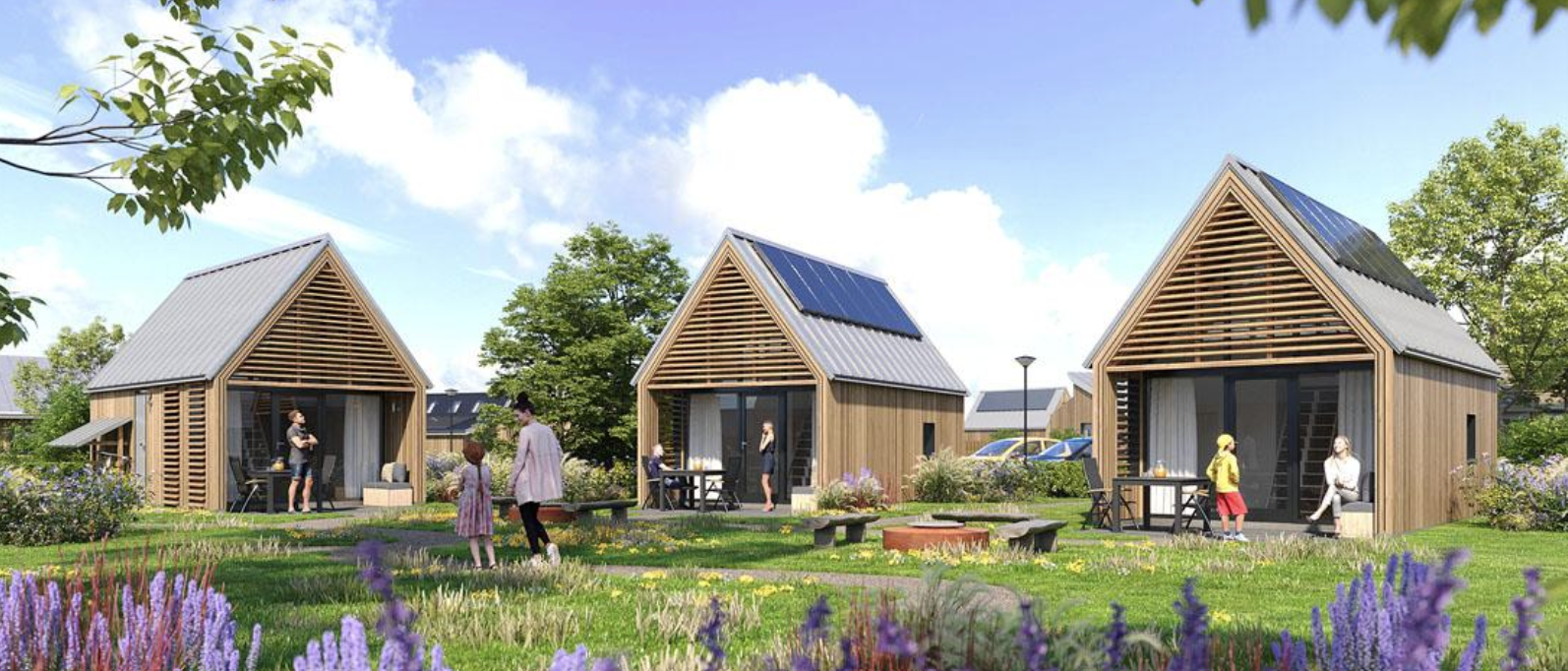
Close enough to hear your neighbor snore !
That’s NOT our goal! People come to enjoy nature in Iceland. A huge mostly empty landscape with amazing views. That should not include your neighbor’s terrace. Our primary critirion was: guests should feel comfortable walking around naked in their cabin without the fear of being seen by others 😉. Privacy is luxury!
Each cabin (approx. 55m2) will be placed about 25-80 m. apart, depending on the topography and vegetation, in such a way that they can’t ‘see’ each other and all have a onobstructed view of the fjord, mountains and/or valley.
We have identified about 40 excellent potential building spots to place these cabins which you can explore via this link. It will show you pictures and panoramic videos.
But it’s not only the spots that are spectacular: the cabin design in itself is unique and going to be a huge factor in our hotel’ USP. Nothing like this exists and yet it’s 500-year old proven technology to make it happen.
See more on our cabin design at this page.

Within an hour drive from Reykjavik yet surrounded by untouched nature and a few vacation homes (nearest at 2 km.) we have the best of both worlds.


Within an hour’s driving from Reykjavik on an excellent, partly 4-lane road. Our location used to be next to the ring road until about 20 years ago the tunnel was opened and this road lost its importance. However, it’s still kept snow-free all winter.

The airport is 45 min. from Reykavik city center and yes, we’re at a very safe distance from the recent volcanic activity near Grindavik.
After almost 2 years of searching for the right property we found it.

Most of all because of the views and surroundings:
- A hill-slope overlooking the Hvalfjörður fjord (whale fjord)
- 40% coverage with native birch trees, allowing to hide buildings all around the property. For instance, the hot springs facility building with not be seen (or at most part of its green roof) from the hotel. The different hot spring pools can all have an infinity edge yet not ‘see’ each other (when in the pool). The 20-25 cabins (dispered over 8-9 hectares) we plan in a later stage will mostly be hidden from each other and all have a fantastic view.
- Close to Iceland’s most spectacular Glymur waterfall. At 198 m. (600 ft.) the highest waterfall of Iceland (that is accessible without a helicopter).
- There is geothermal water below our land (according to the experts) providing us with endless heating of the building, pools and sidewalks (want to keep them free of snow).
- Good paved road all the way to the property (former national road).

Ask us for latest Google Earth KMZ file - A less than 3 km. drive to the public parking lot to start the hike to the Glymur waterfall. From the parking lot it’s a 3 km. hike.
- A lovely small creek next to the property, a bigger one 240 m. away with great potential for small hydropower plant (100-150 KVA).
Check the pictures here and some videos here.
The more we explored the property, the more we realized how well its topography suits our project — more than we ever imagined. The cabins can be hidden from each other between the trees, allowing an unparalleled degree of privacy. The combination of topography and tree coverage was simply perfect for realising our vision.
Our guiding principle when choosing cabin sites was simple: you must be able to walk around naked without worrying about anyone walking by. We succeeded. And looking from cabin to cabin, the most you’ll see is its roof.
We’re happy to share a Google Earth KMZ file for a closer look. Just send us a mail.
This 3D viewer also gives a great sense of the topography.
And last but not least, have a look at this page to see pictures and videos of each carefully chosen cabin site.
Enjoy and get excited !
Sewage
How Hugarro cabins handle wastewater the Icelandic way
At Hugarro, every detail of our cabin design is guided by three principles: respect for the landscape, reliability in all conditions, and simplicity of installation, operation and maintenance. Our approach to wastewater treatment is no exception — and it gives rise to one of our most quietly ingenious features: a small, fully functional utility structure that disappears almost entirely into the Icelandic hillside.
Why we separate black water and grey water
Not all wastewater is equal. In conventional systems, toilet waste and sink/shower water are combined and sent to a single treatment unit. We deliberately keep them separate — and for good reason.
Black water — from toilets only — is biologically concentrated but hydraulically modest. It contains the pathogens and nitrogen compounds that require robust biological treatment.
Grey water — from sinks, showers, and baths — accounts for 65–75% of total wastewater volume from a cabin, but carries a far lower biological load. It is primarily soap, body oils, food residue, and warm water.
Mixing the two forces a single system to handle both the peak hydraulic loads of bathing and the biological complexity of toilet waste simultaneously — a compromise in both directions. Separating them allows each system to be optimised for its actual task:
| Black water | Grey water | |
|---|---|---|
| Source | Toilets only | Sinks, showers, baths |
| Volume | Low (~50 L/person/day) | High (~100 L/person/day) |
| Biological load | High | Low–moderate |
| Treatment required | Full biological treatment | Filtration + passive biotreatment |
| Our system | Biorock BEASY-2000 | Biolan + surge buffer |
The practical result: ouir biological reactor will never be overwhelmed by peak shower or bath flows, operates well within its rated capacity at all times, and requires far less frequent maintenance than a combined system would. The grey water system, in turn, handles a cleaner, more predictable load and performs accordingly.
Black water treatment — The Biorock BEASY-2000
We treat black water (toilet waste) using the Biorock BEASY-2000, a compact, all-in-one biological treatment unit certified to the European standard EN 12566-3+A2. It was chosen after careful evaluation of available technologies, and for good reason:
Click to enlarge
No electricity, no moving parts. The BEASY-2000 operates entirely on passive aeration — wastewater flows through a mineral biofilm media bed where naturally occurring bacteria break down pollutants. There is nothing to break down, no pump to fail, no alarm to go off in the middle of the night.
Minimal maintenance. The system requires only an annual visual inspection and a desludging of the primary tank every three to five years under our low-occupancy cabin loading. No specialist equipment is needed — a licensed tanker visit every few years is all it takes.
Built for low and intermittent loads. Because we treat grey water separately, only toilet waste enters the BEASY-2000. This significantly reduces the biological load on the system — effectively placing it well within its rated capacity at all times. At this load level, the internal biofilm media may never need replacement over the lifetime of the installation.
Compact and self-contained. At just 225 × 121 × 121 cm, the entire two-stage system — primary settling tank and bioreactor — is housed in a single moulded unit. One tank, one connection, one annual check.
European certified. Discharge quality meets or exceeds the EN 12566-3+A2 standard, with BOD removal exceeding 94% and COD removal exceeding 85% in certified testing. This is a system with a documented, verified performance record across thousands of installations in Europe, including Scandinavia.
Grey water treatment — Biolan filter with surge buffer
Grey water from sinks, showers, and baths is treated by a dedicated passive filter system: the Biolan Greywater Filter, a compact Finland-land made unit designed specifically for cabin and holiday home use in cold climates. Like the BEASY-2000, it requires no electricity and has no moving parts.
Water trickles downward through successive layers of peat, mineral fibre, and activated carbon, which together remove suspended solids, organic compounds, phosphorus, and odours before the treated water reaches a soakaway or drainage field. The filter media requires replacement every few years — a straightforward task taking less than an hour.
Managing peak flows — The surge buffer tank
The Biolan filter is optimised for steady, low flow rates — ideal for showers and basin use. A bathtub, however, can release 150 litres in under five minutes: a peak flow rate some 40 times higher than the filter can accept. Sending a bathtub drain directly to the Biolan would bypass treatment entirely and risk overloading the filter media.
Our solution is simple and entirely passive: a 200-litre surge buffer tank mounted on a rack above the Biolan inside the utility shed. All grey water — from kitchen sink, shower, basin, and bath — enters the surge tank first. A small-bore outlet at the base of the tank allows water to trickle down into the Biolan at a controlled, gentle rate regardless of how fast it arrived. No sensors, no valves, no electronics — just gravity doing its job.
Kitchen sink water carries fats, oils, and greases (FOG) from cooking and dishwashing. FOG is the primary cause of premature clogging in passive grey water filters. A simple passive grease trap — a small baffled chamber where warm water slows, FOG floats to the surface, and is retained — is installed immediately after the kitchen sink drain and before the surge tank. It requires cleaning every three to six months: a quick scoop-and-dispose task during routine cabin checks.
Shower and basin water bypasses the grease trap (it carries soap but negligible FOG) and flows directly into the surge tank. This separation of kitchen and bathing water streams keeps the grease trap small and the Biolan filter performing at its best.
Winter operation
Grey water arriving from a heated cabin is warm by nature — shower water at 35°C, dishwashing water at 40°C — and warms the Biolan filter media continuously during occupancy. The utility shed enclosure, already heated passively by the BEASY-2000’s thermostat heater, maintains a stable internal temperature well above freezing throughout winter. No supplemental heating is needed for the grey water system.
In the rare event of Biolan maintenance or media replacement, grey water can be temporarily rerouted to the BEASY-2000 via a simple manual valve — a contingency built into the pipework from the start. The BEASY handles the short-term combined load with ease.
The structure — A partial dig that makes sense and looks great
Rather than burying the tanks fully underground — expensive and challenging in Iceland’s rocky volcanic substrate at several cabin locations — we partially sink a purpose-built utility enclosure into the ground, typically one metre below grade. This approach is deliberate and smart on multiple levels:
Excavation cost is kept to a minimum. Full burial of tanks in Icelandic lava rock can cost several times the price of the equipment itself. Our partial-dig approach requires a modest, manageable excavation — reducing groundwork costs significantly while achieving the same thermal and structural benefits.
The ground does the heavy lifting thermally. At one metre depth, the surrounding earth and rock maintain a stable temperature year-round — buffering the system against Iceland’s winter extremes. The three buried or bermed walls of the enclosure are insulated with moisture-resistant XPS foam board, ensuring that the internal environment stays comfortably above the minimum operating temperature even in the coldest months.
A small 200W thermostatically controlled heater — no larger than an aquarium heater — is placed in the BEASY-2000 primary tank as a backup for the coldest periods. It consumes less energy annually than a single light bulb left on for a week, and ensures the bacterial treatment community remains active and effective regardless of external conditions.
Pipe runs between the cabin and the enclosure are kept short and insulated, eliminating any risk of freezing in the connection lines.
The architecture — An Icelandic turf structure
The enclosure itself is built in the tradition of Iceland’s historic torfbær — the turf outbuildings that have sheltered tools, food stores, and animals in this landscape for over a thousand years. A simple timber-framed structure with a 30-degree pitched roof, it presents only a weathered wooden gable and a low door to the outside world. Everything else disappears under living turf.
Click to enlarge
The roof follows traditional construction: a structural timber deck, a modern EPDM rubber waterproofing membrane in place of the original birch bark, a drainage layer, and two layers of Icelandic turf slab — the lower layer grass-side down, the upper grass-side up — just as it has always been done. Within a single growing season, the roof is indistinguishable from the surrounding meadow.
Three sides of the structure are bermed with the excavated material and seeded with local grasses. The fourth side — the entrance face — can be oriented toward the cabin for convenient access, or away from the main view to preserve sightlines.
The result is a structure that is essentially invisible in the landscape — a small green rise in the ground, entirely at home in Iceland’s valleys and hillsides.
More than a utility box — A true services hub
The enclosure is dimensioned generously enough — approximately 250 × 320 cm internally — to serve as a complete services hub for each cabin cluster. Inside, every system is accessible from a single point:
| Service | Notes |
|---|---|
| Biorock BEASY-2000 | Black water biological treatment — primary tank + bioreactor in one unit |
| Biolan grey water filter | Passive filter for sink, shower, and bath water |
| 200L surge buffer tank | Mounted on rack above Biolan — absorbs peak bath flows passively |
| Kitchen sink grease trap | Protects filter media from fats, oils, and grease |
| Potable water meter & shutoff | Accessible without entering the cabin |
| Heating circuit distribution & heat exchanger | Hot water from a central source distributed to cabins from this point |
| Electrical connection point & main breaker | Per-cabin metering and isolation in one accessible location |
| Storage | Chemicals, maintenance tools, spare parts — on a simple shelf above the tanks |
This means that every utility serving the cabin can be accessed, inspected, isolated, and serviced from a single point, without entering the cabin or disturbing guests. For a hospitality operation, this is a significant operational advantage — maintenance can be performed discreetly, quickly, and at any time.
The cabin underfloor installation for the cabin turning system will have a separate access point, also avoiding the need for cabin entry during routine checks.
In summary
Our wastewater and utility approach at Hugarro combines European-certified biological treatment technology with centuries-old Icelandic building tradition. Black water and grey water are treated separately — each by a system sized and optimised for its specific task — and both housed within a single compact enclosure that is virtually invisible in the landscape.
The result is a system that is invisible to guests, kind to the environment, robust in all seasons, and straightforward to maintain — a small buried structure that quietly does everything, and shows almost nothing.
All Hugarró sewage systems meet or exceed applicable Icelandic and European standards (ÍST EN 12566 / EN 16941-2).
Hotel & geothermal pool facilities
Our hotel and pool complex is served by a compact, containerised biological treatment plant — fully out of sight and designed for the higher load of a commercial accommodation facility.
Free-standing cabins
Each cabin uses a certified two-stage septic system. We separate grey water (showers, kitchen sinks — typically up to 70% of total wastewater volume) from black water (toilets), feeding only the smaller black water stream into the septic tank. This significantly reduces tank size and the footprint of the required soakaway field — a real advantage on a site where we want to keep the land as undisturbed as possible.
Monitoring & maintenance
All systems are remotely monitored — tank levels and temperatures are tracked continuously so that any issue can be caught and resolved before it becomes a problem. Routine maintenance needs are minimal by design.
Year-round reliability — Thanks to geothermal
Iceland’s winters can challenge conventional septic systems. Because Hugarró has its own geothermal source, every cabin can be connected to gentle tank heating, ensuring reliable, trouble-free operation throughout the year — at no additional energy cost.
Water reuse
Treated effluent from the grey water systems can be used for on-site irrigation where appropriate, and otherwise infiltrates naturally back into the ground. A clean cycle, fitting for a site where clean water is both abundant and worth protecting.
Staff issues
Q: You run a high-end hotel. Surely you will use proven HR frameworks from leading international chains?
Not exactly — and here’s why that matters.
When building our performance review, onboarding, and training systems, the obvious move is to look at what major hotel brands do and borrow their playbook. It’s tempting. But it’s also a classic mistake: confusing best practice with best fit.
Q: What’s the difference?
Strategic HRM literature distinguishes two fundamentally different approaches:
| Approach | Logic | Assumption |
|---|---|---|
| Best practice (universalist) | A fixed set of high-performance work practices — pay-for-performance, extensive training, employee voice — that reliably improve outcomes everywhere | One size fits all |
| Best fit (contingency) | HR effectiveness depends entirely on context: your strategy, culture, market conditions, and workforce | Fit your HR to your organisation |
The best-practice model is popular because it’s simple and sounds reassuring. The problem? What works at a 500-room airport hotel with high turnover and standardised service doesn’t automatically translate to a boutique four-star property built around personalised guest experiences.
Q: So what did you actually do differently?
We built our HR approach around what fits us, not what looks good in a conference presentation.
- Annual appraisals → out. We replaced them with short, regular feedback conversations between managers and staff — better suited to the rhythm of a hotel where every day is different.
- Individual performance targets → out. We tied incentives to team goals: guest satisfaction scores and sustainability metrics, values that reflect our actual culture.
- Rigid frameworks → out. We kept only the elements that genuinely work in our context.
Q: Why does this matter for guests?
Because engaged, empowered staff deliver better experiences — consistently. We’re confident this approach drives higher guest satisfaction, lower staff turnover, and — most importantly — a real sense of ownership among our team.
Q: Isn’t this just reinventing the wheel?
No. It’s grounded in solid academic research. A strong fit between HR practices and organisational context consistently outperforms the adoption of fashionable frameworks.
“There is no one best way to manage people.”
> — Boxall & Purcell, Strategy and Human Resource Management
References
- Boxall, P., & Purcell, J. (2016). Strategy and Human Resource Management. Palgrave Macmillan.
- Delery, J.E., & Doty, D.H. (1996). Modes of theorizing in strategic human resource management. Academy of Management Journal, 39(4), 802–835.
- Paauwe, J. (2009). HRM and Performance. Journal of Management Studies, 46(1), 129–142.
Finding and retaining good people is never easy — and doing so in a remote location makes it harder still. That is why we have committed meaningful investment to providing on-site staff accommodation at Hugarro.
This will be particularly valuable for non-Icelandic staff who have no existing housing in the area. Reykjavik is expensive, and a daily 55-minute commute is neither practical nor desirable. By housing the key people of our team on-site and running the facility at near-full occupancy, we can keep individual costs genuinely affordable.
For staff heading into Reykjavik on days off, we also plan to acquire a house or plot close to the city where employees can rent a room at a reasonable rate — a proper place to relax away from the work environment.
Why we’re doing this
Operational reliability. In Iceland’s remote highlands, severe weather can make travel dangerous or impossible at short notice. Having staff on-site keeps the operation running safely regardless of conditions.
A real recruitment advantage. Housing shortages are a known barrier for international and seasonal workers. Bundling accommodation with a role removes the single biggest obstacle many candidates face.
Team culture. Shared living, done well, builds a strong sense of community — something that matters when you’re working and living far from home.
Cost of living support. Nordic living costs are high. Employer-provided housing directly reduces the financial pressure on employees and eliminates daily transport costs for both parties.
Honest challenges to manage
Work-life separation. When home and workplace are the same location, the boundary between on- and off-duty time can blur. Without deliberate management, this becomes a driver of burnout.
Interpersonal dynamics. A multicultural team sharing confined living spaces requires clear expectations and good conflict-resolution processes. Issues in the accommodation can quickly affect performance on the floor.
Isolation. The on-site community can be close-knit, but it can also become insular. Geographic remoteness limits organic contact with the broader local community, which matters for long-term wellbeing.
Standards matter. Cramped or poorly maintained accommodation quickly erodes morale and, by extension, service quality. The investment in decent housing is an investment in operational continuity.
How we plan to implement this well
Private space is non-negotiable. Communal areas are fine, but every employee needs a genuinely private space to decompress. Hospitality is demanding work; people need a real off switch.
Clear boundaries for managers. Off-duty means off-duty. Management will respect that line.
Thorough onboarding. New staff will be prepared not just for their role, but for the realities of communal living in a remote environment.
Peer support. Returning staff will be paired with new joiners to help them settle in — practically and socially.
The units
To avoid eating into our 5,000 m² building allowance (cabin RevPAM runs approximately 10× higher than staff accommodation so the math is straightforward), we plan to use mobile/modular units rather than permanent structures. The advantages are meaningful: no foundations required, and the units can be relocated to other sites if needed. We may also configure one as a sales or café unit to support local marketing.
Our current plan is approximately 10 units, each suitable for one person or a couple, sourced directly from a manufacturer — likely in Eastern Europe — to keep costs down.
Ideally, we will acquire nearby land in future to expand staff housing capacity if required. We know the municipality looks favorable to this kind of arrangement.
(See the Iceland Property Register for land listings.)
Reykjavik off-site base
We have budgeted for the purchase of a building plot near Reykjavik — for example, in the Mosfellsbær area — with the intent to build a dedicated staff retreat. The concept: a purpose-built prefab house with approximately 10 small private rooms, shared bathrooms, and a well-equipped common area. Non-Icelandic employees would receive an allocation of roughly 8 days per month to use the facility on breaks.
At near-full utilisation, the property would comfortably pay for itself.
Luxury in Practice — The Details That Actually Make a Difference
We recently updated our Luxury page with a clearer explanation of what luxury means to us at Hugarró. The short version: it’s not about gold taps. It’s about a stay that is calm, effortless, and restorative.
But talk is easy. So let’s get specific.
Over years of travelling and staying in hotels — good ones, average ones, and a few that deserved better reviews than they got — a pattern emerges. The stays that linger in your memory aren’t defined by the grandeur of the lobby. They’re defined by a hundred small things that either worked or didn’t. Here’s our take on what “working” actually looks like.
🛏️ The bedroom — Where rest begins
When you get up in the middle of the night, you shouldn’t have to fumble for a light switch. A discreet red LED strip beneath the bed activates the moment your feet touch the floor — low light, the right colour temperature, just enough to find your way. The bathroom light follows the same logic: it comes on softly, not at full blast.
Sleep itself matters too. Beds should be genuinely comfortable — not just described that way. We offer a pillow menu and let guests indicate their mattress firmness preference at the time of booking. Not everyone sleeps the same way, and that’s fine.
Privacy goes without saying — or it should. Rooms are positioned and designed so that nobody outside can look in.
🚿 The bathroom — A room in its own right
The bathroom is soundproofed from the main room. If your travel companion keeps different hours, that’s their business.
Toilets have a bidet function. Once you’ve had one, going back feels like a step backwards.
Showers have somewhere to put your own things — your shampoo, your conditioner, whatever you’ve brought. A simple shelf. You’d think this was standard. It isn’t.
🧹 Cleanliness — The Baseline That Can’t Slip
The place is spotless. Full stop.
We’d also add: no strange smells in changing rooms or locker areas. Ever. That one’s non-negotiable and more commonly neglected than it should be.
⚠️ Safety — The airline mindset
Some geothermal destinations have pool pathways that are genuinely hazardous in winter — slippery surfaces, steep edges, poor lighting. That is not a design quirk; it’s a liability and, more importantly, a risk to people.
We take a simple principle from aviation: if you think safety costs money, wait until you price an accident. Every pathway, every pool edge, every walkway on the property is designed and maintained with this in mind.
Pathways are kept ice-free at all times. Roads with above-average inclines are cleared of snow and ice — always. Motion-activated lighting along all routes is effective but unobtrusive. You’re guided without being spotlit.
🥾 The outdoors — Ready when you are
“I’m thinking of going for a hike. Where should I go?”
Here’s a printed map with suggested routes. Scan this QR code and load them directly into your hiking app of choice. Want a packed lunch? Give us 20 minutes. Need a rain poncho just in case? We have a few — borrow one.
When you get back, there’s a drying room where your wet gear can dry properly overnight. Complimentary slippers are waiting.
🌊 The pools — All year round
Food and drink can be ordered at all the pools. You shouldn’t have to get out just because you’re thirsty.
In winter — which in Iceland means wind, snow, and occasionally full horizontal rain — glass barriers mean you can sit in a geothermal pool and enjoy the landscape without being battered by it. We keep complimentary beanies on hand, because your head isn’t in the water. And waterproof phone pouches too, because the views are worth photographing and we want you to share them.
Private pools can be arranged on request.
🚗 The Car
“My car is filthy.”
We have a cleaning station at the entrance to the car park. Prefer someone else handles it? We can arrange that too.
🪧 Getting around the property
Signage is discrete but effective. You won’t feel like you’re navigating a theme park, but you also won’t get lost.
👥 The people — staff and guests
Our staff smiles — genuinely, not as a performance requirement. More importantly, they have the authority to resolve issues on the spot. No “I’ll need to check with management.” They just fix it.
They also speak your language in a way you can actually understand. Clear communication is part of the service.
On the guest side: we don’t allow loud, disruptive children. We know this is a commercial decision as much as a design one, and we’re comfortable with it. Hugarró is a place for people who came to rest.
♿ Accessibility — No caveats
Accessibility at Hugarró is not a box-ticking exercise. Every inch of the property is designed with full ADA compliance in mind (including some pools), and our staff are trained — properly trained — on how to support guests with disabilities in a way that is helpful without being patronising.
This connects to something we believe firmly: our staff are our most important asset. Guests feel that, or they don’t. There’s no faking it.
What Would You Add?
This list came from real experience — hotels that got it right and ones that quietly got it wrong. We’re building Hugarró around the former, and we genuinely want to know: what’s missing from this list?
What’s the detail that made a stay memorable for you — or the small thing that quietly ruined it? Let us know in the comments below.
TechStack
A property management system (PMS) is software that facilitates a hotel’s reservation management and administrative tasks. The most important functions include front-desk operations, reservations, channel management, housekeeping, rate and occupancy management, and payment processing.
To read more about the need for and advantages of a PMS, see this link.
The best PMS systems are ranked on the very informative website of Hotel TechReport: check the list here.
We don’t use any of them 😊. Not because they are not good but most of them (for instance MEWS from the Netherlands) are not supported in Iceland. This seems to have to do with the fact that Iceland is member of the
European Free Trade Association (EFTA) but not of the EU and has its own currency.
Update December 2026:
We are currently leaning towards StayNTouch but our techstack will be determined in consultation with Provision-Partners, a company of which Daniel a consulting partner and European rep.
Transportation
Rationale
The profile of Hugarró’s target clientele — high-net-worth individuals and discerning travellers for whom time and seamless experience are paramount — makes helicopter access a natural and expected feature of the offering. Several comparable ultra-luxury retreats across Europe and further afield have made private aviation access a defining element of their guest journey, and the expectation is increasingly standard at this market tier. Offering it from day one positions Hugarró firmly within that peer group.
Location constraints
Botnsdalur’s value lies precisely in its seclusion and tranquillity. Introducing helicopter traffic directly at or adjacent to the property would undermine that core asset — for the arriving guests themselves as much as for those already on site. We have therefore set a clear constraint: any landing facility must be located no more than 10 minutes by road from the property, far enough to remove all noise and visual impact, while still delivering a swift and comfortable ground transfer.
Candidate site
Initial reconnaissance has identified the industrial waterfront area in Hvalfjördur as a strong candidate. The facilities operated by Scandinavian Tank Storage AB and Olíudreifing (ODR) in the fjord represent the type of non-residential, infrastructure-grade environment that suits this purpose well.
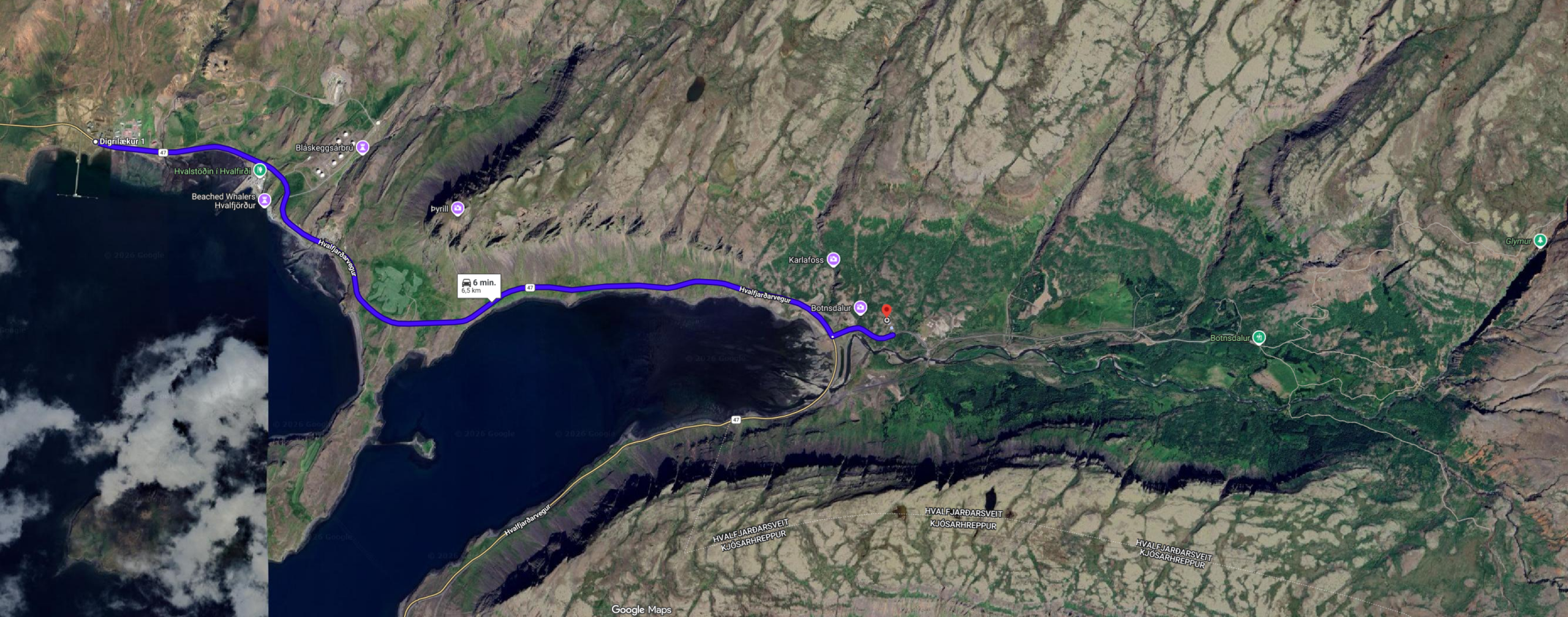
Key advantages include:
- Industrial zoning — no residential neighbours, minimal risk of noise complaints
- Open terrain with good sightlines and approach paths
- Road access to Botnsdalur within the target transfer window
- Potential proximity to Jet A1 aviation fuel storage
We intend to approach both operators to explore the possibility of a long-term land lease for a dedicated landing area. Conversations are at an early stage and no commitments have been made.
Regulatory path
Iceland’s regulatory framework — governed by the Icelandic Transport Authority (Icetra) under Regulation 464/2007 — provides a clear and well-defined route for registering a ground-level helicopter landing site. Given the intended frequency of operations (several flights per week), we will pursue full registration as a landing site rather than relying on informal cleared-area status.
This is the responsible and commercially appropriate choice, for several reasons:
- Registration gives guests, operators, and insurers confidence in the facility’s legitimacy
- It eliminates any ambiguity around whether the site constitutes an unlicensed facility
- It establishes a formal operational record, which will support future scaling or route development
- A registered site can be published in the Aeronautical Information Publication (AIP), making it accessible to any operator flying guests to Hugarró
The registration process under Icetra is manageable and well-precedented for sites of this nature.
Next steps
| Action | Owner | |
|---|---|---|
| Approach Scandinavian Tank Storage AB regarding land lease | Management | |
| Approach ODR regarding land lease | Management | |
| Site visit and preliminary technical assessment | Management + aviation consultant | |
| Initiate Icetra registration application | Aviation consultant |
Utilities
We planned for this from day one
Drilling for geothermal water in Iceland is well-founded — the geology around Hvalfjörður is exceptional and nearby wells prove the potential. But geothermal exploration always carries uncertainty. Fractures can be missed. A well can come up dry. Investors can lose patience.
We designed Hugarró so that this scenario, however unlikely (see this post), does not stop us.
Our answer is a purpose-built alternative heating system that delivers the same pools, the same warmth, the same experience — drawing heat not from the ground below, but from the river and the earth around us.
Why our heating needs are surprisingly modest
Most facilities of this kind would be in serious trouble without a geothermal source. Ours is not — because of how efficiently we use energy in the first place.
Our closed-loop pool system recirculates water rather than constantly replacing it, recovering 33% more heat than the traditional Icelandic approach. Our cascade design runs geothermal water through pools, then buildings, then roads — extracting every usable degree before returning it. Floating insulation covers eliminate heat loss overnight.
The result: our total heating demand — seven pools at 38°C, full hotel and cabin heating, road de-icing — requires the equivalent of just 1,185 kW of continuous thermal output. For a facility of this scale, that is a lean number. And it is exactly what our backup system is sized to deliver.
The alternative: CO₂ heat pumps
If no geothermal source is found, we install three Fenagy (or other reliable brand) H-600 CO₂ heat pump units, each delivering 600 kW of thermal output. Together they provide 1,800 kW of installed capacity — comfortably above our 1,185 kW peak demand, with full redundancy built in.
CO₂ (R744) is the ideal refrigerant for this application:
- GWP of 1 — the most climate-neutral refrigerant available
- No chemicals — fully aligned with Iceland’s environmental standards
- Highest efficiency in the 38–70°C output range — exactly our operating window
- Proven technology — widely used in Scandinavian district heating systems
The heat pumps run as water-to-water units, extracting heat from a local water source and delivering it at the temperatures our cascade system requires. The full cascade — pools, buildings, roads — operates identically to the geothermal design. From a guest perspective, nothing changes.
Where the heat comes from: a two-tier water source
Instead of one geothermal well, we use two complementary water sources that together provide year-round reliability.
Tier 1 — The Brunná river (primary, spring through autumn)
The Brunná flows just 200 metres from our plant room, crossing land whose owner has no objection to our intake (in fact, we are co-owner). A short insulated HDPE pipe draws water at ~6°C, passes it through a heat exchanger, and returns it a few degrees cooler. The river provides more than enough flow for our needs during the eight warmest months of the year.
Tier 2 — Two drilled groundwater wells (winter backup)
For the winter months, when surface water flow can drop and ice becomes a risk, we rely on two drilled wells at 80–150 metres depth. At that depth, groundwater in the Botnsdalur valley maintains a stable 4–6°C year-round — completely unaffected by surface weather, frost, or seasonal variation. No river. No tidal influence. No moving parts except a submersible pump in each well.
Crucially, these wells are drilled while the geothermal exploration rig is already on site — a modest incremental cost on an already-mobilised programme, and one that simultaneously provides valuable geological data to guide the deep geothermal drill.
The system switches automatically between sources based on flow sensors and temperature readings. No manual intervention required.
The buffer tank — smoothing out demand peaks
Between the heat pumps and the distribution system sits a 35 m3 insulated thermal buffer tank, maintained at 45–50°C. It acts as a reservoir of stored heat, absorbing demand peaks and allowing the heat pumps to run at steady, optimal load rather than cycling up and down.
The effect is meaningful: peak source water demand drops by around 20%, the heat pumps run more efficiently, and the system becomes more resilient to short interruptions in either water source. It is the thermal equivalent of a battery — simple, passive, and highly effective.
What it costs to run
Iceland’s electricity is among the cleanest and most affordable in Europe, generated almost entirely from hydro and geothermal sources. At current industrial tariffs:
| Scenario | Annual electricity | Annual cost |
|---|---|---|
| Winter conditions (COP 3.5) | Higher draw | — |
| Summer conditions (COP 5.0) | Lower draw | — |
| Annual average (COP ~3.8) | ~2,730 MWh | ~€240,000/year |
For every unit of electricity the heat pumps consume, they deliver 3.8 units of heat — the rest comes free from the river or the wells. Compared to direct electric heating, the CO₂ heat pump system saves approximately €750,000 per year in energy costs.
How the two systems compare
| Geothermal well | CO₂ heat pump backup | |
|---|---|---|
| Heat source | Earth (70–90°C) | River + groundwater wells |
| Electricity required | Minimal (pumps only) | ~312 kW continuous |
| Annual energy cost | Near zero | ~€240,000 |
| Guest experience | Identical | Identical |
| Environmental impact | Zero discharge | Zero discharge |
| Cascade compatibility | Full | Full |
| CO₂ emissions | Zero | Zero (Icelandic grid) |
The bottom line
Finding geothermal water is our ambition and our expectation. The geology strongly supports it. But if exploration falls short, Hugarró does not fall with it.
Our backup system — three CO₂ heat pumps, two groundwater wells, a river intake, and a thermal buffer — delivers the same warmth, the same pools, and the same guest experience at a known, manageable operating cost. It was engineered in parallel with the geothermal design, not as an afterthought.
We are not betting everything on a single drill result. That is how Hugarró was designed.
Electrical power passes over our land but allows only a 1-phase, 80 A. connection. We need a lot more.
The image below shows the grid of the rural utility company RARIK. The 3-phase grid ends about 3.7 km west of us (orange dot)..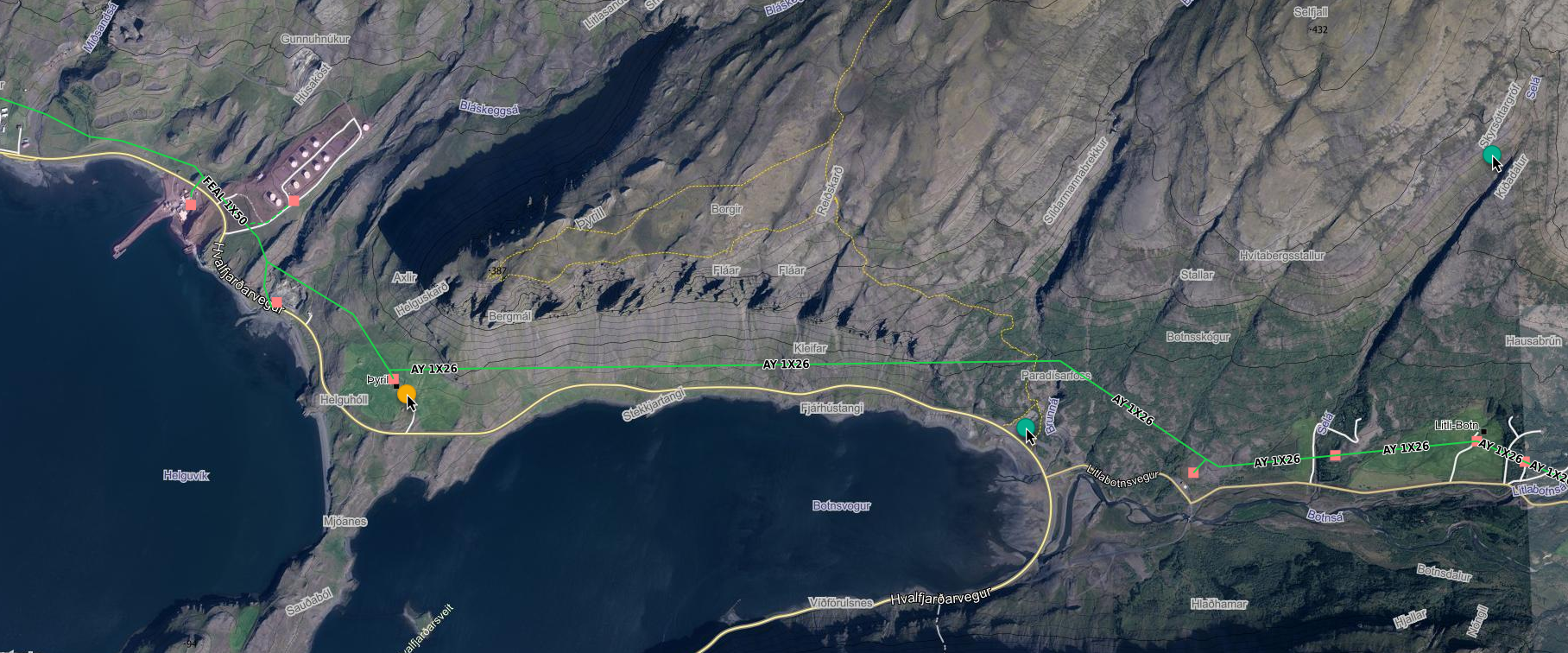
These images gives a better idea. Click to enlarge. 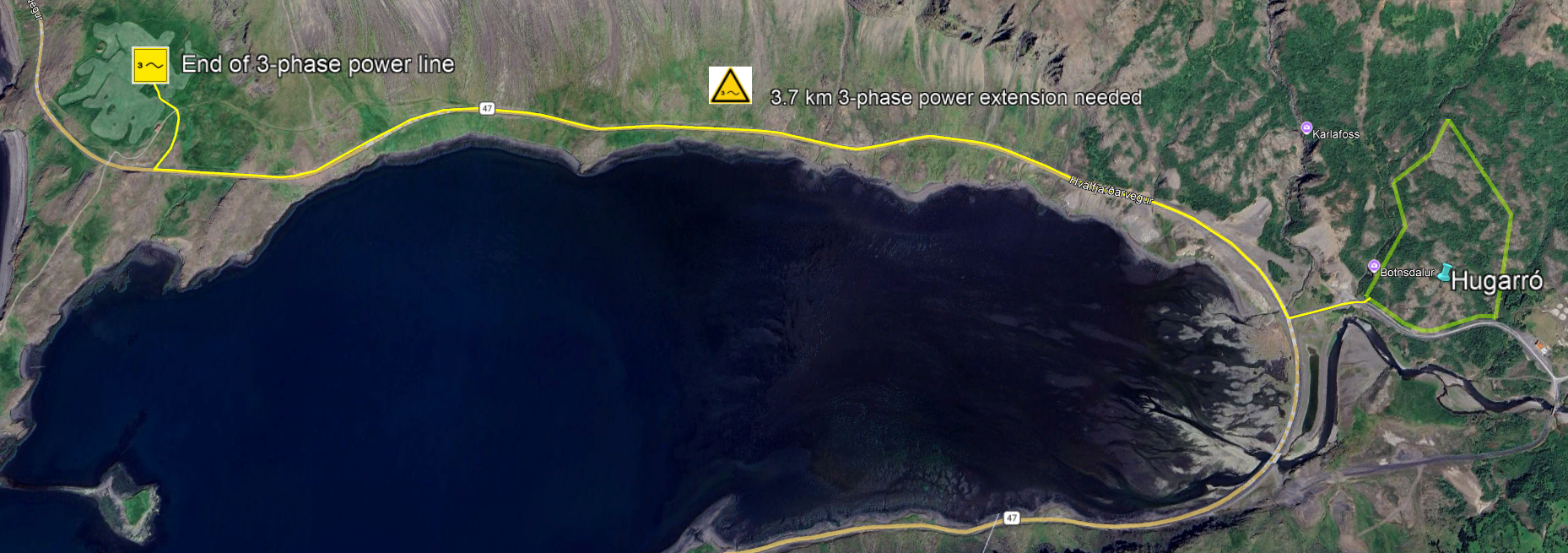
One we have defined our exact electrical power needs, the utility company is legally required to install the line. New regulation and international funding mean this extension will be installed subterranean which assures highest reliablity even under most challenging weather conditions.
Another option is a small hydropower plant in the Brunná river (240 m. from our property). This has potential to generate 30-150 KW, depending on the season (water flow varies). The estimated investment is about 400K.
The landowner is not opposed to this but this option will take time. Permitting for plants under 200 KW is relatively easy and straight forward in Iceland.
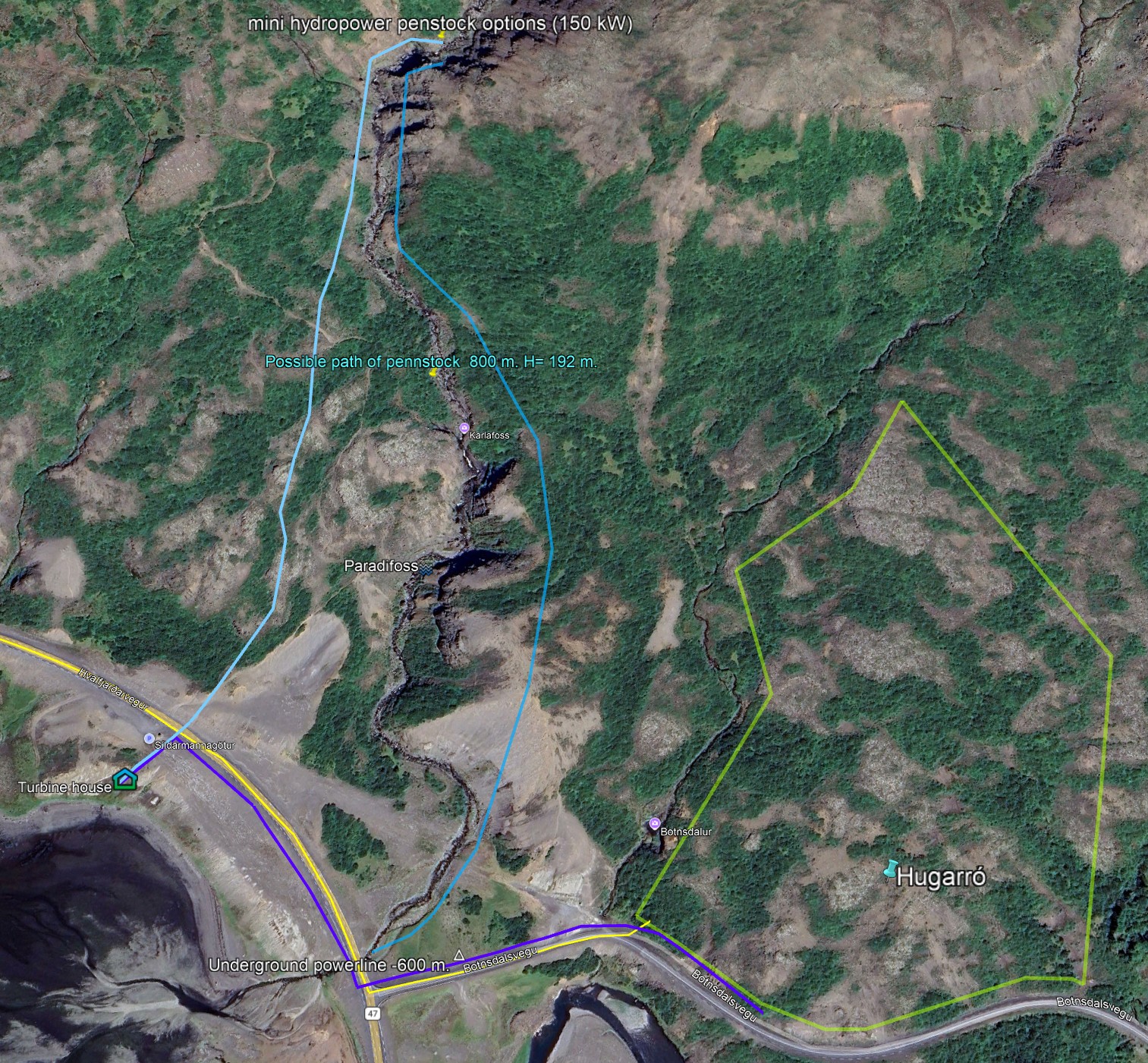
The law in Iceland allows us to sell our electricity (and hot water service) to our direct neighbours. In time this alone will help us recover all related investments.
Of course an on-site backup diesel generator will be part of our power availability strategy.
Our energy source: the earth itself
Hugarró is heated entirely by geothermal energy — natural heat drawn from deep underground. It powers our pools, our hot water, our buildings, and even our roads in winter. No fossil fuels. No emissions. No utility bills.
Smarter than the traditional approach
The standard practice in Iceland is to continuously replace pool water with fresh geothermal water — discarding around 230 m³ of hot water into nature every single day. We think that is wasteful, and we designed our way around it.
Our pools use a closed-loop recirculation system: water stays in the pools and is kept clean through UV disinfection and ultrafiltration membranes — the same technology used in drinking water treatment. No chemicals are used or permitted in Iceland. A real-time microbiological monitoring system continuously checks water quality across all seven pools, so you are always swimming in water that is measurably clean.
The result? We use 91% less water than a traditional Icelandic pool operation, and we recover 33% more heat energy by not throwing it away.
One source, four uses — in sequence
Rather than drawing separate energy for each need, we run our geothermal water through a cascade:
- Geothermal pools — water enters at 70°C and heats our pools to a perfect 38°C
- Hotel & cabin heating — the same water, still warm at 50°C, then heats all our buildings
- Hot tap water — covered in the same circuit
- Road de-icing — remaining warmth is used to keep paths and roads clear in winter
The water is then returned underground at 30°C — completing a fully closed, zero-discharge cycle.
A modest well is all we need
Because our system is so efficient, a geothermal well yielding just 7–10 litres per second at 70°C covers all our needs — pools, buildings, roads, and future expansion. For context, a typical productive well in Iceland delivers 15–50 litres per second. We are not greedy with the resource.
This also means we have realistic capacity to supply heating to neighbouring summer homes and future development in the area — turning a facility cost into a potential revenue stream.
The bottom line
| Traditional Icelandic pools | Hugarró | |
|---|---|---|
| Daily water discharged to nature | 230 m³ | 0 m³ |
| Heat energy wasted | 33% | 0% |
| Chemicals in pool water | None | None |
| Well yield required | 15–50 L/s | 7–10 L/s |
| Neighbours supplied with heat | No | Yes — planned |
Vacation home district heating — Iceland
Prepared: September 2026 | Confidential — For Discussion Purposes
Executive Summary
Our geothermal project will generate significantly more thermal capacity than the primary development requires. We propose to monetise this surplus by supplying hot water to a neighbouring planned vacation home community of 50 homes across two clusters. The developer of that community has indicated willingness to co-invest in the distribution infrastructure, which materially de-risks the project and compresses the payback period to approximately 10–11 years on a shared CAPEX basis — well within the operational lifespan of the asset (30–40 years).
This is a low-marginal-cost, recurring revenue stream built on zero-cost fuel.
Project overview
| Parameter | Detail |
|---|---|
| Heat source | Geothermal (surplus capacity from primary project) |
| Customers — Phase 1 | 25 vacation homes, Cluster A |
| Customers — Phase 2 | 25 vacation homes, Cluster B |
| Distance to Cluster A | 800 m from source |
| Distance to Cluster B | 1,700 m from source |
| Billing model | Fixed annual subscription + flow capacity |
| Developer role | Co-investor in pipeline infrastructure (50% CAPEX) |
Capital expenditure
| Item | Total Cost | Developer (50%) | Our Share (50%) |
|---|---|---|---|
| Trunk line, Source → Cluster A (800 m) | €524,800 | €262,400 | €262,400 |
| Extension, Cluster A → Cluster B (900 m) | €590,400 | €295,200 | €295,200 |
| Internal distribution, Cluster A | €173,700 | €86,850 | €86,850 |
| Internal distribution, Cluster B | €173,700 | €86,850 | €86,850 |
| Pump station & substations | €65,000 | €32,500 | €32,500 |
| Metering cabinets (50 homes) | €75,000 | €37,500 | €37,500 |
| Total | €1,602,600 | €801,300 | €801,300 |
| Less: Connection fees collected (50 × €3,200) | –€160,000 | ||
| Net CAPEX outlay | €641,300 |
Build is phased: Phase 1 (Cluster A, ~€801k) triggers on Cluster A construction start; Phase 2 (Cluster B) triggers on Cluster B confirmation. No idle capital.
Revenue & Financial Projection
| Revenue Item | Annual |
|---|---|
| Subscriptions — 40 standard homes (×€1,450/yr) | €58,000 |
| Subscriptions — 10 hot tub homes (×€1,750/yr) | €17,500 |
| Gross Revenue | €75,500 |
| Operating costs (maintenance, pumping, admin) | –€15,000 |
| Net Annual Income | €60,500 |
| Financial Metric | Value |
|---|---|
| One-time connection fee income | €160,000 |
| Net annual income (steady state) | ~€60,500 |
| Net CAPEX after connection fees | €641,300 |
| Payback period | ~10.6 years |
| Revenue from year 11 onwards | Near-pure margin |
| Asset operational life | 30–40 years |
Why the developer co-invests
The developer’s motivation is straightforward. In Iceland, geothermal hot water access is a market baseline expectation — lots without it sell at a meaningful discount. Based on regional comparables, reliable hot water supply adds an estimated €15,000–€25,000 per lot in realised sale value. Across 50 lots, that represents a €750k–€1.25M uplift in gross development value — making a €800k infrastructure contribution not just reasonable, but commercially rational. We are effectively subsidising their product quality.
This alignment of interests is a structural strength of the deal.
Key strengths
- Zero fuel cost. The heat is a by-product of our existing geothermal investment. Marginal cost of production is effectively nil.
- Recurring, inflation-linked income. Subscription tariffs are typically indexed to energy price benchmarks. Utility revenues are sticky and predictable.
- Captive customer base. Once connected, switching costs are prohibitive. Customer churn is essentially zero.
- Developer co-investment halves our exposure and signals strong demand validation before a single pipe is laid.
- Phased build eliminates idle capital risk. Phase 2 is only committed when Cluster B development is confirmed.
- Enhances our own project’s social licence. Community benefit strengthens planning relationships and long-term operating position.
- Gateway asset. Once operational, additional projects in the area will find our infrastructure already in place, with extension economics improving per additional customer.
Risks & mitigants
| Risk | Likelihood | Mitigant |
|---|---|---|
| Developer delays Phase 2 or backs out | Medium | Phase-gate agreements; Phase 1 is independently viable |
| Connection take-up below 100% | Medium | Mandatory connection covenant in lot sale contracts |
| Hot water chemistry unsuitable for bathing | Low–Medium | Test borehole water pre-commitment; heat exchanger option |
| Regulatory licence requirement (Orkustofnun) | Low–Medium | Early engagement with regulator; licence process is established |
| Pipeline CAPEX overrun | Medium | Fixed-price contractor quotes locked before commitment; 10% contingency |
| Developer seeks equity/pricing control | Medium | Contribution structured as infrastructure grant, not equity; ownership stays with us |
| Phase 2 development delayed 3–5 years | Medium | Phase-gating means no stranded capital; Phase 1 payback unaffected |
Strategic upside (not in base case)
10 existing vacation homes in the wider area were judged too dispersed and few to connect at present. As our network grows and additional developments emerge, incremental connections become progressively cheaper per home.
- Future developments attracted by proven geothermal infrastructure can be connected on similar commercial terms — each new customer improves the network economics for all parties.
- Carbon credit potential. Displacing oil or electric boiler heating with geothermal may qualify under relevant Icelandic or European carbon mechanisms — upside not yet quantified.
Summary verdict
This is a long-duration, low-risk infrastructure asset generating clean recurring income from a zero-cost fuel source, with a co-investing partner whose financial interests are directly aligned with ours. The 10.6-year payback on net invested capital is conservative — and from year 11, the revenue stream runs largely unconstrained for a further 20–30 years.
The primary negotiation priority is the mandatory connection covenant in the developer’s lot sale contracts. That single clause converts a projected revenue stream into a contractual one — and that is the difference between a good investment and an excellent one.
This document is prepared for discussion purposes only and does not constitute a formal investment prospectus. All figures are estimates based on comparable Icelandic district heating projects and are subject to detailed engineering and commercial due diligence.
How Hugarro cabins handle wastewater the Icelandic way
At Hugarro, every detail of our cabin design is guided by three principles: respect for the landscape, reliability in all conditions, and simplicity of installation, operation and maintenance. Our approach to wastewater treatment is no exception — and it gives rise to one of our most quietly ingenious features: a small, fully functional utility structure that disappears almost entirely into the Icelandic hillside.
Why we separate black water and grey water
Not all wastewater is equal. In conventional systems, toilet waste and sink/shower water are combined and sent to a single treatment unit. We deliberately keep them separate — and for good reason.
Black water — from toilets only — is biologically concentrated but hydraulically modest. It contains the pathogens and nitrogen compounds that require robust biological treatment.
Grey water — from sinks, showers, and baths — accounts for 65–75% of total wastewater volume from a cabin, but carries a far lower biological load. It is primarily soap, body oils, food residue, and warm water.
Mixing the two forces a single system to handle both the peak hydraulic loads of bathing and the biological complexity of toilet waste simultaneously — a compromise in both directions. Separating them allows each system to be optimised for its actual task:
| Black water | Grey water | |
|---|---|---|
| Source | Toilets only | Sinks, showers, baths |
| Volume | Low (~50 L/person/day) | High (~100 L/person/day) |
| Biological load | High | Low–moderate |
| Treatment required | Full biological treatment | Filtration + passive biotreatment |
| Our system | Biorock BEASY-2000 | Biolan + surge buffer |
The practical result: ouir biological reactor will never be overwhelmed by peak shower or bath flows, operates well within its rated capacity at all times, and requires far less frequent maintenance than a combined system would. The grey water system, in turn, handles a cleaner, more predictable load and performs accordingly.
Black water treatment — The Biorock BEASY-2000
We treat black water (toilet waste) using the Biorock BEASY-2000, a compact, all-in-one biological treatment unit certified to the European standard EN 12566-3+A2. It was chosen after careful evaluation of available technologies, and for good reason:
Click to enlarge
No electricity, no moving parts. The BEASY-2000 operates entirely on passive aeration — wastewater flows through a mineral biofilm media bed where naturally occurring bacteria break down pollutants. There is nothing to break down, no pump to fail, no alarm to go off in the middle of the night.
Minimal maintenance. The system requires only an annual visual inspection and a desludging of the primary tank every three to five years under our low-occupancy cabin loading. No specialist equipment is needed — a licensed tanker visit every few years is all it takes.
Built for low and intermittent loads. Because we treat grey water separately, only toilet waste enters the BEASY-2000. This significantly reduces the biological load on the system — effectively placing it well within its rated capacity at all times. At this load level, the internal biofilm media may never need replacement over the lifetime of the installation.
Compact and self-contained. At just 225 × 121 × 121 cm, the entire two-stage system — primary settling tank and bioreactor — is housed in a single moulded unit. One tank, one connection, one annual check.
European certified. Discharge quality meets or exceeds the EN 12566-3+A2 standard, with BOD removal exceeding 94% and COD removal exceeding 85% in certified testing. This is a system with a documented, verified performance record across thousands of installations in Europe, including Scandinavia.
Grey water treatment — Biolan filter with surge buffer
Grey water from sinks, showers, and baths is treated by a dedicated passive filter system: the Biolan Greywater Filter, a compact Finland-land made unit designed specifically for cabin and holiday home use in cold climates. Like the BEASY-2000, it requires no electricity and has no moving parts.
Water trickles downward through successive layers of peat, mineral fibre, and activated carbon, which together remove suspended solids, organic compounds, phosphorus, and odours before the treated water reaches a soakaway or drainage field. The filter media requires replacement every few years — a straightforward task taking less than an hour.
Managing peak flows — The surge buffer tank
The Biolan filter is optimised for steady, low flow rates — ideal for showers and basin use. A bathtub, however, can release 150 litres in under five minutes: a peak flow rate some 40 times higher than the filter can accept. Sending a bathtub drain directly to the Biolan would bypass treatment entirely and risk overloading the filter media.
Our solution is simple and entirely passive: a 200-litre surge buffer tank mounted on a rack above the Biolan inside the utility shed. All grey water — from kitchen sink, shower, basin, and bath — enters the surge tank first. A small-bore outlet at the base of the tank allows water to trickle down into the Biolan at a controlled, gentle rate regardless of how fast it arrived. No sensors, no valves, no electronics — just gravity doing its job.
Kitchen sink water carries fats, oils, and greases (FOG) from cooking and dishwashing. FOG is the primary cause of premature clogging in passive grey water filters. A simple passive grease trap — a small baffled chamber where warm water slows, FOG floats to the surface, and is retained — is installed immediately after the kitchen sink drain and before the surge tank. It requires cleaning every three to six months: a quick scoop-and-dispose task during routine cabin checks.
Shower and basin water bypasses the grease trap (it carries soap but negligible FOG) and flows directly into the surge tank. This separation of kitchen and bathing water streams keeps the grease trap small and the Biolan filter performing at its best.
Winter operation
Grey water arriving from a heated cabin is warm by nature — shower water at 35°C, dishwashing water at 40°C — and warms the Biolan filter media continuously during occupancy. The utility shed enclosure, already heated passively by the BEASY-2000’s thermostat heater, maintains a stable internal temperature well above freezing throughout winter. No supplemental heating is needed for the grey water system.
In the rare event of Biolan maintenance or media replacement, grey water can be temporarily rerouted to the BEASY-2000 via a simple manual valve — a contingency built into the pipework from the start. The BEASY handles the short-term combined load with ease.
The structure — A partial dig that makes sense and looks great
Rather than burying the tanks fully underground — expensive and challenging in Iceland’s rocky volcanic substrate at several cabin locations — we partially sink a purpose-built utility enclosure into the ground, typically one metre below grade. This approach is deliberate and smart on multiple levels:
Excavation cost is kept to a minimum. Full burial of tanks in Icelandic lava rock can cost several times the price of the equipment itself. Our partial-dig approach requires a modest, manageable excavation — reducing groundwork costs significantly while achieving the same thermal and structural benefits.
The ground does the heavy lifting thermally. At one metre depth, the surrounding earth and rock maintain a stable temperature year-round — buffering the system against Iceland’s winter extremes. The three buried or bermed walls of the enclosure are insulated with moisture-resistant XPS foam board, ensuring that the internal environment stays comfortably above the minimum operating temperature even in the coldest months.
A small 200W thermostatically controlled heater — no larger than an aquarium heater — is placed in the BEASY-2000 primary tank as a backup for the coldest periods. It consumes less energy annually than a single light bulb left on for a week, and ensures the bacterial treatment community remains active and effective regardless of external conditions.
Pipe runs between the cabin and the enclosure are kept short and insulated, eliminating any risk of freezing in the connection lines.
The architecture — An Icelandic turf structure
The enclosure itself is built in the tradition of Iceland’s historic torfbær — the turf outbuildings that have sheltered tools, food stores, and animals in this landscape for over a thousand years. A simple timber-framed structure with a 30-degree pitched roof, it presents only a weathered wooden gable and a low door to the outside world. Everything else disappears under living turf.
Click to enlarge
The roof follows traditional construction: a structural timber deck, a modern EPDM rubber waterproofing membrane in place of the original birch bark, a drainage layer, and two layers of Icelandic turf slab — the lower layer grass-side down, the upper grass-side up — just as it has always been done. Within a single growing season, the roof is indistinguishable from the surrounding meadow.
Three sides of the structure are bermed with the excavated material and seeded with local grasses. The fourth side — the entrance face — can be oriented toward the cabin for convenient access, or away from the main view to preserve sightlines.
The result is a structure that is essentially invisible in the landscape — a small green rise in the ground, entirely at home in Iceland’s valleys and hillsides.
More than a utility box — A true services hub
The enclosure is dimensioned generously enough — approximately 250 × 320 cm internally — to serve as a complete services hub for each cabin cluster. Inside, every system is accessible from a single point:
| Service | Notes |
|---|---|
| Biorock BEASY-2000 | Black water biological treatment — primary tank + bioreactor in one unit |
| Biolan grey water filter | Passive filter for sink, shower, and bath water |
| 200L surge buffer tank | Mounted on rack above Biolan — absorbs peak bath flows passively |
| Kitchen sink grease trap | Protects filter media from fats, oils, and grease |
| Potable water meter & shutoff | Accessible without entering the cabin |
| Heating circuit distribution & heat exchanger | Hot water from a central source distributed to cabins from this point |
| Electrical connection point & main breaker | Per-cabin metering and isolation in one accessible location |
| Storage | Chemicals, maintenance tools, spare parts — on a simple shelf above the tanks |
This means that every utility serving the cabin can be accessed, inspected, isolated, and serviced from a single point, without entering the cabin or disturbing guests. For a hospitality operation, this is a significant operational advantage — maintenance can be performed discreetly, quickly, and at any time.
The cabin underfloor installation for the cabin turning system will have a separate access point, also avoiding the need for cabin entry during routine checks.
In summary
Our wastewater and utility approach at Hugarro combines European-certified biological treatment technology with centuries-old Icelandic building tradition. Black water and grey water are treated separately — each by a system sized and optimised for its specific task — and both housed within a single compact enclosure that is virtually invisible in the landscape.
The result is a system that is invisible to guests, kind to the environment, robust in all seasons, and straightforward to maintain — a small buried structure that quietly does everything, and shows almost nothing.
A detailed water consumption analysis
Methodology & assumptions
The estimates below are built from industry benchmarks for 4-star hospitality operations, adjusted for Hugarro’s strong water-conservation focus (low-flow showerheads, dual-flush toilets, modern laundry machines and unique closed-circulation geothermal pool heating system.
Two scenarios are presented:
- Low scenario — minimum occupancy (≈60%), best-in-class water efficiency
- High scenario — near-full occupancy (≈95%), standard conservative usage
Occupancy & headcount assumptions
| Facility | Capacity | Low Scenario | High Scenario |
|---|---|---|---|
| Hotel rooms (32) | 200 guests | 120 guests (22 rooms) | 190 guests (30 rooms) |
| Cabins bath+shower (20, max 2 pax) | 40 guests | 24 guests | 40 guests |
| Cabins shower only (12, max 4 pax) | 48 guests | 32 guests | 48 guests |
| Staff cabins (10, max 2 pax) | 20 staff | 10 staff | 20 staff |
| Meeting cabins (5) | ~50 day visitors | 10 persons | 40 persons |
| Hot springs visitors | 400/day | 200/day | 400/day |
| Hot springs restaurant (50 seats) | ~150 covers/day | 50 covers | 150 covers |
| Hotel restaurant + bar | ~300 covers/day | 200 covers | 300 covers |
🚿 Potable water consumption
Used for: human consumption, showering, bathing, inside cleaning, laundry
Unit benchmarks applied:
- Shower (low-flow, 6–10 L/min): mandatory hot springs shower 1.5 min = 9–15 L/person 2
- 4-star hotel room benchmark: 140–300 L/guest/night (potable items minus toilet) 68
- Modern laundry: 5–10 L/kg linen; assume 3–5 kg/room/day 5
- Restaurant/kitchen: 30–60 L per cover (kitchen, dishwashing, staff) 3
| User Area | Detail | Low (m³/day) | High (m³/day) |
|---|---|---|---|
| Hotel rooms | 120–190 guests × 120–200 L/guest (shower, sink, drinking; excl. toilet) | 14.4 | 38.0 |
| Cabins bath+shower (20) | 24–40 guests × 130–220 L (incl. bath fill 150–200 L) | 3.1 | 8.8 |
| Cabins shower only (12) | 32–48 guests × 100–160 L/guest | 3.2 | 7.7 |
| Staff cabins (10) | 10–20 persons × 100–150 L/person | 1.0 | 3.0 |
| Hotel restaurant + bar | 200–300 covers × 30–60 L/cover (kitchen, dishwash, bar) | 6.0 | 18.0 |
| Hot springs restaurant | 50–150 covers × 30–60 L/cover | 1.5 | 9.0 |
| Hot springs showers | 200–400 visitors × 2 showers × 1.5 min × 6–10 L/min | 3.6 | 12.0 |
| Inside cleaning / housekeeping | Hotel + cabins rooms/surfaces; ~10–20 L/room occupied | 0.5 | 2.0 |
| Meeting cabins | Drinking water only; 10–40 persons × 2–5 L | 0.02 | 0.2 |
| In-house laundry | Hotel + cabins linen 3–5 kg/room × 6–10 L/kg; hot springs towels 200–400 sets × 0.5 kg × 6–10 L | 1.4 | 5.1 |
| POTABLE SUBTOTAL | ~34.7 | ~103.8 |
🪣 Filtered (non-potable) water consumption
Used for: toilet flushing, outdoor cleaning, gardening, car washing, fire system, pool suppletion
Unit benchmarks applied:
- Dual-flush toilet (water-saving): avg 4–5 L/flush, ~4 flushes/person/day 4
- High-pressure car wash: 30–80 L/vehicle 7
- Pool suppletion: given max 25 m³/day (covers evaporation + UF process losses)
| User Area | Detail | Low (m³/day) | High (m³/day) |
|---|---|---|---|
| Toilet flushing — hotel, cabins, staff, meeting | ~200–350 persons × 4 flushes × 4.5 L/flush | 3.6 | 6.3 |
| Toilet flushing — hot springs facility | 200–400 visitors × 2 flushes × 4.5 L | 1.8 | 3.6 |
| Outdoor/facility cleaning | Hard surfaces, equipment, pathways | 0.2 | 1.0 |
| Gardening / irrigation | Iceland climate (moderate, partial landscaping) | 0.5 | 3.0 |
| Car washing (high-pressure) | 20–60 vehicles/day × 30–80 L/vehicle | 0.6 | 4.8 |
| Fire hydrant system | Standby / periodic testing (not an active daily draw) | 0.05 | 0.1 |
| Geothermal pool suppletion | Evaporation + UF process water losses (given: max 25 m³/day) | 10.0 | 25.0 |
| FILTERED SUBTOTAL | ~16.8 | ~43.8 |
♨️ Geothermal water
| Use | Consumption | Notes |
|---|---|---|
| Heat extraction (heat exchangers) | Net zero consumption | Water is circulated through heat exchangers and fully returned to the aquifer. Zero net extraction. Long-term sustainability protected. |
🚽 Sewage / Wastewater
| Stage | Volume (estimated) | Notes |
|---|---|---|
| Raw sewage generated | Low: ~40 m³/day | High: ~120 m³/day | Approximately 80–90% of potable + some filtered water input |
| After 2-stage treatment | Low: ~36 m³/day | High: ~108 m³/day | Quality suitable for irrigation/car wash reuse |
| Current disposition | Filtered into soil | Could offset significant filtered water needs in future |
🔬 UF Plant — potable water treatment losses
When filtered water is upgraded to potable, the UF treatment plant itself consumes water for backwashing. At typical UF recovery rates of 90–95%: 1
| Scenario | Potable demand | Feed water needed | UF process waste |
|---|---|---|---|
| Low | 34.7 m³/day | ~37.7 m³/day | ~3.0 m³/day |
| High | 103.8 m³/day | ~113.0 m³/day | ~9.2 m³/day |
This UF waste becomes part of the sewage/drainage stream.
📊 Consolidated Summary
| Water Type | Low (m³/day) | High (m³/day) |
|---|---|---|
| Filtered — all other uses (toilets, garden, cars, etc.) | 6.8 | 18.8 |
| Filtered — pool suppletion (evaporation) | 10.0 | 25.0 |
| Filtered — UF pool plant process waste | 3.0 | 9.2 |
| Filtered subtotal (revised) | ~19.8 | ~53.0 |
| Potable water consumed | 34.7 | 103.8 |
| TOTAL gross water extraction | ~58 | ~165 |
⚖️ Comparison with extraction permits
| Source | Permit | Hourly | Daily Capacity |
|---|---|---|---|
| Drilled well | 11 m³/hr | 264 m³/day | |
| Mígandalaekur creek | 5 m³/hr | 120 m³/day | |
| Total permitted | 384 m³/day |
| Scenario | Total extraction needed | % of permit used | Surplus |
|---|---|---|---|
| Low | ~58 m³/day | 15% | 326 m³/day |
| High | ~164 m³/day | 43% | 220 m³/day |
Winter source capacity
| Source | Summer (permitted) | Winter (actual) |
|---|---|---|
| Drilled well | 264 m³/day (11 m³/hr) | 264 m³/day (unchanged) |
| Mígandalaekur creek | 120 m³/day (5 m³/hr) | 43.2 m³/day (0.5 L/s) |
| Total available | 384 m³/day | 307.2 m³/day |
The creek drops from a generous 120 m³/day to just 43.2 m³/day in winter — a loss of 76.8 m³/day. However, the well alone at 264 m³/day more than covers all operational needs.
Winter capacity vs. consumption
| Scenario | Consumption | Winter Capacity | Surplus | % Used |
|---|---|---|---|---|
| Low | 58 m³/day | 307.2 m³/day | 249.2 m³/day | 19% |
| High | 165 m³/day | 307.2 m³/day | 142.2 m³/day | 54% |
Key observation
The well alone (264 m³/day) already exceeds even our worst-case daily consumption (165 m³/day) by 99 m³/day. The creek in winter is essentially a bonus source, not a critical dependency.
One practical note worth flagging: in cold Icelandic winters, creek flow can be further affected by freezing. This accounts for ice-reduced flo. Even in that extreme case, the well alone keeps us fully operational.
✅ Both scenarios are well within permitted limits, confirming ample capacity to supply neighbouring communities and local businesses with treated drinking water, as planned.
Additional notes & caveats
- Geothermal pool UF waste is already factored into the 25 m³/day pool suppletion figure (as stated), so it is not double-counted.
- Sewage water reuse — if the treated sewage (2-stage) is eventually used for irrigation and car washing, this could offset 3–8 m³/day of filtered water demand.
- Iceland climate moderates outdoor irrigation needs significantly vs. southern European resorts.
- Hot springs showers are short (1.5 min mandatory) but high-volume due to 400 visitors. Even with low-flow heads at 6–8 L/min, this is a meaningful potable water draw (3.6–12 m³/day).
- Bathtub cabins carry disproportionate water intensity — a single bath fill of 150–200 L versus ~45 L for a 6-minute shower. Offering incentives to use showers over baths would meaningfully reduce consumption.
- Laundry represents only 1.4–5.1 m³/day with modern machines — a significant improvement over older equipment (which could reach 15 L/kg).
- The hotel restaurant is the single largest potable water consumer after hotel rooms, due to kitchen and dishwashing operations at scale.
Zoning plan
With 12.1 hectares in total and about 8.7 hectares reserved for cabins, we would probably add 350 cabins if we were in the Netherlands!
Close enough to hear your neighbor snore !
That’s NOT our goal! People come to enjoy nature in Iceland. A huge mostly empty landscape with amazing views. That should not include your neighbor’s terrace. Our primary critirion was: guests should feel comfortable walking around naked in their cabin without the fear of being seen by others 😉. Privacy is luxury!
Each cabin (approx. 55m2) will be placed about 25-80 m. apart, depending on the topography and vegetation, in such a way that they can’t ‘see’ each other and all have a onobstructed view of the fjord, mountains and/or valley.
We have identified about 40 excellent potential building spots to place these cabins which you can explore via this link. It will show you pictures and panoramic videos.
But it’s not only the spots that are spectacular: the cabin design in itself is unique and going to be a huge factor in our hotel’ USP. Nothing like this exists and yet it’s 500-year old proven technology to make it happen.
See more on our cabin design at this page.
Update September 1, 2026
The public comment phase on our detail zoning plan (deliskipulag) has closed. The municipality is reviewing the comments and with our ELFA consultants addressing them before they send it to HMS/Skipulagstofnun – the national planning agency for review.. We expect this to be wrapped up before the end of the month.
 As we started this project, the municipal council has consistently and unanimouisly approved each step of the process. They support us 200%. In fact, the former major once told us: ‘we need this project’. After all, 50.000 people visit the Glymur area each year without leaving any revenue for the municipality. Based on projection, we think our project once fully operational will increase the municipal tax revenue with 10-15%. That is a welcome improvement for a small municipality likeHvalfjarðarsveit.
HMS then has 4 weeks to review and ask for clarifications. In practice, this time may be extended to 6-8 weeks. After their approval it will be published in the national gazette (Stjórnartíðindi).
Our masterplan limits us to a maximum of 5,000 m² of built area — just 4% of the total site. Unroofed structures such as parking, roads, and pools are excluded from this calculation, which we consider a real advantage of Iceland’s planning regulations.
Mobile structures — including our planned staff housing on wheels, a containerized laundry, sewage treatment plant, watertanks, etc. — are not counted initially, but may be classified as permanent after two years, at which point we can relocate them. The ideal scenario: as demand for meetings and events grows, the spaces currently used for staff cabins become available for guest cabins, while staff accommodation moves to a nearby property within walking or cycling distance.
Why this voluntary limit?
Staying within 5,000 m² allows us to avoid the mandatory environmental impact assessment (EIA). We are confident we would pass such a study, but it could might add some extra time to the permit process and of course add additional consulting costs.
Our consultants at ELFA recommended we start within this 5,000 m² envelope. If, after a year or two of operation, we need more capacity, we will be well-placed to support the required EIA with a demonstrated track record of responsible, low-impact management.
Update August 28:
In consultation with the municipality and our EFLA consultants, we have decided to ask the Planning Ministry whether an EIA is required — proactively, rather than risk complaints that we stayed just under the threshold to avoid scrutiny. We are confident we will pass with flying colors, and full transparency now will also make it easier to add building capacity in the future.