A positive public consultation outcome for the Hugarró Nature Retreat project in Iceland

Wonderful news!  (íslenska hér að neðan)
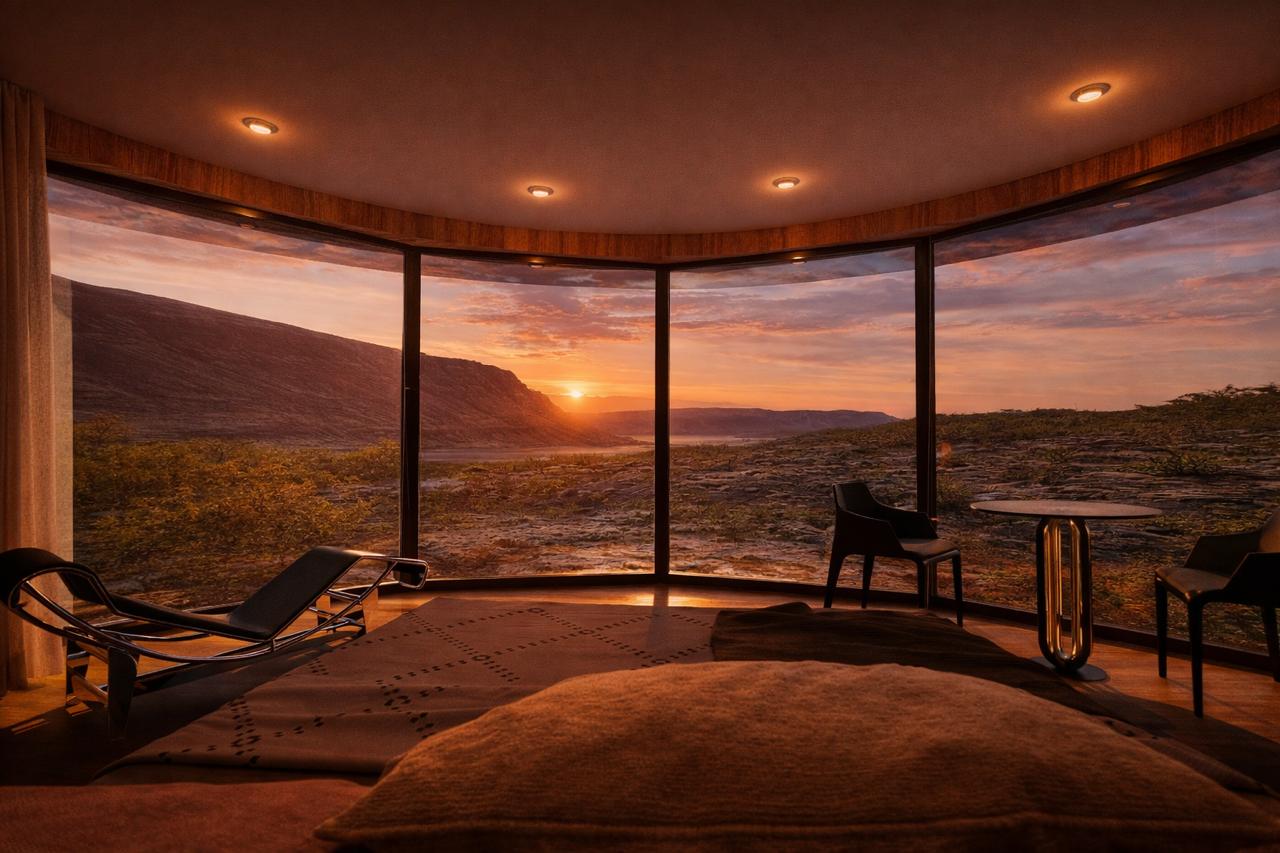
We are deeply aware of what a privilege it is to be given the opportunity to develop this unique, signature project in the breathtaking landscape of Hvalfjörður. A privilege of this scale carries an equally immense responsibility to the land, the local community, and the future of sustainable travel in Iceland—a responsibility we take very seriously.

The public consultation period for the detailed plan for Hugarró at Litla-Botnsland 1 has concluded, and the outcome gives us considerable confidence in the path ahead.

The key national authorities have not raised fundamental objections to the proposal. Instead, they have provided recommendations and requirements that we will address as the project progresses. That is what a constructive planning process should deliver: scrutiny, expert guidance and a clear framework for responsible implementation. The detailed plan has been developed around nature experiences, ecosystem restoration and minimizing disturbance to the existing birch woodland.

Some stakeholders have raised objections during this period and we fully respect their right to participate in the public consultation. Navigating differing viewpoints is a natural and valuable part of any robust planning process. We remain entirely committed to addressing all feedback constructively through the proper administrative channels with Skipulagsstofnun, the National Planning Agency, and as always, we remain open to positive, direct dialogue.
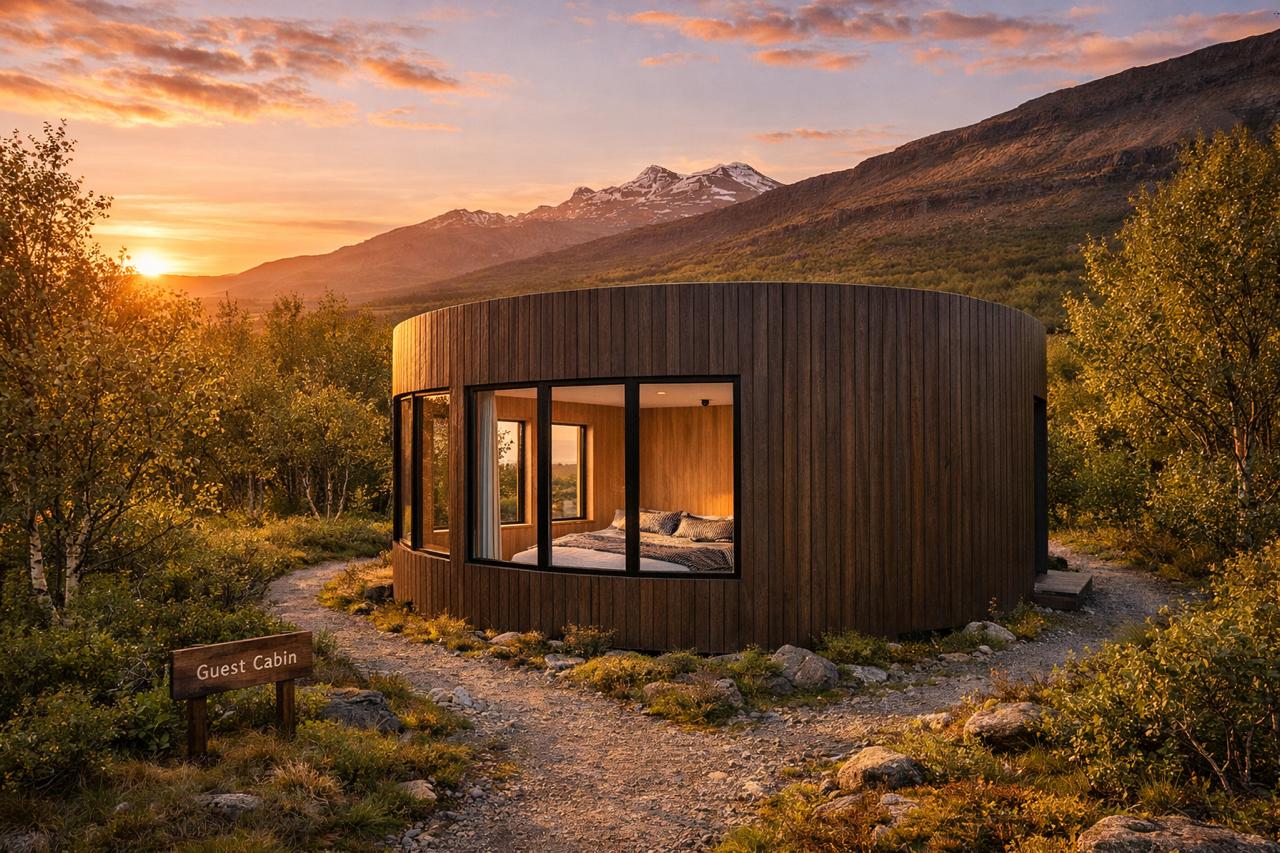
We are particularly grateful for the solid work of our consultants at EFLA, the continued support of the Municipality of Hvalfjarðarsveit, the positive response we have received from the local community during last year’s public meeting at the municipality, and the many kind and encouraging messages received from other Icelandic stakeholders.

Our mission remains unchanged: to demonstrate that nature-based tourism, when developed and operated responsibly, can create a genuine win-win-win for visitors, local communities and nature.

Responsible nature-based tourism can:

  • Create employment and local income through accommodation, guiding, food production and other services.
  • Help generate funding for conservation and protected-area management through entrance fees, permits and concession arrangements where applicable.
  • Increase awareness of the value of nature while supporting mental and physical well-being.

These benefits are also recognized by organizations including UN Tourism, the World Bank, IUCN and the World Health Organization.

At Litla-Botnsland in Hvalfjörður, our ambition is not simply to construct a resort. It is to create a first-class hospitality destination that protects and restores nature, contributes to the local economy and helps guests develop a deeper connection with Iceland’s extraordinary landscape.

This day is an important milestone, although not the end of the process. We look forward to continuing our cooperation with the municipality, government agencies, local stakeholders and our consultants as we turn these principles into practice. 
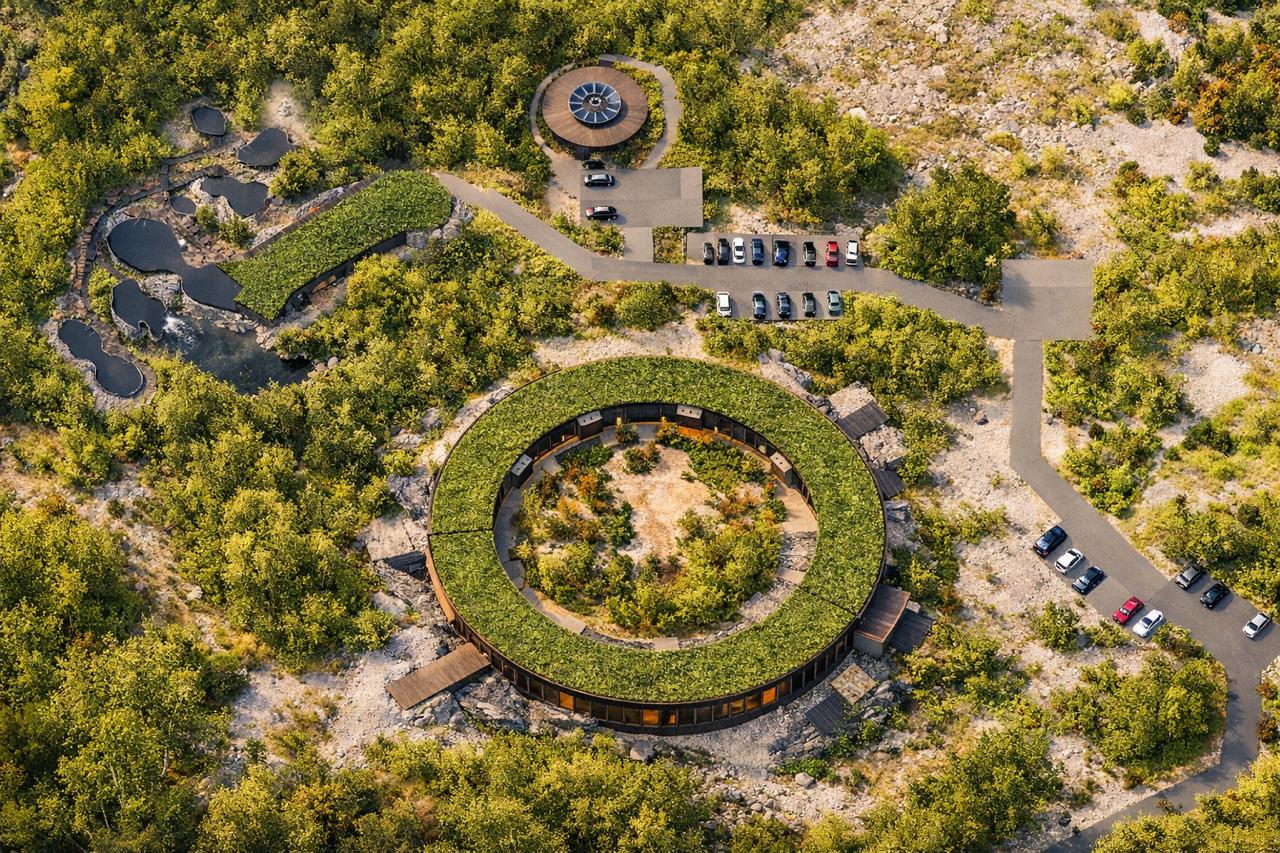


Litla-Botnsland, 14. júlí 2024

Jákvæð niðurstaða opinbers samráðs um náttúrudvalarstaðinn Hugarró á Íslandi

Við gerum okkur fyllilega grein fyrir því hvílík forréttindi felast í því að fá tækifæri til að þróa þetta einstaka og metnaðarfulla verkefni í stórbrotnu landslagi Hvalfjarðar. Slíkum forréttindum fylgir jafnframt mikil ábyrgð gagnvart landsvæðinu, nærsamfélaginu og framtíð sjálfbærrar ferðaþjónustu á Íslandi — ábyrgð sem við tökum mjög alvarlega.

Opinberu samráðsferlinu vegna deiliskipulags Hugarró að Litla-Botnslandi 1 er lokið og niðurstaðan gefur okkur ríka ástæðu til bjartsýni um framhaldið.

Helstu ríkisstofnanir hafa ekki gert grundvallarathugasemdir við tillöguna. Þess í stað hafa þær sett fram ábendingar og kröfur sem við munum vinna úr eftir því sem verkefninu vindur fram. Þannig á uppbyggilegt skipulagsferli einmitt að virka: með vandaðri yfirferð, faglegri leiðsögn og skýrum ramma um ábyrga framkvæmd. Deiliskipulagið hefur verið mótað með áherslu á náttúruupplifun, endurheimt vistkerfa og að halda raski á birkiskóginum sem fyrir er í lágmarki.

Nokkrir hagaðilar hafa sett fram andmæli á þessu tímabili og við virðum að fullu rétt þeirra til þátttöku í opinberu samráði. Mismunandi sjónarmið eru eðlilegur og mikilvægur hluti hvers vandaðs skipulagsferlis. Við erum áfram staðráðin í að bregðast við öllum ábendingum og athugasemdum með uppbyggilegum hætti eftir viðeigandi stjórnsýsluleiðum í samráði við Skipulagsstofnun. Jafnframt erum við, sem fyrr, opin fyrir jákvæðu og beinu samtali.

Við erum sérstaklega þakklát fyrir vandaða vinnu ráðgjafa okkar hjá EFLU, áframhaldandi stuðning Hvalfjarðarsveitar, jákvæð viðbrögð sem við fengum frá nærsamfélaginu á opnum fundi sveitarfélagsins á síðasta ári og þau fjölmörgu hlýju og hvetjandi skilaboð sem okkur hafa borist frá öðrum íslenskum hagaðilum.

Markmið okkar er óbreytt: að sýna fram á að náttúrutengd ferðaþjónusta, þegar hún er þróuð og rekin af ábyrgð, geti skapað raunverulegan þríþættan ávinning fyrir gesti, nærsamfélög og náttúruna.

Ábyrg náttúrutengd ferðaþjónusta getur:

  • Skapað störf og tekjur í heimabyggð með gistingu, leiðsögn, matvælaframleiðslu og annarri þjónustu.

  • Stuðlað að fjármögnun náttúruverndar og umsjónar með friðlýstum svæðum með aðgangsgjöldum, leyfisgjöldum og sérleyfissamningum, þar sem það á við.

  • Aukið vitund um gildi náttúrunnar og um leið stuðlað að andlegri og líkamlegri vellíðan.

Þessi ávinningur er einnig viðurkenndur af alþjóðastofnunum á borð við Ferðamálastofnun Sameinuðu þjóðanna (UN Tourism), Alþjóðabankann, Alþjóðanáttúruverndarsambandið (IUCN) og Alþjóðaheilbrigðismálastofnunina (WHO).

Að Litla-Botnslandi í Hvalfirði er metnaður okkar ekki einfaldlega að reisa dvalarstað. Við ætlum að skapa fyrsta flokks áfangastað í gisti- og upplifunarferðaþjónustu sem verndar og endurheimtir náttúru, leggur sitt af mörkum til efnahagslífsins á svæðinu og hjálpar gestum að mynda dýpri tengsl við einstakt landslag Íslands.

Þessi dagur markar mikilvæg tímamót, þótt ferlinu sé ekki lokið. Við hlökkum til áframhaldandi samstarfs við sveitarfélagið, opinberar stofnanir, hagaðila á svæðinu og ráðgjafa okkar við að hrinda þessum meginreglum í framkvæmd.

Þorvaldur Westmaas

Velkominn – Welcome !

logo Hugarro

Welcome to Hugarró: Where Nature and Well-Being Unite

At Hugarró, we believe nature is not only a source of inspiration but also the foundation of human well-being. By cherishing and preserving it, we can build a sustainable future for all. Our mission is simple: to offer nature-based tourism that honors the Earth while deeply connecting with the heart, ensuring that all guests, including those with mobility challenges, can experience the magic of Iceland comfortably and fully.

We are committed to a vision of sustainability that goes beyond obligation—it’s a way of life. Through our proven 4C framework—Conservation, Community, Culture, and Commerce—we strive to build not only successful businesses but also a brighter future for all.

Our vision is guided by four core principles:

    • Creating spaces where recreation and relaxation thrive in harmony with nature.
    • Ensuring accessibility for everyone—without exception.
    • Promoting local employment and fostering sustainable tourism.
    • Protecting and enhancing the natural beauty of our surroundings

Where Nature Meets Luxury: Our Hvalfjörður Hotel and Retreat
Our first project is set in the breathtaking “whale fjord,” Hvalfjörður, less than an hour’s drive from Reykjavik. Here, we are building something truly special: a 4-star, 32-room hotel, natural hot springs, and 31 round hotel cabins that can rotate with the sun.   Meeting facilities will allow us to host events such as training sessions, lectures, and more.  Add our wellness hub  to further nurturing your own well-being and it’s safe to say we are creating the ideal retreat location in Iceland.   Spanning 12.1 hectares, Hugarró invites you to experience the magic of Iceland in a way that touches your soul.

Inclusivity and Accessibility: A Core Value
At Hugarró, inclusivity is not an afterthought—it’s a cornerstone of our philosophy. We are committed to ensuring that our hotels, cabins, and hot springs are accessible to all, going well beyond legal requirements. For us, accessibility is as important as every other aspect of our vision.

Sustainability in Every Detail
Our approach to sustainability exceeds conventional standards:

    • Filtered river water is used for cleaning and flushing, minimizing waste.
    • Black and grey water are separated, treated, and reused wherever possible.

Our hot springs employ reheating and chemical-free water treatment, paired with real-time water quality monitoring. This ensures the purest water, the lowest energy consumption, and practices that far surpass local standards.

At Hugarró, we invite you to join a movement that connects well-being, nature, and community. This is more than just a stay—it’s an experience that will resonate with you and the planet.

artist impression of siteIn the past 2 years the master zoning pan of  the Municipality of Hvalfjarðarsveit has been updated to accommodate our project, while ensuring compliance with all relevant legal and environmental standards in Iceland. With the help of consulting firm EFLA we have also updated the detailed zoning plan which has already passed the public consultation period and will soon be presented to the Ministry of Planning (HMS/Skipulagsstofnun) for publishing in the national Gazette.

Should you have any questions or want to give feedback, please use our contact form
Kærar þakkir!   – Thank you

Geothermal alternative cost comparison

Energy & heating — built to last, designed to adapt
A facility powered by nature — with a plan B ready from day one

Let’s first recap: 

Hugarró is a seven-pool geothermal wellness complex on the shores of Hvalfjörður, one of Iceland’s most striking fjords. From the water temperature in our pools to the warmth in our cabins and the heat under our roads in winter, every degree of energy in this facility comes from renewable natural sources.

We did not design this system around hope. We designed it around certainty — with a primary strategy backed by Iceland’s exceptional geology, and a fully engineered alternative ready to deploy if exploration falls short. Either way, Hugarró operates as planned.


The primary strategy — geothermal heat

Iceland sits on one of the most geothermally active zones on the planet. The geology around Hvalfjörður reflects this: temperature gradients of 120°C per 1,000 metres have been recorded nearby, and the Hvalur station a few kilometres away produces over 20 litres per second at 140°C. The natural resource is well-established.

Our target is modest by Icelandic standards: a production well yielding 7–10 litres per second at 70–90°C. A typical productive Icelandic well delivers 15–50 litres per second. We are not asking for much.

Finding that water is the ambition. The three-phase exploration programme — shallow pre-drills, drone magnetic survey to map fracture zones, then a targeted production well at 900–1,500 metres — is designed to maximise the probability of a productive strike while managing exploration risk.


One source.  Four uses.  Nothing wasted
When geothermal water is found, it flows through a cascade that extracts every usable degree before returning the water underground:

  1. Pools — water enters at 70–90°C and heats all seven pools to a perfect 38°C
  2. Buildings — the same water, still warm, then heats the hotel and all cabins
  3. Hot water — covered in the same circuit, at no additional energy cost
  4. Roads — remaining warmth keeps paths and access roads clear in winter

The water returns underground at 30°C. Zero discharge. Zero waste.

This cascade design with the closed-loop pool heating approach recovers 33% more thermal energy than the approach used by traditional Icelandic pools, which continuously replace pool water and discharge thousands of cubic metres of hot water to nature every year. We do not do that.


Pool water — clean without chemicals
Our pools recirculate water in a closed loop rather than replacing it. Water is kept clean through UV disinfection. ultrafiltration membranes and biological filters — the same technology used in drinking water treatment — monitored continuously by real-time microbiological sensors across all seven pools.

No chemicals are used or permitted. The result: 91% less water consumed than a traditional Icelandic pool operation, and measurably cleaner water for guests.


Beyond the facility — a district heating opportunity
A geothermal well of this scale does more than serve Hugarró. Should the Botnsdalur valley develop into a wider community, the same well — with capacity to spare — could supply heat to an estimated 200–250 neighbouring vacation homes, each with a hot tub, through a district heating network.

At a metered tariff, this transforms a facility operating cost into a recurring revenue stream. A geothermal well becomes a utility asset.


If no geothermal water is found
Drilling always carries geological uncertainty. A well can miss a fracture. Pre-drills can show unfavourable results. We planned for this before we broke ground. 

Our alternative is a purpose-built system of three Fenagy H-600 CO₂ heat pump units, each delivering 600 kW of thermal output. Together they provide 1,800 kW of installed capacity against a peak demand of 1,185 kW — full redundancy is built in. Two units alone cover peak load; the third is available for future expansion.

CO₂ (R744) is the most climate-neutral refrigerant available — a global warming potential of just 1, compared to 1,400+ for conventional refrigerants. It is also the most efficient refrigerant in the 38–70°C output range, which is exactly where we operate. For every unit of electricity these heat pumps consume, they deliver 3.8 units of heat — the rest comes free from the water sources below.

The cascade — pools, buildings, roads — operates identically to the geothermal design. From a guest perspective, absolutely nothing changes.


Where the heat comes from — two tiers, no single point of failure
The heat pumps draw their source heat from water. We use two complementary sources that together guarantee year-round reliability without dependence on rivers with fishing rights disputes, tidal complications, or expensive sea inlets.

Tier 1 — The Brunná river (spring through autumn)
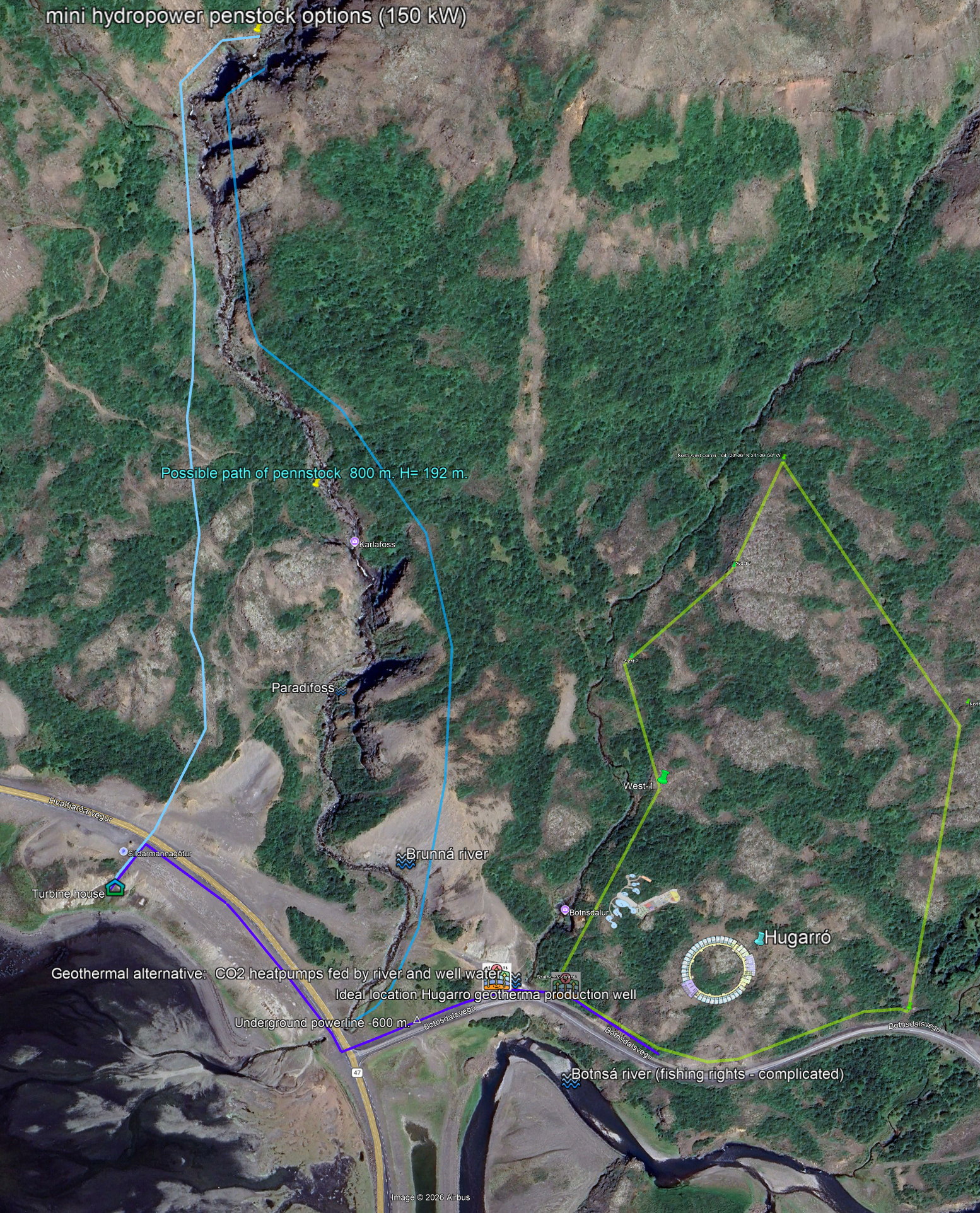
The Brunná flows 200 metres from our plant room, crossing land whose owner raises no objection. A short insulated pipe draws river water at ~6°C, passes it through a heat exchanger, and returns it cooled by a few degrees. During the eight warmer months of the year, the Brunná provides everything we need.

Tier 2 — Two drilled groundwater wells (winter)
At 80–150 metres depth, groundwater in the Botnsdalur valley sits at a stable 4–6°C year-round — completely unaffected by surface frost, ice, or seasonal variation. Two drilled wells provide our winter heat source: reliable, permit-straightforward, and with no fishing rights complications.

Critically, these wells are drilled while the geothermal exploration rig is already on site — a modest incremental cost on an already-mobilised programme. The same activity that seeks geothermal water simultaneously secures our backup water source. The shallow geology data gathered also helps refine the deep drill target.

The system switches automatically between river and wells based on flow and temperature sensors. No manual intervention. No single point of failure.

The buffer tank
Between the heat pumps and the distribution system sits a 35 m3 insulated thermal buffer tank at 45–50°C. It absorbs demand peaks, allows the heat pumps to run at steady optimal load, and reduces peak source water demand by around 20%. Think of it as a thermal battery — passive, simple, and highly effective.


The hydropower multiplier
The same rivers that provide our backup heat source offer a second possible opportunity: small-scale run-of-river hydropower.

A €300,000 investment in a small hydropower plant on the Brunná or Botnsá delivers:

  • 150 kW for eight months of the year (spring through autumn)
  • 50 kW through the four winter months

Click to enlargeThat is enough to offset 50% of the heat pump system’s annual electricity consumption — effectively halving the grid electricity bill.

When river flow is high and heat pump demand is low, surplus hydro power heats the buffer tank directly through resistance elements — free thermal energy that further reduces the load on the heat pumps.

Metric Value
Annual electricity saved ~1,023 MWh
Annual cost saving €97,200/year
Investment payback 3.1 years
20-year net present value €1,114,000

A 3.1-year payback on renewable infrastructure is exceptional by any standard. After that, the plant runs free for its remaining 30–40 year lifespan.


The numbers — what each path costs

  Geothermal well CO₂ heat pumps CO₂ heat pumps + hydro
Capital investment ~€1,870,000 ~€1,630,000 ~€1,930,000
Annual operating cost ~€70,000 ~€270,000 ~€173,000
20-year total cost ~€3,270,000 ~€6,830,000 ~€5,390,000
Grid dependency Minimal High Medium
CO₂ emissions Zero Zero Zero
Guest experience Identical Identical Identical
Technology risk Exploration Very low Very low

The geothermal well is the cheapest long-term solution by a wide margin — €3.5M cheaper than heat pumps alone over 20 years. But the heat pump system combined with hydropower is a fully viable, lower-risk alternative that closes that gap significantly.

The capital costs of all three paths are remarkably similar. What separates them is operating cost — and operating cost is where geothermal wins decisively. Every year of successful geothermal operation saves €200,000 in electricity that the heat pump alternative would otherwise purchase from the grid.


Resilience by design
Most geothermal wellness projects are built around a single assumption: that the well succeeds. Ours is not.

Our engineering team designed the geothermal cascade and the CO₂ heat pump alternative in parallel — same output temperatures, same cascade architecture, same pool experience, same environmental standards. Switching between the two strategies requires no redesign of the facility. The plant room, pipework, heat exchangers, and distribution circuits serve both.

The exploration programme is thorough and data-driven. We expect to find water. But if we do not, a fully costed, fully engineered alternative is ready — one that combines proven industrial heat pump technology with local renewable water and hydropower sources, and delivers the same Hugarró experience at a known, manageable operating cost.

That is not a fallback. It is a feature.

Building with respect for landscape, nature and the night sky

Hugarró is being created in one of Iceland’s most remarkable natural settings. That is both a privilege and a responsibility.

From the beginning, our ambition has been to develop a wellness retreat that works with the landscape rather than against it. We are not interested in building a resort that simply occupies a beautiful place. Our goal is to create a retreat that protects, strengthens and celebrates the natural qualities that make this location special.

As our planning develops, we are using international nature and landscape principles as important reference points, including the Council of Europe Landscape Convention, the Convention on Biological Diversity and the Bern Convention on the Conservation of European Wildlife and Natural Habitats. These frameworks all point in the same direction: development should be planned with care, ecological knowledge, respect for local landscape character, and a clear commitment to avoiding or minimizing harm.

For Hugarró, this means turning broad environmental principles into practical design and construction choices.

A landscape-led approach
The Hugarró concept is based on the principles of landscape hotel design. Instead of placing large, dominant buildings in the landscape, we are designing the retreat to sit quietly within its surroundings.

The natural slope of the land, the existing tree cover, the views across Hvalfjörður and the character of the site all guide the design. Buildings are planned to be low-impact, carefully positioned and visually integrated. Where possible, we use the topography and vegetation to create privacy, shelter and a sense of calm, rather than relying on heavy built structures.

This approach supports the goals of the European Landscape Convention, which recognizes landscape as more than scenery. Landscape is part of local identity, ecological quality and human well-being. At Hugarró, we want the built environment to remain secondary to the land itself.

Building faster, with less disturbance
One of the most important choices we are making is to use modular, pre-fabricated construction.

This means that much of the building work can be completed off-site in controlled conditions. Once the modules arrive, the on-site assembly can take place in a much shorter period than traditional construction. In practical terms, this allows us to reduce noise, traffic, soil disturbance and the overall length of heavy construction activity.

This is particularly important for wildlife. By shortening the construction window, we can plan the most disruptive work outside sensitive periods, including the bird breeding and nesting season, subject to ecological surveys and guidance from the relevant specialists and authorities.

A shorter construction phase is not only more efficient. It is also a way to reduce pressure on the land.

Protecting habitats and biodiversity
The Convention on Biological Diversity emphasizes the need to understand and minimize impacts on ecosystems. The Bern Convention places particular importance on the protection of wild flora, fauna and natural habitats, including migratory and vulnerable species.

For Hugarró, this means that environmental planning cannot be an afterthought. Before construction, the project should be informed by site-specific ecological surveys, including vegetation, habitats, bird life, water systems and any species that may require particular protection.

Our planning principles are straightforward:

  • First, avoid sensitive areas wherever possible.
  • Second, reduce the development footprint.
  • Third, use construction methods that minimize disturbance.
  • Fourth, restore and strengthen native vegetation where the land is affected.
  • Fifth, monitor the site over time so that environmental commitments remain active after opening.

We are especially conscious of the value of Icelandic birch woodland and native vegetation. Our goal is not merely to compensate for disturbance, but to protect and improve the ecological quality of the property over time.

Water, geothermal energy and responsible operations
Hugarró is rooted in Iceland’s geothermal landscape. Our planned hot springs, wellness facilities and accommodations are designed around renewable energy and responsible water use.

The project is being developed with closed-loop thinking wherever possible: using geothermal heat efficiently, reducing waste, limiting unnecessary water consumption and designing systems that can be monitored and improved.

This is important because sustainability is not only about how a destination is built. It is also about how it operates every day: how it uses energy, how it treats wastewater, how it manages visitors, how it handles waste, and how it protects the surrounding landscape from gradual wear.

Our objective is to create a retreat where comfort and environmental discipline are not opposites.

Protecting the night sky
Hvalfjörður’s night sky is part of the experience of the place. It is also part of the natural environment.

Poorly designed outdoor lighting can disturb wildlife, reduce the quality of the night landscape, create glare, and contribute to light pollution far beyond the immediate site. For that reason, lighting design is a key part of our environmental strategy.

We plan to work with lighting specialists to keep outdoor lighting to the minimum needed for safety and orientation. Our lighting principles will include:

  • fully shielded, downward-directed fixtures;
  • warm color temperatures;
  • low light levels;
  • motion sensors and timers where appropriate;
  • no unnecessary decorative uplighting;
  • careful control of light spill toward natural areas;
  • a site-wide lighting management plan.

Our ambition is to pursue the most appropriate dark-sky recognition for Hugarró, whether through DarkSky Approved Lodging or, if feasible with the wider local context, a relevant International Dark Sky Place pathway. Certification is not something we can simply claim in advance. It must be earned through design, measurement, policy and long-term stewardship.

A retreat that remains accountable
International conventions and environmental guidelines are useful because they ask practical questions.

  • Have we understood the landscape?
  • Have we surveyed the habitats and species?
  • Have we avoided unnecessary disturbance?
  • Have we reduced the construction footprint?
  • Have we protected the night sky?
  • Have we planned for monitoring after opening?

These are the questions we want to answer clearly and transparently as Hugarró moves forward.

Our aim is to demonstrate that a high-quality wellness retreat can be developed in Iceland without losing sight of the land, the wildlife, the water, the darkness and the quiet that make the place valuable in the first place.

Hugarró is being designed as a place to unwind. But it is also being designed as a place of restraint: careful in its footprint, quiet in its architecture, responsible in its operations, and respectful of the natural systems around it.

Hugarró – Sjálfbær lúxus í hjarta Hvalfjarðar

Hugarró Í Hvalfirði sem er í innan við klukkustundar fjarlægð frá Reykjavík. Þar er hafin þróun á ferðaþjónustuverkefni sem leggur áherslu á sjálfbærni, samfélagslega ábyrgð og náttúruvernd. Hugarró er verkefni sem sameinar lúxus og náttúru á nýjan og ábyrgari hátt en áður hefur þekkst á Íslandi.

view pools and hotelVerkefnið samanstendur af glæsilegu fjögurra stjörnu hóteli með 32 herbergjum ásamt 25 lúxus smá hýsum sem tryggja að gestir geti ávallt notið útsýnisins án þess að trufla náttúru upplifunina. Í kringum allar byggingar verður notast verður við mjúka og hnitmiðaða lýsingu sem lágmarkar ljósmengun og varðveitir næturhimininn fyrir bæði gesti og dýralíf á svæðinu.

Áhersla okkar er að byggja á eins umhverfis vænan máta og hægt er, til að mynda,  verða náttúruböð okkar að vera sérstaklega hönnuð með virðingu fyrir núverandi landslagi. Tré náttúran í kringum alla framkvæmdina verða varðveittar eins og unnt er. En böðin samanstanda af sjö laugum sem verða á mismunandi hæðar þrepum. Þannig skapast næði og persónulegt rými fyrir gesti með stórkostlegu útsýni yfir Hvalfjörðinn og Botnsdalinn. Sérstaða náttúrubaðanna liggur í orkusparandi og nýstárlegri tækni þar sem vatnið er hitað með varmaskiptum og síast stöðugt án kemískra efna. Vatnsgæði eru vöktuð reglulega með sjálfvirkum búnaði, sem tryggir einstaka tærleika og gæði vatnsins.

view at night - minimal light polution - motion controlled

Sjálfbærni er leiðarljós þessar verkefnisins. Hugarró notar síað vatn úr nágreninu fyrir öll þrif og salerni. Svart- og grávatn verður aðskilið, hreinsað og endurnýtt í samræmi við ströngustu staðla um umhverfisvernd. Með þessu er sóun vatns lágmörkuð og neikvæð áhrif á náttúruna takmörkuð verulega.

Öryggi, aðgengi og þjónusta fyrir nærsamfélagið er mikilvægur þáttur í verkefni okkar. En við erum mjög meðvituð um sögu Litla Botns og að fyrir komu Hvalfjarðarganga þá var Hvalfjörður og sérstaklega þau litlu stopp sem voru á leiðinni mikilvægur staður í samfélaginu. Þessi menningararfur glataðist við komu Hvalfjarðarganganna, en með tilkomu Hugarró þá mun þetta svæði fá þá þjónustu sem var eitt sinn í boði nema í uppfærði mynd. Í dag er svæðið best þekkt hjá þeim heimsækja fossinn Glym eða þá sem fara hér í göngu. Það er markmið okkar hjá Hugarró endurvekja það mikilvæga hlutverk að ferðamenn sem leggja leið sína í gegnum Hvalfjörð geti stoppað og notið sín hér Hvalfirðinum. Verkefni okkar tryggir einnig að það verður ávallt fólk til staðar á svæðinu sem getur gripið inn í ef á reynir hjá ferðafólki sem komið sér hefur í neyð á svæðinu. Þess að auki mun tilkoma Hugarró bæta innviði svæðisins með því að tryggja hita vatnsöflun fyrir nær samfélagið og bæta háhraða internetaðgengi fyrir íbúa og fyrirtæki á svæðinu. Með þessu leggjum við okkar að mörkum að tryggja að nær samfélagið fái við til komu okkar bætta þjónustu með komu okkar, aukið öryggi og nýjan vinnustað sem stutt er í.

view pools and hotel

Við verðum einnig með vellíðunarstöð á svæðinu býður upp á einstakar upplifanir, þar á meðal súrefnisklefa, saltböð, innrauða klefa og súrefnismeðferð í þrýstiklefa. Þjónustan verður í hávegum höfð með umhverfisvænum lausnum og notkun náttúrulegra efna. Vellíðunarstöðin er hönnuð sem griðarstaður fyrir líkama og sál þar sem gestir geta endurnýjað orkuna í samræmi við umhverfisvænar og sjálfbærar lausnir.

Hugarró leggur áherslu á gott samstarf og opið samtal við samfélagið í nær umhverfinu. Ráðgjafafyrirtækið EFLA hefur verið fengið til þess að tryggja að skipulagsvinna fari fram af fagmennsku og í góðu samstarfi við íbúa. Tillaga að endurskoðun á aðalskipulagi hefur þegar verið lögð inn og verður gerð opinber fyrir alla sem vilja kynna sér málið frekar. Síðan verður haldinn opin fundur þann 13 mars 2025 þar sem verkið verður kynnt.

Með verkefninu í Hvalfirði býður Hugarró gestum sínum upp á einstaka upplifun þar sem lúxus, náttúra, vellíðan og samfélagsleg ábyrgð mætast á þann hátt sem gerir svæðið að fyrirmynd í sjálfbærri ferðaþjónustu.

Hiking around Hugarró

Botnsdalur Valley is home to an exceptional abundance of trees, a rare sight in Iceland. While predominantly made up of native birch forests, it also includes a mix of non-native species. In the fall, the valley transforms into a vibrant tapestry of colors, offering a stunning visual spectacle.

Below you find a collection pictures.

This area is a hiker’s paradise, offering more than just the trail to Glymur waterfall. Explore the gentle, flatter sections leading up to it, as well as the numerous smaller waterfalls along the Hvalskarðsá River.