
Being 'green' in practice
BREEAM aims to promote buildings that are environmentally, socially, and economically sustainable, enhancing the well-being of the people who live and work in them while minimizing their environmental impact.
Recommended links:
What is BREEM and why is it important?
BREEAM Version 7 to focus on hotels and net zero carbon
Board questions
Q: You run a high-end hotel. Surely you will use proven HR frameworks from leading international chains?
Not exactly — and here’s why that matters.
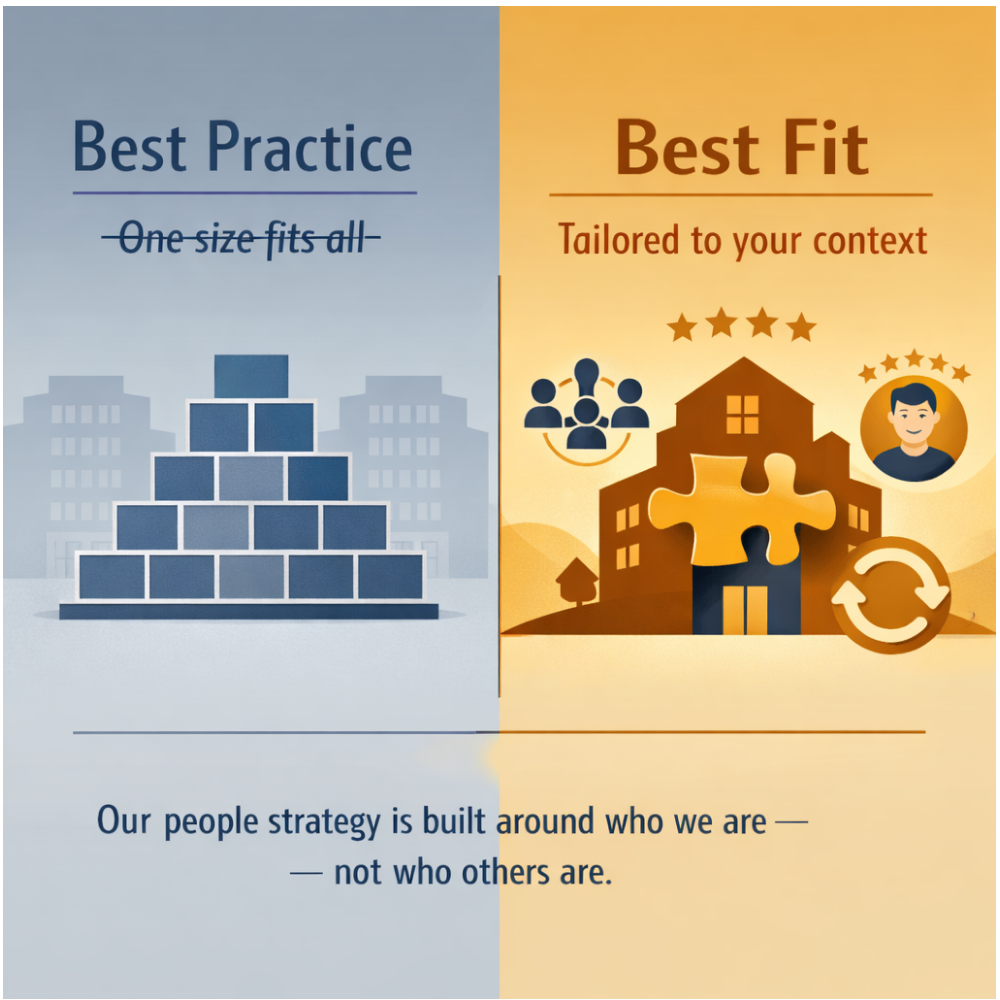
When building our performance review, onboarding, and training systems, the obvious move is to look at what major hotel brands do and borrow their playbook. It’s tempting. But it’s also a classic mistake: confusing best practice with best fit.
Q: What’s the difference?
Strategic HRM literature distinguishes two fundamentally different approaches:
| Approach | Logic | Assumption |
|---|---|---|
| Best practice (universalist) | A fixed set of high-performance work practices — pay-for-performance, extensive training, employee voice — that reliably improve outcomes everywhere | One size fits all |
| Best fit (contingency) | HR effectiveness depends entirely on context: your strategy, culture, market conditions, and workforce | Fit your HR to your organisation |
The best-practice model is popular because it’s simple and sounds reassuring. The problem? What works at a 500-room airport hotel with high turnover and standardised service doesn’t automatically translate to a boutique four-star property built around personalised guest experiences.
Q: So what did you actually do differently?
We built our HR approach around what fits us, not what looks good in a conference presentation.
- Annual appraisals → out. We replaced them with short, regular feedback conversations between managers and staff — better suited to the rhythm of a hotel where every day is different.
- Individual performance targets → out. We tied incentives to team goals: guest satisfaction scores and sustainability metrics, values that reflect our actual culture.
- Rigid frameworks → out. We kept only the elements that genuinely work in our context.
Q: Why does this matter for guests?
Because engaged, empowered staff deliver better experiences — consistently. We’re confident this approach drives higher guest satisfaction, lower staff turnover, and — most importantly — a real sense of ownership among our team.
Q: Isn’t this just reinventing the wheel?
No. It’s grounded in solid academic research. A strong fit between HR practices and organisational context consistently outperforms the adoption of fashionable frameworks.
“There is no one best way to manage people.”
> — Boxall & Purcell, Strategy and Human Resource Management
References
- Boxall, P., & Purcell, J. (2016). Strategy and Human Resource Management. Palgrave Macmillan.
- Delery, J.E., & Doty, D.H. (1996). Modes of theorizing in strategic human resource management. Academy of Management Journal, 39(4), 802–835.
- Paauwe, J. (2009). HRM and Performance. Journal of Management Studies, 46(1), 129–142.
Business objectives
First of all, to make best use of the available land, topography and tree coverage, we decided to build our circle hotel on the indicated place. This location means minimum loss of trees and trees lost will be mostly under 50 cm. Since we are building in what is a ‘protected area’, we really want to commit to low-impact building practices.
This location is also close to where we plan to build our parking space the location of which was choosen based on similar considerations.
In cooperation with our architects we then came to 48 modular units of which 29 will be guest rooms (drawing below is not totally up to date).

The law requires to also have 3 wheelchair accessible rooms. We decided – in close consulting with Sjálfsbjörg, the National Confederation of Physically Disabled People in Iceland – to create 2 wheelchair accessible guestrooms (WAG) in the hotel and 3 separate WAGs with their own parking. Thanks to the products of the Norwegian company Bano, we can create a compliant WAG in the existing hotel modules.
With 5 WAG’s in total we showcase our commitment to travelers with a disability and plan to actively pursue their business. They comprise of just over 10% of the traveling public and few hotels in Iceland will meet our standards of accessibility.
Between these guestrooms and the hotel entrance will be a heated pathway (to keep it snow free) as required by law.
Recommended link:
Accessible tourism (by Icelandic Tourist board)
Q: You run a high-end hotel. Surely you will use proven HR frameworks from leading international chains?
Not exactly — and here’s why that matters.
When building our performance review, onboarding, and training systems, the obvious move is to look at what major hotel brands do and borrow their playbook. It’s tempting. But it’s also a classic mistake: confusing best practice with best fit.
Q: What’s the difference?
Strategic HRM literature distinguishes two fundamentally different approaches:
| Approach | Logic | Assumption |
|---|---|---|
| Best practice (universalist) | A fixed set of high-performance work practices — pay-for-performance, extensive training, employee voice — that reliably improve outcomes everywhere | One size fits all |
| Best fit (contingency) | HR effectiveness depends entirely on context: your strategy, culture, market conditions, and workforce | Fit your HR to your organisation |
The best-practice model is popular because it’s simple and sounds reassuring. The problem? What works at a 500-room airport hotel with high turnover and standardised service doesn’t automatically translate to a boutique four-star property built around personalised guest experiences.
Q: So what did you actually do differently?
We built our HR approach around what fits us, not what looks good in a conference presentation.
- Annual appraisals → out. We replaced them with short, regular feedback conversations between managers and staff — better suited to the rhythm of a hotel where every day is different.
- Individual performance targets → out. We tied incentives to team goals: guest satisfaction scores and sustainability metrics, values that reflect our actual culture.
- Rigid frameworks → out. We kept only the elements that genuinely work in our context.
Q: Why does this matter for guests?
Because engaged, empowered staff deliver better experiences — consistently. We’re confident this approach drives higher guest satisfaction, lower staff turnover, and — most importantly — a real sense of ownership among our team.
Q: Isn’t this just reinventing the wheel?
No. It’s grounded in solid academic research. A strong fit between HR practices and organisational context consistently outperforms the adoption of fashionable frameworks.
“There is no one best way to manage people.”
> — Boxall & Purcell, Strategy and Human Resource Management
References
- Boxall, P., & Purcell, J. (2016). Strategy and Human Resource Management. Palgrave Macmillan.
- Delery, J.E., & Doty, D.H. (1996). Modes of theorizing in strategic human resource management. Academy of Management Journal, 39(4), 802–835.
- Paauwe, J. (2009). HRM and Performance. Journal of Management Studies, 46(1), 129–142.
Consumption in the tourism industry works differently than consumption in many other sectors. People look for fresh experiences, spectacular places and the beauty of the local area, instead of material possessionsor services.
Likewise, as in the world of fashion or food, rends are always influencing the consumption choices in tourism. For example,choosing a destination based on the places that are currently in fashion, looking for the most Instagrammable corners or the places whose offer best suits our tastes and interests; which is indeed a decisive factor.
Here are some of the main trends that are busy shaping the tourism industry and the way people travel. As you will most likely agree, Iceland is perfectly positioned to tap into these trends.
MATCH with the destination
If you have a predilection for nature, you are more likely to travel to a wooded or rural area, rather than to big cities or urban areas. If you prefer to enjoy active sports, you will probably travel to places where you can practice your hobbies: coastal areas for water sports, ski resorts in winter… In this way, it is a question of orienting the tourist offer to the target group.
ECO mentality
Increasingly, travellers are taking into account factors such as travelling to nearby destinations to reduce their carbon footprint or opting for accommodation with sustainability certifications.
Millennial values
The younger generations, who are now making up the tourism target, have grown up in an educational culture with a strong environmental component and social struggle, giving importance to values that until now were not very present in the tourism industry, such as social integration and inclusion, the importance of the local, sustainability, among others.
Post-pandemic ecosystem
Covid-19 has left its mark on the tourism sector and is generating new trends, mostly related to alternatives to mass tourism, the discovery of new places with little influence from the tourism industry and respect for the destination’s environment, its identity and resources.
Public Concern for the Environment is Growing
Recent reports about climate change, together with the news about floods and fires, is raising social concern about this issue.
You yourself are probably already taking some measures to reduce your own
ecological footprint in your every-day life; recycling, driving an electric car or using cloth shopping bags are some of the most popular examples for people to express their environmental concerns.
However, are you keeping up with this responsible behaviour when on holiday?
Studies show that many people consider their holidays to be a time and place torelax and to forget about their environmental responsibilities, seeing them as time-consuming and a burden, assuming that companies should be the ones to ensure they are fulfilled instead.
This trend is shown by the results of the most recent surveys of booking portals, where most of the travellers prefer to choose “eco” options in order to feel fulfilled and happy in this respect, as long as these do not entail additional costs or responsibilities of any kind.
New generations are moving from “seeing” to “experiencing”
In modern-day tourism, a very visible trend is that the focus has shifted from “seeing” to “experiencing”. The main focus of tourism is not on physical high-lights, museums and monuments anymore, but on intangible elements such as culture, atmosphere and lifestyle.
One group playing a big role in this shift of trends is Generation Y (or Millennials) who are now between the ages of 25-35.
And we must be aware of their trends, as these are the present and future generations of the tourism sector and of society in general.
Do you know what their preferences are?
- Investing in experiences rather than material possessions.
- Investing in the present rather than saving for the future.
- Seeing travel as a priority and as a way of discovering the world and themselves.
- Young people give more importance than previous generations on environmental care, inclusiveness and social advocacy.
All in all important trends to consider as a hospitality provider.
BREEAM aims to promote buildings that are environmentally, socially, and economically sustainable, enhancing the well-being of the people who live and work in them while minimizing their environmental impact.
Recommended links:
What is BREEM and why is it important?
BREEAM Version 7 to focus on hotels and net zero carbon
Staff issues
Q: You run a high-end hotel. Surely you will use proven HR frameworks from leading international chains?
Not exactly — and here’s why that matters.
When building our performance review, onboarding, and training systems, the obvious move is to look at what major hotel brands do and borrow their playbook. It’s tempting. But it’s also a classic mistake: confusing best practice with best fit.
Q: What’s the difference?
Strategic HRM literature distinguishes two fundamentally different approaches:
| Approach | Logic | Assumption |
|---|---|---|
| Best practice (universalist) | A fixed set of high-performance work practices — pay-for-performance, extensive training, employee voice — that reliably improve outcomes everywhere | One size fits all |
| Best fit (contingency) | HR effectiveness depends entirely on context: your strategy, culture, market conditions, and workforce | Fit your HR to your organisation |
The best-practice model is popular because it’s simple and sounds reassuring. The problem? What works at a 500-room airport hotel with high turnover and standardised service doesn’t automatically translate to a boutique four-star property built around personalised guest experiences.
Q: So what did you actually do differently?
We built our HR approach around what fits us, not what looks good in a conference presentation.
- Annual appraisals → out. We replaced them with short, regular feedback conversations between managers and staff — better suited to the rhythm of a hotel where every day is different.
- Individual performance targets → out. We tied incentives to team goals: guest satisfaction scores and sustainability metrics, values that reflect our actual culture.
- Rigid frameworks → out. We kept only the elements that genuinely work in our context.
Q: Why does this matter for guests?
Because engaged, empowered staff deliver better experiences — consistently. We’re confident this approach drives higher guest satisfaction, lower staff turnover, and — most importantly — a real sense of ownership among our team.
Q: Isn’t this just reinventing the wheel?
No. It’s grounded in solid academic research. A strong fit between HR practices and organisational context consistently outperforms the adoption of fashionable frameworks.
“There is no one best way to manage people.”
> — Boxall & Purcell, Strategy and Human Resource Management
References
- Boxall, P., & Purcell, J. (2016). Strategy and Human Resource Management. Palgrave Macmillan.
- Delery, J.E., & Doty, D.H. (1996). Modes of theorizing in strategic human resource management. Academy of Management Journal, 39(4), 802–835.
- Paauwe, J. (2009). HRM and Performance. Journal of Management Studies, 46(1), 129–142.