
Board questions
Q: You run a high-end hotel. Surely you will use proven HR frameworks from leading international chains?
Not exactly — and here’s why that matters.
When building our performance review, onboarding, and training systems, the obvious move is to look at what major hotel brands do and borrow their playbook. It’s tempting. But it’s also a classic mistake: confusing best practice with best fit.
Q: What’s the difference?
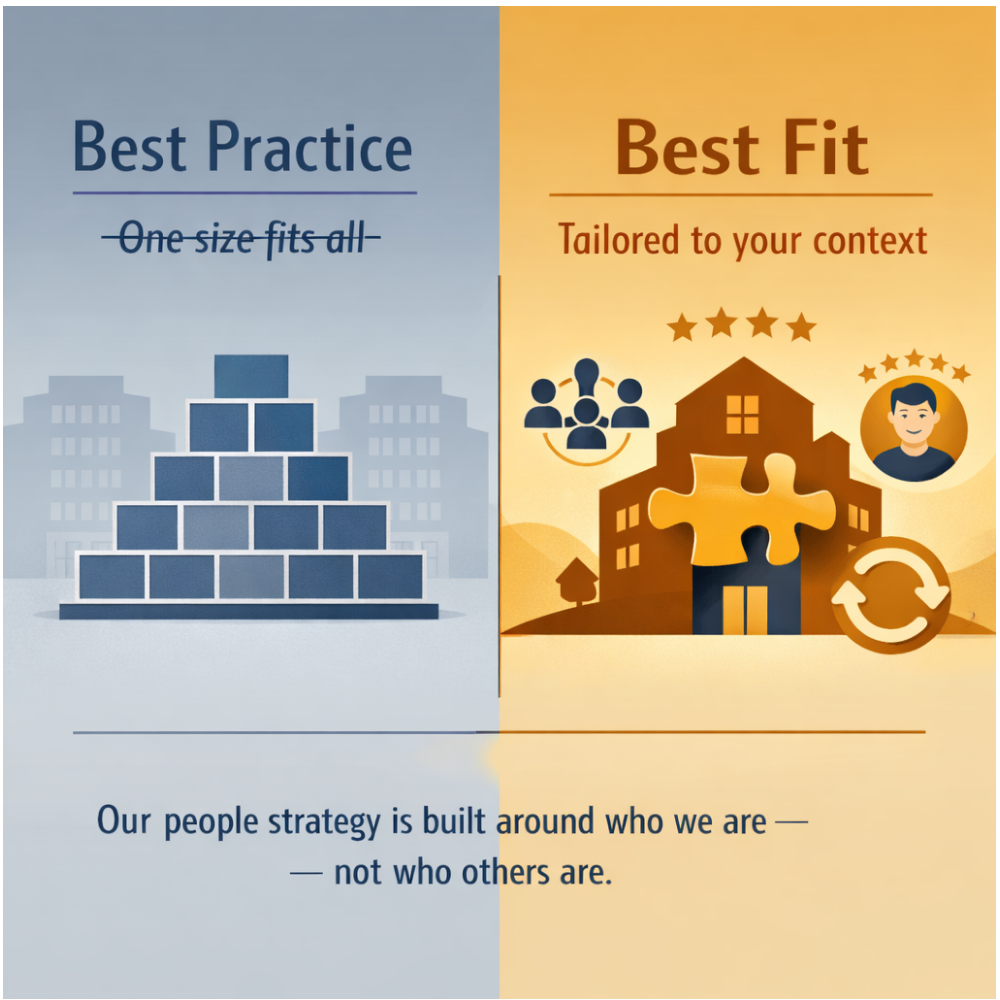
Strategic HRM literature distinguishes two fundamentally different approaches:
| Approach | Logic | Assumption |
|---|---|---|
| Best practice (universalist) | A fixed set of high-performance work practices — pay-for-performance, extensive training, employee voice — that reliably improve outcomes everywhere | One size fits all |
| Best fit (contingency) | HR effectiveness depends entirely on context: your strategy, culture, market conditions, and workforce | Fit your HR to your organisation |
The best-practice model is popular because it’s simple and sounds reassuring. The problem? What works at a 500-room airport hotel with high turnover and standardised service doesn’t automatically translate to a boutique four-star property built around personalised guest experiences.
Q: So what did you actually do differently?
We built our HR approach around what fits us, not what looks good in a conference presentation.
- Annual appraisals → out. We replaced them with short, regular feedback conversations between managers and staff — better suited to the rhythm of a hotel where every day is different.
- Individual performance targets → out. We tied incentives to team goals: guest satisfaction scores and sustainability metrics, values that reflect our actual culture.
- Rigid frameworks → out. We kept only the elements that genuinely work in our context.
Q: Why does this matter for guests?
Because engaged, empowered staff deliver better experiences — consistently. We’re confident this approach drives higher guest satisfaction, lower staff turnover, and — most importantly — a real sense of ownership among our team.
Q: Isn’t this just reinventing the wheel?
No. It’s grounded in solid academic research. A strong fit between HR practices and organisational context consistently outperforms the adoption of fashionable frameworks.
“There is no one best way to manage people.”
> — Boxall & Purcell, Strategy and Human Resource Management
References
- Boxall, P., & Purcell, J. (2016). Strategy and Human Resource Management. Palgrave Macmillan.
- Delery, J.E., & Doty, D.H. (1996). Modes of theorizing in strategic human resource management. Academy of Management Journal, 39(4), 802–835.
- Paauwe, J. (2009). HRM and Performance. Journal of Management Studies, 46(1), 129–142.
Finding and retaining good people is never easy — and doing so in a remote location makes it harder still. That is why we have committed meaningful investment to providing on-site staff accommodation at Hugarro.
This will be particularly valuable for non-Icelandic staff who have no existing housing in the area. Reykjavik is expensive, and a daily 55-minute commute is neither practical nor desirable. By housing the key people of our team on-site and running the facility at near-full occupancy, we can keep individual costs genuinely affordable.
For staff heading into Reykjavik on days off, we also plan to acquire a house or plot close to the city where employees can rent a room at a reasonable rate — a proper place to relax away from the work environment.
Why we’re doing this
Operational reliability. In Iceland’s remote highlands, severe weather can make travel dangerous or impossible at short notice. Having staff on-site keeps the operation running safely regardless of conditions.
A real recruitment advantage. Housing shortages are a known barrier for international and seasonal workers. Bundling accommodation with a role removes the single biggest obstacle many candidates face.
Team culture. Shared living, done well, builds a strong sense of community — something that matters when you’re working and living far from home.
Cost of living support. Nordic living costs are high. Employer-provided housing directly reduces the financial pressure on employees and eliminates daily transport costs for both parties.
Honest challenges to manage
Work-life separation. When home and workplace are the same location, the boundary between on- and off-duty time can blur. Without deliberate management, this becomes a driver of burnout.
Interpersonal dynamics. A multicultural team sharing confined living spaces requires clear expectations and good conflict-resolution processes. Issues in the accommodation can quickly affect performance on the floor.
Isolation. The on-site community can be close-knit, but it can also become insular. Geographic remoteness limits organic contact with the broader local community, which matters for long-term wellbeing.
Standards matter. Cramped or poorly maintained accommodation quickly erodes morale and, by extension, service quality. The investment in decent housing is an investment in operational continuity.
How we plan to implement this well
Private space is non-negotiable. Communal areas are fine, but every employee needs a genuinely private space to decompress. Hospitality is demanding work; people need a real off switch.
Clear boundaries for managers. Off-duty means off-duty. Management will respect that line.
Thorough onboarding. New staff will be prepared not just for their role, but for the realities of communal living in a remote environment.
Peer support. Returning staff will be paired with new joiners to help them settle in — practically and socially.

The units
To avoid eating into our 5,000 m² building allowance (cabin RevPAM runs approximately 10× higher than staff accommodation so the math is straightforward), we plan to use mobile/modular units rather than permanent structures. The advantages are meaningful: no foundations required, and the units can be relocated to other sites if needed. We may also configure one as a sales or café unit to support local marketing.
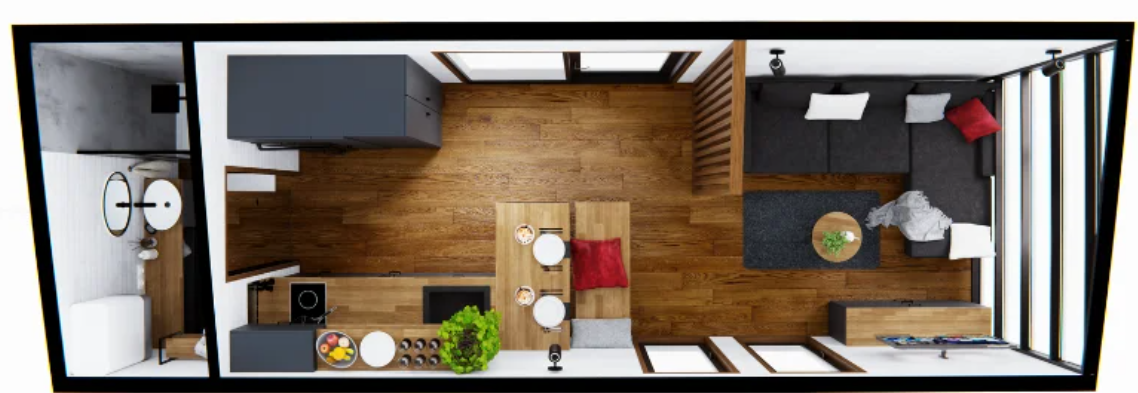
Our current plan is approximately 10 units, each suitable for one person or a couple, sourced directly from a manufacturer — likely in Eastern Europe — to keep costs down.
Ideally, we will acquire nearby land in future to expand staff housing capacity if required. We know the municipality looks favorable to this kind of arrangement.
(See the Iceland Property Register for land listings.)
Reykjavik off-site base
We have budgeted for the purchase of a building plot near Reykjavik — for example, in the Mosfellsbær area — with the intent to build a dedicated staff retreat. The concept: a purpose-built prefab house with approximately 10 small private rooms, shared bathrooms, and a well-equipped common area. Non-Icelandic employees would receive an allocation of roughly 8 days per month to use the facility on breaks.
At near-full utilisation, the property would comfortably pay for itself.
Luxury in Practice — The Details That Actually Make a Difference
We recently updated our Luxury page with a clearer explanation of what luxury means to us at Hugarró. The short version: it’s not about gold taps. It’s about a stay that is calm, effortless, and restorative.
But talk is easy. So let’s get specific.
Over years of travelling and staying in hotels — good ones, average ones, and a few that deserved better reviews than they got — a pattern emerges. The stays that linger in your memory aren’t defined by the grandeur of the lobby. They’re defined by a hundred small things that either worked or didn’t. Here’s our take on what “working” actually looks like.
🛏️ The bedroom — Where rest begins
When you get up in the middle of the night, you shouldn’t have to fumble for a light switch. A discreet red LED strip beneath the bed activates the moment your feet touch the floor — low light, the right colour temperature, just enough to find your way. The bathroom light follows the same logic: it comes on softly, not at full blast.
Sleep itself matters too. Beds should be genuinely comfortable — not just described that way. We offer a pillow menu and let guests indicate their mattress firmness preference at the time of booking. Not everyone sleeps the same way, and that’s fine.
Privacy goes without saying — or it should. Rooms are positioned and designed so that nobody outside can look in.
🚿 The bathroom — A room in its own right
The bathroom is soundproofed from the main room. If your travel companion keeps different hours, that’s their business.
Toilets have a bidet function. Once you’ve had one, going back feels like a step backwards.
Showers have somewhere to put your own things — your shampoo, your conditioner, whatever you’ve brought. A simple shelf. You’d think this was standard. It isn’t.
🧹 Cleanliness — The Baseline That Can’t Slip
The place is spotless. Full stop.
We’d also add: no strange smells in changing rooms or locker areas. Ever. That one’s non-negotiable and more commonly neglected than it should be.
⚠️ Safety — The airline mindset
Some geothermal destinations have pool pathways that are genuinely hazardous in winter — slippery surfaces, steep edges, poor lighting. That is not a design quirk; it’s a liability and, more importantly, a risk to people.
We take a simple principle from aviation: if you think safety costs money, wait until you price an accident. Every pathway, every pool edge, every walkway on the property is designed and maintained with this in mind.
Pathways are kept ice-free at all times. Roads with above-average inclines are cleared of snow and ice — always. Motion-activated lighting along all routes is effective but unobtrusive. You’re guided without being spotlit.
🥾 The outdoors — Ready when you are
“I’m thinking of going for a hike. Where should I go?”
Here’s a printed map with suggested routes. Scan this QR code and load them directly into your hiking app of choice. Want a packed lunch? Give us 20 minutes. Need a rain poncho just in case? We have a few — borrow one.
When you get back, there’s a drying room where your wet gear can dry properly overnight. Complimentary slippers are waiting.
🌊 The pools — All year round
Food and drink can be ordered at all the pools. You shouldn’t have to get out just because you’re thirsty.
In winter — which in Iceland means wind, snow, and occasionally full horizontal rain — glass barriers mean you can sit in a geothermal pool and enjoy the landscape without being battered by it. We keep complimentary beanies on hand, because your head isn’t in the water. And waterproof phone pouches too, because the views are worth photographing and we want you to share them.
Private pools can be arranged on request.
🚗 The Car
“My car is filthy.”
We have a cleaning station at the entrance to the car park. Prefer someone else handles it? We can arrange that too.
🪧 Getting around the property
Signage is discrete but effective. You won’t feel like you’re navigating a theme park, but you also won’t get lost.
👥 The people — staff and guests
Our staff smiles — genuinely, not as a performance requirement. More importantly, they have the authority to resolve issues on the spot. No “I’ll need to check with management.” They just fix it.
They also speak your language in a way you can actually understand. Clear communication is part of the service.
On the guest side: we don’t allow loud, disruptive children. We know this is a commercial decision as much as a design one, and we’re comfortable with it. Hugarró is a place for people who came to rest.
♿ Accessibility — No caveats
Accessibility at Hugarró is not a box-ticking exercise. Every inch of the property is designed with full ADA compliance in mind (including some pools), and our staff are trained — properly trained — on how to support guests with disabilities in a way that is helpful without being patronising.
This connects to something we believe firmly: our staff are our most important asset. Guests feel that, or they don’t. There’s no faking it.
What Would You Add?
This list came from real experience — hotels that got it right and ones that quietly got it wrong. We’re building Hugarró around the former, and we genuinely want to know: what’s missing from this list?
What’s the detail that made a stay memorable for you — or the small thing that quietly ruined it? Let us know in the comments below.
Business objectives
Q: You run a high-end hotel. Surely you will use proven HR frameworks from leading international chains?
Not exactly — and here’s why that matters.
When building our performance review, onboarding, and training systems, the obvious move is to look at what major hotel brands do and borrow their playbook. It’s tempting. But it’s also a classic mistake: confusing best practice with best fit.
Q: What’s the difference?
Strategic HRM literature distinguishes two fundamentally different approaches:
| Approach | Logic | Assumption |
|---|---|---|
| Best practice (universalist) | A fixed set of high-performance work practices — pay-for-performance, extensive training, employee voice — that reliably improve outcomes everywhere | One size fits all |
| Best fit (contingency) | HR effectiveness depends entirely on context: your strategy, culture, market conditions, and workforce | Fit your HR to your organisation |
The best-practice model is popular because it’s simple and sounds reassuring. The problem? What works at a 500-room airport hotel with high turnover and standardised service doesn’t automatically translate to a boutique four-star property built around personalised guest experiences.
Q: So what did you actually do differently?
We built our HR approach around what fits us, not what looks good in a conference presentation.
- Annual appraisals → out. We replaced them with short, regular feedback conversations between managers and staff — better suited to the rhythm of a hotel where every day is different.
- Individual performance targets → out. We tied incentives to team goals: guest satisfaction scores and sustainability metrics, values that reflect our actual culture.
- Rigid frameworks → out. We kept only the elements that genuinely work in our context.
Q: Why does this matter for guests?
Because engaged, empowered staff deliver better experiences — consistently. We’re confident this approach drives higher guest satisfaction, lower staff turnover, and — most importantly — a real sense of ownership among our team.
Q: Isn’t this just reinventing the wheel?
No. It’s grounded in solid academic research. A strong fit between HR practices and organisational context consistently outperforms the adoption of fashionable frameworks.
“There is no one best way to manage people.”
> — Boxall & Purcell, Strategy and Human Resource Management
References
- Boxall, P., & Purcell, J. (2016). Strategy and Human Resource Management. Palgrave Macmillan.
- Delery, J.E., & Doty, D.H. (1996). Modes of theorizing in strategic human resource management. Academy of Management Journal, 39(4), 802–835.
- Paauwe, J. (2009). HRM and Performance. Journal of Management Studies, 46(1), 129–142.
Staff issues
Q: You run a high-end hotel. Surely you will use proven HR frameworks from leading international chains?
Not exactly — and here’s why that matters.
When building our performance review, onboarding, and training systems, the obvious move is to look at what major hotel brands do and borrow their playbook. It’s tempting. But it’s also a classic mistake: confusing best practice with best fit.
Q: What’s the difference?
Strategic HRM literature distinguishes two fundamentally different approaches:
| Approach | Logic | Assumption |
|---|---|---|
| Best practice (universalist) | A fixed set of high-performance work practices — pay-for-performance, extensive training, employee voice — that reliably improve outcomes everywhere | One size fits all |
| Best fit (contingency) | HR effectiveness depends entirely on context: your strategy, culture, market conditions, and workforce | Fit your HR to your organisation |
The best-practice model is popular because it’s simple and sounds reassuring. The problem? What works at a 500-room airport hotel with high turnover and standardised service doesn’t automatically translate to a boutique four-star property built around personalised guest experiences.
Q: So what did you actually do differently?
We built our HR approach around what fits us, not what looks good in a conference presentation.
- Annual appraisals → out. We replaced them with short, regular feedback conversations between managers and staff — better suited to the rhythm of a hotel where every day is different.
- Individual performance targets → out. We tied incentives to team goals: guest satisfaction scores and sustainability metrics, values that reflect our actual culture.
- Rigid frameworks → out. We kept only the elements that genuinely work in our context.
Q: Why does this matter for guests?
Because engaged, empowered staff deliver better experiences — consistently. We’re confident this approach drives higher guest satisfaction, lower staff turnover, and — most importantly — a real sense of ownership among our team.
Q: Isn’t this just reinventing the wheel?
No. It’s grounded in solid academic research. A strong fit between HR practices and organisational context consistently outperforms the adoption of fashionable frameworks.
“There is no one best way to manage people.”
> — Boxall & Purcell, Strategy and Human Resource Management
References
- Boxall, P., & Purcell, J. (2016). Strategy and Human Resource Management. Palgrave Macmillan.
- Delery, J.E., & Doty, D.H. (1996). Modes of theorizing in strategic human resource management. Academy of Management Journal, 39(4), 802–835.
- Paauwe, J. (2009). HRM and Performance. Journal of Management Studies, 46(1), 129–142.
Finding and retaining good people is never easy — and doing so in a remote location makes it harder still. That is why we have committed meaningful investment to providing on-site staff accommodation at Hugarro.
This will be particularly valuable for non-Icelandic staff who have no existing housing in the area. Reykjavik is expensive, and a daily 55-minute commute is neither practical nor desirable. By housing the key people of our team on-site and running the facility at near-full occupancy, we can keep individual costs genuinely affordable.
For staff heading into Reykjavik on days off, we also plan to acquire a house or plot close to the city where employees can rent a room at a reasonable rate — a proper place to relax away from the work environment.
Why we’re doing this
Operational reliability. In Iceland’s remote highlands, severe weather can make travel dangerous or impossible at short notice. Having staff on-site keeps the operation running safely regardless of conditions.
A real recruitment advantage. Housing shortages are a known barrier for international and seasonal workers. Bundling accommodation with a role removes the single biggest obstacle many candidates face.
Team culture. Shared living, done well, builds a strong sense of community — something that matters when you’re working and living far from home.
Cost of living support. Nordic living costs are high. Employer-provided housing directly reduces the financial pressure on employees and eliminates daily transport costs for both parties.
Honest challenges to manage
Work-life separation. When home and workplace are the same location, the boundary between on- and off-duty time can blur. Without deliberate management, this becomes a driver of burnout.
Interpersonal dynamics. A multicultural team sharing confined living spaces requires clear expectations and good conflict-resolution processes. Issues in the accommodation can quickly affect performance on the floor.
Isolation. The on-site community can be close-knit, but it can also become insular. Geographic remoteness limits organic contact with the broader local community, which matters for long-term wellbeing.
Standards matter. Cramped or poorly maintained accommodation quickly erodes morale and, by extension, service quality. The investment in decent housing is an investment in operational continuity.
How we plan to implement this well
Private space is non-negotiable. Communal areas are fine, but every employee needs a genuinely private space to decompress. Hospitality is demanding work; people need a real off switch.
Clear boundaries for managers. Off-duty means off-duty. Management will respect that line.
Thorough onboarding. New staff will be prepared not just for their role, but for the realities of communal living in a remote environment.
Peer support. Returning staff will be paired with new joiners to help them settle in — practically and socially.
The units
To avoid eating into our 5,000 m² building allowance (cabin RevPAM runs approximately 10× higher than staff accommodation so the math is straightforward), we plan to use mobile/modular units rather than permanent structures. The advantages are meaningful: no foundations required, and the units can be relocated to other sites if needed. We may also configure one as a sales or café unit to support local marketing.
Our current plan is approximately 10 units, each suitable for one person or a couple, sourced directly from a manufacturer — likely in Eastern Europe — to keep costs down.
Ideally, we will acquire nearby land in future to expand staff housing capacity if required. We know the municipality looks favorable to this kind of arrangement.
(See the Iceland Property Register for land listings.)
Reykjavik off-site base
We have budgeted for the purchase of a building plot near Reykjavik — for example, in the Mosfellsbær area — with the intent to build a dedicated staff retreat. The concept: a purpose-built prefab house with approximately 10 small private rooms, shared bathrooms, and a well-equipped common area. Non-Icelandic employees would receive an allocation of roughly 8 days per month to use the facility on breaks.
At near-full utilisation, the property would comfortably pay for itself.
Luxury in Practice — The Details That Actually Make a Difference
We recently updated our Luxury page with a clearer explanation of what luxury means to us at Hugarró. The short version: it’s not about gold taps. It’s about a stay that is calm, effortless, and restorative.
But talk is easy. So let’s get specific.
Over years of travelling and staying in hotels — good ones, average ones, and a few that deserved better reviews than they got — a pattern emerges. The stays that linger in your memory aren’t defined by the grandeur of the lobby. They’re defined by a hundred small things that either worked or didn’t. Here’s our take on what “working” actually looks like.
🛏️ The bedroom — Where rest begins
When you get up in the middle of the night, you shouldn’t have to fumble for a light switch. A discreet red LED strip beneath the bed activates the moment your feet touch the floor — low light, the right colour temperature, just enough to find your way. The bathroom light follows the same logic: it comes on softly, not at full blast.
Sleep itself matters too. Beds should be genuinely comfortable — not just described that way. We offer a pillow menu and let guests indicate their mattress firmness preference at the time of booking. Not everyone sleeps the same way, and that’s fine.
Privacy goes without saying — or it should. Rooms are positioned and designed so that nobody outside can look in.
🚿 The bathroom — A room in its own right
The bathroom is soundproofed from the main room. If your travel companion keeps different hours, that’s their business.
Toilets have a bidet function. Once you’ve had one, going back feels like a step backwards.
Showers have somewhere to put your own things — your shampoo, your conditioner, whatever you’ve brought. A simple shelf. You’d think this was standard. It isn’t.
🧹 Cleanliness — The Baseline That Can’t Slip
The place is spotless. Full stop.
We’d also add: no strange smells in changing rooms or locker areas. Ever. That one’s non-negotiable and more commonly neglected than it should be.
⚠️ Safety — The airline mindset
Some geothermal destinations have pool pathways that are genuinely hazardous in winter — slippery surfaces, steep edges, poor lighting. That is not a design quirk; it’s a liability and, more importantly, a risk to people.
We take a simple principle from aviation: if you think safety costs money, wait until you price an accident. Every pathway, every pool edge, every walkway on the property is designed and maintained with this in mind.
Pathways are kept ice-free at all times. Roads with above-average inclines are cleared of snow and ice — always. Motion-activated lighting along all routes is effective but unobtrusive. You’re guided without being spotlit.
🥾 The outdoors — Ready when you are
“I’m thinking of going for a hike. Where should I go?”
Here’s a printed map with suggested routes. Scan this QR code and load them directly into your hiking app of choice. Want a packed lunch? Give us 20 minutes. Need a rain poncho just in case? We have a few — borrow one.
When you get back, there’s a drying room where your wet gear can dry properly overnight. Complimentary slippers are waiting.
🌊 The pools — All year round
Food and drink can be ordered at all the pools. You shouldn’t have to get out just because you’re thirsty.
In winter — which in Iceland means wind, snow, and occasionally full horizontal rain — glass barriers mean you can sit in a geothermal pool and enjoy the landscape without being battered by it. We keep complimentary beanies on hand, because your head isn’t in the water. And waterproof phone pouches too, because the views are worth photographing and we want you to share them.
Private pools can be arranged on request.
🚗 The Car
“My car is filthy.”
We have a cleaning station at the entrance to the car park. Prefer someone else handles it? We can arrange that too.
🪧 Getting around the property
Signage is discrete but effective. You won’t feel like you’re navigating a theme park, but you also won’t get lost.
👥 The people — staff and guests
Our staff smiles — genuinely, not as a performance requirement. More importantly, they have the authority to resolve issues on the spot. No “I’ll need to check with management.” They just fix it.
They also speak your language in a way you can actually understand. Clear communication is part of the service.
On the guest side: we don’t allow loud, disruptive children. We know this is a commercial decision as much as a design one, and we’re comfortable with it. Hugarró is a place for people who came to rest.
♿ Accessibility — No caveats
Accessibility at Hugarró is not a box-ticking exercise. Every inch of the property is designed with full ADA compliance in mind (including some pools), and our staff are trained — properly trained — on how to support guests with disabilities in a way that is helpful without being patronising.
This connects to something we believe firmly: our staff are our most important asset. Guests feel that, or they don’t. There’s no faking it.
What Would You Add?
This list came from real experience — hotels that got it right and ones that quietly got it wrong. We’re building Hugarró around the former, and we genuinely want to know: what’s missing from this list?
What’s the detail that made a stay memorable for you — or the small thing that quietly ruined it? Let us know in the comments below.