With 12.1 hectares in total and about 8.7 hectares reserved for cabins, we would probably add 350 cabins if we were in the Netherlands!
Close enough to hear your neighbor snore !
That’s NOT our goal! People come to enjoy nature in Iceland. A huge mostly empty landscape with amazing views. That should not include your neighbor’s terrace. Our primary critirion was: guests should feel comfortable walking around naked in their cabin without the fear of being seen by others 😉. Privacy is luxury!
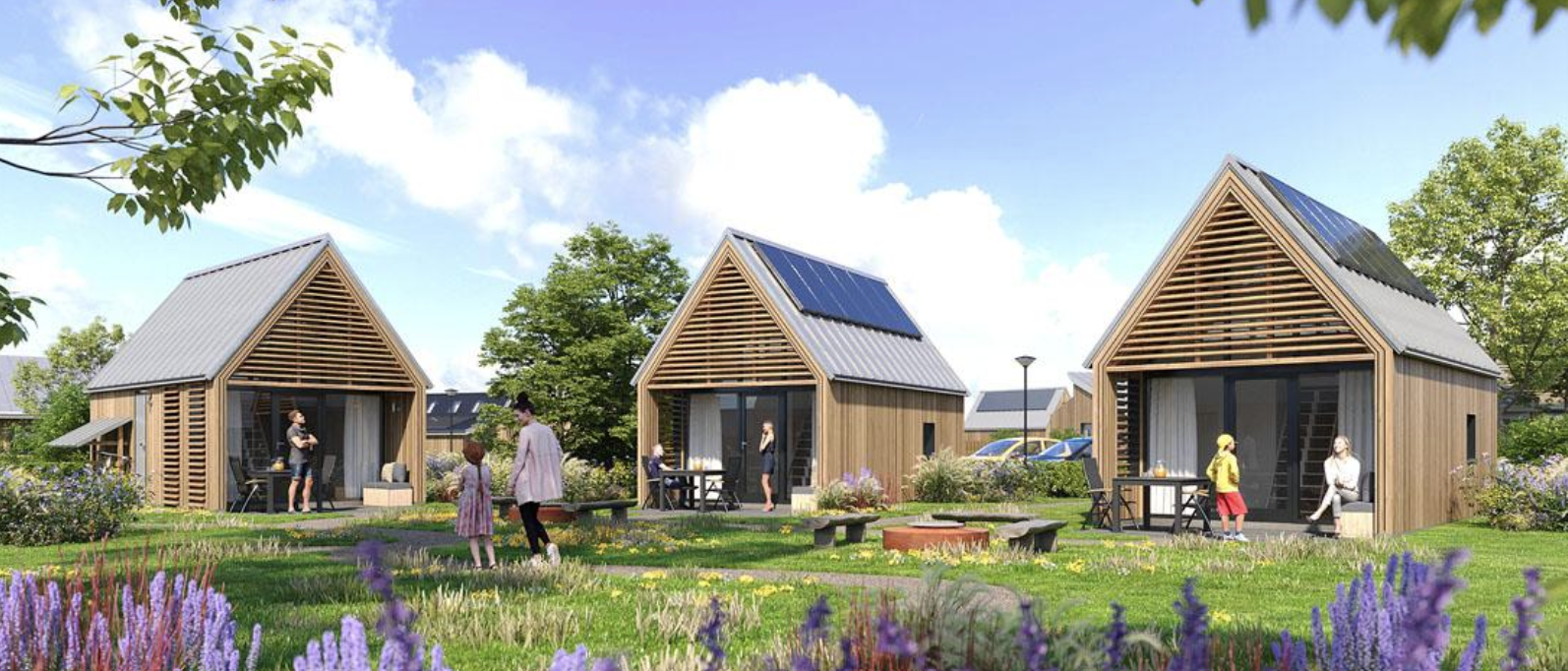
Each cabin (approx. 55m2) will be placed about 25-80 m. apart, depending on the topography and vegetation, in such a way that they can’t ‘see’ each other and all have a onobstructed view of the fjord, mountains and/or valley.
We have identified about 40 excellent potential building spots to place these cabins which you can explore via this link. It will show you pictures and panoramic videos.
But it’s not only the spots that are spectacular: the cabin design in itself is unique and going to be a huge factor in our hotel’ USP. Nothing like this exists and yet it’s 500-year old proven technology to make it happen. See more on our cabin design at this page.
The main reason we have decided to go with modular prefab construction is our desire to out-design the need for local labour to an absolute minimum and minimize the influence the weather can have on the building process and progress..
There are no Icelandic companies that can deliver the cost-effectiveness, quality and experience we can find in the Netherlands and Eastern Europe. In fact, most similar projects in Iceland are also pre-fab units coming from Eastern Europe and even China (but that hotel project gave a lot of headaches I was told).
Our hotel consists of 48 modules. The cabins are made up from 2 halves. We plan to charter a vessel to bring them from a Dutch seaport to Iceland. That’s a lot cheaper and convenient than ro-ro serices. Our own vessel can dock at the nearby port of Grundartangi from which it’s a 30 minute ride over a very quiet road.
If we are lucky, we can negotiate a deal with the owner of a nearby whaling station at less than 10 minutes away. That would make things a lot cheaper and faster but we’re still finding out the maximum draft possible at that dock.
Thorwald’s experience with shipping is definitely a great plus to make sure this logistical challenge will go smoothly.
The anchor of our development and major revenue source will be the geothermal pools. While previous exploratory drillings in the area indicate excellent potential for geothermall water sources with a temperature gradient of 120 degrees C. / 1.000 m. the real challenge is to hit the hot water source. It’s typically located along cracks in the rock layers below.
We are consulting with one of Iceland’s premier geothermal experts, to make sure we minimize the chance of failure to find geothermal water and carry out the search in the most cost-effective way.
This means we start with 3-4 exploratory drills of up to 80 meters, followed by a magnetic survey (done with a drone). This will give us an indication on where to start drilling the production well that we expect to go 900-1.500 m. deep). It will also give us guidance on the drilling method to use: straight down, under an angle or directional. Each have pro’s and con’s. Directional drilling give most flexibility and highest chance of success but it’s also a factor 40-60% more expensive.
A typical small geothermal well in Iceland – say producing 10 liters/sec. watrer of 90 C. that is cooled down to 30 C. can easily produce about 2.5 MW, enough to heat hundreds of homes. Certainly enough for our project.. But just in case our well’s production is a lot less, our heat-exchanger pool heating system (more on that in other post) will allow us to meet our heating needs with even 3 liters/sec.
Below a breakdown of the cost of our drilling project based on actual quotes and estimates received from local companies. A lot cheaper than in the Netherlands! Probably one of the few things that is cheaper in Iceland😂.
The drinking water production cost include drilling a well, building a water intake in the nearby creek, a filter installations, UV desinfection equipment, a 58 m3 water silo for storage and (remote) monitoring equipment.
We plan to use Microsoft Business Central (BC) for our accounting and budgetting needs.
While BC is an ERP package and might seem overkill for a start up, it offers a few essential advantages:
One accounting system for all our companies: a single source of truth.
BC offer localization for Netherlands and Iceland which means our bookkeeping software in both countries is totally adjusted to the practices and requirement in both countries.
Deep integration possible with PMS software, access control software (like Vintia) and much more, including of course all MS Officee products.
Implementation of BC is normally a very expensive (20K+) project that is handled through autorized resellers. We have, however, located an independent Dutch BC consultant who can do the job in cooperation with our accountants (PwC in Iceland) and bookkeepers (Abaki ehf in Iceland and Cashflow Administrations in NL) for a considerable lower amount. Our primary focus is currently on getting the basics going and use BC for budgetting and scenario creation.
In Iceland we will have 2 companies: the development company (PropCo) that owns the land (Hugarro Hvalfjordur ehf) and the operations company (OpCo) that will operate the resort(s): Hugarro Hospitality ehf. Both are fully owned daughters of the Dutch company Naturally Iceland BV which is owned by Thorwald and Daniel via individual holding companies.
We plan for the future investors to get equity stakes in the Icelandic PropCo which will have a hybrid lease agreement with the OpCo that will balance the financial interests of investors and operator. We are currently (Dec. ’25) consulting on a hybrid lease agreement so we can put relevant numbers in feasibility projections.
For now, the masterplan change limits us to building maximum 5.000 m2. This represents only 4% of the total land area because structures without a roof such as parking spaces, roads and pools don’t count (don’t you just love that?).
Mobile structures (like our planned staff housing on wheels) don’t count initially but may be considered permanent structures after 2 year (after which we can move them to another location).
Why this (voluntary) limit? Because this way we avoided the requirement of an environmental impact study (EIS). We would surely pass such an EIS but it could potentially be challenged, adding delay and more consulting costs.
Our consultants at ELFA recommended we start with our 5.000 m2. If after say 1-2 years of operation we need more m2, we won’t have trouble increasing the permited density as we will have a record of responsible and low-impact operation that will support the required EIS.
Since finding and retaining good staff is a challenge even under ideal circumstances, we have allocated a considerable amount of money to provide staff housing on-site.
This will appeal especially to non-Icelandic workers who don’t have housing in the area or (very) Rekjavik. Housing is expensive in Reykjavik and it would be very convenient to avoid a daily 55 min. commute. With a nearly 100% occupancy rate of such facilities we can also make it very affordable.
For workers going on (weekend) leave, we plan to acquire a house or piece of land close to Reykjavik where they can also rent an affordable room and relax outside the work environment.
To avoid eating into our max. 5.000 m2 bulding limit (RevPAM of our cabins will be 10x higher than that of our staff cabins 😊) we plan to use mobile units like these.
Not only will it save on foundations, we can also easily move them to other (project) locations when needed. We could even make a ‘sales office’ or ‘coffee café’ version to support our local marketing efforts.
Ideally we will be able to acquire some land nearby in the future to accommodate more of these cabins if needed.
See https://geo.fasteignaskra.is/landeignaskra/224375 to have a look at property register in Iceland.
The current projection provides for approximately 10 units that can accommodate one person or a couple. To save expenses we plan to acquire them directly from a manufacturer, possibly in Eastern Europe.
We would also like to budget some extra money to buy in building plot near Rekjavik. For instance in the Mosfellsbær area. and later build a staff ‘AirBnB’ for those who are on a (weekend) break and want an affordable place to stay. Or we could include say 8 days a month for non-Icelandic employees. Most likely a newly build pre-fab house with say 10 small private rooms with shared showers and a nicely equiped common area. It would easily pay for itself.
Typically, when people talk about sustainable building practices, environmental sustainablity in hospitality, the talk has been about reducing, reusing, and recycling.
As an aspiring B-corp, our ambitions are higher. We want to go beyond the traditional sustainability practices in the hospitality industry and call it regenerative hospitality.
With our hospitality projects we seek to create positive impacts. It’s not just about reducing harm, but about doing more good and actively contributing to the improvement of the environment and society. In the case of our first project near Glymur it would be planting more frees and protecting the existing and native birch forest by fencing it so roaming sheep stop destroying it. Or fund the improvement of trails leading towards the Glymur waterfall to make them safer. Share knowledge with our guests and visitors about the history and culture of the area. Investing in professionalism of our staff members and providing excellent and affordable housing opportunities to them.
In the end, we aim to prove that running a responsible hospitality operation can have a neglectable negative impact on its environment while adding understanding, respect and support for nature conservation.
Besides the basic importance of good stewardship of our planet’s resources, today’s travelers aren’t just better educated and better-informed, they’re more concerned than ever about adopting responsible practices around their personal journeys.
Travelers understand that their trips can leave significant ecological footprints, and they want to minimize these impacts. The upshot is that these savvy travelers actively seek out experiences and accommodations that are in alignment with their values — especially as they pertain to environmental and sustainability practices.
In today’s digital/global age, generalized “environmental” claims in a hotel’s marketing efforts are no longer enough. Instead, it’s becoming crucial to emphasize how a guest’s choice to stay with you directly contributes to worldwide sustainability practices. This level of transparency not only educates guests but also empowers them to make responsible choices, better aligning their travel experiences with their values.
That’s the other reason why we have high ambitions in proving we are building and operating an environmentally friendly hotel business so we attract these eco-conscious travelers.
A property management system (PMS) is software that facilitates a hotel’s reservation management and administrative tasks. The most important functions include front-desk operations, reservations, channel management, housekeeping, rate and occupancy management, and payment processing.
To read more about the need for and advantages of a PMS, see this link.
The best PMS systems are ranked on the very informative website of Hotel TechReport: check the list here.
We don’t use any of them 😊. Not because they are not good but most of them (for instance MEWS from the Netherlands) are not supported in Iceland. This seems to have to do with the fact that Iceland is member of the
European Free Trade Association (EFTA) but not of the EU and has its own currency.
Update December 2026:
We are currently leaning towards StayNTouch but our techstack will be determined in consultation with Provision-Partners, a company of which Daniel a consulting partner and European rep.



 The anchor of our development and major revenue source will be the geothermal pools. While previous exploratory drillings in the area indicate excellent potential for geothermall water sources with a temperature gradient of 120 degrees C. / 1.000 m. the real challenge is to hit the hot water source. It’s typically located along cracks in the rock layers below.
 A typical small geothermal well in Iceland – say producing 10 liters/sec. watrer of 90 C. that is cooled down to 30 C. can easily produce about 2.5 MW, enough to heat hundreds of homes. Certainly enough for our project.. But just in case our well’s production is a lot less, our heat-exchanger pool heating system (more on that in other post) will allow us to meet our heating needs with even 3 liters/sec.


 The best PMS systems are ranked on the very informative website of Hotel TechReport: