
Finding and retaining good people is never easy — and doing so in a remote location makes it harder still. That is why we have committed meaningful investment to providing on-site staff accommodation at Hugarro.
This will be particularly valuable for non-Icelandic staff who have no existing housing in the area. Reykjavik is expensive, and a daily 55-minute commute is neither practical nor desirable. By housing the key people of our team on-site and running the facility at near-full occupancy, we can keep individual costs genuinely affordable.
For staff heading into Reykjavik on days off, we also plan to acquire a house or plot close to the city where employees can rent a room at a reasonable rate — a proper place to relax away from the work environment.
Why we’re doing this
Operational reliability. In Iceland’s remote highlands, severe weather can make travel dangerous or impossible at short notice. Having staff on-site keeps the operation running safely regardless of conditions.
A real recruitment advantage. Housing shortages are a known barrier for international and seasonal workers. Bundling accommodation with a role removes the single biggest obstacle many candidates face.
Team culture. Shared living, done well, builds a strong sense of community — something that matters when you’re working and living far from home.
Cost of living support. Nordic living costs are high. Employer-provided housing directly reduces the financial pressure on employees and eliminates daily transport costs for both parties.
Honest challenges to manage
Work-life separation. When home and workplace are the same location, the boundary between on- and off-duty time can blur. Without deliberate management, this becomes a driver of burnout.
Interpersonal dynamics. A multicultural team sharing confined living spaces requires clear expectations and good conflict-resolution processes. Issues in the accommodation can quickly affect performance on the floor.
Isolation. The on-site community can be close-knit, but it can also become insular. Geographic remoteness limits organic contact with the broader local community, which matters for long-term wellbeing.
Standards matter. Cramped or poorly maintained accommodation quickly erodes morale and, by extension, service quality. The investment in decent housing is an investment in operational continuity.
How we plan to implement this well
Private space is non-negotiable. Communal areas are fine, but every employee needs a genuinely private space to decompress. Hospitality is demanding work; people need a real off switch.
Clear boundaries for managers. Off-duty means off-duty. Management will respect that line.
Thorough onboarding. New staff will be prepared not just for their role, but for the realities of communal living in a remote environment.
Peer support. Returning staff will be paired with new joiners to help them settle in — practically and socially.

The units
To avoid eating into our 5,000 m² building allowance (cabin RevPAM runs approximately 10× higher than staff accommodation so the math is straightforward), we plan to use mobile/modular units rather than permanent structures. The advantages are meaningful: no foundations required, and the units can be relocated to other sites if needed. We may also configure one as a sales or café unit to support local marketing.
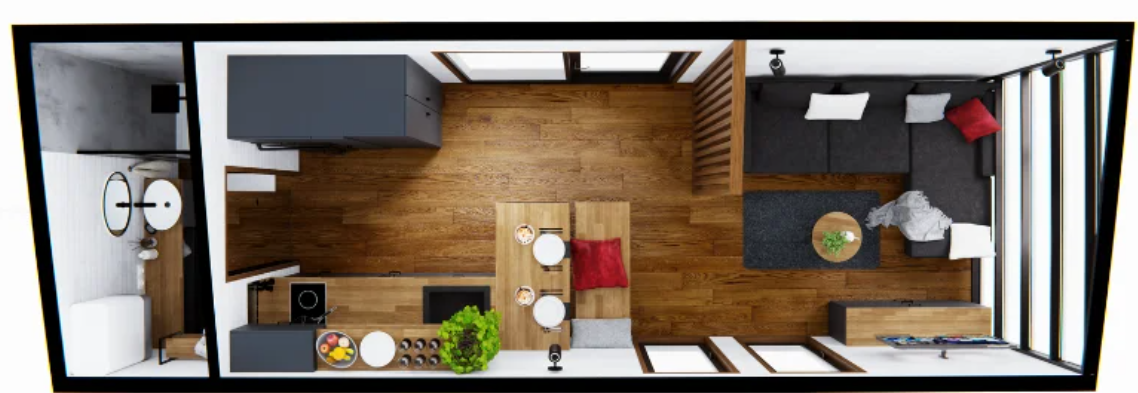
Our current plan is approximately 10 units, each suitable for one person or a couple, sourced directly from a manufacturer — likely in Eastern Europe — to keep costs down.
Ideally, we will acquire nearby land in future to expand staff housing capacity if required. We know the municipality looks favorable to this kind of arrangement.
(See the Iceland Property Register for land listings.)
Reykjavik off-site base
We have budgeted for the purchase of a building plot near Reykjavik — for example, in the Mosfellsbær area — with the intent to build a dedicated staff retreat. The concept: a purpose-built prefab house with approximately 10 small private rooms, shared bathrooms, and a well-equipped common area. Non-Icelandic employees would receive an allocation of roughly 8 days per month to use the facility on breaks.
At near-full utilisation, the property would comfortably pay for itself.