The foundation of everything
Hugarró runs on the heat of the earth. Our geothermal pools, building heating, hot water, and road de-icing all draw from a single underground source. Finding that source — and doing so reliably and cost-effectively — is one of the most important investments we make.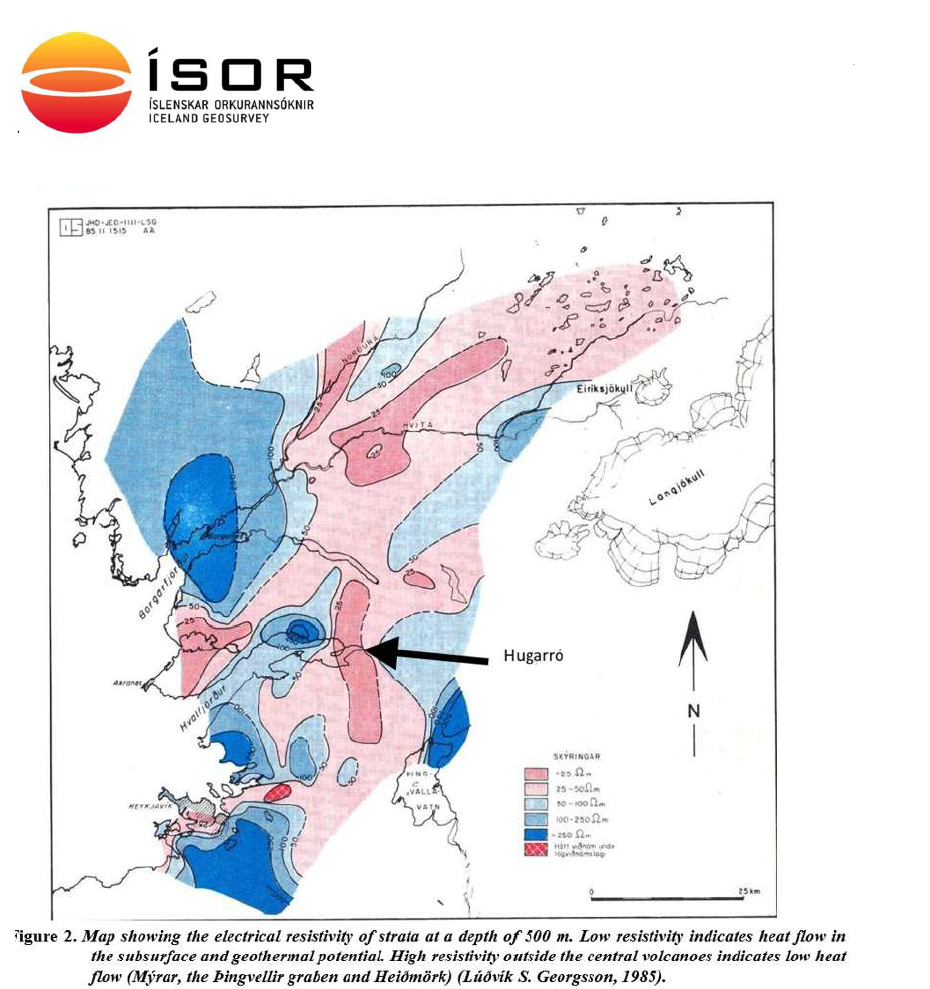
Click to enlarge Iceland’s geological advantage
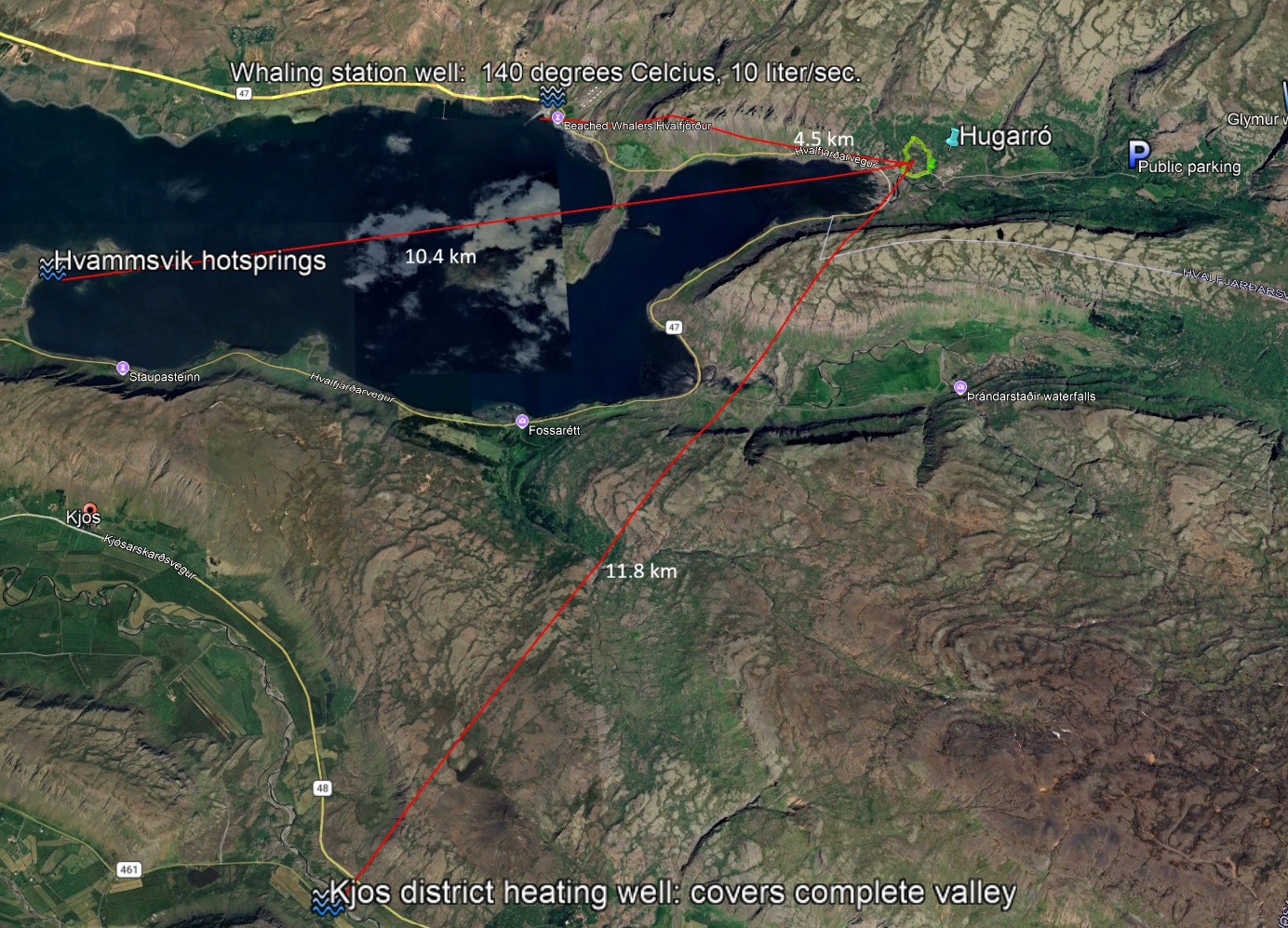
The area around Hvalfjörður sits on one of the most geothermally active zones on the planet. Exploratory data from previous drillings in the area shows a temperature gradient of 120°C per 1,000 metres — well above the global average. The nearby Hvalur station, just a few kilometres away, produces over 20 litres per second at 140°C. Nature has already proven the potential here.
How we find the water?
Geothermal water typically flows along fractures and fault lines in the rock. Hitting those fractures is the real challenge — which is why we do not simply drill and hope.
Our approach, developed with one of Iceland’s leading geothermal specialists, follows a structured three-phase methodology:
- Shallow exploratory drilling — 3 to 4 boreholes to 80 metres, mapping the subsurface geology
- Drone magnetic survey — a non-invasive aerial survey pinpointing fault lines and fracture zones below ground
- Production well — a single deep well of 900–1,500 metres, drilled with the best possible information, maximising the chance of a productive strike

On drilling method, we will choose between vertical, angled, or directional drilling based on what the survey data reveals. Directional drilling offers the greatest flexibility and the highest probability of intersecting a productive fracture — at a 40–60% premium over straight drilling. A worthwhile investment if the geology calls for it.
How much water do we actually need?
Surprisingly little, thanks to our closed-loop pool system. Our engineering calculations show that 7–10 litres per second at 70°C is sufficient to heat all seven pools to 38°C, supply all buildings and cabins with heat, and de-ice roads in winter — with capacity to spare.
Should the Botnsdalur valley ever develop into a wider community, that same well could realistically supply up to 50 holiday homes with heat at no additional extraction cost. If water temperature would be 90°C and the flow 12 litres per second , 250 modern, well-insulated homes could benefit. With their hot tubs of course: a must in Iceland!
Needless to say the additional potential revenue stream of this option is considerable which is why the design of our geothermal water distribution system will be designed for this opportunity.
What it costs
The table below shows our drilling budget, based on actual quotes from Icelandic contractors. Geothermal drilling in Iceland is one of the few things that costs significantly less here than in mainland Europe — geological conditions and a mature local industry make it so.
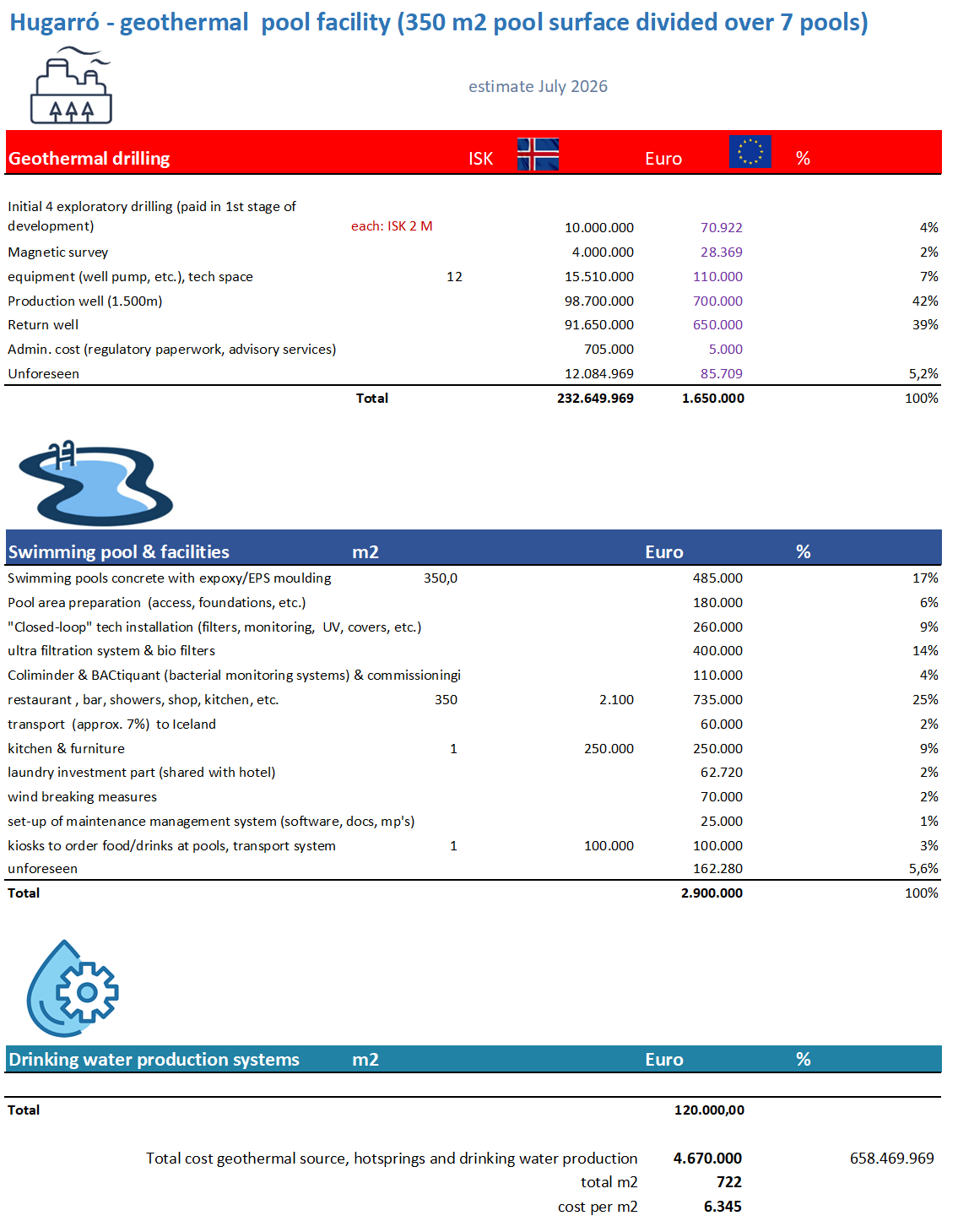 Click to enlarge
Our drinking water infrastructure — borehole, creek intake, filtration, UV disinfection, a 58 m³ storage tank and remote monitoring — is included in the budget above.

You may wonder why drilling a geothermal source in Iceland is considerably cheaper than in mainland Europe.
Icelandic groundwater is extremely hot (often 80°C to well over 150°C). The temperature gradient our our location suggests a temperature of 120 °C at 1.000 m. depth. So if we hit an aquafier at 800 m. with 90 °C water we’re avoid extra drilling cost. Moreover, the water there is often under natural pressure and rises on its own as an artesian spring, or with only a light pump. As a result, the costs for a heavy, expensive deep-well pump in the production well are often eliminated where a well depth of 2.500 m. is not uncommon.
The map below shows the distance to nearby wells.