Board questions
We planned for this from day one
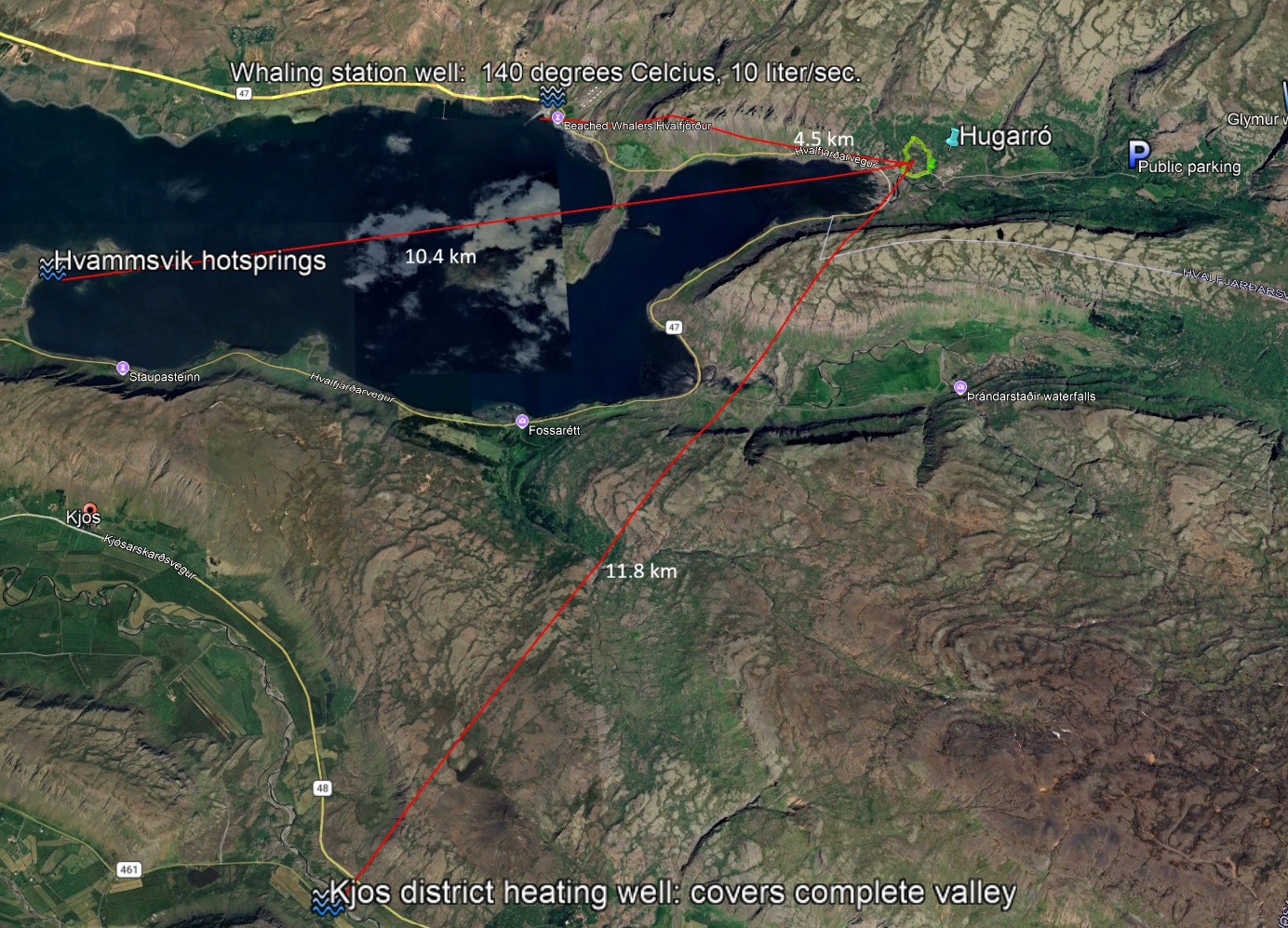
Drilling for geothermal water in Iceland is well-founded — the geology around Hvalfjörður is exceptional and nearby wells prove the potential. But geothermal exploration always carries uncertainty. Fractures can be missed. A well can come up dry. Investors can lose patience.
We designed Hugarró so that this scenario, however unlikely (see this post), does not stop us.
Our answer is a purpose-built alternative heating system that delivers the same pools, the same warmth, the same experience — drawing heat not from the ground below, but from the river and the earth around us.
Why our heating needs are surprisingly modest
Most facilities of this kind would be in serious trouble without a geothermal source. Ours is not — because of how efficiently we use energy in the first place.
Our closed-loop pool system recirculates water rather than constantly replacing it, recovering 33% more heat than the traditional Icelandic approach. Our cascade design runs geothermal water through pools, then buildings, then roads — extracting every usable degree before returning it. Floating insulation covers eliminate heat loss overnight.
The result: our total heating demand — seven pools at 38°C, full hotel and cabin heating, road de-icing — requires the equivalent of just 1,185 kW of continuous thermal output. For a facility of this scale, that is a lean number. And it is exactly what our backup system is sized to deliver.
The alternative: CO₂ heat pumps
If no geothermal source is found, we install three Fenagy (or other reliable brand) H-600 CO₂ heat pump units, each delivering 600 kW of thermal output. Together they provide 1,800 kW of installed capacity — comfortably above our 1,185 kW peak demand, with full redundancy built in.
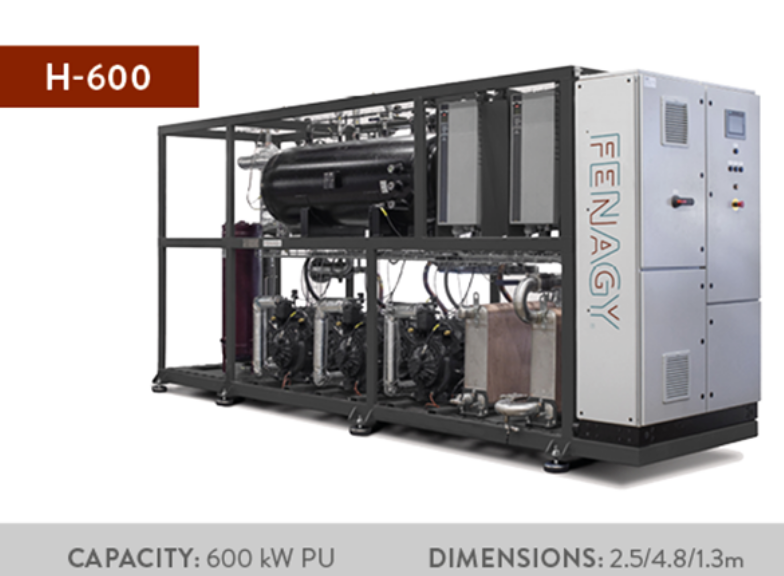
CO₂ (R744) is the ideal refrigerant for this application:
- GWP of 1 — the most climate-neutral refrigerant available
- No chemicals — fully aligned with Iceland’s environmental standards
- Highest efficiency in the 38–70°C output range — exactly our operating window
- Proven technology — widely used in Scandinavian district heating systems
The heat pumps run as water-to-water units, extracting heat from a local water source and delivering it at the temperatures our cascade system requires. The full cascade — pools, buildings, roads — operates identically to the geothermal design. From a guest perspective, nothing changes.
Where the heat comes from: a two-tier water source
Instead of one geothermal well, we use two complementary water sources that together provide year-round reliability.
Tier 1 — The Brunná river (primary, spring through autumn)
The Brunná flows just 200 metres from our plant room, crossing land whose owner has no objection to our intake (in fact, we are co-owner). A short insulated HDPE pipe draws water at ~6°C, passes it through a heat exchanger, and returns it a few degrees cooler. The river provides more than enough flow for our needs during the eight warmest months of the year.
Tier 2 — Two drilled groundwater wells (winter backup)
For the winter months, when surface water flow can drop and ice becomes a risk, we rely on two drilled wells at 80–150 metres depth. At that depth, groundwater in the Botnsdalur valley maintains a stable 4–6°C year-round — completely unaffected by surface weather, frost, or seasonal variation. No river. No tidal influence. No moving parts except a submersible pump in each well.
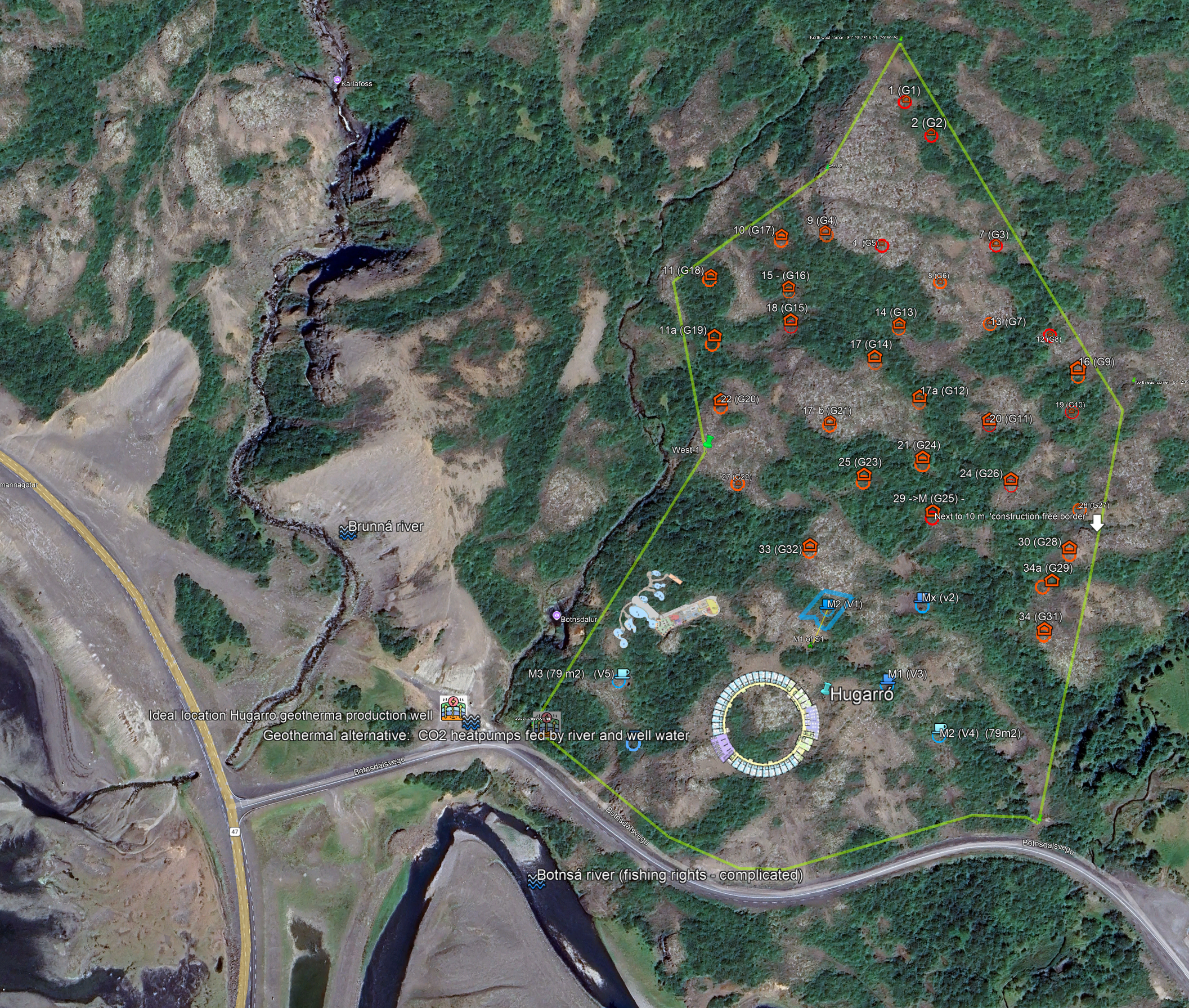
Crucially, these wells are drilled while the geothermal exploration rig is already on site — a modest incremental cost on an already-mobilised programme, and one that simultaneously provides valuable geological data to guide the deep geothermal drill.
The system switches automatically between sources based on flow sensors and temperature readings. No manual intervention required.
The buffer tank — smoothing out demand peaks
Between the heat pumps and the distribution system sits a 35 m3 insulated thermal buffer tank, maintained at 45–50°C. It acts as a reservoir of stored heat, absorbing demand peaks and allowing the heat pumps to run at steady, optimal load rather than cycling up and down.
The effect is meaningful: peak source water demand drops by around 20%, the heat pumps run more efficiently, and the system becomes more resilient to short interruptions in either water source. It is the thermal equivalent of a battery — simple, passive, and highly effective.
What it costs to run
Iceland’s electricity is among the cleanest and most affordable in Europe, generated almost entirely from hydro and geothermal sources. At current industrial tariffs:
| Scenario | Annual electricity | Annual cost |
|---|---|---|
| Winter conditions (COP 3.5) | Higher draw | — |
| Summer conditions (COP 5.0) | Lower draw | — |
| Annual average (COP ~3.8) | ~2,730 MWh | ~€240,000/year |
For every unit of electricity the heat pumps consume, they deliver 3.8 units of heat — the rest comes free from the river or the wells. Compared to direct electric heating, the CO₂ heat pump system saves approximately €750,000 per year in energy costs.
How the two systems compare
| Geothermal well | CO₂ heat pump backup | |
|---|---|---|
| Heat source | Earth (70–90°C) | River + groundwater wells |
| Electricity required | Minimal (pumps only) | ~312 kW continuous |
| Annual energy cost | Near zero | ~€240,000 |
| Guest experience | Identical | Identical |
| Environmental impact | Zero discharge | Zero discharge |
| Cascade compatibility | Full | Full |
| CO₂ emissions | Zero | Zero (Icelandic grid) |
The bottom line
Finding geothermal water is our ambition and our expectation. The geology strongly supports it. But if exploration falls short, Hugarró does not fall with it.
Our backup system — three CO₂ heat pumps, two groundwater wells, a river intake, and a thermal buffer — delivers the same warmth, the same pools, and the same guest experience at a known, manageable operating cost. It was engineered in parallel with the geothermal design, not as an afterthought.
We are not betting everything on a single drill result. That is how Hugarró was designed.
Vacation home district heating — Iceland
Prepared: September 2026 | Confidential — For Discussion Purposes
Executive Summary
Our geothermal project will generate significantly more thermal capacity than the primary development requires. We propose to monetise this surplus by supplying hot water to a neighbouring planned vacation home community of 50 homes across two clusters. The developer of that community has indicated willingness to co-invest in the distribution infrastructure, which materially de-risks the project and compresses the payback period to approximately 10–11 years on a shared CAPEX basis — well within the operational lifespan of the asset (30–40 years).
This is a low-marginal-cost, recurring revenue stream built on zero-cost fuel.
Project overview
| Parameter | Detail |
|---|---|
| Heat source | Geothermal (surplus capacity from primary project) |
| Customers — Phase 1 | 25 vacation homes, Cluster A |
| Customers — Phase 2 | 25 vacation homes, Cluster B |
| Distance to Cluster A | 800 m from source |
| Distance to Cluster B | 1,700 m from source |
| Billing model | Fixed annual subscription + flow capacity |
| Developer role | Co-investor in pipeline infrastructure (50% CAPEX) |
Capital expenditure
| Item | Total Cost | Developer (50%) | Our Share (50%) |
|---|---|---|---|
| Trunk line, Source → Cluster A (800 m) | €524,800 | €262,400 | €262,400 |
| Extension, Cluster A → Cluster B (900 m) | €590,400 | €295,200 | €295,200 |
| Internal distribution, Cluster A | €173,700 | €86,850 | €86,850 |
| Internal distribution, Cluster B | €173,700 | €86,850 | €86,850 |
| Pump station & substations | €65,000 | €32,500 | €32,500 |
| Metering cabinets (50 homes) | €75,000 | €37,500 | €37,500 |
| Total | €1,602,600 | €801,300 | €801,300 |
| Less: Connection fees collected (50 × €3,200) | –€160,000 | ||
| Net CAPEX outlay | €641,300 |
Build is phased: Phase 1 (Cluster A, ~€801k) triggers on Cluster A construction start; Phase 2 (Cluster B) triggers on Cluster B confirmation. No idle capital.
Revenue & Financial Projection
| Revenue Item | Annual |
|---|---|
| Subscriptions — 40 standard homes (×€1,450/yr) | €58,000 |
| Subscriptions — 10 hot tub homes (×€1,750/yr) | €17,500 |
| Gross Revenue | €75,500 |
| Operating costs (maintenance, pumping, admin) | –€15,000 |
| Net Annual Income | €60,500 |
| Financial Metric | Value |
|---|---|
| One-time connection fee income | €160,000 |
| Net annual income (steady state) | ~€60,500 |
| Net CAPEX after connection fees | €641,300 |
| Payback period | ~10.6 years |
| Revenue from year 11 onwards | Near-pure margin |
| Asset operational life | 30–40 years |
Why the developer co-invests
The developer’s motivation is straightforward. In Iceland, geothermal hot water access is a market baseline expectation — lots without it sell at a meaningful discount. Based on regional comparables, reliable hot water supply adds an estimated €15,000–€25,000 per lot in realised sale value. Across 50 lots, that represents a €750k–€1.25M uplift in gross development value — making a €800k infrastructure contribution not just reasonable, but commercially rational. We are effectively subsidising their product quality.
This alignment of interests is a structural strength of the deal.
Key strengths
- Zero fuel cost. The heat is a by-product of our existing geothermal investment. Marginal cost of production is effectively nil.
- Recurring, inflation-linked income. Subscription tariffs are typically indexed to energy price benchmarks. Utility revenues are sticky and predictable.
- Captive customer base. Once connected, switching costs are prohibitive. Customer churn is essentially zero.
- Developer co-investment halves our exposure and signals strong demand validation before a single pipe is laid.
- Phased build eliminates idle capital risk. Phase 2 is only committed when Cluster B development is confirmed.
- Enhances our own project’s social licence. Community benefit strengthens planning relationships and long-term operating position.
- Gateway asset. Once operational, additional projects in the area will find our infrastructure already in place, with extension economics improving per additional customer.
Risks & mitigants
| Risk | Likelihood | Mitigant |
|---|---|---|
| Developer delays Phase 2 or backs out | Medium | Phase-gate agreements; Phase 1 is independently viable |
| Connection take-up below 100% | Medium | Mandatory connection covenant in lot sale contracts |
| Hot water chemistry unsuitable for bathing | Low–Medium | Test borehole water pre-commitment; heat exchanger option |
| Regulatory licence requirement (Orkustofnun) | Low–Medium | Early engagement with regulator; licence process is established |
| Pipeline CAPEX overrun | Medium | Fixed-price contractor quotes locked before commitment; 10% contingency |
| Developer seeks equity/pricing control | Medium | Contribution structured as infrastructure grant, not equity; ownership stays with us |
| Phase 2 development delayed 3–5 years | Medium | Phase-gating means no stranded capital; Phase 1 payback unaffected |
Strategic upside (not in base case)
10 existing vacation homes in the wider area were judged too dispersed and few to connect at present. As our network grows and additional developments emerge, incremental connections become progressively cheaper per home.
- Future developments attracted by proven geothermal infrastructure can be connected on similar commercial terms — each new customer improves the network economics for all parties.
- Carbon credit potential. Displacing oil or electric boiler heating with geothermal may qualify under relevant Icelandic or European carbon mechanisms — upside not yet quantified.
Summary verdict
This is a long-duration, low-risk infrastructure asset generating clean recurring income from a zero-cost fuel source, with a co-investing partner whose financial interests are directly aligned with ours. The 10.6-year payback on net invested capital is conservative — and from year 11, the revenue stream runs largely unconstrained for a further 20–30 years.
The primary negotiation priority is the mandatory connection covenant in the developer’s lot sale contracts. That single clause converts a projected revenue stream into a contractual one — and that is the difference between a good investment and an excellent one.
This document is prepared for discussion purposes only and does not constitute a formal investment prospectus. All figures are estimates based on comparable Icelandic district heating projects and are subject to detailed engineering and commercial due diligence.
Environment
How Hugarro cabins handle wastewater the Icelandic way
At Hugarro, every detail of our cabin design is guided by three principles: respect for the landscape, reliability in all conditions, and simplicity of installation, operation and maintenance. Our approach to wastewater treatment is no exception — and it gives rise to one of our most quietly ingenious features: a small, fully functional utility structure that disappears almost entirely into the Icelandic hillside.
Why we separate black water and grey water
Not all wastewater is equal. In conventional systems, toilet waste and sink/shower water are combined and sent to a single treatment unit. We deliberately keep them separate — and for good reason.
Black water — from toilets only — is biologically concentrated but hydraulically modest. It contains the pathogens and nitrogen compounds that require robust biological treatment.
Grey water — from sinks, showers, and baths — accounts for 65–75% of total wastewater volume from a cabin, but carries a far lower biological load. It is primarily soap, body oils, food residue, and warm water.
Mixing the two forces a single system to handle both the peak hydraulic loads of bathing and the biological complexity of toilet waste simultaneously — a compromise in both directions. Separating them allows each system to be optimised for its actual task:
| Black water | Grey water | |
|---|---|---|
| Source | Toilets only | Sinks, showers, baths |
| Volume | Low (~50 L/person/day) | High (~100 L/person/day) |
| Biological load | High | Low–moderate |
| Treatment required | Full biological treatment | Filtration + passive biotreatment |
| Our system | Biorock BEASY-2000 | Biolan + surge buffer |
The practical result: ouir biological reactor will never be overwhelmed by peak shower or bath flows, operates well within its rated capacity at all times, and requires far less frequent maintenance than a combined system would. The grey water system, in turn, handles a cleaner, more predictable load and performs accordingly.
Black water treatment — The Biorock BEASY-2000
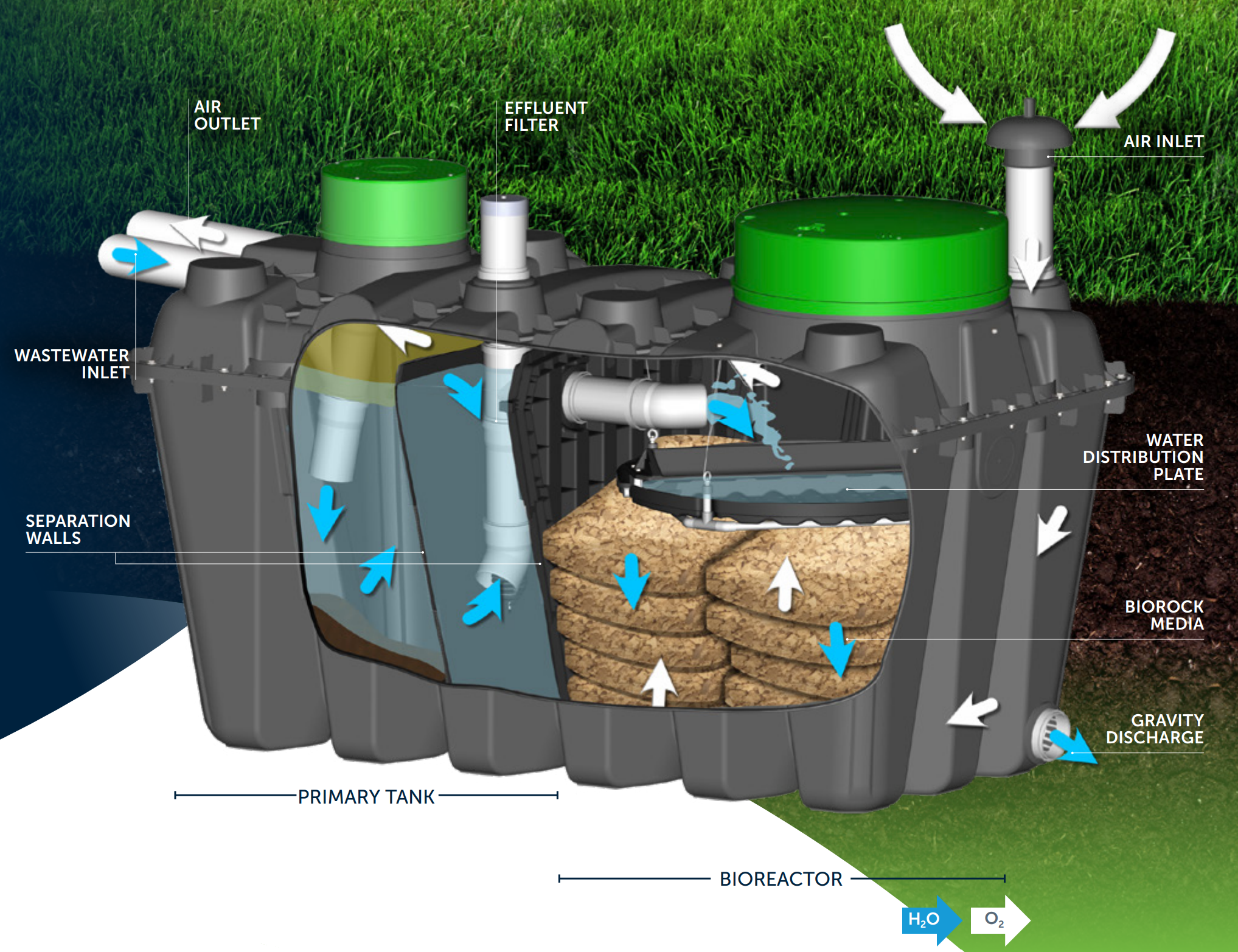
We treat black water (toilet waste) using the Biorock BEASY-2000, a compact, all-in-one biological treatment unit certified to the European standard EN 12566-3+A2. It was chosen after careful evaluation of available technologies, and for good reason:
Click to enlarge
No electricity, no moving parts. The BEASY-2000 operates entirely on passive aeration — wastewater flows through a mineral biofilm media bed where naturally occurring bacteria break down pollutants. There is nothing to break down, no pump to fail, no alarm to go off in the middle of the night.
Minimal maintenance. The system requires only an annual visual inspection and a desludging of the primary tank every three to five years under our low-occupancy cabin loading. No specialist equipment is needed — a licensed tanker visit every few years is all it takes.
Built for low and intermittent loads. Because we treat grey water separately, only toilet waste enters the BEASY-2000. This significantly reduces the biological load on the system — effectively placing it well within its rated capacity at all times. At this load level, the internal biofilm media may never need replacement over the lifetime of the installation.
Compact and self-contained. At just 225 × 121 × 121 cm, the entire two-stage system — primary settling tank and bioreactor — is housed in a single moulded unit. One tank, one connection, one annual check.
European certified. Discharge quality meets or exceeds the EN 12566-3+A2 standard, with BOD removal exceeding 94% and COD removal exceeding 85% in certified testing. This is a system with a documented, verified performance record across thousands of installations in Europe, including Scandinavia.
Grey water treatment — Biolan filter with surge buffer
Grey water from sinks, showers, and baths is treated by a dedicated passive filter system: the Biolan Greywater Filter, a compact Finland-land made unit designed specifically for cabin and holiday home use in cold climates. Like the BEASY-2000, it requires no electricity and has no moving parts.
Water trickles downward through successive layers of peat, mineral fibre, and activated carbon, which together remove suspended solids, organic compounds, phosphorus, and odours before the treated water reaches a soakaway or drainage field. The filter media requires replacement every few years — a straightforward task taking less than an hour.
Managing peak flows — The surge buffer tank
The Biolan filter is optimised for steady, low flow rates — ideal for showers and basin use. A bathtub, however, can release 150 litres in under five minutes: a peak flow rate some 40 times higher than the filter can accept. Sending a bathtub drain directly to the Biolan would bypass treatment entirely and risk overloading the filter media.
Our solution is simple and entirely passive: a 200-litre surge buffer tank mounted on a rack above the Biolan inside the utility shed. All grey water — from kitchen sink, shower, basin, and bath — enters the surge tank first. A small-bore outlet at the base of the tank allows water to trickle down into the Biolan at a controlled, gentle rate regardless of how fast it arrived. No sensors, no valves, no electronics — just gravity doing its job.
Kitchen sink water carries fats, oils, and greases (FOG) from cooking and dishwashing. FOG is the primary cause of premature clogging in passive grey water filters. A simple passive grease trap — a small baffled chamber where warm water slows, FOG floats to the surface, and is retained — is installed immediately after the kitchen sink drain and before the surge tank. It requires cleaning every three to six months: a quick scoop-and-dispose task during routine cabin checks.
Shower and basin water bypasses the grease trap (it carries soap but negligible FOG) and flows directly into the surge tank. This separation of kitchen and bathing water streams keeps the grease trap small and the Biolan filter performing at its best.
Winter operation
Grey water arriving from a heated cabin is warm by nature — shower water at 35°C, dishwashing water at 40°C — and warms the Biolan filter media continuously during occupancy. The utility shed enclosure, already heated passively by the BEASY-2000’s thermostat heater, maintains a stable internal temperature well above freezing throughout winter. No supplemental heating is needed for the grey water system.
In the rare event of Biolan maintenance or media replacement, grey water can be temporarily rerouted to the BEASY-2000 via a simple manual valve — a contingency built into the pipework from the start. The BEASY handles the short-term combined load with ease.
The structure — A partial dig that makes sense and looks great
Rather than burying the tanks fully underground — expensive and challenging in Iceland’s rocky volcanic substrate at several cabin locations — we partially sink a purpose-built utility enclosure into the ground, typically one metre below grade. This approach is deliberate and smart on multiple levels:
Excavation cost is kept to a minimum. Full burial of tanks in Icelandic lava rock can cost several times the price of the equipment itself. Our partial-dig approach requires a modest, manageable excavation — reducing groundwork costs significantly while achieving the same thermal and structural benefits.
The ground does the heavy lifting thermally. At one metre depth, the surrounding earth and rock maintain a stable temperature year-round — buffering the system against Iceland’s winter extremes. The three buried or bermed walls of the enclosure are insulated with moisture-resistant XPS foam board, ensuring that the internal environment stays comfortably above the minimum operating temperature even in the coldest months.
A small 200W thermostatically controlled heater — no larger than an aquarium heater — is placed in the BEASY-2000 primary tank as a backup for the coldest periods. It consumes less energy annually than a single light bulb left on for a week, and ensures the bacterial treatment community remains active and effective regardless of external conditions.
Pipe runs between the cabin and the enclosure are kept short and insulated, eliminating any risk of freezing in the connection lines.
The architecture — An Icelandic turf structure
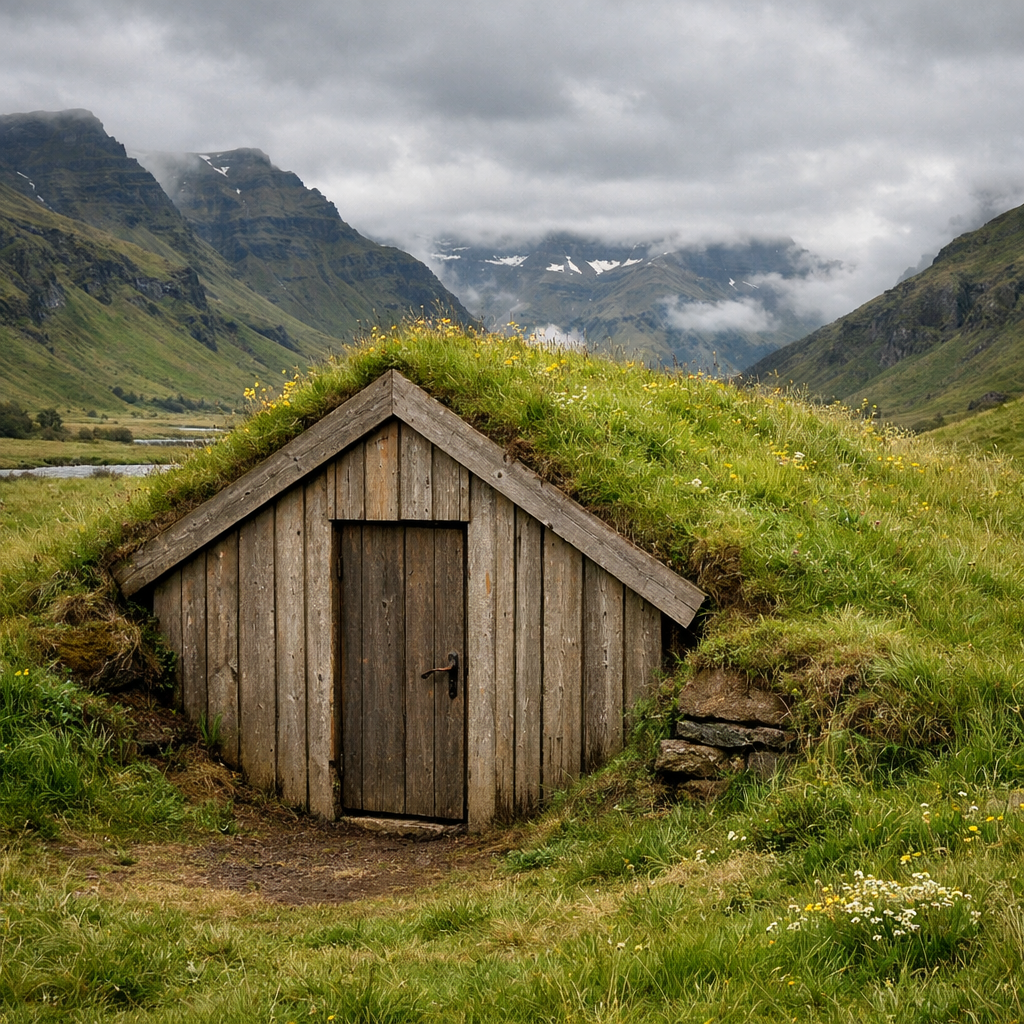
The enclosure itself is built in the tradition of Iceland’s historic torfbær — the turf outbuildings that have sheltered tools, food stores, and animals in this landscape for over a thousand years. A simple timber-framed structure with a 30-degree pitched roof, it presents only a weathered wooden gable and a low door to the outside world. Everything else disappears under living turf.
Click to enlarge
The roof follows traditional construction: a structural timber deck, a modern EPDM rubber waterproofing membrane in place of the original birch bark, a drainage layer, and two layers of Icelandic turf slab — the lower layer grass-side down, the upper grass-side up — just as it has always been done. Within a single growing season, the roof is indistinguishable from the surrounding meadow.
Three sides of the structure are bermed with the excavated material and seeded with local grasses. The fourth side — the entrance face — can be oriented toward the cabin for convenient access, or away from the main view to preserve sightlines.
The result is a structure that is essentially invisible in the landscape — a small green rise in the ground, entirely at home in Iceland’s valleys and hillsides.
More than a utility box — A true services hub
The enclosure is dimensioned generously enough — approximately 250 × 320 cm internally — to serve as a complete services hub for each cabin cluster. Inside, every system is accessible from a single point:
| Service | Notes |
|---|---|
| Biorock BEASY-2000 | Black water biological treatment — primary tank + bioreactor in one unit |
| Biolan grey water filter | Passive filter for sink, shower, and bath water |
| 200L surge buffer tank | Mounted on rack above Biolan — absorbs peak bath flows passively |
| Kitchen sink grease trap | Protects filter media from fats, oils, and grease |
| Potable water meter & shutoff | Accessible without entering the cabin |
| Heating circuit distribution & heat exchanger | Hot water from a central source distributed to cabins from this point |
| Electrical connection point & main breaker | Per-cabin metering and isolation in one accessible location |
| Storage | Chemicals, maintenance tools, spare parts — on a simple shelf above the tanks |
This means that every utility serving the cabin can be accessed, inspected, isolated, and serviced from a single point, without entering the cabin or disturbing guests. For a hospitality operation, this is a significant operational advantage — maintenance can be performed discreetly, quickly, and at any time.
The cabin underfloor installation for the cabin turning system will have a separate access point, also avoiding the need for cabin entry during routine checks.
In summary
Our wastewater and utility approach at Hugarro combines European-certified biological treatment technology with centuries-old Icelandic building tradition. Black water and grey water are treated separately — each by a system sized and optimised for its specific task — and both housed within a single compact enclosure that is virtually invisible in the landscape.
The result is a system that is invisible to guests, kind to the environment, robust in all seasons, and straightforward to maintain — a small buried structure that quietly does everything, and shows almost nothing.
Geothermal
We planned for this from day one
Drilling for geothermal water in Iceland is well-founded — the geology around Hvalfjörður is exceptional and nearby wells prove the potential. But geothermal exploration always carries uncertainty. Fractures can be missed. A well can come up dry. Investors can lose patience.
We designed Hugarró so that this scenario, however unlikely (see this post), does not stop us.
Our answer is a purpose-built alternative heating system that delivers the same pools, the same warmth, the same experience — drawing heat not from the ground below, but from the river and the earth around us.
Why our heating needs are surprisingly modest
Most facilities of this kind would be in serious trouble without a geothermal source. Ours is not — because of how efficiently we use energy in the first place.
Our closed-loop pool system recirculates water rather than constantly replacing it, recovering 33% more heat than the traditional Icelandic approach. Our cascade design runs geothermal water through pools, then buildings, then roads — extracting every usable degree before returning it. Floating insulation covers eliminate heat loss overnight.
The result: our total heating demand — seven pools at 38°C, full hotel and cabin heating, road de-icing — requires the equivalent of just 1,185 kW of continuous thermal output. For a facility of this scale, that is a lean number. And it is exactly what our backup system is sized to deliver.
The alternative: CO₂ heat pumps
If no geothermal source is found, we install three Fenagy (or other reliable brand) H-600 CO₂ heat pump units, each delivering 600 kW of thermal output. Together they provide 1,800 kW of installed capacity — comfortably above our 1,185 kW peak demand, with full redundancy built in.
CO₂ (R744) is the ideal refrigerant for this application:
- GWP of 1 — the most climate-neutral refrigerant available
- No chemicals — fully aligned with Iceland’s environmental standards
- Highest efficiency in the 38–70°C output range — exactly our operating window
- Proven technology — widely used in Scandinavian district heating systems
The heat pumps run as water-to-water units, extracting heat from a local water source and delivering it at the temperatures our cascade system requires. The full cascade — pools, buildings, roads — operates identically to the geothermal design. From a guest perspective, nothing changes.
Where the heat comes from: a two-tier water source
Instead of one geothermal well, we use two complementary water sources that together provide year-round reliability.
Tier 1 — The Brunná river (primary, spring through autumn)
The Brunná flows just 200 metres from our plant room, crossing land whose owner has no objection to our intake (in fact, we are co-owner). A short insulated HDPE pipe draws water at ~6°C, passes it through a heat exchanger, and returns it a few degrees cooler. The river provides more than enough flow for our needs during the eight warmest months of the year.
Tier 2 — Two drilled groundwater wells (winter backup)
For the winter months, when surface water flow can drop and ice becomes a risk, we rely on two drilled wells at 80–150 metres depth. At that depth, groundwater in the Botnsdalur valley maintains a stable 4–6°C year-round — completely unaffected by surface weather, frost, or seasonal variation. No river. No tidal influence. No moving parts except a submersible pump in each well.
Crucially, these wells are drilled while the geothermal exploration rig is already on site — a modest incremental cost on an already-mobilised programme, and one that simultaneously provides valuable geological data to guide the deep geothermal drill.
The system switches automatically between sources based on flow sensors and temperature readings. No manual intervention required.
The buffer tank — smoothing out demand peaks
Between the heat pumps and the distribution system sits a 35 m3 insulated thermal buffer tank, maintained at 45–50°C. It acts as a reservoir of stored heat, absorbing demand peaks and allowing the heat pumps to run at steady, optimal load rather than cycling up and down.
The effect is meaningful: peak source water demand drops by around 20%, the heat pumps run more efficiently, and the system becomes more resilient to short interruptions in either water source. It is the thermal equivalent of a battery — simple, passive, and highly effective.
What it costs to run
Iceland’s electricity is among the cleanest and most affordable in Europe, generated almost entirely from hydro and geothermal sources. At current industrial tariffs:
| Scenario | Annual electricity | Annual cost |
|---|---|---|
| Winter conditions (COP 3.5) | Higher draw | — |
| Summer conditions (COP 5.0) | Lower draw | — |
| Annual average (COP ~3.8) | ~2,730 MWh | ~€240,000/year |
For every unit of electricity the heat pumps consume, they deliver 3.8 units of heat — the rest comes free from the river or the wells. Compared to direct electric heating, the CO₂ heat pump system saves approximately €750,000 per year in energy costs.
How the two systems compare
| Geothermal well | CO₂ heat pump backup | |
|---|---|---|
| Heat source | Earth (70–90°C) | River + groundwater wells |
| Electricity required | Minimal (pumps only) | ~312 kW continuous |
| Annual energy cost | Near zero | ~€240,000 |
| Guest experience | Identical | Identical |
| Environmental impact | Zero discharge | Zero discharge |
| Cascade compatibility | Full | Full |
| CO₂ emissions | Zero | Zero (Icelandic grid) |
The bottom line
Finding geothermal water is our ambition and our expectation. The geology strongly supports it. But if exploration falls short, Hugarró does not fall with it.
Our backup system — three CO₂ heat pumps, two groundwater wells, a river intake, and a thermal buffer — delivers the same warmth, the same pools, and the same guest experience at a known, manageable operating cost. It was engineered in parallel with the geothermal design, not as an afterthought.
We are not betting everything on a single drill result. That is how Hugarró was designed.
Our energy source: the earth itself
Hugarró is heated entirely by geothermal energy — natural heat drawn from deep underground. It powers our pools, our hot water, our buildings, and even our roads in winter. No fossil fuels. No emissions. No utility bills.
Smarter than the traditional approach
The standard practice in Iceland is to continuously replace pool water with fresh geothermal water — discarding around 230 m³ of hot water into nature every single day. We think that is wasteful, and we designed our way around it.
Our pools use a closed-loop recirculation system: water stays in the pools and is kept clean through UV disinfection and ultrafiltration membranes — the same technology used in drinking water treatment. No chemicals are used or permitted in Iceland. A real-time microbiological monitoring system continuously checks water quality across all seven pools, so you are always swimming in water that is measurably clean.
The result? We use 91% less water than a traditional Icelandic pool operation, and we recover 33% more heat energy by not throwing it away.
One source, four uses — in sequence
Rather than drawing separate energy for each need, we run our geothermal water through a cascade:
- Geothermal pools — water enters at 70°C and heats our pools to a perfect 38°C
- Hotel & cabin heating — the same water, still warm at 50°C, then heats all our buildings
- Hot tap water — covered in the same circuit
- Road de-icing — remaining warmth is used to keep paths and roads clear in winter
The water is then returned underground at 30°C — completing a fully closed, zero-discharge cycle.
A modest well is all we need
Because our system is so efficient, a geothermal well yielding just 7–10 litres per second at 70°C covers all our needs — pools, buildings, roads, and future expansion. For context, a typical productive well in Iceland delivers 15–50 litres per second. We are not greedy with the resource.
This also means we have realistic capacity to supply heating to neighbouring summer homes and future development in the area — turning a facility cost into a potential revenue stream.
The bottom line
| Traditional Icelandic pools | Hugarró | |
|---|---|---|
| Daily water discharged to nature | 230 m³ | 0 m³ |
| Heat energy wasted | 33% | 0% |
| Chemicals in pool water | None | None |
| Well yield required | 15–50 L/s | 7–10 L/s |
| Neighbours supplied with heat | No | Yes — planned |
Vacation home district heating — Iceland
Prepared: September 2026 | Confidential — For Discussion Purposes
Executive Summary
Our geothermal project will generate significantly more thermal capacity than the primary development requires. We propose to monetise this surplus by supplying hot water to a neighbouring planned vacation home community of 50 homes across two clusters. The developer of that community has indicated willingness to co-invest in the distribution infrastructure, which materially de-risks the project and compresses the payback period to approximately 10–11 years on a shared CAPEX basis — well within the operational lifespan of the asset (30–40 years).
This is a low-marginal-cost, recurring revenue stream built on zero-cost fuel.
Project overview
| Parameter | Detail |
|---|---|
| Heat source | Geothermal (surplus capacity from primary project) |
| Customers — Phase 1 | 25 vacation homes, Cluster A |
| Customers — Phase 2 | 25 vacation homes, Cluster B |
| Distance to Cluster A | 800 m from source |
| Distance to Cluster B | 1,700 m from source |
| Billing model | Fixed annual subscription + flow capacity |
| Developer role | Co-investor in pipeline infrastructure (50% CAPEX) |
Capital expenditure
| Item | Total Cost | Developer (50%) | Our Share (50%) |
|---|---|---|---|
| Trunk line, Source → Cluster A (800 m) | €524,800 | €262,400 | €262,400 |
| Extension, Cluster A → Cluster B (900 m) | €590,400 | €295,200 | €295,200 |
| Internal distribution, Cluster A | €173,700 | €86,850 | €86,850 |
| Internal distribution, Cluster B | €173,700 | €86,850 | €86,850 |
| Pump station & substations | €65,000 | €32,500 | €32,500 |
| Metering cabinets (50 homes) | €75,000 | €37,500 | €37,500 |
| Total | €1,602,600 | €801,300 | €801,300 |
| Less: Connection fees collected (50 × €3,200) | –€160,000 | ||
| Net CAPEX outlay | €641,300 |
Build is phased: Phase 1 (Cluster A, ~€801k) triggers on Cluster A construction start; Phase 2 (Cluster B) triggers on Cluster B confirmation. No idle capital.
Revenue & Financial Projection
| Revenue Item | Annual |
|---|---|
| Subscriptions — 40 standard homes (×€1,450/yr) | €58,000 |
| Subscriptions — 10 hot tub homes (×€1,750/yr) | €17,500 |
| Gross Revenue | €75,500 |
| Operating costs (maintenance, pumping, admin) | –€15,000 |
| Net Annual Income | €60,500 |
| Financial Metric | Value |
|---|---|
| One-time connection fee income | €160,000 |
| Net annual income (steady state) | ~€60,500 |
| Net CAPEX after connection fees | €641,300 |
| Payback period | ~10.6 years |
| Revenue from year 11 onwards | Near-pure margin |
| Asset operational life | 30–40 years |
Why the developer co-invests
The developer’s motivation is straightforward. In Iceland, geothermal hot water access is a market baseline expectation — lots without it sell at a meaningful discount. Based on regional comparables, reliable hot water supply adds an estimated €15,000–€25,000 per lot in realised sale value. Across 50 lots, that represents a €750k–€1.25M uplift in gross development value — making a €800k infrastructure contribution not just reasonable, but commercially rational. We are effectively subsidising their product quality.
This alignment of interests is a structural strength of the deal.
Key strengths
- Zero fuel cost. The heat is a by-product of our existing geothermal investment. Marginal cost of production is effectively nil.
- Recurring, inflation-linked income. Subscription tariffs are typically indexed to energy price benchmarks. Utility revenues are sticky and predictable.
- Captive customer base. Once connected, switching costs are prohibitive. Customer churn is essentially zero.
- Developer co-investment halves our exposure and signals strong demand validation before a single pipe is laid.
- Phased build eliminates idle capital risk. Phase 2 is only committed when Cluster B development is confirmed.
- Enhances our own project’s social licence. Community benefit strengthens planning relationships and long-term operating position.
- Gateway asset. Once operational, additional projects in the area will find our infrastructure already in place, with extension economics improving per additional customer.
Risks & mitigants
| Risk | Likelihood | Mitigant |
|---|---|---|
| Developer delays Phase 2 or backs out | Medium | Phase-gate agreements; Phase 1 is independently viable |
| Connection take-up below 100% | Medium | Mandatory connection covenant in lot sale contracts |
| Hot water chemistry unsuitable for bathing | Low–Medium | Test borehole water pre-commitment; heat exchanger option |
| Regulatory licence requirement (Orkustofnun) | Low–Medium | Early engagement with regulator; licence process is established |
| Pipeline CAPEX overrun | Medium | Fixed-price contractor quotes locked before commitment; 10% contingency |
| Developer seeks equity/pricing control | Medium | Contribution structured as infrastructure grant, not equity; ownership stays with us |
| Phase 2 development delayed 3–5 years | Medium | Phase-gating means no stranded capital; Phase 1 payback unaffected |
Strategic upside (not in base case)
10 existing vacation homes in the wider area were judged too dispersed and few to connect at present. As our network grows and additional developments emerge, incremental connections become progressively cheaper per home.
- Future developments attracted by proven geothermal infrastructure can be connected on similar commercial terms — each new customer improves the network economics for all parties.
- Carbon credit potential. Displacing oil or electric boiler heating with geothermal may qualify under relevant Icelandic or European carbon mechanisms — upside not yet quantified.
Summary verdict
This is a long-duration, low-risk infrastructure asset generating clean recurring income from a zero-cost fuel source, with a co-investing partner whose financial interests are directly aligned with ours. The 10.6-year payback on net invested capital is conservative — and from year 11, the revenue stream runs largely unconstrained for a further 20–30 years.
The primary negotiation priority is the mandatory connection covenant in the developer’s lot sale contracts. That single clause converts a projected revenue stream into a contractual one — and that is the difference between a good investment and an excellent one.
This document is prepared for discussion purposes only and does not constitute a formal investment prospectus. All figures are estimates based on comparable Icelandic district heating projects and are subject to detailed engineering and commercial due diligence.
Sewage
How Hugarro cabins handle wastewater the Icelandic way
At Hugarro, every detail of our cabin design is guided by three principles: respect for the landscape, reliability in all conditions, and simplicity of installation, operation and maintenance. Our approach to wastewater treatment is no exception — and it gives rise to one of our most quietly ingenious features: a small, fully functional utility structure that disappears almost entirely into the Icelandic hillside.
Why we separate black water and grey water
Not all wastewater is equal. In conventional systems, toilet waste and sink/shower water are combined and sent to a single treatment unit. We deliberately keep them separate — and for good reason.
Black water — from toilets only — is biologically concentrated but hydraulically modest. It contains the pathogens and nitrogen compounds that require robust biological treatment.
Grey water — from sinks, showers, and baths — accounts for 65–75% of total wastewater volume from a cabin, but carries a far lower biological load. It is primarily soap, body oils, food residue, and warm water.
Mixing the two forces a single system to handle both the peak hydraulic loads of bathing and the biological complexity of toilet waste simultaneously — a compromise in both directions. Separating them allows each system to be optimised for its actual task:
| Black water | Grey water | |
|---|---|---|
| Source | Toilets only | Sinks, showers, baths |
| Volume | Low (~50 L/person/day) | High (~100 L/person/day) |
| Biological load | High | Low–moderate |
| Treatment required | Full biological treatment | Filtration + passive biotreatment |
| Our system | Biorock BEASY-2000 | Biolan + surge buffer |
The practical result: ouir biological reactor will never be overwhelmed by peak shower or bath flows, operates well within its rated capacity at all times, and requires far less frequent maintenance than a combined system would. The grey water system, in turn, handles a cleaner, more predictable load and performs accordingly.
Black water treatment — The Biorock BEASY-2000
We treat black water (toilet waste) using the Biorock BEASY-2000, a compact, all-in-one biological treatment unit certified to the European standard EN 12566-3+A2. It was chosen after careful evaluation of available technologies, and for good reason:
Click to enlarge
No electricity, no moving parts. The BEASY-2000 operates entirely on passive aeration — wastewater flows through a mineral biofilm media bed where naturally occurring bacteria break down pollutants. There is nothing to break down, no pump to fail, no alarm to go off in the middle of the night.
Minimal maintenance. The system requires only an annual visual inspection and a desludging of the primary tank every three to five years under our low-occupancy cabin loading. No specialist equipment is needed — a licensed tanker visit every few years is all it takes.
Built for low and intermittent loads. Because we treat grey water separately, only toilet waste enters the BEASY-2000. This significantly reduces the biological load on the system — effectively placing it well within its rated capacity at all times. At this load level, the internal biofilm media may never need replacement over the lifetime of the installation.
Compact and self-contained. At just 225 × 121 × 121 cm, the entire two-stage system — primary settling tank and bioreactor — is housed in a single moulded unit. One tank, one connection, one annual check.
European certified. Discharge quality meets or exceeds the EN 12566-3+A2 standard, with BOD removal exceeding 94% and COD removal exceeding 85% in certified testing. This is a system with a documented, verified performance record across thousands of installations in Europe, including Scandinavia.
Grey water treatment — Biolan filter with surge buffer
Grey water from sinks, showers, and baths is treated by a dedicated passive filter system: the Biolan Greywater Filter, a compact Finland-land made unit designed specifically for cabin and holiday home use in cold climates. Like the BEASY-2000, it requires no electricity and has no moving parts.
Water trickles downward through successive layers of peat, mineral fibre, and activated carbon, which together remove suspended solids, organic compounds, phosphorus, and odours before the treated water reaches a soakaway or drainage field. The filter media requires replacement every few years — a straightforward task taking less than an hour.
Managing peak flows — The surge buffer tank
The Biolan filter is optimised for steady, low flow rates — ideal for showers and basin use. A bathtub, however, can release 150 litres in under five minutes: a peak flow rate some 40 times higher than the filter can accept. Sending a bathtub drain directly to the Biolan would bypass treatment entirely and risk overloading the filter media.
Our solution is simple and entirely passive: a 200-litre surge buffer tank mounted on a rack above the Biolan inside the utility shed. All grey water — from kitchen sink, shower, basin, and bath — enters the surge tank first. A small-bore outlet at the base of the tank allows water to trickle down into the Biolan at a controlled, gentle rate regardless of how fast it arrived. No sensors, no valves, no electronics — just gravity doing its job.
Kitchen sink water carries fats, oils, and greases (FOG) from cooking and dishwashing. FOG is the primary cause of premature clogging in passive grey water filters. A simple passive grease trap — a small baffled chamber where warm water slows, FOG floats to the surface, and is retained — is installed immediately after the kitchen sink drain and before the surge tank. It requires cleaning every three to six months: a quick scoop-and-dispose task during routine cabin checks.
Shower and basin water bypasses the grease trap (it carries soap but negligible FOG) and flows directly into the surge tank. This separation of kitchen and bathing water streams keeps the grease trap small and the Biolan filter performing at its best.
Winter operation
Grey water arriving from a heated cabin is warm by nature — shower water at 35°C, dishwashing water at 40°C — and warms the Biolan filter media continuously during occupancy. The utility shed enclosure, already heated passively by the BEASY-2000’s thermostat heater, maintains a stable internal temperature well above freezing throughout winter. No supplemental heating is needed for the grey water system.
In the rare event of Biolan maintenance or media replacement, grey water can be temporarily rerouted to the BEASY-2000 via a simple manual valve — a contingency built into the pipework from the start. The BEASY handles the short-term combined load with ease.
The structure — A partial dig that makes sense and looks great
Rather than burying the tanks fully underground — expensive and challenging in Iceland’s rocky volcanic substrate at several cabin locations — we partially sink a purpose-built utility enclosure into the ground, typically one metre below grade. This approach is deliberate and smart on multiple levels:
Excavation cost is kept to a minimum. Full burial of tanks in Icelandic lava rock can cost several times the price of the equipment itself. Our partial-dig approach requires a modest, manageable excavation — reducing groundwork costs significantly while achieving the same thermal and structural benefits.
The ground does the heavy lifting thermally. At one metre depth, the surrounding earth and rock maintain a stable temperature year-round — buffering the system against Iceland’s winter extremes. The three buried or bermed walls of the enclosure are insulated with moisture-resistant XPS foam board, ensuring that the internal environment stays comfortably above the minimum operating temperature even in the coldest months.
A small 200W thermostatically controlled heater — no larger than an aquarium heater — is placed in the BEASY-2000 primary tank as a backup for the coldest periods. It consumes less energy annually than a single light bulb left on for a week, and ensures the bacterial treatment community remains active and effective regardless of external conditions.
Pipe runs between the cabin and the enclosure are kept short and insulated, eliminating any risk of freezing in the connection lines.
The architecture — An Icelandic turf structure
The enclosure itself is built in the tradition of Iceland’s historic torfbær — the turf outbuildings that have sheltered tools, food stores, and animals in this landscape for over a thousand years. A simple timber-framed structure with a 30-degree pitched roof, it presents only a weathered wooden gable and a low door to the outside world. Everything else disappears under living turf.
Click to enlarge
The roof follows traditional construction: a structural timber deck, a modern EPDM rubber waterproofing membrane in place of the original birch bark, a drainage layer, and two layers of Icelandic turf slab — the lower layer grass-side down, the upper grass-side up — just as it has always been done. Within a single growing season, the roof is indistinguishable from the surrounding meadow.
Three sides of the structure are bermed with the excavated material and seeded with local grasses. The fourth side — the entrance face — can be oriented toward the cabin for convenient access, or away from the main view to preserve sightlines.
The result is a structure that is essentially invisible in the landscape — a small green rise in the ground, entirely at home in Iceland’s valleys and hillsides.
More than a utility box — A true services hub
The enclosure is dimensioned generously enough — approximately 250 × 320 cm internally — to serve as a complete services hub for each cabin cluster. Inside, every system is accessible from a single point:
| Service | Notes |
|---|---|
| Biorock BEASY-2000 | Black water biological treatment — primary tank + bioreactor in one unit |
| Biolan grey water filter | Passive filter for sink, shower, and bath water |
| 200L surge buffer tank | Mounted on rack above Biolan — absorbs peak bath flows passively |
| Kitchen sink grease trap | Protects filter media from fats, oils, and grease |
| Potable water meter & shutoff | Accessible without entering the cabin |
| Heating circuit distribution & heat exchanger | Hot water from a central source distributed to cabins from this point |
| Electrical connection point & main breaker | Per-cabin metering and isolation in one accessible location |
| Storage | Chemicals, maintenance tools, spare parts — on a simple shelf above the tanks |
This means that every utility serving the cabin can be accessed, inspected, isolated, and serviced from a single point, without entering the cabin or disturbing guests. For a hospitality operation, this is a significant operational advantage — maintenance can be performed discreetly, quickly, and at any time.
The cabin underfloor installation for the cabin turning system will have a separate access point, also avoiding the need for cabin entry during routine checks.
In summary
Our wastewater and utility approach at Hugarro combines European-certified biological treatment technology with centuries-old Icelandic building tradition. Black water and grey water are treated separately — each by a system sized and optimised for its specific task — and both housed within a single compact enclosure that is virtually invisible in the landscape.
The result is a system that is invisible to guests, kind to the environment, robust in all seasons, and straightforward to maintain — a small buried structure that quietly does everything, and shows almost nothing.
Utilities
We planned for this from day one
Drilling for geothermal water in Iceland is well-founded — the geology around Hvalfjörður is exceptional and nearby wells prove the potential. But geothermal exploration always carries uncertainty. Fractures can be missed. A well can come up dry. Investors can lose patience.
We designed Hugarró so that this scenario, however unlikely (see this post), does not stop us.
Our answer is a purpose-built alternative heating system that delivers the same pools, the same warmth, the same experience — drawing heat not from the ground below, but from the river and the earth around us.
Why our heating needs are surprisingly modest
Most facilities of this kind would be in serious trouble without a geothermal source. Ours is not — because of how efficiently we use energy in the first place.
Our closed-loop pool system recirculates water rather than constantly replacing it, recovering 33% more heat than the traditional Icelandic approach. Our cascade design runs geothermal water through pools, then buildings, then roads — extracting every usable degree before returning it. Floating insulation covers eliminate heat loss overnight.
The result: our total heating demand — seven pools at 38°C, full hotel and cabin heating, road de-icing — requires the equivalent of just 1,185 kW of continuous thermal output. For a facility of this scale, that is a lean number. And it is exactly what our backup system is sized to deliver.
The alternative: CO₂ heat pumps
If no geothermal source is found, we install three Fenagy (or other reliable brand) H-600 CO₂ heat pump units, each delivering 600 kW of thermal output. Together they provide 1,800 kW of installed capacity — comfortably above our 1,185 kW peak demand, with full redundancy built in.
CO₂ (R744) is the ideal refrigerant for this application:
- GWP of 1 — the most climate-neutral refrigerant available
- No chemicals — fully aligned with Iceland’s environmental standards
- Highest efficiency in the 38–70°C output range — exactly our operating window
- Proven technology — widely used in Scandinavian district heating systems
The heat pumps run as water-to-water units, extracting heat from a local water source and delivering it at the temperatures our cascade system requires. The full cascade — pools, buildings, roads — operates identically to the geothermal design. From a guest perspective, nothing changes.
Where the heat comes from: a two-tier water source
Instead of one geothermal well, we use two complementary water sources that together provide year-round reliability.
Tier 1 — The Brunná river (primary, spring through autumn)
The Brunná flows just 200 metres from our plant room, crossing land whose owner has no objection to our intake (in fact, we are co-owner). A short insulated HDPE pipe draws water at ~6°C, passes it through a heat exchanger, and returns it a few degrees cooler. The river provides more than enough flow for our needs during the eight warmest months of the year.
Tier 2 — Two drilled groundwater wells (winter backup)
For the winter months, when surface water flow can drop and ice becomes a risk, we rely on two drilled wells at 80–150 metres depth. At that depth, groundwater in the Botnsdalur valley maintains a stable 4–6°C year-round — completely unaffected by surface weather, frost, or seasonal variation. No river. No tidal influence. No moving parts except a submersible pump in each well.
Crucially, these wells are drilled while the geothermal exploration rig is already on site — a modest incremental cost on an already-mobilised programme, and one that simultaneously provides valuable geological data to guide the deep geothermal drill.
The system switches automatically between sources based on flow sensors and temperature readings. No manual intervention required.
The buffer tank — smoothing out demand peaks
Between the heat pumps and the distribution system sits a 35 m3 insulated thermal buffer tank, maintained at 45–50°C. It acts as a reservoir of stored heat, absorbing demand peaks and allowing the heat pumps to run at steady, optimal load rather than cycling up and down.
The effect is meaningful: peak source water demand drops by around 20%, the heat pumps run more efficiently, and the system becomes more resilient to short interruptions in either water source. It is the thermal equivalent of a battery — simple, passive, and highly effective.
What it costs to run
Iceland’s electricity is among the cleanest and most affordable in Europe, generated almost entirely from hydro and geothermal sources. At current industrial tariffs:
| Scenario | Annual electricity | Annual cost |
|---|---|---|
| Winter conditions (COP 3.5) | Higher draw | — |
| Summer conditions (COP 5.0) | Lower draw | — |
| Annual average (COP ~3.8) | ~2,730 MWh | ~€240,000/year |
For every unit of electricity the heat pumps consume, they deliver 3.8 units of heat — the rest comes free from the river or the wells. Compared to direct electric heating, the CO₂ heat pump system saves approximately €750,000 per year in energy costs.
How the two systems compare
| Geothermal well | CO₂ heat pump backup | |
|---|---|---|
| Heat source | Earth (70–90°C) | River + groundwater wells |
| Electricity required | Minimal (pumps only) | ~312 kW continuous |
| Annual energy cost | Near zero | ~€240,000 |
| Guest experience | Identical | Identical |
| Environmental impact | Zero discharge | Zero discharge |
| Cascade compatibility | Full | Full |
| CO₂ emissions | Zero | Zero (Icelandic grid) |
The bottom line
Finding geothermal water is our ambition and our expectation. The geology strongly supports it. But if exploration falls short, Hugarró does not fall with it.
Our backup system — three CO₂ heat pumps, two groundwater wells, a river intake, and a thermal buffer — delivers the same warmth, the same pools, and the same guest experience at a known, manageable operating cost. It was engineered in parallel with the geothermal design, not as an afterthought.
We are not betting everything on a single drill result. That is how Hugarró was designed.
Electrical power passes over our land but allows only a 1-phase, 80 A. connection. We need a lot more.
The image below shows the grid of the rural utility company RARIK. The 3-phase grid ends about 3.7 km west of us (orange dot)..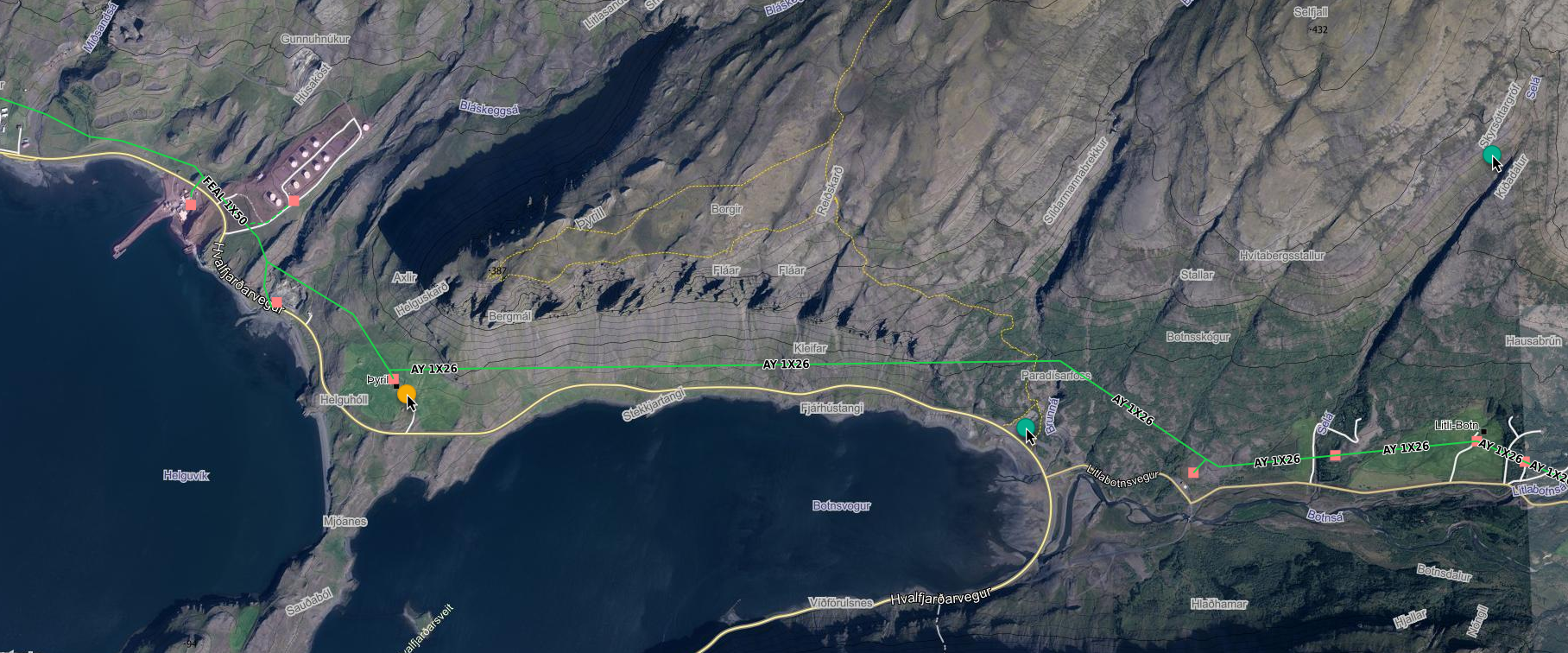
These images gives a better idea. Click to enlarge. 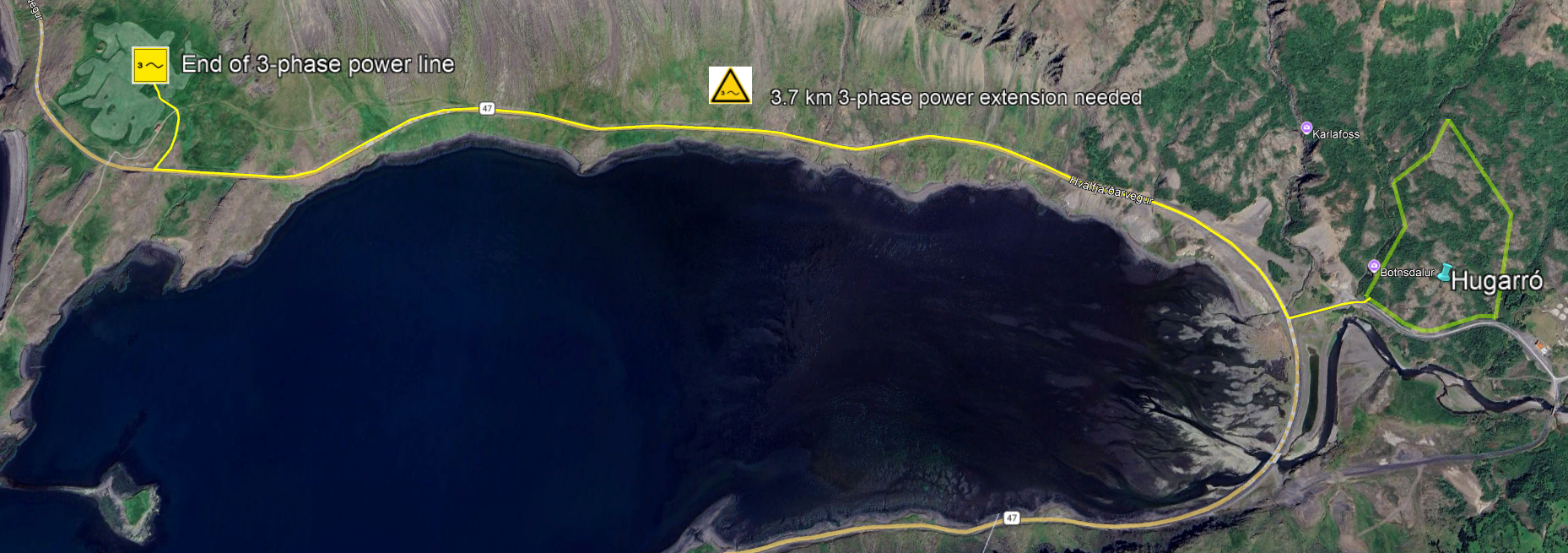
One we have defined our exact electrical power needs, the utility company is legally required to install the line. New regulation and international funding mean this extension will be installed subterranean which assures highest reliablity even under most challenging weather conditions.
Another option is a small hydropower plant in the Brunná river (240 m. from our property). This has potential to generate 30-150 KW, depending on the season (water flow varies). The estimated investment is about 400K.
The landowner is not opposed to this but this option will take time. Permitting for plants under 200 KW is relatively easy and straight forward in Iceland.
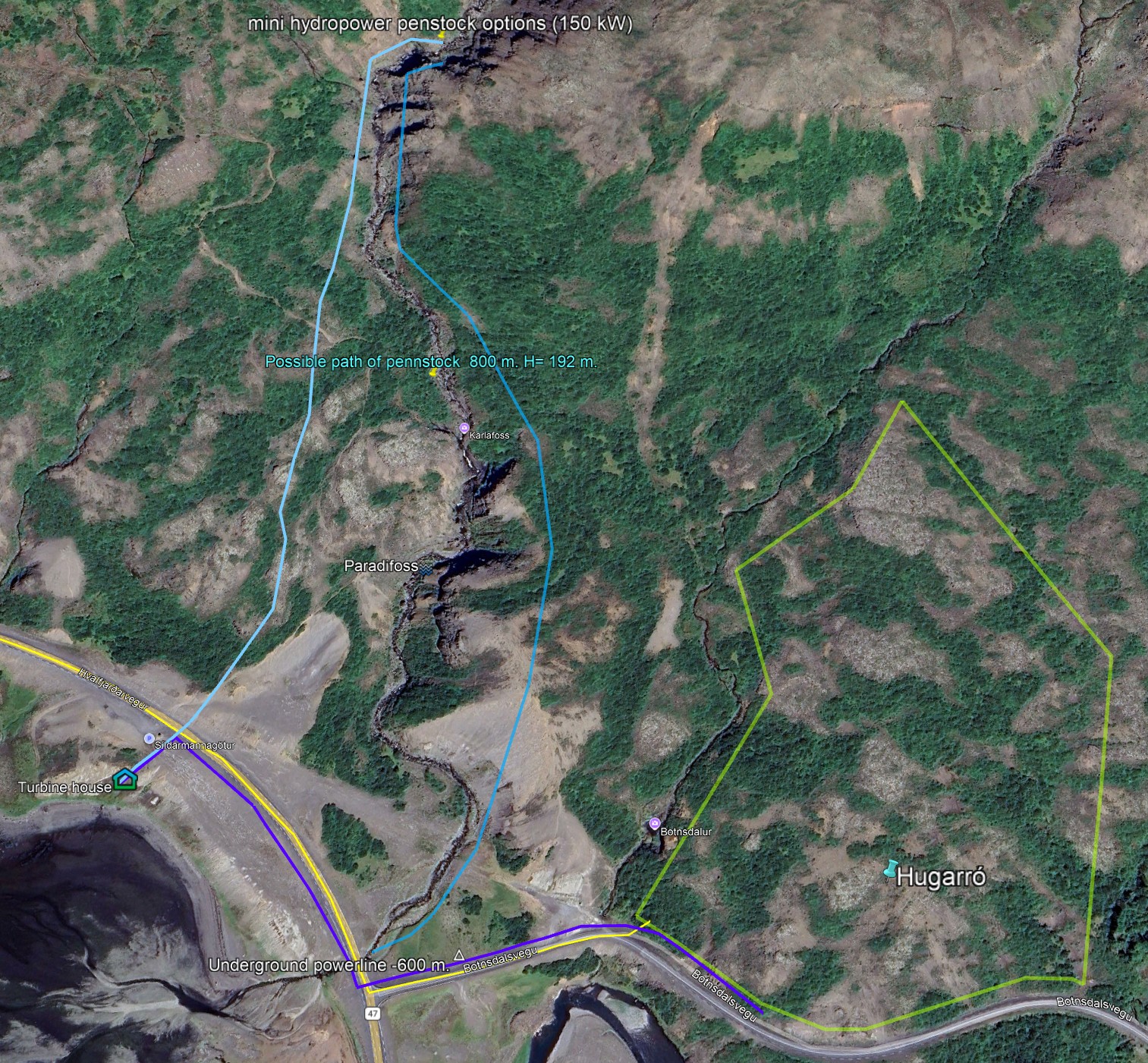
The law in Iceland allows us to sell our electricity (and hot water service) to our direct neighbours. In time this alone will help us recover all related investments.
Of course an on-site backup diesel generator will be part of our power availability strategy.
Our energy source: the earth itself
Hugarró is heated entirely by geothermal energy — natural heat drawn from deep underground. It powers our pools, our hot water, our buildings, and even our roads in winter. No fossil fuels. No emissions. No utility bills.
Smarter than the traditional approach
The standard practice in Iceland is to continuously replace pool water with fresh geothermal water — discarding around 230 m³ of hot water into nature every single day. We think that is wasteful, and we designed our way around it.
Our pools use a closed-loop recirculation system: water stays in the pools and is kept clean through UV disinfection and ultrafiltration membranes — the same technology used in drinking water treatment. No chemicals are used or permitted in Iceland. A real-time microbiological monitoring system continuously checks water quality across all seven pools, so you are always swimming in water that is measurably clean.
The result? We use 91% less water than a traditional Icelandic pool operation, and we recover 33% more heat energy by not throwing it away.
One source, four uses — in sequence
Rather than drawing separate energy for each need, we run our geothermal water through a cascade:
- Geothermal pools — water enters at 70°C and heats our pools to a perfect 38°C
- Hotel & cabin heating — the same water, still warm at 50°C, then heats all our buildings
- Hot tap water — covered in the same circuit
- Road de-icing — remaining warmth is used to keep paths and roads clear in winter
The water is then returned underground at 30°C — completing a fully closed, zero-discharge cycle.
A modest well is all we need
Because our system is so efficient, a geothermal well yielding just 7–10 litres per second at 70°C covers all our needs — pools, buildings, roads, and future expansion. For context, a typical productive well in Iceland delivers 15–50 litres per second. We are not greedy with the resource.
This also means we have realistic capacity to supply heating to neighbouring summer homes and future development in the area — turning a facility cost into a potential revenue stream.
The bottom line
| Traditional Icelandic pools | Hugarró | |
|---|---|---|
| Daily water discharged to nature | 230 m³ | 0 m³ |
| Heat energy wasted | 33% | 0% |
| Chemicals in pool water | None | None |
| Well yield required | 15–50 L/s | 7–10 L/s |
| Neighbours supplied with heat | No | Yes — planned |
Vacation home district heating — Iceland
Prepared: September 2026 | Confidential — For Discussion Purposes
Executive Summary
Our geothermal project will generate significantly more thermal capacity than the primary development requires. We propose to monetise this surplus by supplying hot water to a neighbouring planned vacation home community of 50 homes across two clusters. The developer of that community has indicated willingness to co-invest in the distribution infrastructure, which materially de-risks the project and compresses the payback period to approximately 10–11 years on a shared CAPEX basis — well within the operational lifespan of the asset (30–40 years).
This is a low-marginal-cost, recurring revenue stream built on zero-cost fuel.
Project overview
| Parameter | Detail |
|---|---|
| Heat source | Geothermal (surplus capacity from primary project) |
| Customers — Phase 1 | 25 vacation homes, Cluster A |
| Customers — Phase 2 | 25 vacation homes, Cluster B |
| Distance to Cluster A | 800 m from source |
| Distance to Cluster B | 1,700 m from source |
| Billing model | Fixed annual subscription + flow capacity |
| Developer role | Co-investor in pipeline infrastructure (50% CAPEX) |
Capital expenditure
| Item | Total Cost | Developer (50%) | Our Share (50%) |
|---|---|---|---|
| Trunk line, Source → Cluster A (800 m) | €524,800 | €262,400 | €262,400 |
| Extension, Cluster A → Cluster B (900 m) | €590,400 | €295,200 | €295,200 |
| Internal distribution, Cluster A | €173,700 | €86,850 | €86,850 |
| Internal distribution, Cluster B | €173,700 | €86,850 | €86,850 |
| Pump station & substations | €65,000 | €32,500 | €32,500 |
| Metering cabinets (50 homes) | €75,000 | €37,500 | €37,500 |
| Total | €1,602,600 | €801,300 | €801,300 |
| Less: Connection fees collected (50 × €3,200) | –€160,000 | ||
| Net CAPEX outlay | €641,300 |
Build is phased: Phase 1 (Cluster A, ~€801k) triggers on Cluster A construction start; Phase 2 (Cluster B) triggers on Cluster B confirmation. No idle capital.
Revenue & Financial Projection
| Revenue Item | Annual |
|---|---|
| Subscriptions — 40 standard homes (×€1,450/yr) | €58,000 |
| Subscriptions — 10 hot tub homes (×€1,750/yr) | €17,500 |
| Gross Revenue | €75,500 |
| Operating costs (maintenance, pumping, admin) | –€15,000 |
| Net Annual Income | €60,500 |
| Financial Metric | Value |
|---|---|
| One-time connection fee income | €160,000 |
| Net annual income (steady state) | ~€60,500 |
| Net CAPEX after connection fees | €641,300 |
| Payback period | ~10.6 years |
| Revenue from year 11 onwards | Near-pure margin |
| Asset operational life | 30–40 years |
Why the developer co-invests
The developer’s motivation is straightforward. In Iceland, geothermal hot water access is a market baseline expectation — lots without it sell at a meaningful discount. Based on regional comparables, reliable hot water supply adds an estimated €15,000–€25,000 per lot in realised sale value. Across 50 lots, that represents a €750k–€1.25M uplift in gross development value — making a €800k infrastructure contribution not just reasonable, but commercially rational. We are effectively subsidising their product quality.
This alignment of interests is a structural strength of the deal.
Key strengths
- Zero fuel cost. The heat is a by-product of our existing geothermal investment. Marginal cost of production is effectively nil.
- Recurring, inflation-linked income. Subscription tariffs are typically indexed to energy price benchmarks. Utility revenues are sticky and predictable.
- Captive customer base. Once connected, switching costs are prohibitive. Customer churn is essentially zero.
- Developer co-investment halves our exposure and signals strong demand validation before a single pipe is laid.
- Phased build eliminates idle capital risk. Phase 2 is only committed when Cluster B development is confirmed.
- Enhances our own project’s social licence. Community benefit strengthens planning relationships and long-term operating position.
- Gateway asset. Once operational, additional projects in the area will find our infrastructure already in place, with extension economics improving per additional customer.
Risks & mitigants
| Risk | Likelihood | Mitigant |
|---|---|---|
| Developer delays Phase 2 or backs out | Medium | Phase-gate agreements; Phase 1 is independently viable |
| Connection take-up below 100% | Medium | Mandatory connection covenant in lot sale contracts |
| Hot water chemistry unsuitable for bathing | Low–Medium | Test borehole water pre-commitment; heat exchanger option |
| Regulatory licence requirement (Orkustofnun) | Low–Medium | Early engagement with regulator; licence process is established |
| Pipeline CAPEX overrun | Medium | Fixed-price contractor quotes locked before commitment; 10% contingency |
| Developer seeks equity/pricing control | Medium | Contribution structured as infrastructure grant, not equity; ownership stays with us |
| Phase 2 development delayed 3–5 years | Medium | Phase-gating means no stranded capital; Phase 1 payback unaffected |
Strategic upside (not in base case)
10 existing vacation homes in the wider area were judged too dispersed and few to connect at present. As our network grows and additional developments emerge, incremental connections become progressively cheaper per home.
- Future developments attracted by proven geothermal infrastructure can be connected on similar commercial terms — each new customer improves the network economics for all parties.
- Carbon credit potential. Displacing oil or electric boiler heating with geothermal may qualify under relevant Icelandic or European carbon mechanisms — upside not yet quantified.
Summary verdict
This is a long-duration, low-risk infrastructure asset generating clean recurring income from a zero-cost fuel source, with a co-investing partner whose financial interests are directly aligned with ours. The 10.6-year payback on net invested capital is conservative — and from year 11, the revenue stream runs largely unconstrained for a further 20–30 years.
The primary negotiation priority is the mandatory connection covenant in the developer’s lot sale contracts. That single clause converts a projected revenue stream into a contractual one — and that is the difference between a good investment and an excellent one.
This document is prepared for discussion purposes only and does not constitute a formal investment prospectus. All figures are estimates based on comparable Icelandic district heating projects and are subject to detailed engineering and commercial due diligence.
How Hugarro cabins handle wastewater the Icelandic way
At Hugarro, every detail of our cabin design is guided by three principles: respect for the landscape, reliability in all conditions, and simplicity of installation, operation and maintenance. Our approach to wastewater treatment is no exception — and it gives rise to one of our most quietly ingenious features: a small, fully functional utility structure that disappears almost entirely into the Icelandic hillside.
Why we separate black water and grey water
Not all wastewater is equal. In conventional systems, toilet waste and sink/shower water are combined and sent to a single treatment unit. We deliberately keep them separate — and for good reason.
Black water — from toilets only — is biologically concentrated but hydraulically modest. It contains the pathogens and nitrogen compounds that require robust biological treatment.
Grey water — from sinks, showers, and baths — accounts for 65–75% of total wastewater volume from a cabin, but carries a far lower biological load. It is primarily soap, body oils, food residue, and warm water.
Mixing the two forces a single system to handle both the peak hydraulic loads of bathing and the biological complexity of toilet waste simultaneously — a compromise in both directions. Separating them allows each system to be optimised for its actual task:
| Black water | Grey water | |
|---|---|---|
| Source | Toilets only | Sinks, showers, baths |
| Volume | Low (~50 L/person/day) | High (~100 L/person/day) |
| Biological load | High | Low–moderate |
| Treatment required | Full biological treatment | Filtration + passive biotreatment |
| Our system | Biorock BEASY-2000 | Biolan + surge buffer |
The practical result: ouir biological reactor will never be overwhelmed by peak shower or bath flows, operates well within its rated capacity at all times, and requires far less frequent maintenance than a combined system would. The grey water system, in turn, handles a cleaner, more predictable load and performs accordingly.
Black water treatment — The Biorock BEASY-2000
We treat black water (toilet waste) using the Biorock BEASY-2000, a compact, all-in-one biological treatment unit certified to the European standard EN 12566-3+A2. It was chosen after careful evaluation of available technologies, and for good reason:
Click to enlarge
No electricity, no moving parts. The BEASY-2000 operates entirely on passive aeration — wastewater flows through a mineral biofilm media bed where naturally occurring bacteria break down pollutants. There is nothing to break down, no pump to fail, no alarm to go off in the middle of the night.
Minimal maintenance. The system requires only an annual visual inspection and a desludging of the primary tank every three to five years under our low-occupancy cabin loading. No specialist equipment is needed — a licensed tanker visit every few years is all it takes.
Built for low and intermittent loads. Because we treat grey water separately, only toilet waste enters the BEASY-2000. This significantly reduces the biological load on the system — effectively placing it well within its rated capacity at all times. At this load level, the internal biofilm media may never need replacement over the lifetime of the installation.
Compact and self-contained. At just 225 × 121 × 121 cm, the entire two-stage system — primary settling tank and bioreactor — is housed in a single moulded unit. One tank, one connection, one annual check.
European certified. Discharge quality meets or exceeds the EN 12566-3+A2 standard, with BOD removal exceeding 94% and COD removal exceeding 85% in certified testing. This is a system with a documented, verified performance record across thousands of installations in Europe, including Scandinavia.
Grey water treatment — Biolan filter with surge buffer
Grey water from sinks, showers, and baths is treated by a dedicated passive filter system: the Biolan Greywater Filter, a compact Finland-land made unit designed specifically for cabin and holiday home use in cold climates. Like the BEASY-2000, it requires no electricity and has no moving parts.
Water trickles downward through successive layers of peat, mineral fibre, and activated carbon, which together remove suspended solids, organic compounds, phosphorus, and odours before the treated water reaches a soakaway or drainage field. The filter media requires replacement every few years — a straightforward task taking less than an hour.
Managing peak flows — The surge buffer tank
The Biolan filter is optimised for steady, low flow rates — ideal for showers and basin use. A bathtub, however, can release 150 litres in under five minutes: a peak flow rate some 40 times higher than the filter can accept. Sending a bathtub drain directly to the Biolan would bypass treatment entirely and risk overloading the filter media.
Our solution is simple and entirely passive: a 200-litre surge buffer tank mounted on a rack above the Biolan inside the utility shed. All grey water — from kitchen sink, shower, basin, and bath — enters the surge tank first. A small-bore outlet at the base of the tank allows water to trickle down into the Biolan at a controlled, gentle rate regardless of how fast it arrived. No sensors, no valves, no electronics — just gravity doing its job.
Kitchen sink water carries fats, oils, and greases (FOG) from cooking and dishwashing. FOG is the primary cause of premature clogging in passive grey water filters. A simple passive grease trap — a small baffled chamber where warm water slows, FOG floats to the surface, and is retained — is installed immediately after the kitchen sink drain and before the surge tank. It requires cleaning every three to six months: a quick scoop-and-dispose task during routine cabin checks.
Shower and basin water bypasses the grease trap (it carries soap but negligible FOG) and flows directly into the surge tank. This separation of kitchen and bathing water streams keeps the grease trap small and the Biolan filter performing at its best.
Winter operation
Grey water arriving from a heated cabin is warm by nature — shower water at 35°C, dishwashing water at 40°C — and warms the Biolan filter media continuously during occupancy. The utility shed enclosure, already heated passively by the BEASY-2000’s thermostat heater, maintains a stable internal temperature well above freezing throughout winter. No supplemental heating is needed for the grey water system.
In the rare event of Biolan maintenance or media replacement, grey water can be temporarily rerouted to the BEASY-2000 via a simple manual valve — a contingency built into the pipework from the start. The BEASY handles the short-term combined load with ease.
The structure — A partial dig that makes sense and looks great
Rather than burying the tanks fully underground — expensive and challenging in Iceland’s rocky volcanic substrate at several cabin locations — we partially sink a purpose-built utility enclosure into the ground, typically one metre below grade. This approach is deliberate and smart on multiple levels:
Excavation cost is kept to a minimum. Full burial of tanks in Icelandic lava rock can cost several times the price of the equipment itself. Our partial-dig approach requires a modest, manageable excavation — reducing groundwork costs significantly while achieving the same thermal and structural benefits.
The ground does the heavy lifting thermally. At one metre depth, the surrounding earth and rock maintain a stable temperature year-round — buffering the system against Iceland’s winter extremes. The three buried or bermed walls of the enclosure are insulated with moisture-resistant XPS foam board, ensuring that the internal environment stays comfortably above the minimum operating temperature even in the coldest months.
A small 200W thermostatically controlled heater — no larger than an aquarium heater — is placed in the BEASY-2000 primary tank as a backup for the coldest periods. It consumes less energy annually than a single light bulb left on for a week, and ensures the bacterial treatment community remains active and effective regardless of external conditions.
Pipe runs between the cabin and the enclosure are kept short and insulated, eliminating any risk of freezing in the connection lines.
The architecture — An Icelandic turf structure
The enclosure itself is built in the tradition of Iceland’s historic torfbær — the turf outbuildings that have sheltered tools, food stores, and animals in this landscape for over a thousand years. A simple timber-framed structure with a 30-degree pitched roof, it presents only a weathered wooden gable and a low door to the outside world. Everything else disappears under living turf.
Click to enlarge
The roof follows traditional construction: a structural timber deck, a modern EPDM rubber waterproofing membrane in place of the original birch bark, a drainage layer, and two layers of Icelandic turf slab — the lower layer grass-side down, the upper grass-side up — just as it has always been done. Within a single growing season, the roof is indistinguishable from the surrounding meadow.
Three sides of the structure are bermed with the excavated material and seeded with local grasses. The fourth side — the entrance face — can be oriented toward the cabin for convenient access, or away from the main view to preserve sightlines.
The result is a structure that is essentially invisible in the landscape — a small green rise in the ground, entirely at home in Iceland’s valleys and hillsides.
More than a utility box — A true services hub
The enclosure is dimensioned generously enough — approximately 250 × 320 cm internally — to serve as a complete services hub for each cabin cluster. Inside, every system is accessible from a single point:
| Service | Notes |
|---|---|
| Biorock BEASY-2000 | Black water biological treatment — primary tank + bioreactor in one unit |
| Biolan grey water filter | Passive filter for sink, shower, and bath water |
| 200L surge buffer tank | Mounted on rack above Biolan — absorbs peak bath flows passively |
| Kitchen sink grease trap | Protects filter media from fats, oils, and grease |
| Potable water meter & shutoff | Accessible without entering the cabin |
| Heating circuit distribution & heat exchanger | Hot water from a central source distributed to cabins from this point |
| Electrical connection point & main breaker | Per-cabin metering and isolation in one accessible location |
| Storage | Chemicals, maintenance tools, spare parts — on a simple shelf above the tanks |
This means that every utility serving the cabin can be accessed, inspected, isolated, and serviced from a single point, without entering the cabin or disturbing guests. For a hospitality operation, this is a significant operational advantage — maintenance can be performed discreetly, quickly, and at any time.
The cabin underfloor installation for the cabin turning system will have a separate access point, also avoiding the need for cabin entry during routine checks.
In summary
Our wastewater and utility approach at Hugarro combines European-certified biological treatment technology with centuries-old Icelandic building tradition. Black water and grey water are treated separately — each by a system sized and optimised for its specific task — and both housed within a single compact enclosure that is virtually invisible in the landscape.
The result is a system that is invisible to guests, kind to the environment, robust in all seasons, and straightforward to maintain — a small buried structure that quietly does everything, and shows almost nothing.
A detailed water consumption analysis
Methodology & assumptions
The estimates below are built from industry benchmarks for 4-star hospitality operations, adjusted for Hugarro’s strong water-conservation focus (low-flow showerheads, dual-flush toilets, modern laundry machines and unique closed-circulation geothermal pool heating system.
Two scenarios are presented:
- Low scenario — minimum occupancy (≈60%), best-in-class water efficiency
- High scenario — near-full occupancy (≈95%), standard conservative usage
Occupancy & headcount assumptions
| Facility | Capacity | Low Scenario | High Scenario |
|---|---|---|---|
| Hotel rooms (32) | 200 guests | 120 guests (22 rooms) | 190 guests (30 rooms) |
| Cabins bath+shower (20, max 2 pax) | 40 guests | 24 guests | 40 guests |
| Cabins shower only (12, max 4 pax) | 48 guests | 32 guests | 48 guests |
| Staff cabins (10, max 2 pax) | 20 staff | 10 staff | 20 staff |
| Meeting cabins (5) | ~50 day visitors | 10 persons | 40 persons |
| Hot springs visitors | 400/day | 200/day | 400/day |
| Hot springs restaurant (50 seats) | ~150 covers/day | 50 covers | 150 covers |
| Hotel restaurant + bar | ~300 covers/day | 200 covers | 300 covers |
🚿 Potable water consumption
Used for: human consumption, showering, bathing, inside cleaning, laundry
Unit benchmarks applied:
- Shower (low-flow, 6–10 L/min): mandatory hot springs shower 1.5 min = 9–15 L/person 2
- 4-star hotel room benchmark: 140–300 L/guest/night (potable items minus toilet) 68
- Modern laundry: 5–10 L/kg linen; assume 3–5 kg/room/day 5
- Restaurant/kitchen: 30–60 L per cover (kitchen, dishwashing, staff) 3
| User Area | Detail | Low (m³/day) | High (m³/day) |
|---|---|---|---|
| Hotel rooms | 120–190 guests × 120–200 L/guest (shower, sink, drinking; excl. toilet) | 14.4 | 38.0 |
| Cabins bath+shower (20) | 24–40 guests × 130–220 L (incl. bath fill 150–200 L) | 3.1 | 8.8 |
| Cabins shower only (12) | 32–48 guests × 100–160 L/guest | 3.2 | 7.7 |
| Staff cabins (10) | 10–20 persons × 100–150 L/person | 1.0 | 3.0 |
| Hotel restaurant + bar | 200–300 covers × 30–60 L/cover (kitchen, dishwash, bar) | 6.0 | 18.0 |
| Hot springs restaurant | 50–150 covers × 30–60 L/cover | 1.5 | 9.0 |
| Hot springs showers | 200–400 visitors × 2 showers × 1.5 min × 6–10 L/min | 3.6 | 12.0 |
| Inside cleaning / housekeeping | Hotel + cabins rooms/surfaces; ~10–20 L/room occupied | 0.5 | 2.0 |
| Meeting cabins | Drinking water only; 10–40 persons × 2–5 L | 0.02 | 0.2 |
| In-house laundry | Hotel + cabins linen 3–5 kg/room × 6–10 L/kg; hot springs towels 200–400 sets × 0.5 kg × 6–10 L | 1.4 | 5.1 |
| POTABLE SUBTOTAL | ~34.7 | ~103.8 |
🪣 Filtered (non-potable) water consumption
Used for: toilet flushing, outdoor cleaning, gardening, car washing, fire system, pool suppletion
Unit benchmarks applied:
- Dual-flush toilet (water-saving): avg 4–5 L/flush, ~4 flushes/person/day 4
- High-pressure car wash: 30–80 L/vehicle 7
- Pool suppletion: given max 25 m³/day (covers evaporation + UF process losses)
| User Area | Detail | Low (m³/day) | High (m³/day) |
|---|---|---|---|
| Toilet flushing — hotel, cabins, staff, meeting | ~200–350 persons × 4 flushes × 4.5 L/flush | 3.6 | 6.3 |
| Toilet flushing — hot springs facility | 200–400 visitors × 2 flushes × 4.5 L | 1.8 | 3.6 |
| Outdoor/facility cleaning | Hard surfaces, equipment, pathways | 0.2 | 1.0 |
| Gardening / irrigation | Iceland climate (moderate, partial landscaping) | 0.5 | 3.0 |
| Car washing (high-pressure) | 20–60 vehicles/day × 30–80 L/vehicle | 0.6 | 4.8 |
| Fire hydrant system | Standby / periodic testing (not an active daily draw) | 0.05 | 0.1 |
| Geothermal pool suppletion | Evaporation + UF process water losses (given: max 25 m³/day) | 10.0 | 25.0 |
| FILTERED SUBTOTAL | ~16.8 | ~43.8 |
♨️ Geothermal water
| Use | Consumption | Notes |
|---|---|---|
| Heat extraction (heat exchangers) | Net zero consumption | Water is circulated through heat exchangers and fully returned to the aquifer. Zero net extraction. Long-term sustainability protected. |
🚽 Sewage / Wastewater
| Stage | Volume (estimated) | Notes |
|---|---|---|
| Raw sewage generated | Low: ~40 m³/day | High: ~120 m³/day | Approximately 80–90% of potable + some filtered water input |
| After 2-stage treatment | Low: ~36 m³/day | High: ~108 m³/day | Quality suitable for irrigation/car wash reuse |
| Current disposition | Filtered into soil | Could offset significant filtered water needs in future |
🔬 UF Plant — potable water treatment losses
When filtered water is upgraded to potable, the UF treatment plant itself consumes water for backwashing. At typical UF recovery rates of 90–95%: 1
| Scenario | Potable demand | Feed water needed | UF process waste |
|---|---|---|---|
| Low | 34.7 m³/day | ~37.7 m³/day | ~3.0 m³/day |
| High | 103.8 m³/day | ~113.0 m³/day | ~9.2 m³/day |
This UF waste becomes part of the sewage/drainage stream.
📊 Consolidated Summary
| Water Type | Low (m³/day) | High (m³/day) |
|---|---|---|
| Filtered — all other uses (toilets, garden, cars, etc.) | 6.8 | 18.8 |
| Filtered — pool suppletion (evaporation) | 10.0 | 25.0 |
| Filtered — UF pool plant process waste | 3.0 | 9.2 |
| Filtered subtotal (revised) | ~19.8 | ~53.0 |
| Potable water consumed | 34.7 | 103.8 |
| TOTAL gross water extraction | ~58 | ~165 |
⚖️ Comparison with extraction permits
| Source | Permit | Hourly | Daily Capacity |
|---|---|---|---|
| Drilled well | 11 m³/hr | 264 m³/day | |
| Mígandalaekur creek | 5 m³/hr | 120 m³/day | |
| Total permitted | 384 m³/day |
| Scenario | Total extraction needed | % of permit used | Surplus |
|---|---|---|---|
| Low | ~58 m³/day | 15% | 326 m³/day |
| High | ~164 m³/day | 43% | 220 m³/day |
Winter source capacity
| Source | Summer (permitted) | Winter (actual) |
|---|---|---|
| Drilled well | 264 m³/day (11 m³/hr) | 264 m³/day (unchanged) |
| Mígandalaekur creek | 120 m³/day (5 m³/hr) | 43.2 m³/day (0.5 L/s) |
| Total available | 384 m³/day | 307.2 m³/day |
The creek drops from a generous 120 m³/day to just 43.2 m³/day in winter — a loss of 76.8 m³/day. However, the well alone at 264 m³/day more than covers all operational needs.
Winter capacity vs. consumption
| Scenario | Consumption | Winter Capacity | Surplus | % Used |
|---|---|---|---|---|
| Low | 58 m³/day | 307.2 m³/day | 249.2 m³/day | 19% |
| High | 165 m³/day | 307.2 m³/day | 142.2 m³/day | 54% |
Key observation
The well alone (264 m³/day) already exceeds even our worst-case daily consumption (165 m³/day) by 99 m³/day. The creek in winter is essentially a bonus source, not a critical dependency.
One practical note worth flagging: in cold Icelandic winters, creek flow can be further affected by freezing. This accounts for ice-reduced flo. Even in that extreme case, the well alone keeps us fully operational.
✅ Both scenarios are well within permitted limits, confirming ample capacity to supply neighbouring communities and local businesses with treated drinking water, as planned.
Additional notes & caveats
- Geothermal pool UF waste is already factored into the 25 m³/day pool suppletion figure (as stated), so it is not double-counted.
- Sewage water reuse — if the treated sewage (2-stage) is eventually used for irrigation and car washing, this could offset 3–8 m³/day of filtered water demand.
- Iceland climate moderates outdoor irrigation needs significantly vs. southern European resorts.
- Hot springs showers are short (1.5 min mandatory) but high-volume due to 400 visitors. Even with low-flow heads at 6–8 L/min, this is a meaningful potable water draw (3.6–12 m³/day).
- Bathtub cabins carry disproportionate water intensity — a single bath fill of 150–200 L versus ~45 L for a 6-minute shower. Offering incentives to use showers over baths would meaningfully reduce consumption.
- Laundry represents only 1.4–5.1 m³/day with modern machines — a significant improvement over older equipment (which could reach 15 L/kg).
- The hotel restaurant is the single largest potable water consumer after hotel rooms, due to kitchen and dishwashing operations at scale.