
Environment
How Hugarro cabins handle wastewater the Icelandic way
At Hugarro, every detail of our cabin design is guided by three principles: respect for the landscape, reliability in all conditions, and simplicity of installation, operation and maintenance. Our approach to wastewater treatment is no exception — and it gives rise to one of our most quietly ingenious features: a small, fully functional utility structure that disappears almost entirely into the Icelandic hillside.
Why we separate black water and grey water
Not all wastewater is equal. In conventional systems, toilet waste and sink/shower water are combined and sent to a single treatment unit. We deliberately keep them separate — and for good reason.
Black water — from toilets only — is biologically concentrated but hydraulically modest. It contains the pathogens and nitrogen compounds that require robust biological treatment.
Grey water — from sinks, showers, and baths — accounts for 65–75% of total wastewater volume from a cabin, but carries a far lower biological load. It is primarily soap, body oils, food residue, and warm water.
Mixing the two forces a single system to handle both the peak hydraulic loads of bathing and the biological complexity of toilet waste simultaneously — a compromise in both directions. Separating them allows each system to be optimised for its actual task:
| Black water | Grey water | |
|---|---|---|
| Source | Toilets only | Sinks, showers, baths |
| Volume | Low (~50 L/person/day) | High (~100 L/person/day) |
| Biological load | High | Low–moderate |
| Treatment required | Full biological treatment | Filtration + passive biotreatment |
| Our system | Biorock BEASY-2000 | Biolan + surge buffer |
The practical result: ouir biological reactor will never be overwhelmed by peak shower or bath flows, operates well within its rated capacity at all times, and requires far less frequent maintenance than a combined system would. The grey water system, in turn, handles a cleaner, more predictable load and performs accordingly.
Black water treatment — The Biorock BEASY-2000
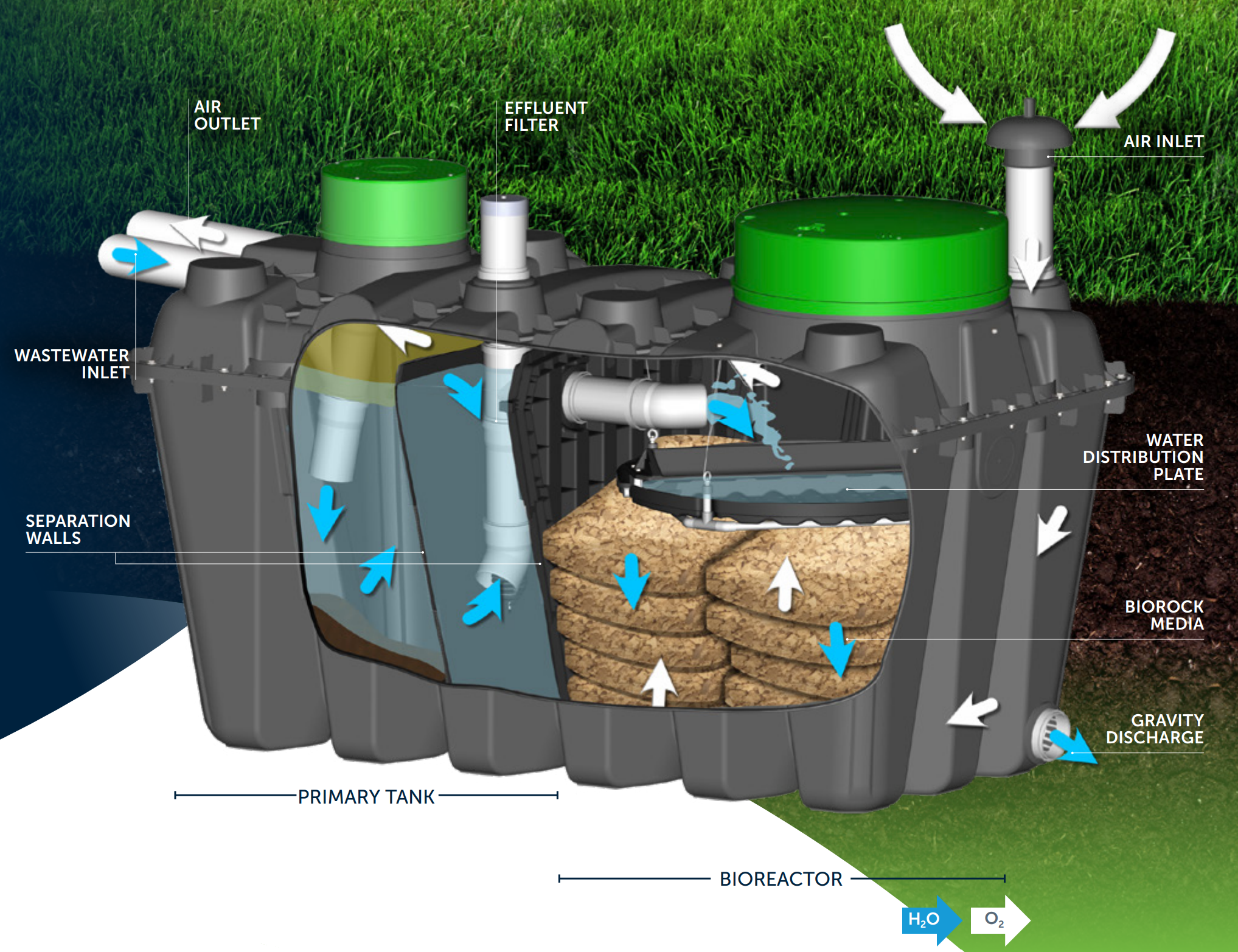
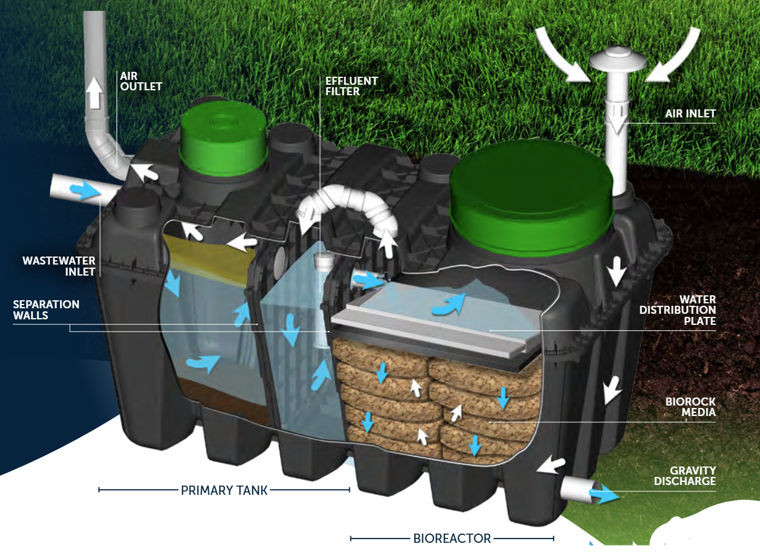
We treat black water (toilet waste) using the Biorock BEASY-2000, a compact, all-in-one biological treatment unit certified to the European standard EN 12566-3+A2. It was chosen after careful evaluation of available technologies, and for good reason:
Click to enlarge
No electricity, no moving parts. The BEASY-2000 operates entirely on passive aeration — wastewater flows through a mineral biofilm media bed where naturally occurring bacteria break down pollutants. There is nothing to break down, no pump to fail, no alarm to go off in the middle of the night.
Minimal maintenance. The system requires only an annual visual inspection and a desludging of the primary tank every three to five years under our low-occupancy cabin loading. No specialist equipment is needed — a licensed tanker visit every few years is all it takes.
Built for low and intermittent loads. Because we treat grey water separately, only toilet waste enters the BEASY-2000. This significantly reduces the biological load on the system — effectively placing it well within its rated capacity at all times. At this load level, the internal biofilm media may never need replacement over the lifetime of the installation.
Compact and self-contained. At just 225 × 121 × 121 cm, the entire two-stage system — primary settling tank and bioreactor — is housed in a single moulded unit. One tank, one connection, one annual check.
European certified. Discharge quality meets or exceeds the EN 12566-3+A2 standard, with BOD removal exceeding 94% and COD removal exceeding 85% in certified testing. This is a system with a documented, verified performance record across thousands of installations in Europe, including Scandinavia.
Grey water treatment — Biolan filter with surge buffer
Grey water from sinks, showers, and baths is treated by a dedicated passive filter system: the Biolan Greywater Filter, a compact Finland-land made unit designed specifically for cabin and holiday home use in cold climates. Like the BEASY-2000, it requires no electricity and has no moving parts.
Water trickles downward through successive layers of peat, mineral fibre, and activated carbon, which together remove suspended solids, organic compounds, phosphorus, and odours before the treated water reaches a soakaway or drainage field. The filter media requires replacement every few years — a straightforward task taking less than an hour.
Managing peak flows — The surge buffer tank
The Biolan filter is optimised for steady, low flow rates — ideal for showers and basin use. A bathtub, however, can release 150 litres in under five minutes: a peak flow rate some 40 times higher than the filter can accept. Sending a bathtub drain directly to the Biolan would bypass treatment entirely and risk overloading the filter media.
Our solution is simple and entirely passive: a 200-litre surge buffer tank mounted on a rack above the Biolan inside the utility shed. All grey water — from kitchen sink, shower, basin, and bath — enters the surge tank first. A small-bore outlet at the base of the tank allows water to trickle down into the Biolan at a controlled, gentle rate regardless of how fast it arrived. No sensors, no valves, no electronics — just gravity doing its job.
Kitchen sink water carries fats, oils, and greases (FOG) from cooking and dishwashing. FOG is the primary cause of premature clogging in passive grey water filters. A simple passive grease trap — a small baffled chamber where warm water slows, FOG floats to the surface, and is retained — is installed immediately after the kitchen sink drain and before the surge tank. It requires cleaning every three to six months: a quick scoop-and-dispose task during routine cabin checks.
Shower and basin water bypasses the grease trap (it carries soap but negligible FOG) and flows directly into the surge tank. This separation of kitchen and bathing water streams keeps the grease trap small and the Biolan filter performing at its best.
Winter operation
Grey water arriving from a heated cabin is warm by nature — shower water at 35°C, dishwashing water at 40°C — and warms the Biolan filter media continuously during occupancy. The utility shed enclosure, already heated passively by the BEASY-2000’s thermostat heater, maintains a stable internal temperature well above freezing throughout winter. No supplemental heating is needed for the grey water system.
In the rare event of Biolan maintenance or media replacement, grey water can be temporarily rerouted to the BEASY-2000 via a simple manual valve — a contingency built into the pipework from the start. The BEASY handles the short-term combined load with ease.
The structure — A partial dig that makes sense and looks great
Rather than burying the tanks fully underground — expensive and challenging in Iceland’s rocky volcanic substrate at several cabin locations — we partially sink a purpose-built utility enclosure into the ground, typically one metre below grade. This approach is deliberate and smart on multiple levels:
Excavation cost is kept to a minimum. Full burial of tanks in Icelandic lava rock can cost several times the price of the equipment itself. Our partial-dig approach requires a modest, manageable excavation — reducing groundwork costs significantly while achieving the same thermal and structural benefits.
The ground does the heavy lifting thermally. At one metre depth, the surrounding earth and rock maintain a stable temperature year-round — buffering the system against Iceland’s winter extremes. The three buried or bermed walls of the enclosure are insulated with moisture-resistant XPS foam board, ensuring that the internal environment stays comfortably above the minimum operating temperature even in the coldest months.
A small 200W thermostatically controlled heater — no larger than an aquarium heater — is placed in the BEASY-2000 primary tank as a backup for the coldest periods. It consumes less energy annually than a single light bulb left on for a week, and ensures the bacterial treatment community remains active and effective regardless of external conditions.
Pipe runs between the cabin and the enclosure are kept short and insulated, eliminating any risk of freezing in the connection lines.
The architecture — An Icelandic turf structure
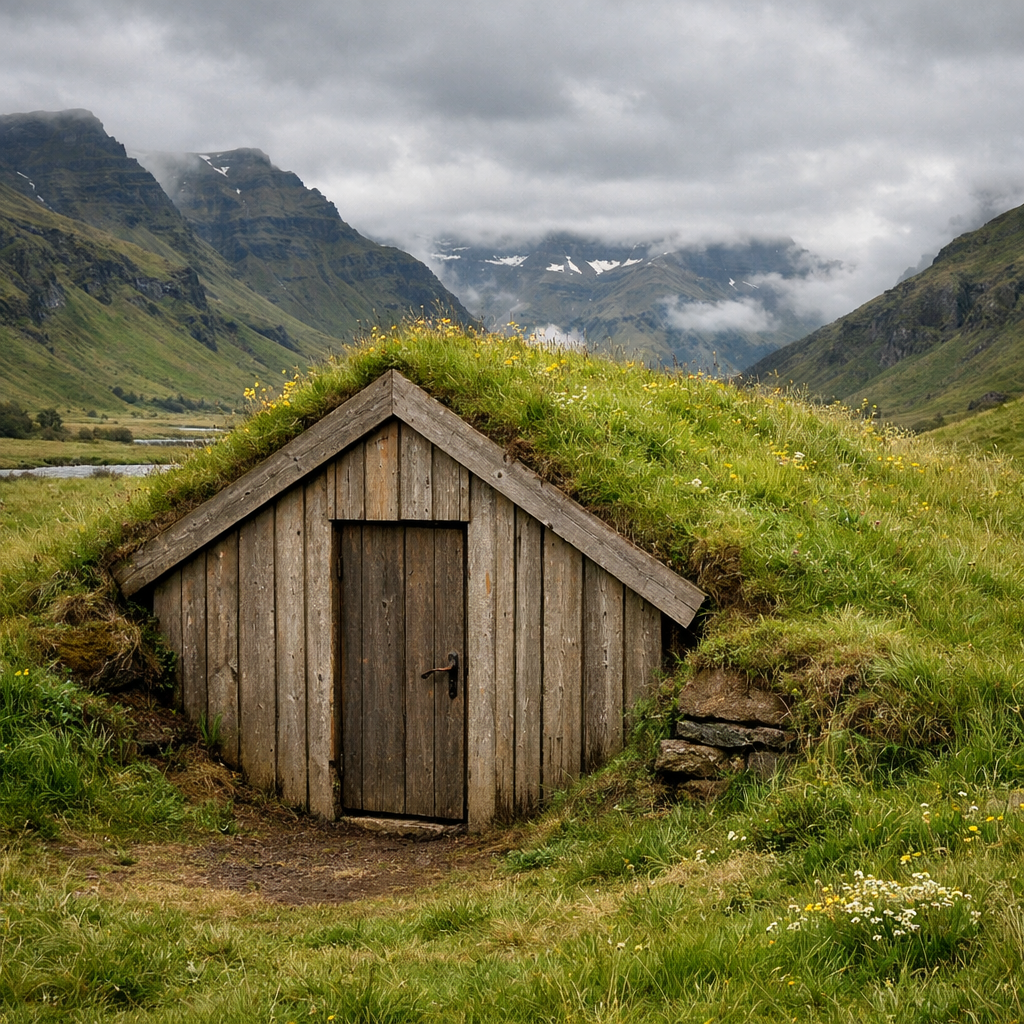
The enclosure itself is built in the tradition of Iceland’s historic torfbær — the turf outbuildings that have sheltered tools, food stores, and animals in this landscape for over a thousand years. A simple timber-framed structure with a 30-degree pitched roof, it presents only a weathered wooden gable and a low door to the outside world. Everything else disappears under living turf.
Click to enlarge
The roof follows traditional construction: a structural timber deck, a modern EPDM rubber waterproofing membrane in place of the original birch bark, a drainage layer, and two layers of Icelandic turf slab — the lower layer grass-side down, the upper grass-side up — just as it has always been done. Within a single growing season, the roof is indistinguishable from the surrounding meadow.
Three sides of the structure are bermed with the excavated material and seeded with local grasses. The fourth side — the entrance face — can be oriented toward the cabin for convenient access, or away from the main view to preserve sightlines.
The result is a structure that is essentially invisible in the landscape — a small green rise in the ground, entirely at home in Iceland’s valleys and hillsides.
More than a utility box — A true services hub
The enclosure is dimensioned generously enough — approximately 250 × 320 cm internally — to serve as a complete services hub for each cabin cluster. Inside, every system is accessible from a single point:
| Service | Notes |
|---|---|
| Biorock BEASY-2000 | Black water biological treatment — primary tank + bioreactor in one unit |
| Biolan grey water filter | Passive filter for sink, shower, and bath water |
| 200L surge buffer tank | Mounted on rack above Biolan — absorbs peak bath flows passively |
| Kitchen sink grease trap | Protects filter media from fats, oils, and grease |
| Potable water meter & shutoff | Accessible without entering the cabin |
| Heating circuit distribution & heat exchanger | Hot water from a central source distributed to cabins from this point |
| Electrical connection point & main breaker | Per-cabin metering and isolation in one accessible location |
| Storage | Chemicals, maintenance tools, spare parts — on a simple shelf above the tanks |
This means that every utility serving the cabin can be accessed, inspected, isolated, and serviced from a single point, without entering the cabin or disturbing guests. For a hospitality operation, this is a significant operational advantage — maintenance can be performed discreetly, quickly, and at any time.
The cabin underfloor installation for the cabin turning system will have a separate access point, also avoiding the need for cabin entry during routine checks.
In summary
Our wastewater and utility approach at Hugarro combines European-certified biological treatment technology with centuries-old Icelandic building tradition. Black water and grey water are treated separately — each by a system sized and optimised for its specific task — and both housed within a single compact enclosure that is virtually invisible in the landscape.
The result is a system that is invisible to guests, kind to the environment, robust in all seasons, and straightforward to maintain — a small buried structure that quietly does everything, and shows almost nothing.
All Hugarró sewage systems meet or exceed applicable Icelandic and European standards (ÍST EN 12566 / EN 16941-2).
Hotel & geothermal pool facilities
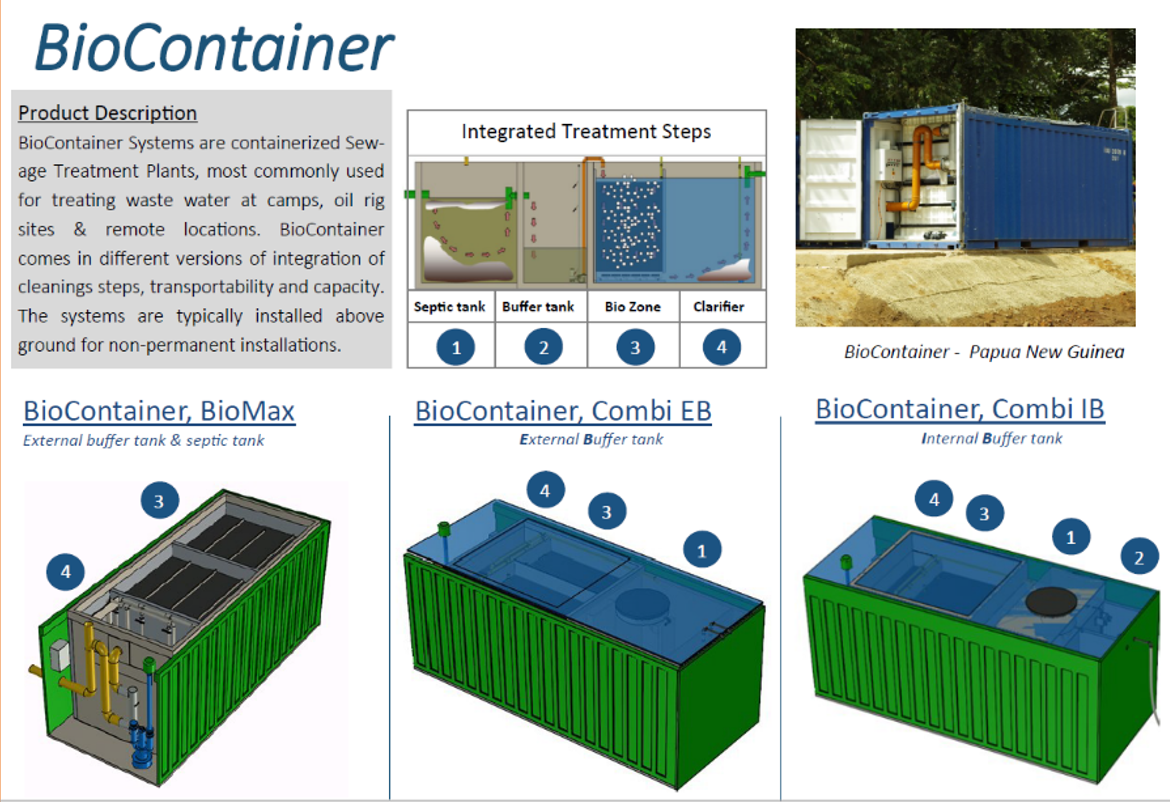
Our hotel and pool complex is served by a compact, containerised biological treatment plant — fully out of sight and designed for the higher load of a commercial accommodation facility.
Free-standing cabins
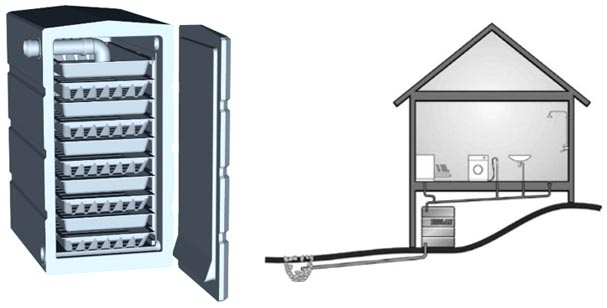
Each cabin uses a certified two-stage septic system. We separate grey water (showers, kitchen sinks — typically up to 70% of total wastewater volume) from black water (toilets), feeding only the smaller black water stream into the septic tank. This significantly reduces tank size and the footprint of the required soakaway field — a real advantage on a site where we want to keep the land as undisturbed as possible.
Monitoring & maintenance
All systems are remotely monitored — tank levels and temperatures are tracked continuously so that any issue can be caught and resolved before it becomes a problem. Routine maintenance needs are minimal by design.
Year-round reliability — Thanks to geothermal
Iceland’s winters can challenge conventional septic systems. Because Hugarró has its own geothermal source, every cabin can be connected to gentle tank heating, ensuring reliable, trouble-free operation throughout the year — at no additional energy cost.
Water reuse
Treated effluent from the grey water systems can be used for on-site irrigation where appropriate, and otherwise infiltrates naturally back into the ground. A clean cycle, fitting for a site where clean water is both abundant and worth protecting.
Sewage
How Hugarro cabins handle wastewater the Icelandic way
At Hugarro, every detail of our cabin design is guided by three principles: respect for the landscape, reliability in all conditions, and simplicity of installation, operation and maintenance. Our approach to wastewater treatment is no exception — and it gives rise to one of our most quietly ingenious features: a small, fully functional utility structure that disappears almost entirely into the Icelandic hillside.
Why we separate black water and grey water
Not all wastewater is equal. In conventional systems, toilet waste and sink/shower water are combined and sent to a single treatment unit. We deliberately keep them separate — and for good reason.
Black water — from toilets only — is biologically concentrated but hydraulically modest. It contains the pathogens and nitrogen compounds that require robust biological treatment.
Grey water — from sinks, showers, and baths — accounts for 65–75% of total wastewater volume from a cabin, but carries a far lower biological load. It is primarily soap, body oils, food residue, and warm water.
Mixing the two forces a single system to handle both the peak hydraulic loads of bathing and the biological complexity of toilet waste simultaneously — a compromise in both directions. Separating them allows each system to be optimised for its actual task:
| Black water | Grey water | |
|---|---|---|
| Source | Toilets only | Sinks, showers, baths |
| Volume | Low (~50 L/person/day) | High (~100 L/person/day) |
| Biological load | High | Low–moderate |
| Treatment required | Full biological treatment | Filtration + passive biotreatment |
| Our system | Biorock BEASY-2000 | Biolan + surge buffer |
The practical result: ouir biological reactor will never be overwhelmed by peak shower or bath flows, operates well within its rated capacity at all times, and requires far less frequent maintenance than a combined system would. The grey water system, in turn, handles a cleaner, more predictable load and performs accordingly.
Black water treatment — The Biorock BEASY-2000
We treat black water (toilet waste) using the Biorock BEASY-2000, a compact, all-in-one biological treatment unit certified to the European standard EN 12566-3+A2. It was chosen after careful evaluation of available technologies, and for good reason:
Click to enlarge
No electricity, no moving parts. The BEASY-2000 operates entirely on passive aeration — wastewater flows through a mineral biofilm media bed where naturally occurring bacteria break down pollutants. There is nothing to break down, no pump to fail, no alarm to go off in the middle of the night.
Minimal maintenance. The system requires only an annual visual inspection and a desludging of the primary tank every three to five years under our low-occupancy cabin loading. No specialist equipment is needed — a licensed tanker visit every few years is all it takes.
Built for low and intermittent loads. Because we treat grey water separately, only toilet waste enters the BEASY-2000. This significantly reduces the biological load on the system — effectively placing it well within its rated capacity at all times. At this load level, the internal biofilm media may never need replacement over the lifetime of the installation.
Compact and self-contained. At just 225 × 121 × 121 cm, the entire two-stage system — primary settling tank and bioreactor — is housed in a single moulded unit. One tank, one connection, one annual check.
European certified. Discharge quality meets or exceeds the EN 12566-3+A2 standard, with BOD removal exceeding 94% and COD removal exceeding 85% in certified testing. This is a system with a documented, verified performance record across thousands of installations in Europe, including Scandinavia.
Grey water treatment — Biolan filter with surge buffer
Grey water from sinks, showers, and baths is treated by a dedicated passive filter system: the Biolan Greywater Filter, a compact Finland-land made unit designed specifically for cabin and holiday home use in cold climates. Like the BEASY-2000, it requires no electricity and has no moving parts.
Water trickles downward through successive layers of peat, mineral fibre, and activated carbon, which together remove suspended solids, organic compounds, phosphorus, and odours before the treated water reaches a soakaway or drainage field. The filter media requires replacement every few years — a straightforward task taking less than an hour.
Managing peak flows — The surge buffer tank
The Biolan filter is optimised for steady, low flow rates — ideal for showers and basin use. A bathtub, however, can release 150 litres in under five minutes: a peak flow rate some 40 times higher than the filter can accept. Sending a bathtub drain directly to the Biolan would bypass treatment entirely and risk overloading the filter media.
Our solution is simple and entirely passive: a 200-litre surge buffer tank mounted on a rack above the Biolan inside the utility shed. All grey water — from kitchen sink, shower, basin, and bath — enters the surge tank first. A small-bore outlet at the base of the tank allows water to trickle down into the Biolan at a controlled, gentle rate regardless of how fast it arrived. No sensors, no valves, no electronics — just gravity doing its job.
Kitchen sink water carries fats, oils, and greases (FOG) from cooking and dishwashing. FOG is the primary cause of premature clogging in passive grey water filters. A simple passive grease trap — a small baffled chamber where warm water slows, FOG floats to the surface, and is retained — is installed immediately after the kitchen sink drain and before the surge tank. It requires cleaning every three to six months: a quick scoop-and-dispose task during routine cabin checks.
Shower and basin water bypasses the grease trap (it carries soap but negligible FOG) and flows directly into the surge tank. This separation of kitchen and bathing water streams keeps the grease trap small and the Biolan filter performing at its best.
Winter operation
Grey water arriving from a heated cabin is warm by nature — shower water at 35°C, dishwashing water at 40°C — and warms the Biolan filter media continuously during occupancy. The utility shed enclosure, already heated passively by the BEASY-2000’s thermostat heater, maintains a stable internal temperature well above freezing throughout winter. No supplemental heating is needed for the grey water system.
In the rare event of Biolan maintenance or media replacement, grey water can be temporarily rerouted to the BEASY-2000 via a simple manual valve — a contingency built into the pipework from the start. The BEASY handles the short-term combined load with ease.
The structure — A partial dig that makes sense and looks great
Rather than burying the tanks fully underground — expensive and challenging in Iceland’s rocky volcanic substrate at several cabin locations — we partially sink a purpose-built utility enclosure into the ground, typically one metre below grade. This approach is deliberate and smart on multiple levels:
Excavation cost is kept to a minimum. Full burial of tanks in Icelandic lava rock can cost several times the price of the equipment itself. Our partial-dig approach requires a modest, manageable excavation — reducing groundwork costs significantly while achieving the same thermal and structural benefits.
The ground does the heavy lifting thermally. At one metre depth, the surrounding earth and rock maintain a stable temperature year-round — buffering the system against Iceland’s winter extremes. The three buried or bermed walls of the enclosure are insulated with moisture-resistant XPS foam board, ensuring that the internal environment stays comfortably above the minimum operating temperature even in the coldest months.
A small 200W thermostatically controlled heater — no larger than an aquarium heater — is placed in the BEASY-2000 primary tank as a backup for the coldest periods. It consumes less energy annually than a single light bulb left on for a week, and ensures the bacterial treatment community remains active and effective regardless of external conditions.
Pipe runs between the cabin and the enclosure are kept short and insulated, eliminating any risk of freezing in the connection lines.
The architecture — An Icelandic turf structure
The enclosure itself is built in the tradition of Iceland’s historic torfbær — the turf outbuildings that have sheltered tools, food stores, and animals in this landscape for over a thousand years. A simple timber-framed structure with a 30-degree pitched roof, it presents only a weathered wooden gable and a low door to the outside world. Everything else disappears under living turf.
Click to enlarge
The roof follows traditional construction: a structural timber deck, a modern EPDM rubber waterproofing membrane in place of the original birch bark, a drainage layer, and two layers of Icelandic turf slab — the lower layer grass-side down, the upper grass-side up — just as it has always been done. Within a single growing season, the roof is indistinguishable from the surrounding meadow.
Three sides of the structure are bermed with the excavated material and seeded with local grasses. The fourth side — the entrance face — can be oriented toward the cabin for convenient access, or away from the main view to preserve sightlines.
The result is a structure that is essentially invisible in the landscape — a small green rise in the ground, entirely at home in Iceland’s valleys and hillsides.
More than a utility box — A true services hub
The enclosure is dimensioned generously enough — approximately 250 × 320 cm internally — to serve as a complete services hub for each cabin cluster. Inside, every system is accessible from a single point:
| Service | Notes |
|---|---|
| Biorock BEASY-2000 | Black water biological treatment — primary tank + bioreactor in one unit |
| Biolan grey water filter | Passive filter for sink, shower, and bath water |
| 200L surge buffer tank | Mounted on rack above Biolan — absorbs peak bath flows passively |
| Kitchen sink grease trap | Protects filter media from fats, oils, and grease |
| Potable water meter & shutoff | Accessible without entering the cabin |
| Heating circuit distribution & heat exchanger | Hot water from a central source distributed to cabins from this point |
| Electrical connection point & main breaker | Per-cabin metering and isolation in one accessible location |
| Storage | Chemicals, maintenance tools, spare parts — on a simple shelf above the tanks |
This means that every utility serving the cabin can be accessed, inspected, isolated, and serviced from a single point, without entering the cabin or disturbing guests. For a hospitality operation, this is a significant operational advantage — maintenance can be performed discreetly, quickly, and at any time.
The cabin underfloor installation for the cabin turning system will have a separate access point, also avoiding the need for cabin entry during routine checks.
In summary
Our wastewater and utility approach at Hugarro combines European-certified biological treatment technology with centuries-old Icelandic building tradition. Black water and grey water are treated separately — each by a system sized and optimised for its specific task — and both housed within a single compact enclosure that is virtually invisible in the landscape.
The result is a system that is invisible to guests, kind to the environment, robust in all seasons, and straightforward to maintain — a small buried structure that quietly does everything, and shows almost nothing.
All Hugarró sewage systems meet or exceed applicable Icelandic and European standards (ÍST EN 12566 / EN 16941-2).
Hotel & geothermal pool facilities
Our hotel and pool complex is served by a compact, containerised biological treatment plant — fully out of sight and designed for the higher load of a commercial accommodation facility.
Free-standing cabins
Each cabin uses a certified two-stage septic system. We separate grey water (showers, kitchen sinks — typically up to 70% of total wastewater volume) from black water (toilets), feeding only the smaller black water stream into the septic tank. This significantly reduces tank size and the footprint of the required soakaway field — a real advantage on a site where we want to keep the land as undisturbed as possible.
Monitoring & maintenance
All systems are remotely monitored — tank levels and temperatures are tracked continuously so that any issue can be caught and resolved before it becomes a problem. Routine maintenance needs are minimal by design.
Year-round reliability — Thanks to geothermal
Iceland’s winters can challenge conventional septic systems. Because Hugarró has its own geothermal source, every cabin can be connected to gentle tank heating, ensuring reliable, trouble-free operation throughout the year — at no additional energy cost.
Water reuse
Treated effluent from the grey water systems can be used for on-site irrigation where appropriate, and otherwise infiltrates naturally back into the ground. A clean cycle, fitting for a site where clean water is both abundant and worth protecting.
Utilities
How Hugarro cabins handle wastewater the Icelandic way
At Hugarro, every detail of our cabin design is guided by three principles: respect for the landscape, reliability in all conditions, and simplicity of installation, operation and maintenance. Our approach to wastewater treatment is no exception — and it gives rise to one of our most quietly ingenious features: a small, fully functional utility structure that disappears almost entirely into the Icelandic hillside.
Why we separate black water and grey water
Not all wastewater is equal. In conventional systems, toilet waste and sink/shower water are combined and sent to a single treatment unit. We deliberately keep them separate — and for good reason.
Black water — from toilets only — is biologically concentrated but hydraulically modest. It contains the pathogens and nitrogen compounds that require robust biological treatment.
Grey water — from sinks, showers, and baths — accounts for 65–75% of total wastewater volume from a cabin, but carries a far lower biological load. It is primarily soap, body oils, food residue, and warm water.
Mixing the two forces a single system to handle both the peak hydraulic loads of bathing and the biological complexity of toilet waste simultaneously — a compromise in both directions. Separating them allows each system to be optimised for its actual task:
| Black water | Grey water | |
|---|---|---|
| Source | Toilets only | Sinks, showers, baths |
| Volume | Low (~50 L/person/day) | High (~100 L/person/day) |
| Biological load | High | Low–moderate |
| Treatment required | Full biological treatment | Filtration + passive biotreatment |
| Our system | Biorock BEASY-2000 | Biolan + surge buffer |
The practical result: ouir biological reactor will never be overwhelmed by peak shower or bath flows, operates well within its rated capacity at all times, and requires far less frequent maintenance than a combined system would. The grey water system, in turn, handles a cleaner, more predictable load and performs accordingly.
Black water treatment — The Biorock BEASY-2000
We treat black water (toilet waste) using the Biorock BEASY-2000, a compact, all-in-one biological treatment unit certified to the European standard EN 12566-3+A2. It was chosen after careful evaluation of available technologies, and for good reason:
Click to enlarge
No electricity, no moving parts. The BEASY-2000 operates entirely on passive aeration — wastewater flows through a mineral biofilm media bed where naturally occurring bacteria break down pollutants. There is nothing to break down, no pump to fail, no alarm to go off in the middle of the night.
Minimal maintenance. The system requires only an annual visual inspection and a desludging of the primary tank every three to five years under our low-occupancy cabin loading. No specialist equipment is needed — a licensed tanker visit every few years is all it takes.
Built for low and intermittent loads. Because we treat grey water separately, only toilet waste enters the BEASY-2000. This significantly reduces the biological load on the system — effectively placing it well within its rated capacity at all times. At this load level, the internal biofilm media may never need replacement over the lifetime of the installation.
Compact and self-contained. At just 225 × 121 × 121 cm, the entire two-stage system — primary settling tank and bioreactor — is housed in a single moulded unit. One tank, one connection, one annual check.
European certified. Discharge quality meets or exceeds the EN 12566-3+A2 standard, with BOD removal exceeding 94% and COD removal exceeding 85% in certified testing. This is a system with a documented, verified performance record across thousands of installations in Europe, including Scandinavia.
Grey water treatment — Biolan filter with surge buffer
Grey water from sinks, showers, and baths is treated by a dedicated passive filter system: the Biolan Greywater Filter, a compact Finland-land made unit designed specifically for cabin and holiday home use in cold climates. Like the BEASY-2000, it requires no electricity and has no moving parts.
Water trickles downward through successive layers of peat, mineral fibre, and activated carbon, which together remove suspended solids, organic compounds, phosphorus, and odours before the treated water reaches a soakaway or drainage field. The filter media requires replacement every few years — a straightforward task taking less than an hour.
Managing peak flows — The surge buffer tank
The Biolan filter is optimised for steady, low flow rates — ideal for showers and basin use. A bathtub, however, can release 150 litres in under five minutes: a peak flow rate some 40 times higher than the filter can accept. Sending a bathtub drain directly to the Biolan would bypass treatment entirely and risk overloading the filter media.
Our solution is simple and entirely passive: a 200-litre surge buffer tank mounted on a rack above the Biolan inside the utility shed. All grey water — from kitchen sink, shower, basin, and bath — enters the surge tank first. A small-bore outlet at the base of the tank allows water to trickle down into the Biolan at a controlled, gentle rate regardless of how fast it arrived. No sensors, no valves, no electronics — just gravity doing its job.
Kitchen sink water carries fats, oils, and greases (FOG) from cooking and dishwashing. FOG is the primary cause of premature clogging in passive grey water filters. A simple passive grease trap — a small baffled chamber where warm water slows, FOG floats to the surface, and is retained — is installed immediately after the kitchen sink drain and before the surge tank. It requires cleaning every three to six months: a quick scoop-and-dispose task during routine cabin checks.
Shower and basin water bypasses the grease trap (it carries soap but negligible FOG) and flows directly into the surge tank. This separation of kitchen and bathing water streams keeps the grease trap small and the Biolan filter performing at its best.
Winter operation
Grey water arriving from a heated cabin is warm by nature — shower water at 35°C, dishwashing water at 40°C — and warms the Biolan filter media continuously during occupancy. The utility shed enclosure, already heated passively by the BEASY-2000’s thermostat heater, maintains a stable internal temperature well above freezing throughout winter. No supplemental heating is needed for the grey water system.
In the rare event of Biolan maintenance or media replacement, grey water can be temporarily rerouted to the BEASY-2000 via a simple manual valve — a contingency built into the pipework from the start. The BEASY handles the short-term combined load with ease.
The structure — A partial dig that makes sense and looks great
Rather than burying the tanks fully underground — expensive and challenging in Iceland’s rocky volcanic substrate at several cabin locations — we partially sink a purpose-built utility enclosure into the ground, typically one metre below grade. This approach is deliberate and smart on multiple levels:
Excavation cost is kept to a minimum. Full burial of tanks in Icelandic lava rock can cost several times the price of the equipment itself. Our partial-dig approach requires a modest, manageable excavation — reducing groundwork costs significantly while achieving the same thermal and structural benefits.
The ground does the heavy lifting thermally. At one metre depth, the surrounding earth and rock maintain a stable temperature year-round — buffering the system against Iceland’s winter extremes. The three buried or bermed walls of the enclosure are insulated with moisture-resistant XPS foam board, ensuring that the internal environment stays comfortably above the minimum operating temperature even in the coldest months.
A small 200W thermostatically controlled heater — no larger than an aquarium heater — is placed in the BEASY-2000 primary tank as a backup for the coldest periods. It consumes less energy annually than a single light bulb left on for a week, and ensures the bacterial treatment community remains active and effective regardless of external conditions.
Pipe runs between the cabin and the enclosure are kept short and insulated, eliminating any risk of freezing in the connection lines.
The architecture — An Icelandic turf structure
The enclosure itself is built in the tradition of Iceland’s historic torfbær — the turf outbuildings that have sheltered tools, food stores, and animals in this landscape for over a thousand years. A simple timber-framed structure with a 30-degree pitched roof, it presents only a weathered wooden gable and a low door to the outside world. Everything else disappears under living turf.
Click to enlarge
The roof follows traditional construction: a structural timber deck, a modern EPDM rubber waterproofing membrane in place of the original birch bark, a drainage layer, and two layers of Icelandic turf slab — the lower layer grass-side down, the upper grass-side up — just as it has always been done. Within a single growing season, the roof is indistinguishable from the surrounding meadow.
Three sides of the structure are bermed with the excavated material and seeded with local grasses. The fourth side — the entrance face — can be oriented toward the cabin for convenient access, or away from the main view to preserve sightlines.
The result is a structure that is essentially invisible in the landscape — a small green rise in the ground, entirely at home in Iceland’s valleys and hillsides.
More than a utility box — A true services hub
The enclosure is dimensioned generously enough — approximately 250 × 320 cm internally — to serve as a complete services hub for each cabin cluster. Inside, every system is accessible from a single point:
| Service | Notes |
|---|---|
| Biorock BEASY-2000 | Black water biological treatment — primary tank + bioreactor in one unit |
| Biolan grey water filter | Passive filter for sink, shower, and bath water |
| 200L surge buffer tank | Mounted on rack above Biolan — absorbs peak bath flows passively |
| Kitchen sink grease trap | Protects filter media from fats, oils, and grease |
| Potable water meter & shutoff | Accessible without entering the cabin |
| Heating circuit distribution & heat exchanger | Hot water from a central source distributed to cabins from this point |
| Electrical connection point & main breaker | Per-cabin metering and isolation in one accessible location |
| Storage | Chemicals, maintenance tools, spare parts — on a simple shelf above the tanks |
This means that every utility serving the cabin can be accessed, inspected, isolated, and serviced from a single point, without entering the cabin or disturbing guests. For a hospitality operation, this is a significant operational advantage — maintenance can be performed discreetly, quickly, and at any time.
The cabin underfloor installation for the cabin turning system will have a separate access point, also avoiding the need for cabin entry during routine checks.
In summary
Our wastewater and utility approach at Hugarro combines European-certified biological treatment technology with centuries-old Icelandic building tradition. Black water and grey water are treated separately — each by a system sized and optimised for its specific task — and both housed within a single compact enclosure that is virtually invisible in the landscape.
The result is a system that is invisible to guests, kind to the environment, robust in all seasons, and straightforward to maintain — a small buried structure that quietly does everything, and shows almost nothing.