
Energy & heating — built to last, designed to adapt
A facility powered by nature — with a plan B ready from day one
Let’s first recap:
Hugarró is a seven-pool geothermal wellness complex on the shores of Hvalfjörður, one of Iceland’s most striking fjords. From the water temperature in our pools to the warmth in our cabins and the heat under our roads in winter, every degree of energy in this facility comes from renewable natural sources.
We did not design this system around hope. We designed it around certainty — with a primary strategy backed by Iceland’s exceptional geology, and a fully engineered alternative ready to deploy if exploration falls short. Either way, Hugarró operates as planned.
The primary strategy — geothermal heat
Iceland sits on one of the most geothermally active zones on the planet. The geology around Hvalfjörður reflects this: temperature gradients of 120°C per 1,000 metres have been recorded nearby, and the Hvalur station a few kilometres away produces over 20 litres per second at 140°C. The natural resource is well-established.
Our target is modest by Icelandic standards: a production well yielding 7–10 litres per second at 70–90°C. A typical productive Icelandic well delivers 15–50 litres per second. We are not asking for much.
Finding that water is the ambition. The three-phase exploration programme — shallow pre-drills, drone magnetic survey to map fracture zones, then a targeted production well at 900–1,500 metres — is designed to maximise the probability of a productive strike while managing exploration risk.
One source. Four uses. Nothing wasted
When geothermal water is found, it flows through a cascade that extracts every usable degree before returning the water underground:
- Pools — water enters at 70–90°C and heats all seven pools to a perfect 38°C
- Buildings — the same water, still warm, then heats the hotel and all cabins
- Hot water — covered in the same circuit, at no additional energy cost
- Roads — remaining warmth keeps paths and access roads clear in winter
The water returns underground at 30°C. Zero discharge. Zero waste.
This cascade design with the closed-loop pool heating approach recovers 33% more thermal energy than the approach used by traditional Icelandic pools, which continuously replace pool water and discharge thousands of cubic metres of hot water to nature every year. We do not do that.
Pool water — clean without chemicals
Our pools recirculate water in a closed loop rather than replacing it. Water is kept clean through UV disinfection. ultrafiltration membranes and biological filters — the same technology used in drinking water treatment — monitored continuously by real-time microbiological sensors across all seven pools.
No chemicals are used or permitted. The result: 91% less water consumed than a traditional Icelandic pool operation, and measurably cleaner water for guests.
Beyond the facility — a district heating opportunity
A geothermal well of this scale does more than serve Hugarró. Should the Botnsdalur valley develop into a wider community, the same well — with capacity to spare — could supply heat to an estimated 200–250 neighbouring vacation homes, each with a hot tub, through a district heating network.
At a metered tariff, this transforms a facility operating cost into a recurring revenue stream. A geothermal well becomes a utility asset.
If no geothermal water is found
Drilling always carries geological uncertainty. A well can miss a fracture. Pre-drills can show unfavourable results. We planned for this before we broke ground.
Our alternative is a purpose-built system of three Fenagy H-600 CO₂ heat pump units, each delivering 600 kW of thermal output. Together they provide 1,800 kW of installed capacity against a peak demand of 1,185 kW — full redundancy is built in. Two units alone cover peak load; the third is available for future expansion.
CO₂ (R744) is the most climate-neutral refrigerant available — a global warming potential of just 1, compared to 1,400+ for conventional refrigerants. It is also the most efficient refrigerant in the 38–70°C output range, which is exactly where we operate. For every unit of electricity these heat pumps consume, they deliver 3.8 units of heat — the rest comes free from the water sources below.
The cascade — pools, buildings, roads — operates identically to the geothermal design. From a guest perspective, absolutely nothing changes.
Where the heat comes from — two tiers, no single point of failure
The heat pumps draw their source heat from water. We use two complementary sources that together guarantee year-round reliability without dependence on rivers with fishing rights disputes, tidal complications, or expensive sea inlets.
Tier 1 — The Brunná river (spring through autumn)
The Brunná flows 200 metres from our plant room, crossing land whose owner raises no objection. A short insulated pipe draws river water at ~6°C, passes it through a heat exchanger, and returns it cooled by a few degrees. During the eight warmer months of the year, the Brunná provides everything we need.
Tier 2 — Two drilled groundwater wells (winter)
At 80–150 metres depth, groundwater in the Botnsdalur valley sits at a stable 4–6°C year-round — completely unaffected by surface frost, ice, or seasonal variation. Two drilled wells provide our winter heat source: reliable, permit-straightforward, and with no fishing rights complications.
Critically, these wells are drilled while the geothermal exploration rig is already on site — a modest incremental cost on an already-mobilised programme. The same activity that seeks geothermal water simultaneously secures our backup water source. The shallow geology data gathered also helps refine the deep drill target.
The system switches automatically between river and wells based on flow and temperature sensors. No manual intervention. No single point of failure.
The buffer tank
Between the heat pumps and the distribution system sits a 35 m3 insulated thermal buffer tank at 45–50°C. It absorbs demand peaks, allows the heat pumps to run at steady optimal load, and reduces peak source water demand by around 20%. Think of it as a thermal battery — passive, simple, and highly effective.
The hydropower multiplier
The same rivers that provide our backup heat source offer a second possible opportunity: small-scale run-of-river hydropower.
A €300,000 investment in a small hydropower plant on the Brunná or Botnsá delivers:
- 150 kW for eight months of the year (spring through autumn)
- 50 kW through the four winter months
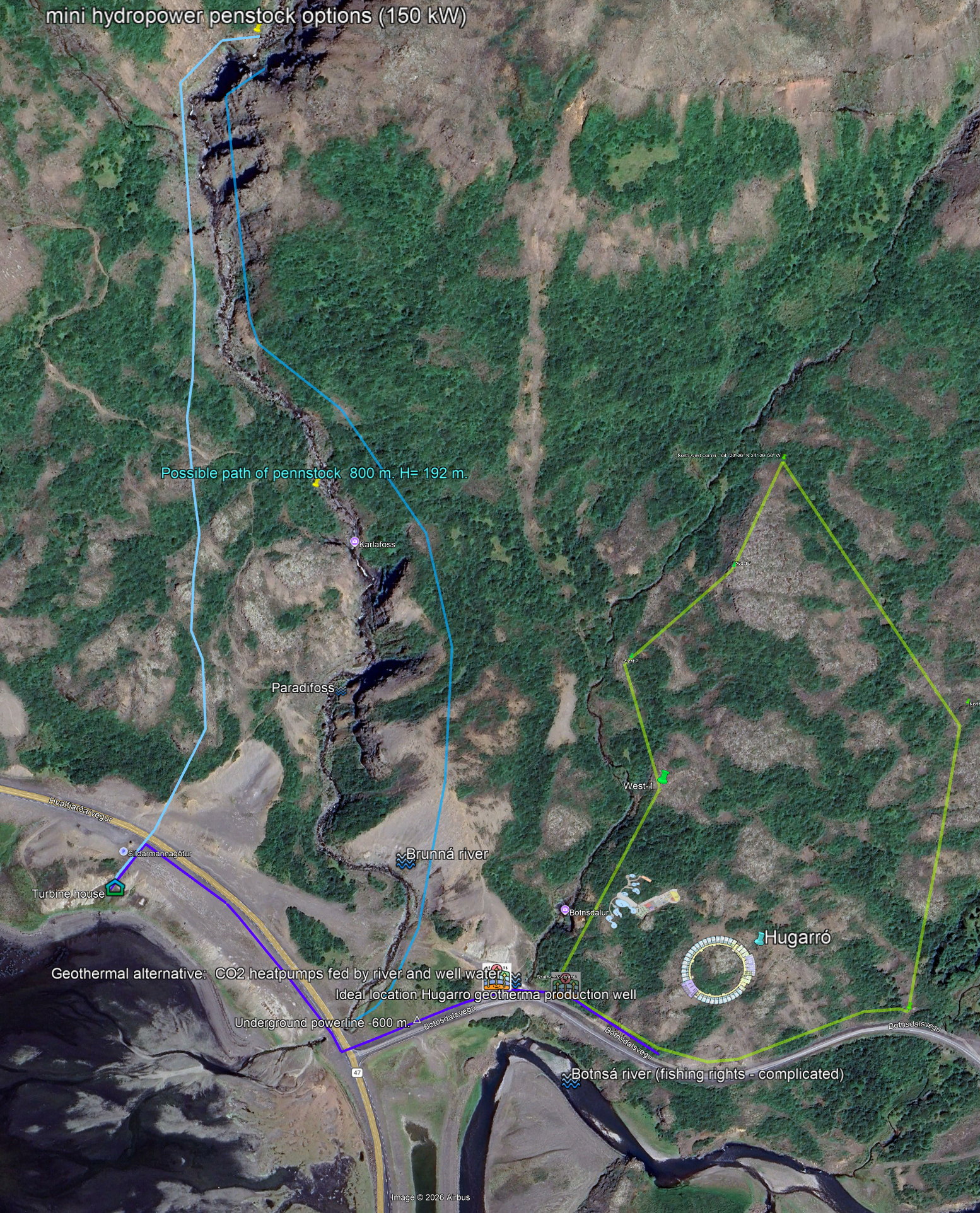
Click to enlargeThat is enough to offset 50% of the heat pump system’s annual electricity consumption — effectively halving the grid electricity bill.
When river flow is high and heat pump demand is low, surplus hydro power heats the buffer tank directly through resistance elements — free thermal energy that further reduces the load on the heat pumps.
| Metric | Value |
|---|---|
| Annual electricity saved | ~1,023 MWh |
| Annual cost saving | €97,200/year |
| Investment payback | 3.1 years |
| 20-year net present value | €1,114,000 |
A 3.1-year payback on renewable infrastructure is exceptional by any standard. After that, the plant runs free for its remaining 30–40 year lifespan.
The numbers — what each path costs
| Geothermal well | CO₂ heat pumps | CO₂ heat pumps + hydro | |
|---|---|---|---|
| Capital investment | ~€1,870,000 | ~€1,630,000 | ~€1,930,000 |
| Annual operating cost | ~€70,000 | ~€270,000 | ~€173,000 |
| 20-year total cost | ~€3,270,000 | ~€6,830,000 | ~€5,390,000 |
| Grid dependency | Minimal | High | Medium |
| CO₂ emissions | Zero | Zero | Zero |
| Guest experience | Identical | Identical | Identical |
| Technology risk | Exploration | Very low | Very low |
The geothermal well is the cheapest long-term solution by a wide margin — €3.5M cheaper than heat pumps alone over 20 years. But the heat pump system combined with hydropower is a fully viable, lower-risk alternative that closes that gap significantly.
The capital costs of all three paths are remarkably similar. What separates them is operating cost — and operating cost is where geothermal wins decisively. Every year of successful geothermal operation saves €200,000 in electricity that the heat pump alternative would otherwise purchase from the grid.
Resilience by design
Most geothermal wellness projects are built around a single assumption: that the well succeeds. Ours is not.
Our engineering team designed the geothermal cascade and the CO₂ heat pump alternative in parallel — same output temperatures, same cascade architecture, same pool experience, same environmental standards. Switching between the two strategies requires no redesign of the facility. The plant room, pipework, heat exchangers, and distribution circuits serve both.
The exploration programme is thorough and data-driven. We expect to find water. But if we do not, a fully costed, fully engineered alternative is ready — one that combines proven industrial heat pump technology with local renewable water and hydropower sources, and delivers the same Hugarró experience at a known, manageable operating cost.
That is not a fallback. It is a feature.