
Where it started for us
In 2011, Icelandic geographer Gunnthóra Ólafsdóttir published a paper that would inspire the direction of our founder’s thinking. Her work — Practicing Nature-Based Tourism: Introduction, published in the academic journal Landabréfið — was not a market report or a business case. It was something more fundamental: a rigorous examination of why human beings feel compelled to seek out nature, and what actually happens to us when we do.
Her argument was simple but important. Nature-based tourism, she wrote, feeds “the perceived need to undertake an exodus from the everyday in order to be in nature” — a deeply rooted belief in the “therapeutic and regenerative agency of nature” for people whose lives have become tiring and stressful. Tourism, she argued, is not merely a product or a commercial transaction. At its best, it is “a creative, contextual, embodied practice” — one that creates a genuine sense of self, of place, and of connection.
That paper was the catalyst. It pointed our founder towards Iceland, and towards a question worth building a business around: what if we took this idea seriously?
More than a label
“Nature-based tourism” has become a catch-all — used to describe everything from five-star safari lodges to crowded waterfall selfie queues. The label alone means very little.
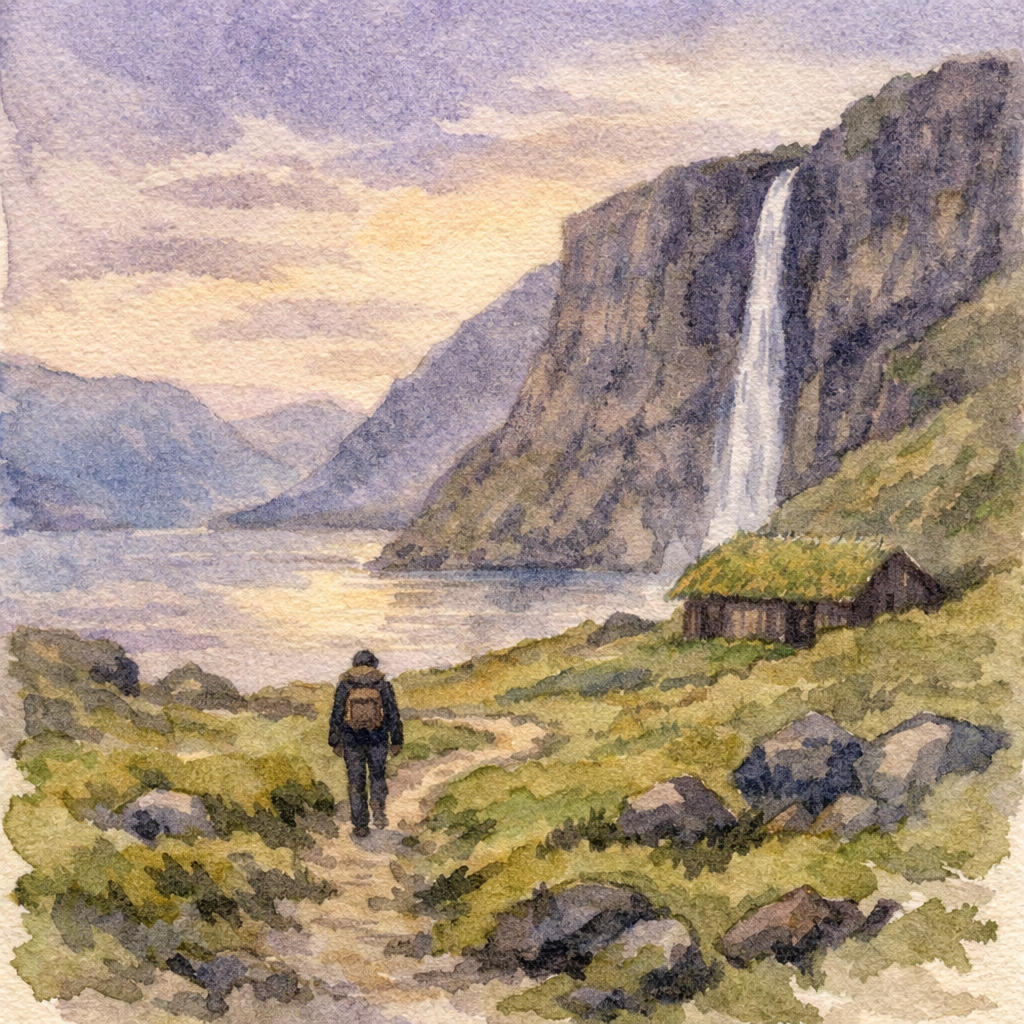
What we mean by it is closer to what Ólafsdóttir described: an experience that is embodied. One that engages all the senses. One where the most memorable moments are, as Icelandic architect and tour guide Hildigunnur Sverrisdóttir observed in her own research, “not tied to any pre-established must-sees or dos but to something completely random, simple and unforeseen.” The smell of moss after rain. The silence of a fjord at dusk. Standing at the base of a 198-metre waterfall and feeling very, very small.
That is what we are designing for.
The science behind the pull
The appeal of nature is not sentimental. It is physiological and psychological — and the evidence has been building for decades.
Research consistently demonstrates that contact with nature measurably reduces stress, anxiety, and depression. A landmark 2024 meta-analysis of 449 peer-reviewed studies, published in Nature Cities, quantified the mental health benefits of nature exposure across multiple outcome measures. Studies cited in the Environments special issue on nature-based tourism (Green, Croft & Wolf, 2019) confirm that tourism, planning, and psychological research “all find an important relationship between nature-based experiences and the physical and psychological well-being of participants.” Research from King’s College London has found that the risk of developing depression or anxiety is 71% lower among urban dwellers who live near green spaces — and that benefits extend to everyday, brief encounters with biodiverse nature. 1
The minimum threshold for detectable mental health benefit from nature exposure is approximately two hours per week. 5 This is not a luxury product. It is a response to a documented human need.
In an increasingly screen-saturated, urbanised world, that need is only growing. As Green, Croft and Wolf put it in their 2019 environmental impact study: “In a fractious world, where anxiety mounts as an irreversible tipping point to habitable climate change approaches, the calm of nature will be increasingly important.”
The market is responding
Traveller behaviour reflects this shift. The global nature-based tourism market was valued at approximately $600 billion in 2024 and is projected to reach $1.2 trillion by 2033, growing at a CAGR of 8.2%. 4 Of the 1.8 billion international tourist arrivals recorded in 2024, approximately 42% engaged in nature-related activities — wildlife tourism, ecotourism, and adventure travel. 2
Demand is particularly strong among younger travellers: 78% of millennials actively prefer destinations that feature natural landscapes, and 65% of global travellers now prioritise sustainable travel options when making decisions. 2
This is a structural shift, not a post-pandemic bounce. The direction of travel is clear.
An honest tension
We believe in being direct about what nature-based tourism can also get wrong.
Natural habitats are under pressure precisely because more people want to visit them. Research specifically examining Iceland’s vegetation — published in Environments (Runnström et al., 2019) — found that experimental trampling caused significant damage, particularly in highland areas and in moss and heath communities. The study recommends concentrating visitor trails in lowland grassland where resilience is higher. Iceland’s most popular sites already show the strain.
Traditional tourism on Iceland, as our own website acknowledges, “doesn’t have a very good track record when it comes to the environment.” Overcrowded trails, unmanaged visitor flows, and short-term commercial thinking are real problems — and they are precisely what distinguishes responsible operators from the rest.
The challenge, as Green, Croft and Wolf concluded in their research, is to “take visitors down the sustainable and gentle path of communing with nature and to leave the conquest of nature to an ignorant past.” We take that seriously.
Iceland: the right place
Few countries are better positioned for responsible nature-based tourism than Iceland. Tourism accounted for 8.8% of Iceland’s GDP in 2025, up from 8.2% the year before — one of the highest tourism-to-GDP ratios in the world. 3 Revenue from foreign tourists reached 621.4 billion ISK (approximately $4.9 billion USD) in 2024, up 9% year-on-year. 6 Just under 2.3 million international visitors arrived in 2025. 7
The country’s appeal is obvious: dramatic, unspoiled landscapes, geothermal energy, the Northern Lights, and a culture that has always lived in close relationship with the natural world. But what makes Iceland genuinely special for nature-based hospitality is scarcity. There is a finite amount of truly wild, accessible landscape — and that scarcity is an asset for operators who position themselves correctly.
Our first property, Hugarró Nature Retreat, sits at the gateway to Glymur — Iceland’s second-tallest waterfall, dropping 198 metres into Botnsá, the main river in Botnsdalur leading ot the Hvalfjörður fjord, just an hour from Reykjavík. Accessible only on foot, Glymur is one of Iceland’s most visited natural landmarks. The guests who make that hike are precisely the engaged, nature-motivated travellers our model is built for.
This is also, we should note, the country where Gunnthóra Ólafsdóttir’s academic conference on Practicing Nature-Based Tourism took place in 2011. Iceland has been a serious intellectual home for this conversation for a long time. We feel we belong in it.
How we do it differently
Following the nature-based tourism standards of Preferred by Nature, and inspired by the principles in Ólafsdóttir’s research, we have built our approach around a few commitments that inform every operational decision:
- Keep it small. A maximum of 32 rooms plus 31 intimate cabin, merged into the landscape. The environment is never overwhelmed, and the guest experience remains genuine.
- Protect the landscape. Fencing birch forest areas to allow natural regeneration; co-funding trail improvements near Glymur to manage visitor flow responsibly — applying the very recommendations made by Icelandic trampling research.
- Be honest about impact. Monitoring, measuring, and publishing our environmental footprint. Guests deserve to know, and so do investors.
- Invest in people. Affordable staff housing, real career development, and genuine integration with local communities — because, as Lucy Lippard argued at the 2011 Reykjavík conference, tourism that denigrates the communities it builds its attraction on is “simply wrong.”
- Design for depth, not throughput. Educating guests about Iceland’s ecology, geology, history, and culture. Leaving room for the unplanned moments that Sverrisdóttir identified as the most meaningful of all.
The financial case
Genuine nature-based hospitality is not a trade-off against financial performance. It is the basis for it.
Responsibly operated eco-lodges and nature retreats command 10–20% premium ADRs over conventional competitors, with some studies finding guests willing to pay up to 34% more for certified sustainable accommodation. Renewable energy and efficient design deliver 10–30% savings on operating costs compared to conventional builds. And ESG-aligned operators increasingly access capital on preferential terms — global ESG assets have surpassed $41 trillion, with institutional capital continuing to flow toward businesses with credible, measurable sustainability commitments.
More fundamentally: a location people genuinely want to visit, an experience that delivers what it promises, and an operation that takes its environmental responsibilities seriously — that combination produces loyal guests, strong reviews, high repeat intent, and a business worth investing in for the long term.
We believe the market is catching up to what the science has always known. Nature is good for people. And people who are good for nature build better businesses.