
We planned for this from day one
Drilling for geothermal water in Iceland is well-founded — the geology around Hvalfjörður is exceptional and nearby wells prove the potential. But geothermal exploration always carries uncertainty. Fractures can be missed. A well can come up dry. Investors can lose patience.
We designed Hugarró so that this scenario, however unlikely (see this post), does not stop us.
Our answer is a purpose-built alternative heating system that delivers the same pools, the same warmth, the same experience — drawing heat not from the ground below, but from the river and the earth around us.
Why our heating needs are surprisingly modest
Most facilities of this kind would be in serious trouble without a geothermal source. Ours is not — because of how efficiently we use energy in the first place.
Our closed-loop pool system recirculates water rather than constantly replacing it, recovering 33% more heat than the traditional Icelandic approach. Our cascade design runs geothermal water through pools, then buildings, then roads — extracting every usable degree before returning it. Floating insulation covers eliminate heat loss overnight.
The result: our total heating demand — seven pools at 38°C, full hotel and cabin heating, road de-icing — requires the equivalent of just 1,185 kW of continuous thermal output. For a facility of this scale, that is a lean number. And it is exactly what our backup system is sized to deliver.
The alternative: CO₂ heat pumps
If no geothermal source is found, we install three Fenagy (or other reliable brand) H-600 CO₂ heat pump units, each delivering 600 kW of thermal output. Together they provide 1,800 kW of installed capacity — comfortably above our 1,185 kW peak demand, with full redundancy built in.
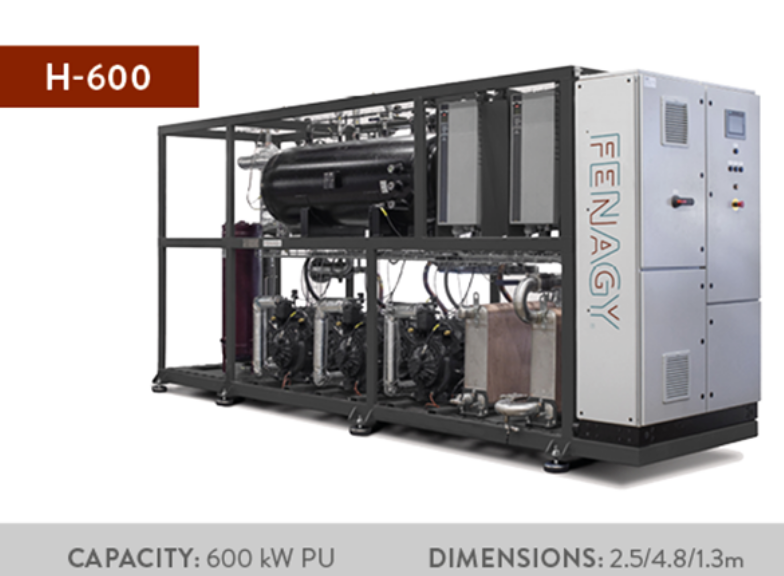
CO₂ (R744) is the ideal refrigerant for this application:
- GWP of 1 — the most climate-neutral refrigerant available
- No chemicals — fully aligned with Iceland’s environmental standards
- Highest efficiency in the 38–70°C output range — exactly our operating window
- Proven technology — widely used in Scandinavian district heating systems
The heat pumps run as water-to-water units, extracting heat from a local water source and delivering it at the temperatures our cascade system requires. The full cascade — pools, buildings, roads — operates identically to the geothermal design. From a guest perspective, nothing changes.
Where the heat comes from: a two-tier water source
Instead of one geothermal well, we use two complementary water sources that together provide year-round reliability.
Tier 1 — The Brunná river (primary, spring through autumn)
The Brunná flows just 200 metres from our plant room, crossing land whose owner has no objection to our intake (in fact, we are co-owner). A short insulated HDPE pipe draws water at ~6°C, passes it through a heat exchanger, and returns it a few degrees cooler. The river provides more than enough flow for our needs during the eight warmest months of the year.
Tier 2 — Two drilled groundwater wells (winter backup)
For the winter months, when surface water flow can drop and ice becomes a risk, we rely on two drilled wells at 80–150 metres depth. At that depth, groundwater in the Botnsdalur valley maintains a stable 4–6°C year-round — completely unaffected by surface weather, frost, or seasonal variation. No river. No tidal influence. No moving parts except a submersible pump in each well.
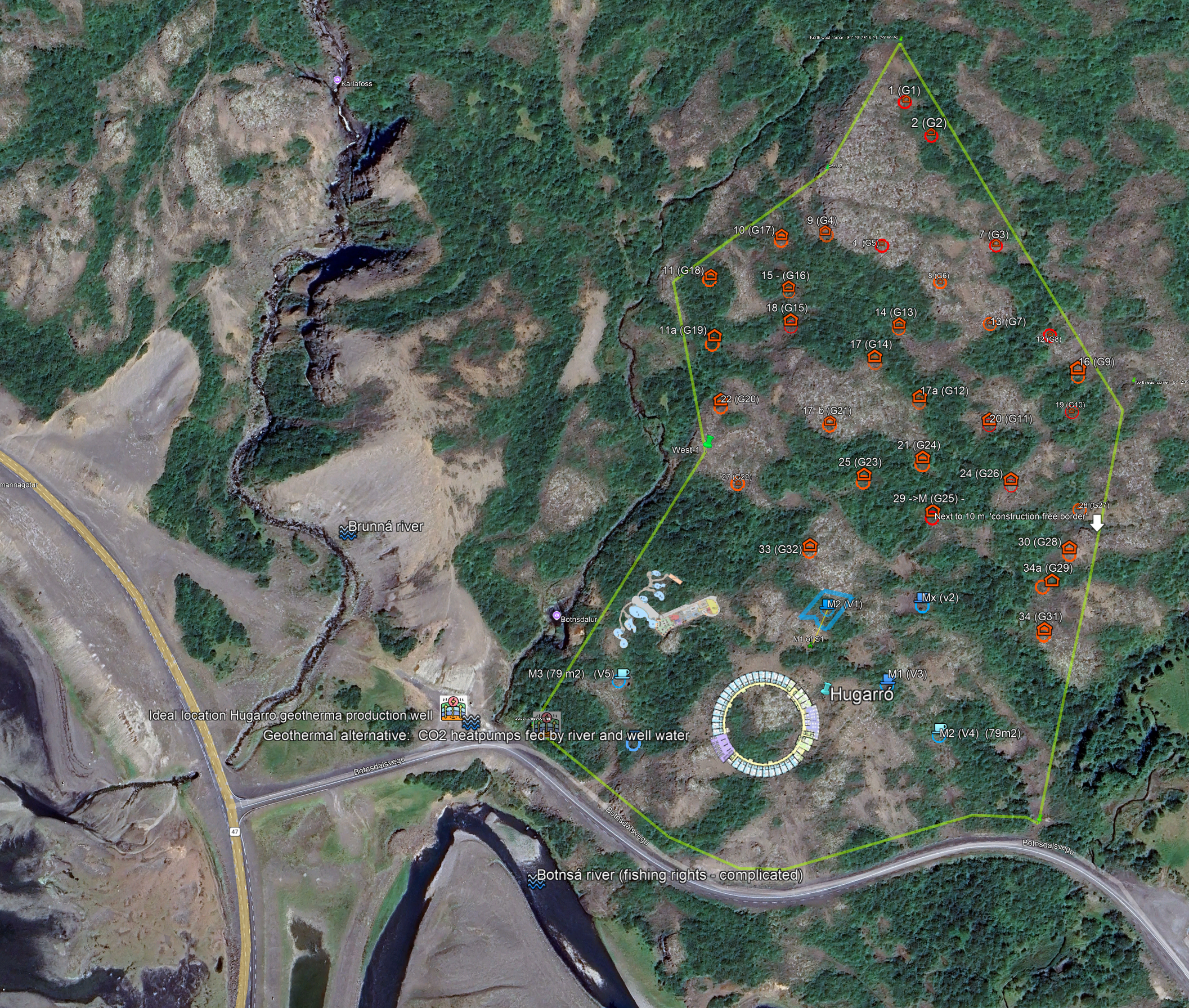
Crucially, these wells are drilled while the geothermal exploration rig is already on site — a modest incremental cost on an already-mobilised programme, and one that simultaneously provides valuable geological data to guide the deep geothermal drill.
The system switches automatically between sources based on flow sensors and temperature readings. No manual intervention required.
The buffer tank — smoothing out demand peaks
Between the heat pumps and the distribution system sits a 35 m3 insulated thermal buffer tank, maintained at 45–50°C. It acts as a reservoir of stored heat, absorbing demand peaks and allowing the heat pumps to run at steady, optimal load rather than cycling up and down.
The effect is meaningful: peak source water demand drops by around 20%, the heat pumps run more efficiently, and the system becomes more resilient to short interruptions in either water source. It is the thermal equivalent of a battery — simple, passive, and highly effective.
What it costs to run
Iceland’s electricity is among the cleanest and most affordable in Europe, generated almost entirely from hydro and geothermal sources. At current industrial tariffs:
| Scenario | Annual electricity | Annual cost |
|---|---|---|
| Winter conditions (COP 3.5) | Higher draw | — |
| Summer conditions (COP 5.0) | Lower draw | — |
| Annual average (COP ~3.8) | ~2,730 MWh | ~€240,000/year |
For every unit of electricity the heat pumps consume, they deliver 3.8 units of heat — the rest comes free from the river or the wells. Compared to direct electric heating, the CO₂ heat pump system saves approximately €750,000 per year in energy costs.
How the two systems compare
| Geothermal well | CO₂ heat pump backup | |
|---|---|---|
| Heat source | Earth (70–90°C) | River + groundwater wells |
| Electricity required | Minimal (pumps only) | ~312 kW continuous |
| Annual energy cost | Near zero | ~€240,000 |
| Guest experience | Identical | Identical |
| Environmental impact | Zero discharge | Zero discharge |
| Cascade compatibility | Full | Full |
| CO₂ emissions | Zero | Zero (Icelandic grid) |
The bottom line
Finding geothermal water is our ambition and our expectation. The geology strongly supports it. But if exploration falls short, Hugarró does not fall with it.
Our backup system — three CO₂ heat pumps, two groundwater wells, a river intake, and a thermal buffer — delivers the same warmth, the same pools, and the same guest experience at a known, manageable operating cost. It was engineered in parallel with the geothermal design, not as an afterthought.
We are not betting everything on a single drill result. That is how Hugarró was designed.