
Q: You run a high-end hotel. Surely you will use proven HR frameworks from leading international chains?
Not exactly — and here’s why that matters.
When building our performance review, onboarding, and training systems, the obvious move is to look at what major hotel brands do and borrow their playbook. It’s tempting. But it’s also a classic mistake: confusing best practice with best fit.
Q: What’s the difference?
Strategic HRM literature distinguishes two fundamentally different approaches:
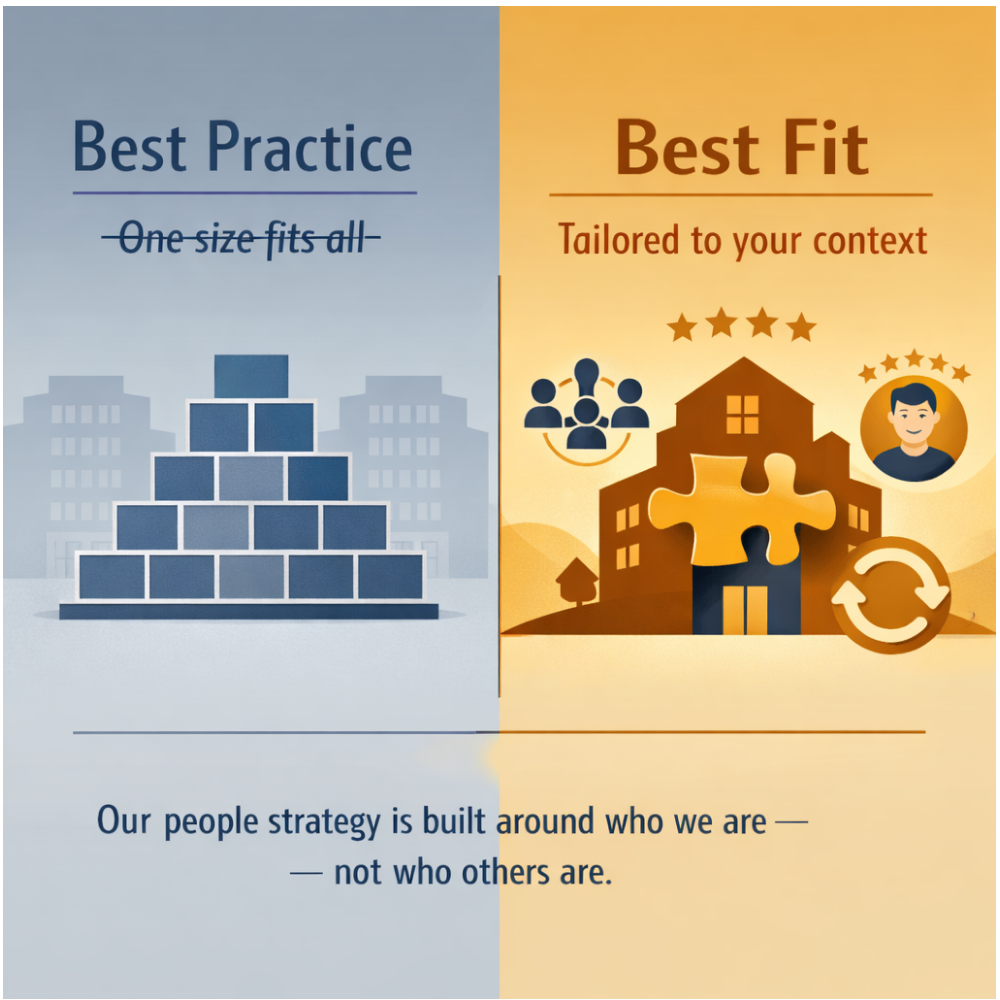
| Approach | Logic | Assumption |
|---|---|---|
| Best practice (universalist) | A fixed set of high-performance work practices — pay-for-performance, extensive training, employee voice — that reliably improve outcomes everywhere | One size fits all |
| Best fit (contingency) | HR effectiveness depends entirely on context: your strategy, culture, market conditions, and workforce | Fit your HR to your organisation |
The best-practice model is popular because it’s simple and sounds reassuring. The problem? What works at a 500-room airport hotel with high turnover and standardised service doesn’t automatically translate to a boutique four-star property built around personalised guest experiences.
Q: So what did you actually do differently?
We built our HR approach around what fits us, not what looks good in a conference presentation.
- Annual appraisals → out. We replaced them with short, regular feedback conversations between managers and staff — better suited to the rhythm of a hotel where every day is different.
- Individual performance targets → out. We tied incentives to team goals: guest satisfaction scores and sustainability metrics, values that reflect our actual culture.
- Rigid frameworks → out. We kept only the elements that genuinely work in our context.
Q: Why does this matter for guests?
Because engaged, empowered staff deliver better experiences — consistently. We’re confident this approach drives higher guest satisfaction, lower staff turnover, and — most importantly — a real sense of ownership among our team.
Q: Isn’t this just reinventing the wheel?
No. It’s grounded in solid academic research. A strong fit between HR practices and organisational context consistently outperforms the adoption of fashionable frameworks.
“There is no one best way to manage people.”
> — Boxall & Purcell, Strategy and Human Resource Management
References
- Boxall, P., & Purcell, J. (2016). Strategy and Human Resource Management. Palgrave Macmillan.
- Delery, J.E., & Doty, D.H. (1996). Modes of theorizing in strategic human resource management. Academy of Management Journal, 39(4), 802–835.
- Paauwe, J. (2009). HRM and Performance. Journal of Management Studies, 46(1), 129–142.